A lug nut that won’t budge leaves you with a simple-sounding question: do you need power or leverage? An impact wrench delivers power in fast hammering bursts. A breaker bar delivers leverage, steady torque that comes from a long handle and your own effort. Neither is “stronger” in every situation, and which one works depends on why the nut is stuck and what you have on hand. This guide explains how each tool actually works, which failure each one solves, the safe way to use both together, and six tools worth considering, from a compact flex-head bar to high-torque cordless wrenches.
Quick answer: Use a breaker bar when you need steady, controlled torque, when your impact wrench rattles without moving the nut, or when you have no power source. Use an impact wrench when you need speed and shock to break a stuck fastener, or when you’re loosening a lot of them. Most people are best served by owning both: the bar to break stubborn nuts loose, the impact wrench to spin them off, and a torque wrench to tighten them correctly afterward. Neither the bar nor the impact wrench tells you how much torque you’re applying.
Impact Wrench vs. Breaker Bar at a Glance
| Factor | Impact Wrench | Breaker Bar |
|---|---|---|
| How it delivers force | Rapid hammering bursts from a motor | Steady leverage from a long handle |
| Power source | Battery, air, or cord | None, just your effort |
| Speed | Fast, especially on several fasteners | Slow, one nut at a time |
| Control | Less control over the moment a nut releases | Smooth, steady, and easy to stop |
| Torque feedback | None | None |
| Cost | Typically a large purchase | Typically a fraction of the price |
| Best for | Speed, shock, and multiple fasteners | Stuck nuts, thin capped nuts, no-power situations |
| Main risk | Overtightening when running nuts on | Over-torquing with too much leverage |
How Each Tool Actually Works
Power: The Impact Wrench

An impact wrench uses a hammering mechanism to deliver its force in short, rapid bursts. Guides comparing the two describe that percussive action as what lets it break loose many stuck fasteners without needing you to brace and pull. Its strength comes from the tool, not from your body weight, which is why it is the faster, easier choice when it has enough breakaway torque for the job.
Leverage: The Breaker Bar
A breaker bar is a long, solid, non-ratcheting handle on a socket drive. Its power is simple physics: torque equals force times distance. The longer the handle, the more torque the same push produces. A 24-inch bar with a 50 lb pull produces about 100 ft-lb, and doubling the pull doubles the torque.
| Bar Length | 50 lb Pull | 100 lb Pull | 150 lb Pull |
|---|---|---|---|
| 15 in | 62.5 ft-lb | 125 ft-lb | 187.5 ft-lb |
| 24 in | 100 ft-lb | 200 ft-lb | 300 ft-lb |
| 36 in | 150 ft-lb | 300 ft-lb | 450 ft-lb |
These figures assume a pull perpendicular to the bar, with your hands at the end of the handle. The lever arm that counts is the distance from the fastener to where your hands actually push, not the full length of the bar. Compare the numbers to the roughly 80 to 120 ft-lb commonly cited for passenger-car wheels (always check your own manual) and you can see the catch: a bar makes it very easy to apply far more torque than a fastener was ever meant to see, with nothing telling you when you’ve passed the line.
Which Failure Are You Solving?
The most useful way to choose isn’t “which is stronger.” It’s what is actually going wrong.
| What You See | Best Move |
|---|---|
| Impact wrench rattles at full power but the nut won’t move | Switch to a breaker bar. Steady torque can succeed where the impact energy isn’t enough. Check the basics first: battery, mode, socket fit, and tool size. |
| Nut moves a little, then the socket slips | Stop. The socket may be the wrong size or the nut may be rounding. Neither tool fixes that; see the extractor advice in our lug nut troubleshooting guide. |
| Thin, decorative capped lug nuts | A breaker bar gives you more control, and one owner report describes it as easier on thin capped nuts. Use a thin-wall impact socket. |
| Rotating all four wheels, nuts not stuck | Impact wrench, for speed |
| Flat tire on the road, no power | Breaker bar, which owners say is worth keeping in the trunk |
| Tight access behind suspension parts | Flex-head breaker bar or a compact impact wrench |
| Rust-seized fastener on an older vehicle | Penetrating oil and dwell time first, then steady force with a breaker bar |
| Nut turns but the stud turns with it | Stop and get professional help |
When an Impact Wrench Wins
Reach for the impact wrench when you’re dealing with several fasteners, when speed matters, and when the tool has enough breakaway torque for the job. It also helps in spots where you can’t get a bar into a position to pull cleanly. Owner reports are consistent that a mid-torque wrench handles most passenger-car work, and that high-torque models are worth their extra weight mainly on trucks, equipment, and seized hardware.
When a Breaker Bar Wins
A breaker bar wins when your impact wrench runs out of breakaway torque, when you want to control the exact moment a nut releases, when the nuts are thin or capped, and when you have no power source or battery on hand. It is also the simplest emergency tool: owners commonly keep a 24 or 25-inch bar and the right socket in the trunk for a roadside flat.
The Workflow That Uses Both
- Set up safely. Level ground, parking brake on, gear or Park engaged, wheel chocked. Keep the wheel on the ground while you break the nuts loose.
- Try the tool you trust to have enough torque. If you use the impact wrench and the nut doesn’t move after a few seconds, stop hammering and switch to the breaker bar.
- Apply steady force with the bar. Use a fully seated six-point impact socket, keep the bar roughly perpendicular to the fastener, and load it smoothly instead of jerking or bouncing.
- Spin the nuts off. Once they’re loose, an impact wrench on a low setting, or a ratchet, speeds up removal.
- Reinstall by hand first, then snug the nuts lightly.
- Finish with a torque wrench to your vehicle manufacturer’s specification, tightening in a criss-cross pattern in stages. See our guide to the best torque wrenches.
Safety: What Not to Do
- Don’t use a cheater pipe. Slipping a pipe over the handle pushes the bar, socket, and fastener past their ratings, and tool makers and safety guides consistently warn against it. If you need more leverage, use a longer bar or a bigger drive size instead.
- Pull toward you instead of pushing away, so you stay in control if the nut suddenly releases. If you have to push, use an open palm, not a closed fist.
- Use smooth, steady force. Jerking or bouncing invites slips, rounded nuts, and broken studs.
- Use six-point impact sockets, not chrome hand sockets, especially with an impact wrench. See impact sockets vs. regular sockets.
- Don’t use a torque wrench as a breaker bar. It can damage the torque mechanism.
- Don’t final-tighten with either tool. Neither an impact wrench nor a breaker bar gives torque feedback.
- Stop if a nut starts rounding, a stud twists, or the setup feels unsafe, and get professional help.
Choosing a Breaker Bar: Drive Size and Length
For most passenger-car work, a 1/2-inch drive bar in the 18 to 24-inch range is the standard choice, and one guide describes 24 inches as common for automotive work. A longer bar multiplies your force more, but it also makes over-torquing easier, so match the length to the job. A short flex-head bar is handy in tight spaces but delivers less torque per pound of pull. If you work on trucks or large equipment with big fasteners, check the drive size and length listed for your specific application before you buy.
Breaker Bars Worth Considering
1. TEKTON 24″ Breaker Bar (SBH00224) – Best All-Around

A 1/2-inch drive, 24-inch bar with a head that pivots through a 230-degree arc and an internal spring that holds it in position while you work. TEKTON says the head is AISI 4140 steel, heat treated to be stronger and more ductile than the handle, and that the bars exceed industry proof-torque standards. The external head design is meant to resist spreading, twisting, and fracturing.
Not the right fit if: you need something compact for a tool bag or tight access. A 24-inch bar takes more room to store and to swing.
Pros: A full 24-inch lever arm; wide 230-degree pivot; documented head material and proof-torque claims; comfortable handle.
Cons: Longer to store; gives no torque feedback, so technique matters.
2. NEIKO 00206A 24″ Breaker Bar – Best Budget Long Bar
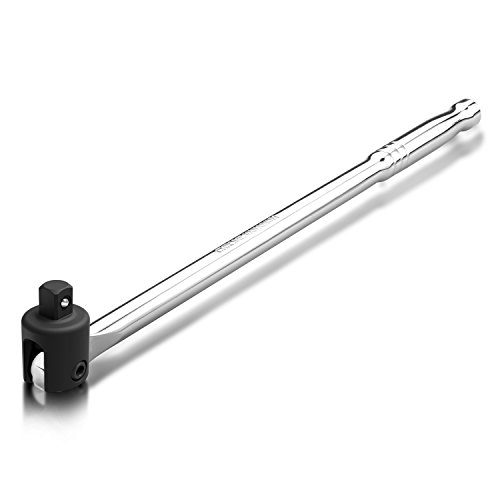
A 24-inch, 1/2-inch drive bar with a hardened chrome-moly head, a drop-forged heat-treated chrome vanadium handle, a 180-degree flex head, and a spring-loaded ball bearing that retains sockets.
Not the right fit if: you want a documented proof-torque rating in the listing. The listing text we reviewed doesn’t cite one the way TEKTON’s does.
Pros: The same 24-inch length as pricier bars; flex head for angled access; polished, grooved handle for grip.
Cons: 180-degree head pivots less than TEKTON’s 230 degrees; less documentation of its strength testing in the listing.
3. TEKTON 15355 15″ Flex-Head Breaker Bar – Best Compact
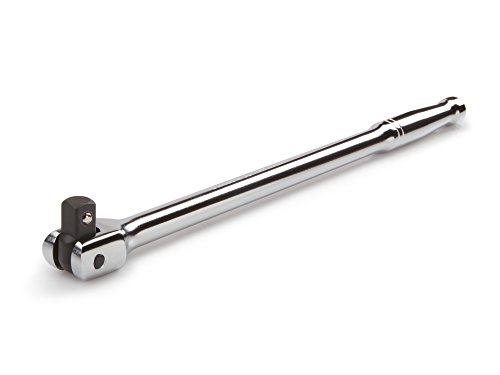
A 1/2-inch drive, 15-inch bar with a 180-degree chrome-moly flex head and a spring-loaded ball bearing that keeps sockets from dropping off. Its short length makes it easy to carry and to use in tight spaces.
Not the right fit if: you regularly fight seized hardware. A short arm produces less torque for the same effort, and one Amazon reviewer reported a head failure on a brake caliper bolt and noted some play in the head. Treat it as a lug-nut and lighter-duty bar.
Pros: Compact and easy to store in a trunk or tool bag; flex head for tight access; secure socket retention.
Cons: Shortest lever arm of the three, so the least torque per pound of pull; some buyers report head play; not suited to the toughest seized fasteners.
Impact Wrenches Worth Considering
4. DeWalt DCF891B (Mid-Range, Bare Tool) – Best for Most Cars

DeWalt’s 20V MAX XR mid-range 1/2-inch wrench claims 600 ft-lbs of fastening torque and 800 ft-lbs of breakaway torque, with a Precision Wrench mode, an LED work light, and a weight DeWalt lists at under 4 lbs for the tool alone. Pro Tool Reviews measured 392.6 ft-lbs in an inertia torque test, which is a different measurement from the claimed maximum but a useful reminder that headline numbers are ceilings.
Not the right fit if: you work on trucks or heavy equipment with big fasteners. Owners report mid-torque tools can run out of breakaway torque on seized truck suspension hardware. It is also sold as a bare tool, so you’ll need DeWalt 20V MAX batteries and a charger.
Pros: Light and compact; enough for typical passenger-car lug nuts per owner feedback; Precision Wrench control.
Cons: Less breakaway torque than the high-torque models below; bare tool needs a battery and charger.
5. DeWalt DCF900B (High Torque, Bare Tool) – Best High-Torque DeWalt

DeWalt’s high-torque 1/2-inch wrench claims 1,030 ft-lbs fastening and 1,400 ft-lbs breakaway, for trucks, heavy equipment, and the fasteners a mid-torque wrench can’t move. It is heavier and longer, listed at 6.4 lbs and 8.8 inches. Read our full DeWalt DCF900B review.
Not the right fit if: you mostly work on passenger cars, where the lighter DCF891B is usually enough and easier on your arms. It is also a bare tool.
Pros: Very high claimed breakaway torque; Precision Wrench control; runs on DeWalt 20V MAX batteries.
Cons: Heavy; more power than most car work needs; torque figures are manufacturer claims.
6. Milwaukee M18 FUEL 2967-21B (High Torque Kit) – Best High-Torque Kit
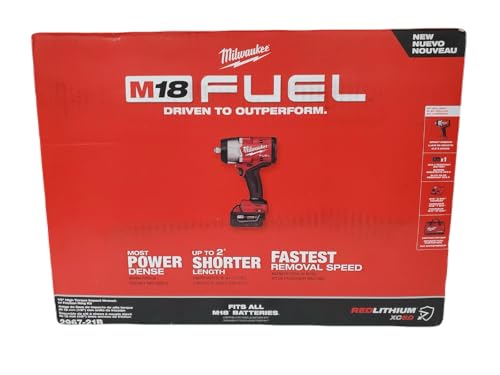
Milwaukee’s 1/2-inch high-torque kit claims up to 1,100 ft-lbs fastening and 1,500 ft-lbs nut-busting torque with the included XC5.0 battery, at 7.6 inches long and, per Pro Tool Reviews, 5.9 lbs bare or 7.5 lbs with the battery. The kit includes the battery, a charger, and a contractor bag. Read our full Milwaukee 2967-21B review.
Not the right fit if: you’re already invested in another battery platform. It runs only on Milwaukee M18 batteries, and the kit is best if you need the battery and charger too.
Pros: High claimed torque in a compact body; useful Mode 4 with a low forward limit and bolt removal control; battery, charger, and bag included.
Cons: Heavy with a battery attached; the higher torque rating needs a separate FORGE battery; torque figures are manufacturer claims.
For more options across brands, see our roundup of the best cordless impact wrenches.
Sockets: The Piece You Can’t Skip
Both tools work best with a fully seated six-point impact socket. Chrome hand sockets aren’t built for repeated impact loads, and a breaker bar under heavy torque is easier on a tougher impact-rated socket too.
NEIKO 02448A 1/2″ Drive Master Impact Socket Set, 65-Piece

Pros: SAE and metric coverage in both deep and shallow sizes; includes extension bars, a ratchet, and adapters; covers the 1/2-inch drive size both tools here use.
Cons: Heavy and bulky to store as a full case.
TEKTON SIF92400 1/2″ Deep Thin Wall Impact Flip Socket Set

A dedicated lug nut set with thin walls for clearance around decorative wheel caps, useful with either tool.
Pros: Thin-wall design built for lug nut wells; flip design covers two sizes per socket; radiused corners help reduce round-off on worn lug nuts.
Cons: Lug nut sizes only, not a general-purpose set.
Building out a whole garage? See our guide to the best mechanic tool set for beginners.
Common Mistakes
- Hammering on a nut with an impact wrench for minutes instead of switching to a bar.
- Using a cheater pipe to get “just a little more” leverage.
- Pushing on the bar with a closed fist, or bouncing on the handle.
- Using a chrome hand socket with an impact wrench.
- Assuming a longer bar is always better, when it just makes over-torquing easier.
- Tightening wheels to spec with an impact wrench or a bar instead of a torque wrench.
- Raising the vehicle before breaking the nuts loose.
- Using a torque wrench as a breaker bar.
- Pushing on after a nut starts to round.
Frequently Asked Questions
Is a breaker bar better than an impact wrench for lug nuts?
Neither is better in every case. A breaker bar gives steady, controllable torque and needs no power, while an impact wrench is faster and can break friction with hammering bursts. If your impact wrench can’t move a nut, a breaker bar is the natural next step.
Do I need both?
Most home mechanics benefit from owning both. The impact wrench handles speed and routine work, and the breaker bar covers stubborn nuts, thin capped nuts, and no-power situations.
What length breaker bar do I need for lug nuts?
A 1/2-inch drive bar in the 18 to 24-inch range is the usual choice for passenger cars. Longer bars multiply your force further, which helps on stubborn fasteners but also makes over-torquing easier.
Can I use a cheater pipe on a breaker bar?
No. It pushes the bar, socket, and fastener past their ratings, and it is a common cause of tool failure and injury. Use a longer bar or a bigger drive size if you need more leverage.
Can I use a torque wrench as a breaker bar?
No. A torque wrench is built for accurate tightening within a specific range, and using it to break fasteners loose can damage its mechanism.
Should I tighten lug nuts with an impact wrench or a breaker bar?
Neither for the final torque. Both can be used to run nuts on lightly, but final tightening should be done with a calibrated torque wrench to your vehicle manufacturer’s specification.
Why won’t my impact wrench move a lug nut when a breaker bar will?
Common reasons include not enough breakaway torque for that nut, a weak battery or air supply, or the wrong socket or mode. See our guide to why an impact wrench won’t remove lug nuts for the full checklist.
Is an impact wrench or a breaker bar safer?
Both are safe with good technique and unsafe without it. A bar’s main risk is applying too much torque with no feedback. An impact wrench’s main risk is overtightening when running nuts on, and both call for a torque wrench at the end.
Final Verdict
If you can only buy one, think about what you’re most likely to face. A breaker bar is the inexpensive, no-power tool that solves the specific problem this article is about, a nut that won’t move, and it is the one to keep in the trunk. An impact wrench is the faster, easier tool for routine work, and a mid-torque model handles most passenger-car jobs, with high-torque models worth their weight mainly on trucks and seized hardware. For most people the answer is both, plus impact-rated sockets and a torque wrench for the final tightening.
Our Pick
TEKTON 24″ Breaker Bar (SBH00224)
If a nut won’t move, a 24-inch bar with a wide pivot head gives you steady, controllable leverage, and it works with or without a power tool. Pair it with a six-point impact socket and finish with a torque wrench.