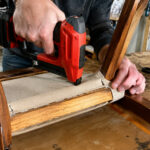
For most walls in a house, you want #6 coarse-thread drywall screws: 1-1/4″ long for 1/2″ drywall and 1-5/8″ for 5/8″ drywall. Use fine thread only if you’re screwing into metal studs. That covers 90% of jobs. The rest of this guide covers the other 10%, plus the drywall screws worth buying, spacing rules, and how deep to set them so the paper doesn’t tear.
Quick Picks
- Best overall for wood studs: Grip-Rite Coarse Thread #6 x 1-5/8″ (1 lb)
- Best for metal studs: Grip-Rite Fine Thread #6 x 1-5/8″ (5 lb)
- Best for 1/2″ drywall: JEGONFRI #6 x 1-1/4″ Coarse (210 pcs)
- Best budget 5/8″ pack: Fas-N-Tite #6 x 1-5/8″ Coarse (190 pcs)
- Good 1 lb pack for 1/2″ board: MR SCREWS #6 x 1-1/4″ Coarse (280 pcs)
- Best collated (wood): SENCO DuraSpin #6 x 1-1/4″ Collated (1,000 ct)
- Best collated (light steel): SENCO DuraSpin #6 x 1-1/4″ to Light Steel
- Best for thin board and small repairs: Hillman #6 x 1″ (100 pk)

Comparison Table
| Screw | Thread | Size | Count | Best for |
|---|---|---|---|---|
| Grip-Rite 158CDWS1 | Coarse | #6 x 1-5/8″ | 189 (1 lb) | 5/8″ board on wood |
| Grip-Rite 158DWS5 | Fine | #6 x 1-5/8″ | 1,190 (5 lb) | Metal studs |
| JEGONFRI | Coarse | #6 x 1-1/4″ | 210 | 1/2″ board on wood |
| Fas-N-Tite | Coarse | #6 x 1-5/8″ | 190 | Small 5/8″ jobs |
| MR SCREWS | Coarse | #6 x 1-1/4″ | 280 (1 lb) | 1/2″ board, one room |
| SENCO 06A125P | Coarse (Type W) | #6 x 1-1/4″ | 1,000 collated | Auto-feed screw guns |
| SENCO 06B125P | Fine (light steel) | #6 x 1-1/4″ | Collated | Auto-feed into steel studs |
| Hillman | – | #6 x 1″ | 100 | 3/8″ board, small repairs |
Drywall Screw Size Chart
| Drywall thickness | Framing | Screw | Length | Approx. count per lb |
|---|---|---|---|---|
| 1/4″ to 3/8″ | Wood or light steel | #6 coarse or fine | 1″ to 1-1/8″ | About 330 |
| 1/2″ | Wood studs | #6 coarse | 1-1/4″ | About 300 |
| 1/2″ | Light-gauge steel | #6 fine | 1-1/4″ | About 300 |
| 5/8″ (Type X) | Wood studs | #6 coarse | 1-5/8″ | About 230 |
| 5/8″ (Type X) | Light-gauge steel | #6 fine | 1-5/8″ | About 230 |
| Double layer | Wood or steel | #8 coarse or fine | 2-1/4″ or longer | About 130 |
| Any | Heavy-gauge steel (18 ga and up) | #8 self-drilling | Varies | About 150 |
Chart data follows Zoro’s drywall screw size chart. Counts per pound vary by brand. The Grip-Rite 1-5/8″ box in this guide holds 189, fewer than the 230 estimate.

Coarse vs Fine Thread (Type W vs Type S)
Coarse thread drywall screws are built for wood studs. The wide, deep threads grab wood fibers and pull the board tight. The industry standard for them is ASTM C1002 Type W, and you’ll see “Type W” on pro boxes like the SENCO 06A series.
Fine thread screws are built for light-gauge steel studs (25 to 20 gauge). The tighter threads and sharp point tap into thin steel without walking. That’s ASTM C1002 Type S. Use fine thread in wood and it tends to strip out or spin because the threads don’t bite deep enough.
For steel studs heavier than 20 gauge, step up to self-drilling screws with a drill-point tip. A sharp-point fine-thread screw can burn its tip before it gets through thick steel.
Not sure what’s behind the wall? Push a magnet against it. If it sticks along a straight line every 16 or 24 inches, you have steel studs.
How Long Should Drywall Screws Be?
The screw needs at least 5/8″ of bite into wood framing. That’s the minimum building departments cite under the International Residential Code. Add that to the board thickness and you get the standard sizes:
- 1/2″ drywall + 5/8″ bite = about 1-1/8″, so use 1-1/4″.
- 5/8″ drywall + 5/8″ bite = about 1-1/4″, and most installers use 1-5/8″, especially on ceilings where gravity works against you.
Don’t go much longer than you need. In a standard 2×4 wall, electrical cable runs through holes near the center of the stud. A 1-1/4″ screw through 1/2″ board only goes 3/4″ into the stud, which keeps it well clear. A 3″ screw doesn’t.
Drywall Screw Spacing (Walls and Ceilings)
Maximum spacing on wood framing for 1/2″ drywall, per IRC Table R702.3.5 as published by the City of Hopkins, MN building department:
| Location | Framing spacing | Max screw spacing |
|---|---|---|
| Ceiling | 16″ on center | 12″ |
| Ceiling (board perpendicular) | 24″ on center | 12″ |
| Wall | 16″ on center | 16″ |
| Wall | 24″ on center | 12″ |
These are maximums. Plenty of installers go tighter on ceilings, and fire-rated assemblies or local codes may require different spacing. Check with your building department for 5/8″ Type X and steel framing. Keep screws back from the board edges so they don’t crumble the gypsum core. Your local code or the board maker’s instructions give the exact edge distance.
How many screws per sheet? A 4×8 sheet hung on a wall with studs 16″ on center crosses 7 studs. At 16″ spacing that works out to about 28 screws. On a ceiling at 12″ spacing, figure about 35. So a 1 lb box of 1-1/4″ screws (about 300) covers roughly 8 to 10 sheets on walls.
How Deep to Set a Drywall Screw
The head should sit just below the surface in a shallow dimple, with the face paper intact. That dimple is what holds the mud. Go too shallow and the head shows through the finish. Go too deep and you tear the paper, and a screw that breaks the paper has almost no holding power left. If you tear one, drive another screw about 2 inches away and leave the torn one for the mud to cover.
The easiest fix is a setter bit, which stops the screw at the right depth every time:
BOSCH D60498 Dimpler Drywall Screw Setter
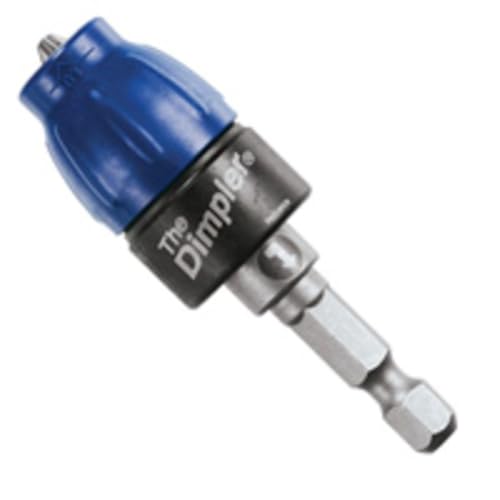
The Dimpler has a preset depth and an automatic clutch release that stops driving when the head reaches the right depth. It has a magnetic Phillips P2 tip and a spinning finger grip so you can steady it without the bit turning in your hand. At $15.98 it’s the most reviewed setter on Amazon, with 4.0 stars across 2,400+ ratings. The lower score comes mostly from buyers who expect it to last a whole house. Plan on it being a wear item.
TEURSA Magnetic Drywall Screw Setter Bits (5-Pack)

Five PH2 setter bits in S2 steel with a removable aluminum magnetic collar, so you can adjust the stop depth. Because you get five, a worn tip costs you a bit swap instead of a new tool. 4.5 stars across 244 ratings at $12.98.
The Best Drywall Screws
1. Grip-Rite Coarse Thread #6 x 1-5/8″ (158CDWS1) – Best Overall for Wood Studs

Grip-Rite is the box you’ll find in most contractors’ trucks, and this is the size that covers the most jobs. At 1-5/8″ it’s right for 5/8″ ceilings and Type X walls, and it still works on 1/2″ board if you’d rather keep one size on hand.
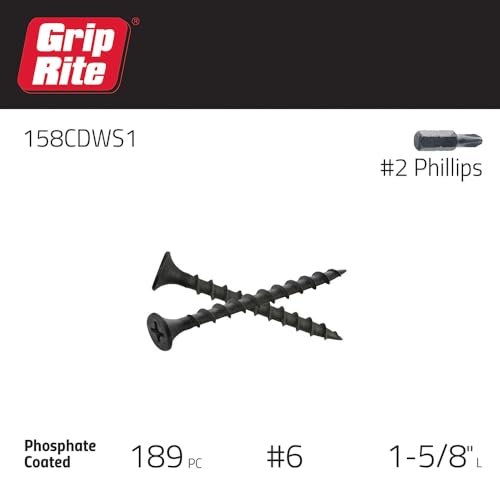
It’s a #6 coarse-thread screw with a #2 Phillips bugle head, a sharp point, and a phosphate coating. The 1 lb box holds 189 screws for $5.97. It rates 4.8 stars across 1,553 ratings, the best score with a big sample in this guide.
Pros: Bugle head seats without tearing paper; sharp point starts fast; cheap per box; strong review record.
Cons: Phosphate coating is for dry interior use only. 1-5/8″ is longer than you need on 1/2″ board, so watch for wiring in shallow spots. One pound covers only about 5 to 6 sheets.
Not the right fit if: you have metal studs. Get the fine-thread Grip-Rite below.
2. Grip-Rite Fine Thread #6 x 1-5/8″ (158DWS5) – Best for Metal Studs
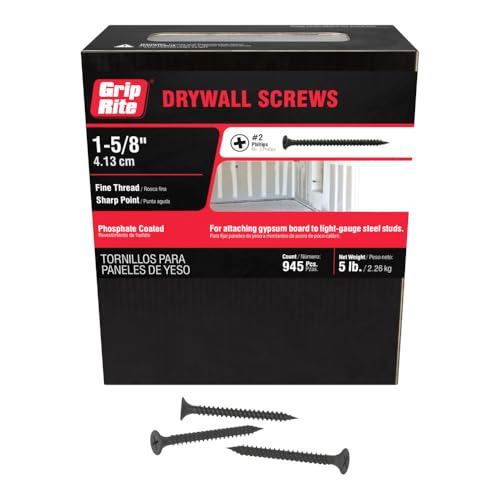
The same Grip-Rite head and point, with fine threads that tap into light-gauge steel studs. Basement remodels and commercial spaces framed with steel are where this belongs.

The 5 lb box holds 1,190 screws for $24.98, enough for a full room. It rates 4.8 stars across 346 ratings.
Pros: Fine thread made for steel studs; bugle head; large box; very good reviews.
Cons: Fine thread holds poorly in wood. Only sold here as a 5 lb box, which is too much for a patch job. For steel heavier than 20 gauge, you need self-drilling screws instead.
Not the right fit if: your studs are wood. Fine thread will strip out.
3. JEGONFRI #6 x 1-1/4″ Coarse Thread (210 pcs) – Best for 1/2″ Drywall
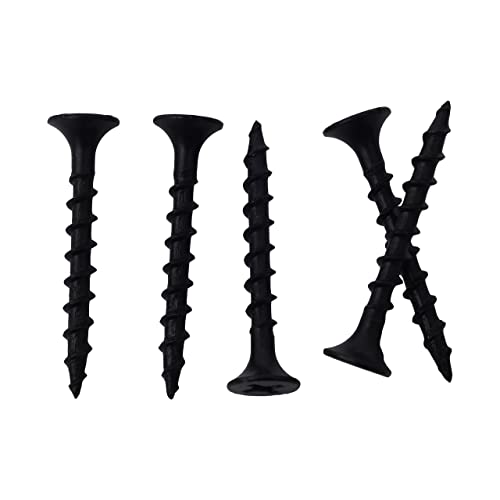
This is the most reviewed drywall screw pack we found on Amazon, with 4.5 stars across nearly 4,000 ratings. The 1-1/4″ length is the standard match for 1/2″ board on wood studs.

JEGONFRI lists heat-treated 1022A carbon steel with a black phosphate coating. 210 pieces cost $7.96.
Pros: Right length for the most common board; huge review base; low price.
Cons: A smaller brand than Grip-Rite or SENCO. The listing markets it for wood and drywall both, but drywall screws are brittle and shouldn’t be used for structural wood joints. Black phosphate is indoor only.
Not the right fit if: you’re hanging 5/8″ ceilings. Go 1-5/8″ instead.
4. Fas-N-Tite #6 x 1-5/8″ Coarse Thread (190 pcs) – Best Budget 5/8″ Pack

A small box for a single wall or ceiling patch in 5/8″ board. It has a Phillips bugle head and black phosphate carbon steel, sized for drywall to wood studs.

190 pieces cost $6.99, and it rates 4.7 stars across 918 ratings. If you only need one box, it’s a close alternative to the Grip-Rite at about the same price.
Pros: Bugle head; coarse thread for wood; low price; good review record.
Cons: 190 screws covers only about 5 sheets. Indoor only.
Not the right fit if: you’re doing a whole room. Buy a 5 lb box or collated screws instead.
5. MR SCREWS #6 x 1-1/4″ Coarse Thread (280 pcs) – Good 1 lb Pack for 1/2″ Board

A 1 lb pack of 280 #6 x 1-1/4″ coarse-thread screws in black phosphate carbon steel. MR SCREWS sells the same line in nearly every length, coarse and fine, which is handy if you need a matching odd size.

It rates 4.6 stars across 357 ratings at $11.90.
Pros: Full size range from the same brand; coarse thread for wood; 280 count.
Cons: The listing describes a flat truss head, not a true bugle head. A bugle head is the shape that protects drywall paper, so check the head before buying for finish work. Costs more per screw than the Grip-Rite.
Not the right fit if: you want the cleanest finish. The bugle-head Grip-Rite or Fas-N-Tite are safer picks.
6. SENCO DuraSpin #6 x 1-1/4″ Collated, Drywall to Wood (06A125P) – Best Collated Screws

If you’re hanging more than a room or two, collated screws in an auto-feed gun are much faster than loading screws one at a time. These are made for SENCO’s DuraSpin auto-feed screwdrivers (DS225-18V, DS222-18V and DS322-18V are the models SENCO lists).

SENCO states they meet ASTM C1002 Type W with a gray phosphate coating, and that they pass an ASTM B117 salt spray test with no red rust for over 24 hours. 1,000 count for $26.98, rated 4.7 stars across 1,700+ ratings.
Pros: Type W standard listed; fast with an auto-feed gun; strong reviews; 1,000 count.
Cons: Only useful with a compatible auto-feed attachment or gun. Check that your collated system takes SENCO strips before you buy.
Not the right fit if: you drive screws with a regular drill or impact driver. Buy a loose box instead. See our best drywall screw guns guide if you’re thinking about switching.
7. SENCO DuraSpin #6 x 1-1/4″ Collated, Drywall to Light Steel (06B125P) – Best Collated for Steel Studs

The steel-stud version of the SENCO strip above, for drywall over light-gauge metal framing with an auto-feed gun.

It rates 4.5 stars, but across only 73 ratings, at $28.98.
Pros: Collated speed for steel framing; same SENCO system as the wood version.
Cons: Much smaller review base than the 06A version. Needs a compatible gun. Not for heavy-gauge steel.
Not the right fit if: your studs are wood. Use the 06A125P.
8. Hillman #6 x 1″ Drywall Screws (100 pk) – Best for Thin Board and Small Repairs

A 100-pack of #6 x 1″ black phosphate drywall screws. One inch is the right length for 3/8″ board and for fastening patch backers in a hole repair.
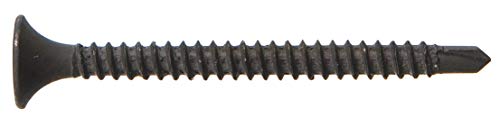
It rates 4.6 stars across 87 ratings at $8.70.
Pros: Small pack, no waste; right length for thin board and patch backers.
Cons: Too short for standard 1/2″ board, which needs 1-1/4″ to meet code. Costs the most per screw in this guide.
Not the right fit if: you’re hanging full sheets of 1/2″ or 5/8″ drywall.
Collated vs Loose Drywall Screws
Loose screws in a box work with any drill, impact driver or drywall screw gun. They’re cheaper per screw and fine for a room or less. Collated screws come on a plastic strip that feeds into an auto-feed gun, so you just push and drive. On a whole-house job, that saves hours and a lot of dropped screws. The catch is that collated strips are brand-specific, so match them to your gun. Our drywall screw gun guide covers which guns take which strips.
If you drive loose screws with an impact driver, a setter bit is worth more than any upgrade to the screws themselves. Our best impact drivers guide has options for every battery platform.
Can You Use Drywall Screws for Wood Projects?
For hanging a picture frame or a light shop jig, sure. For anything that carries load, no. Drywall screws are hardened, which makes them brittle. They snap under sideways (shear) force instead of bending, and their thin shank and phosphate coating aren’t made for outdoor use. Don’t use them for shelves, decks, framing, cabinets or anything structural.
For woodworking, use a proper wood screw. Our wood screw sizes chart shows which gauge and pilot hole to use.
Bathrooms, Basements and Cement Board
Standard phosphate-coated drywall screws are made for dry interior walls. In bathrooms and basements with moisture-resistant board, they’re still common, but a corrosion-resistant coating is a safer bet near showers and in damp basements. Behind tile, cement board needs its own coated cement board screws. Regular drywall screws aren’t made for it, and they’ll rust and lose their grip in wet areas.
Common Drywall Screw Mistakes
- Overdriving: breaking the paper kills the screw’s holding power. Use a setter bit or the clutch on your drill.
- Wrong thread for the stud: fine thread in wood strips out, and coarse thread in steel walks off the stud.
- Screws too close to the edge: the gypsum crumbles and the screw holds nothing.
- Too few screws on ceilings: ceiling board sags and pops screws over time. Stick to 12″ maximum spacing.
- Too long: a long screw can hit wiring or plumbing inside the stud. 1-1/4″ is enough for 1/2″ board.
- Worn bit: a rounded PH2 bit strips heads. Swap bits often. If a head does strip, our stripped screw guide covers how to get it out.
FAQ
What size drywall screws for 1/2″ drywall?
#6 x 1-1/4″ coarse thread for wood studs, or #6 x 1-1/4″ fine thread for light steel studs. That gives the 5/8″ minimum bite into wood framing that building departments cite.
What size drywall screws for 5/8″ drywall on ceilings?
#6 x 1-5/8″ coarse thread on wood joists, spaced no more than 12″ apart.
Coarse or fine drywall screws for wood studs?
Coarse. Fine thread is for metal studs and tends to strip out in wood.
How far apart should drywall screws be?
On wood framing with 1/2″ board: up to 12″ on ceilings, and 16″ on walls with studs 16″ on center (12″ if studs are 24″ on center). Check local code for fire-rated walls.
How many drywall screws per sheet?
About 28 for a 4×8 sheet on a wall with studs 16″ on center, and about 35 on a ceiling at 12″ spacing.
Can you use drywall screws for wood?
Only for light, non-structural tasks. They’re brittle and snap under load. Use wood screws or construction screws for anything that carries weight.
What is the difference between Type W and Type S drywall screws?
Type W (ASTM C1002) is coarse thread for wood framing. Type S is fine thread with a sharp point for light-gauge steel framing.
How many drywall screws are in a pound?
About 300 at 1-1/4″ and about 230 at 1-5/8″, but brands vary. The Grip-Rite 1-5/8″ box holds 189.
Bottom Line
- 1/2″ board on wood studs: JEGONFRI #6 x 1-1/4″ or MR SCREWS #6 x 1-1/4″.
- 5/8″ board and ceilings on wood: Grip-Rite #6 x 1-5/8″ coarse.
- Metal studs: Grip-Rite #6 x 1-5/8″ fine.
- Whole-house job with an auto-feed gun: SENCO DuraSpin 06A125P for wood or 06B125P for steel.
- Patches and thin board: Hillman #6 x 1″.
- Whatever screw you pick: add a BOSCH Dimpler or TEURSA setter bits so every head lands at the right depth.