A concrete grinder turns a lumpy slab, a trip-hazard joint or a floor caked in old mastic into something you can coat, tile or walk on without catching a toe. The tool itself is simple: a high-torque grinder spinning a diamond cup wheel inside a shroud that hooks to a vacuum. The differences that matter are wheel size, how well the shroud seals, and whether the motor holds speed when the wheel bites. This guide compares 10 concrete grinders and planers on Amazon, from 5-inch handheld kits to a 4-head floor machine, plus the accessories you need if you’d rather convert an angle grinder you already own.
Quick Picks
- Best overall: DEWALT DWE46253 5-Inch Surface Grinder Kit
- Best for long days on the tool: Makita PC5010CX1 5″ SJS II Concrete Planer
- Best cordless: BOSCH GBR18V-15SN18X 18V 5″ Surface Grinder
- Best for coating and screed removal: Metabo HPT RSEV 17-125 Renovation Grinder
- Best 7-inch for wide areas: Makita GA9060RX3 with Surface Grinding Shroud
- Best budget kit: KSEIBI 5-Inch Concrete Angle Grinder Kit
- Best for whole garage floors: YUCHENGTECH 4-Head 3800W Concrete Grinder
Quick Comparison
| Product | Wheel | Motor | Speed | Cup wheel in box | Best For |
|---|---|---|---|---|---|
| DEWALT DWE46253 | 5″ | 13A brushless | Variable, up to 9,000 RPM | Yes (DW4777T) | Best Overall |
| Makita PC5010CX1 | 5″ | 12A | 4,000-9,000 RPM | Yes (4-1/2″ low-vibration) | Long Days / Low Vibration |
| BOSCH GBR18V-15SN18X | 5″ | 18V brushless (13A equivalent) | 3 settings, 2,600-8,500 RPM | Yes, plus 8.0Ah battery and charger | Best Cordless |
| Metabo HPT RSEV 17-125 | 5″ | 14.5A | 2,800-9,600 RPM | Yes, plus carrying case | Coatings and Screed |
| Makita GA9060RX3 | 7″ shroud | 15A | 6,600 RPM | No | Best 7-Inch |
| Metabo HPT 7″ Surface Prep | 7″ | 15A / 2400W | 6,600 RPM | Check listing | 7-Inch Edge Work |
| KSEIBI 5″ Kit | 5″ | 11.5A / 1400W | 8,500 RPM | Yes | Best Budget Kit |
| Wohenhao 5″ Planer | 5″ | 12.5A / 1500W | 4,500-8,000 RPM | Yes | Budget Variable Speed |
| YUCHENGTECH 7″ 2200W | 7″ | 2200W | 6 speeds, 2,200-4,800 RPM | Yes | Budget 7-Inch, Wet or Dry |
| YUCHENGTECH 4-Head | 4 x 4″ | 3800W | 6 speeds, up to 6,000 RPM | Yes, 4 wheels plus pads | Whole Garage Floors |
Grinder vs. Planer vs. Floor Grinder: Which One Do You Need?
Amazon listings use “grinder,” “planer” and “surface grinder” almost interchangeably, and most of the tools here are the same basic machine: a heavy-duty angle grinder with a diamond cup wheel and a shroud. Makita calls its version a “planer,” and the name hints at the job, taking a slab down rather than polishing it. What changes is the scale of the job each one suits.
A 5-inch handheld grinder is the right size for trip hazards at slab joints, high spots before laying LVP or tile, edges along walls, and patching around a room. It’s light enough to work a vertical wall or a step riser.
A 7-inch handheld grinder covers more floor per pass and carries a bigger, heavier motor. It’s the better pick for a full basement or a driveway section, but you’ll feel the extra weight in your back and forearms after an hour bent over a floor.
A multi-head floor grinder spins several small wheels under one deck and rolls on wheels, so you push it standing up. It’s the choice for prepping an entire garage floor for epoxy, where a handheld tool would mean hours on your knees.
If you only have one small area to fix once, renting a walk-behind grinder for a day is often cheaper than buying any of these. Owning one starts to pay off when you’re doing flooring or coating work regularly, or when you need to get into edges a rental machine can’t reach.
1. DEWALT DWE46253 5-Inch Surface Grinder Kit – Best Overall
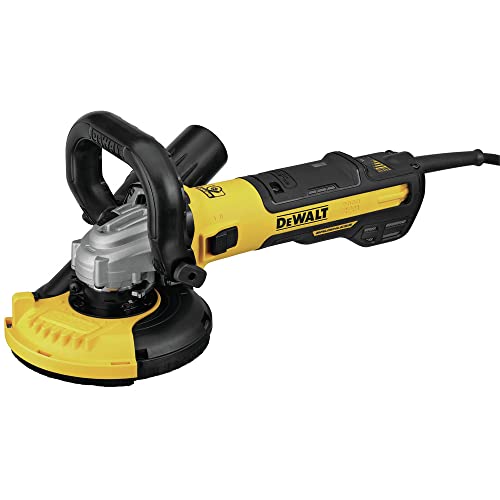
The DWE46253 is a complete surface-grinding kit, not a bare tool. DEWALT packs a 13-amp brushless grinder with a 5-inch surfacing shroud, a DW4777T 5-inch surfacing wheel, a T27 guard for regular grinding, the DWE46005 bail handle and a side handle (DEWALT product page, retrieved 2026-10-14). The bail handle matters more than it sounds. It lets you hold the grinder flat with two hands like a small floor machine, which keeps the cup wheel from rocking onto one edge and gouging the slab.
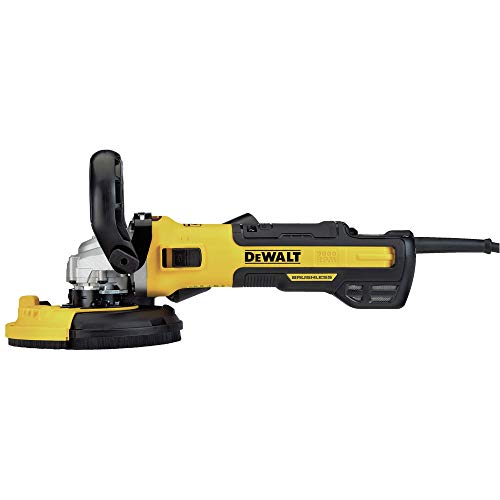
The brushless motor means no brush changes in dusty conditions, and the electronic kickback brake stops the wheel and shuts the motor off if the wheel pinches or binds. Variable speed lets you slow down for thin coatings and speed up for bare concrete. Power-loss reset forces you to cycle the trigger after an outage, so the tool won’t jump to life when a breaker gets reset. It holds 4.4 stars across 368 ratings on Amazon. One verified buyer called it practically dustless with a vacuum attached, but noted that the shroud occasionally caught and popped open.
Compared with the Makita PC5010CX1 below, the DEWALT is brushless and has the kickback brake, while the Makita has the lower-vibration drive and constant speed control. If you’re mostly doing short repair jobs, the DEWALT’s safety electronics are the bigger win.
Pros: Complete kit with shroud, surfacing wheel and bail handle; brushless motor with no brushes to replace; electronic kickback brake; DEWALT lists a 3-year limited warranty.
Cons: Some buyers report the shroud opening during use; at 5 inches, it’s slow for a whole two-car garage.
Skip it if: you need to grind an entire floor. The 4-head YUCHENGTECH or a rental walk-behind will get there in a fraction of the time.
2. Makita PC5010CX1 5″ SJS II Compact Concrete Planer – Best for Long Days on the Tool

Vibration is what wears you out on a concrete grinder, and the PC5010CX1 is built around reducing it. Makita’s SJS II system uses a leaf spring and cam gear drive between the motor and the spindle, which Makita says cuts vibration during extended use. The kit includes the planer with its integrated dust shroud, a 4-1/2-inch low-vibration diamond cup wheel (A-96403) and a lock nut wrench.
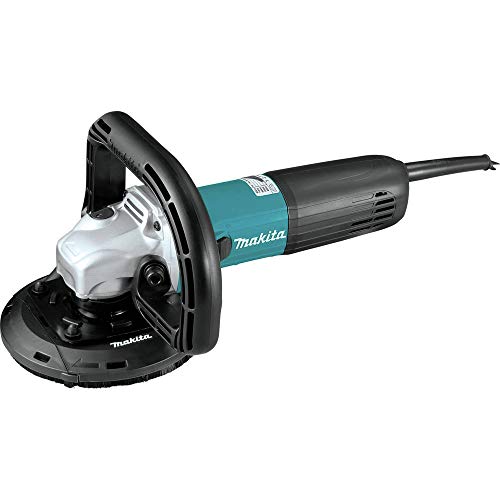
The 12-amp motor runs from 4,000 to 9,000 RPM on a dial, and constant speed control feeds extra power to the motor when the wheel loads up, so it doesn’t bog when you lean into a high spot. The listing weight is 9.28 pounds. It’s rated 4.6 stars across 64 ratings on Amazon.
Against the DEWALT, the Makita trades brushless power and the kickback brake for smoother running and speed that holds under load. Note that it ships with a 4-1/2-inch cup wheel on a 5-inch tool, so the shroud doesn’t get quite as close to the wall as a full 5-inch wheel would.
Pros: SJS II drive reduces vibration; constant speed control under load; variable speed dial from 4,000 to 9,000 RPM; low-vibration cup wheel included.
Cons: Brushed 12-amp motor needs brush changes eventually; no bail handle in the box like the DEWALT.
Skip it if: you want the most raw power in a 5-inch tool. The 14.5-amp Metabo HPT RSEV 17-125 has more motor.
3. BOSCH GBR18V-15SN18X 18V 5″ Concrete Surface Grinder – Best Cordless

A cordless concrete grinder used to mean giving up too much power. Bosch rates the brushless motor in the GBR18V-15SN18X as equivalent to 13 amps of corded power, which puts it level with the DEWALT on paper. It ships as a full kit: the grinder, an EXBA18V-80 8.0Ah battery, a charger, a diamond cup wheel and two brush sets.
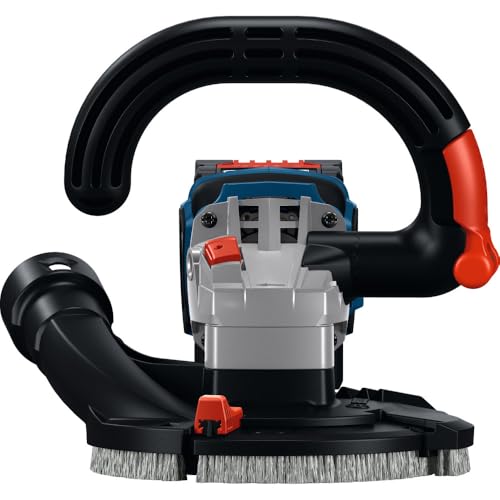
Three speed settings run from 2,600 to 8,500 RPM. The top handle rotates and part of the guard moves out of the way, so you can grind flush to a wall or work in tight spaces. Bosch adds KickBack Control, Drop Control (it shuts off if you drop it), a fast brake and restart protection. The dust shroud has a reinforced suction port with Bosch’s Click & Clean connection. At 13.2 pounds on the listing, it’s the heaviest 5-inch tool here, because the battery sits on the back. It shows 5.0 stars, but from only 8 ratings so far.
The trade-off is cost. This is the most expensive tool in this guide, and you still need a vacuum, which means a cord or a cordless extractor anyway.
Pros: No cord to drag across the slab; 8.0Ah battery and charger included; flush-grinding guard and rotating handle; KickBack and Drop Control.
Cons: Highest price in this guide; heaviest 5-inch tool here; very few Amazon ratings so far.
Skip it if: you have power at the job. The corded DEWALT does the same work for a lot less.
4. Metabo HPT RSEV 17-125 5-Inch Renovation Grinder – Best for Coating and Screed Removal
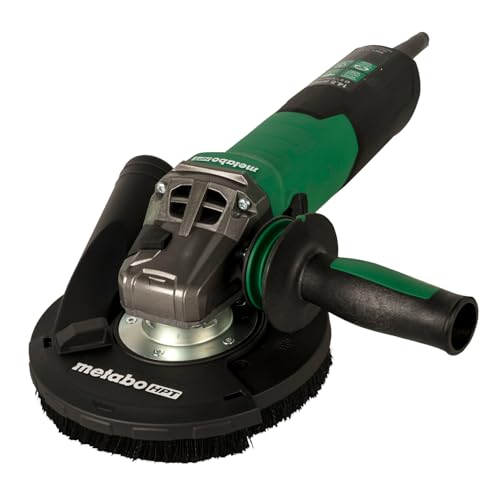
The RSEV 17-125 has the biggest motor among the 5-inch tools here: a 14.5-amp high-torque motor with variable speed from 2,800 to 9,600 RPM. Metabo HPT pitches it for continuous sanding and removal of coatings, concrete and screed. That’s the hard stuff: thick old paint, thinset and self-leveler that a smaller motor slows down on.

The anti-static suction guard comes off without tools, which turns it back into a regular angle grinder. The kit includes a diamond cup wheel, side handle, spanners, flange and a carrying case. Listing weight is 13.97 pounds. The low end of its speed range is useful on coatings: running slower keeps the wheel from heating and smearing paint or adhesive instead of cutting it.
The weak spot is the Amazon track record. When we checked it had only 1 rating, so there’s very little buyer feedback to go on yet.
Pros: 14.5-amp motor, the strongest 5-inch tool here; wide 2,800-9,600 RPM range; tool-free guard removal; carrying case and cup wheel included.
Cons: Almost no Amazon ratings yet; heavier than the DEWALT and Makita 5-inch tools.
Skip it if: you mainly knock down small trip hazards. The DEWALT or Makita do that with less weight.
5. Makita GA9060RX3 with 7″ Surface Grinding Shroud – Best 7-Inch for Wide Areas

The listing calls this a 9-inch concrete surface planer, so read the box contents carefully. It’s Makita’s large 15-amp angle grinder packaged with a 7-inch dust extraction surface grinding shroud (195386-6), an inner flange, lock nut, wrench and a loop handle. No cup wheel is included, so budget for a 7-inch diamond cup wheel on top.
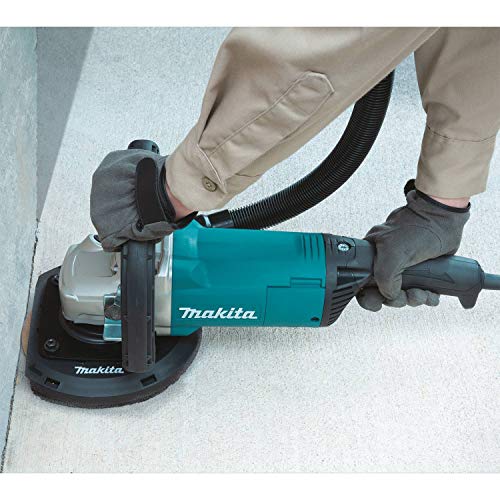
The motor spins at 6,600 RPM and Makita adds Soft Start, which suppresses the jolt when you pull the trigger, plus anti-restart protection after a power cut. A power light warns you about switch failure, cord damage or worn brushes before they stop the job. The listing weight is 19.61 pounds, so this is a two-handed floor tool, not something you’ll hold against a wall. It’s the best-reviewed grinder in this guide, at 4.7 stars across 276 ratings.
Pick this over the 5-inch tools when you’re covering a whole basement or a long run of slab and want more wheel on the floor per pass.
Pros: 15-amp motor with Soft Start; the strongest Amazon rating in this guide; loop handle for two-handed control; power light gives early warning on brushes and cord.
Cons: No cup wheel in the box; heavy for wall or overhead work; the 9-inch name and 7-inch shroud can confuse buyers.
Skip it if: your work is mostly edges, steps and small patches. A 5-inch tool is far easier to handle there.
6. Metabo HPT 7″ Surface Prep Angle Grinder (US646467800) – Best 7-Inch for Edge Work

This is Metabo HPT’s 7-inch surface preparation kit, built on a 15-amp, 2400W motor running at 6,600 RPM. The difference from the Makita above is the convertible dust shroud. It captures dust when paired with a HEPA vacuum and opens up so you can grind right into the edges along a wall, where a closed 7-inch shroud leaves a strip you have to finish with a smaller tool.
Metabo HPT adds its VibraTech damping, a swiveling main handle, a three-position side handle and auto-stop carbon brushes that shut the motor down before worn brushes damage the armature. A safety switch prevents accidental start-up. The listing weight is 22.1 pounds. There were no Amazon ratings yet when we checked, and the listing doesn’t spell out whether a cup wheel is included, so confirm the box contents before you order.
Pros: Convertible shroud reaches edges a fixed 7-inch shroud can’t; auto-stop carbon brushes; vibration damping and swiveling main handle.
Cons: Heaviest handheld tool in this guide; no Amazon ratings yet; box contents not clearly listed.
Skip it if: you want proven buyer feedback. The Makita GA9060RX3 has hundreds of ratings behind it.
7. KSEIBI 5-Inch Concrete Angle Grinder Kit – Best Budget Kit

For a homeowner with one basement or patio to fix, the KSEIBI kit has everything in one bag: the grinder, a dust-extraction shroud, a KSEIBI diamond cup wheel, a cutting wheel, two auxiliary handles (one L-type), an adjustable guard, spare carbon brushes, a wrench and a carry bag. The motor is 11.5 amps (1400W) and spins the 5-inch wheel at 8,500 RPM.

It costs well under half of what the DEWALT does. What you give up is variable speed, a kickback brake and a long track record: the kit has 4.5 stars, but from only 15 ratings. Single speed is fine on bare concrete but less forgiving on paint and mastic, which tend to melt and gum the wheel at full RPM.
Pros: Complete kit including shroud, cup wheel and spare brushes; lowest entry price for a 5-inch shroud setup; L-type handle helps hold the wheel flat.
Cons: Single speed only; no kickback brake; few Amazon ratings so far.
Skip it if: you’ll be removing coatings or adhesives regularly. The Wohenhao below adds variable speed for a similar price.
8. Wohenhao 5 Inch Concrete Planer 1500W – Best Budget Variable Speed

The Wohenhao is a budget copy of the Makita-style planer layout: a 12.5-amp (1500W) motor with variable speed from 4,500 to 8,000 RPM, an integrated dust shroud and a diamond cup wheel in the box. Wohenhao says the shroud stops up to 90% of dust leakage. Treat that as the maker’s claim, not a measured figure.
Variable speed is the reason to pick this over the KSEIBI. Dialing down helps on glue, epoxy, vinyl backing and rubber adhesive, all of which Wohenhao lists as targets for the included wheel. It holds 4.5 stars across 10 ratings.
Pros: Variable speed at a budget price; shroud and cup wheel included; more motor than the KSEIBI.
Cons: Very small number of ratings; the dust-capture figure is unverified; no bail handle or kickback brake.
Skip it if: you need a tool that’ll survive daily trade use. Spend up to the DEWALT or Makita.
9. YUCHENGTECH 7 Inch Concrete Grinder 2200W – Best Budget 7-Inch, Wet or Dry
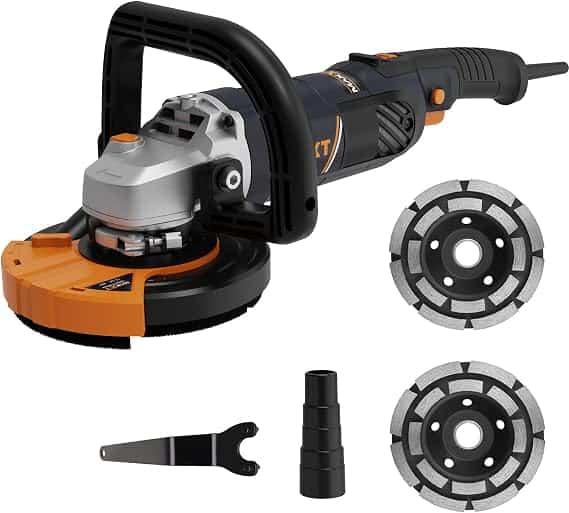
This is the low-cost route to a 7-inch wheel. The 2200W motor has six speed settings from 2,200 to 4,800 RPM. That’s slower than the Makita and Metabo HPT 7-inch tools, which suits polishing and adhesive removal more than fast stock removal. The detachable shroud has both a vacuum port and a water hose port, so you can run it dry with a vacuum or wet to keep dust down.
A diamond cup wheel is included, and the shroud edge is designed to fit close to a wall. It shows 4.2 stars across 14 ratings.
Pros: Lowest-cost 7-inch option here; wet or dry use; six speed settings; cup wheel included.
Cons: Top speed of 4,800 RPM is slow for heavy removal; few ratings; unknown long-term durability.
Skip it if: you’re taking down serious high spots. The Makita GA9060RX3’s 15-amp motor at 6,600 RPM removes material faster.
10. YUCHENGTECH 4-Head Concrete Grinder 3800W – Best for Whole Garage Floors

Prepping a full garage for epoxy with a 5-inch handheld tool is a long, hard day on your knees. The YUCHENGTECH spreads four 4-inch diamond wheels under one gear-driven deck, powered by a 3800W motor with six speeds up to 6,000 RPM. Auxiliary wheels and a non-slip handle let you steer it rather than carry it.
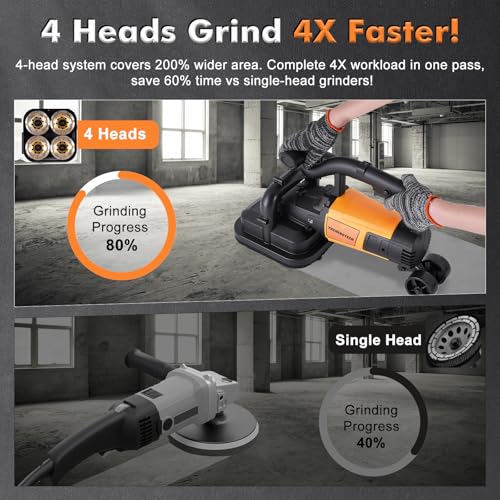
The dust hood detaches so the deck can get tight to a wall, and there are two dust ports for an industrial vacuum. The kit is generous: four diamond wheels, four polishing pads, four sanding discs, four self-adhesive discs and a carbon brush kit. It’s rated 4.1 stars across 14 ratings.
This isn’t a commercial walk-behind, and it won’t match a rental machine on a large warehouse slab. For a homeowner who wants to own something between a handheld grinder and a rental, it’s the only machine of its kind in this guide.
Pros: Four heads cover far more floor per pass than a single cup wheel; rolls on wheels instead of being held; full kit of wheels, pads and discs.
Cons: Lower rating than the brand-name handheld tools; small number of ratings; still needs a 5-inch tool for corners and edges.
Skip it if: you’re only fixing a few joints or high spots. A 5-inch handheld is cheaper and more precise.
The DIY Route: Angle Grinder + Shroud + Cup Wheel
If you already own a 4-1/2 or 5-inch grinder from our best angle grinders guide, you can set it up for light concrete work with two parts: a dust shroud that fits your grinder, and a diamond cup wheel with the right arbor (most US grinders use 5/8″-11).
- Wohenhao Dust Shroud for Angle Grinder (4.5-5 inch): a universal shroud with a vacuum port. Check that the clamp fits your grinder’s collar before you buy.
- KSEIBI 644030 4-1/2″ Diamond Grinding Wheel: 4.6 stars across about 2,400 ratings, the most-reviewed cup wheel we found.
- HRLORKC 4″ Concrete Turbo Diamond Grinding Cup Wheel: 4.5 stars across about 2,270 ratings, a cheap turbo wheel for smoothing.
This works for occasional jobs. The limits are real, though. A general-purpose grinder has no bail handle, so it’s harder to keep the wheel flat. Most also lack variable speed for coatings. A small grinder that bogs under a cup wheel will also overheat. If yours keeps cutting out under load, our guide to why an angle grinder stops under load covers the usual causes.
Silica Dust: What OSHA Table 1 Asks For
Grinding concrete releases respirable crystalline silica. For handheld grinders on jobs other than mortar removal, OSHA’s Table 1 compliance option calls for a commercially available shroud and dust collection system matched to the grinder and wheel size. The vacuum must deliver at least 25 cubic feet per minute (cfm) of airflow per inch of wheel, so a 5-inch wheel needs 125 cfm or more. The vacuum also needs a filter with 99% or greater efficiency for respirable particles, plus a cyclonic pre-separator or a filter-cleaning mechanism. Indoors or in enclosed areas for more than 4 hours per shift, OSHA adds a respirator with an assigned protection factor of at least 10 (OSHA Fact Sheet FS-3628, retrieved 2026-10-14).
Homeowners aren’t bound by OSHA rules, but silica in your basement air doesn’t care who’s holding the grinder. In practice that means three things. Use the shroud every time. Run it into a vacuum with real airflow and a HEPA-grade filter, not a bare shop vac with a paper cartridge. And wear a properly fitted respirator. A regular shop vacuum filter will clog in minutes on concrete dust. See our dust extractor guide and heavy-duty shop vacuums for options. Add safety glasses and hearing protection, because a cup wheel on concrete is loud.
Choosing a Diamond Cup Wheel
The cup wheel does the cutting, and the wrong one wastes the grinder.
Turbo cup wheels have a continuous rim with small slots. They’re the smoothing wheel: good for light leveling and finishing passes, with less chatter.
Single-row segmented wheels remove material quickly and are easier to control on a handheld tool, which makes them the usual pick for high spots and trip hazards.
Double-row segmented wheels carry more diamond and last longer, but they take more motor to drive. They pair best with the 13 to 15-amp tools in this guide.
PCD (polycrystalline diamond) wheels scrape rather than grind. They’re the tool for thick epoxy, paint, mastic and glue, which load up and smear a normal segmented wheel.
Match the arbor and diameter to your grinder and shroud. A 7-inch wheel won’t fit a 5-inch shroud, and running a wheel above its rated RPM is how wheels come apart.
Buying Guide
Wheel Size: 5-Inch vs. 7-Inch
A 5-inch tool handles edges, walls, steps and small areas, and you can hold it for longer. A 7-inch tool covers more floor per pass but weighs a lot more (about 19 to 22 pounds on the listings in this guide, versus roughly 7 to 14 for the 5-inch tools). Many contractors own both: a 7-inch or floor machine for the field and a 5-inch for edges.
Motor and Speed Control
Amps tell you how hard the motor can push before it bogs. Constant speed control (Makita) or a high-torque motor (Metabo HPT) keeps the wheel spinning when you lean on it. Variable speed matters most if you’ll remove coatings and adhesives, which need lower RPM to cut instead of melting.
Safety Electronics
Kickback brakes (DEWALT, Bosch), drop control (Bosch) and restart protection (most tools here) all reduce the chance of a grinder twisting out of your hands. On a cup wheel that grabs a raised joint, that matters.
Before You Grind
Check the slab for moisture before you coat it. A concrete moisture meter will tell you whether the epoxy or flooring will bond after all that prep. If the grinding job is on your knees, a good pair of flooring knee pads is worth more than any upgrade on the tool.
Frequently Asked Questions
Can I use a regular angle grinder on concrete?
Yes, for light work, if you add a dust shroud and a diamond cup wheel sized for your grinder. A dedicated concrete grinder adds a sealed shroud, a bail or loop handle for holding the wheel flat, and usually more motor and speed control. For a whole floor, those features save a lot of time and dust.
What’s the difference between a concrete grinder and a concrete planer?
On Amazon, very little. Makita sells the PC5010CX1 as a “planer,” but it’s the same layout as the others: a grinder, a diamond cup wheel and a dust shroud. Larger walk-behind “planers” or scarifiers use rotating cutters instead of a cup wheel and are mostly rental equipment.
What wheel removes epoxy or paint from concrete?
A PCD cup wheel. It scrapes coatings off instead of grinding them, so it doesn’t clog. Run the grinder at a lower speed to keep the coating from melting.
Do I need water when grinding concrete?
No. All of the tools here are built for dry grinding with a vacuum. Wet grinding keeps dust down without a vacuum, but it leaves slurry to clean up, and only the YUCHENGTECH 7-inch here has a water port.
What size vacuum do I need for a concrete grinder?
Under OSHA’s Table 1 rule for handheld grinders, at least 25 cfm per inch of wheel, so 125 cfm for a 5-inch wheel. The vacuum also needs a 99% efficient filter and a cyclonic pre-separator or filter-cleaning mechanism.
Should I rent or buy a concrete grinder?
Rent a walk-behind for a single large floor. Buy a 5-inch handheld if you’ll grind joints, edges, steps or small areas more than a couple of times, or if you do flooring or coating work for a living.
Bottom Line
Pick the wheel size for the job first, then the motor.
- Best overall: DEWALT DWE46253 – a complete brushless kit with a kickback brake and bail handle.
- Best for long days on the tool: Makita PC5010CX1 – SJS II vibration control and constant speed under load.
- Best cordless: BOSCH GBR18V-15SN18X – 13-amp-class power with the battery and charger included.
- Best for coating and screed removal: Metabo HPT RSEV 17-125 – the strongest 5-inch motor here with a wide speed range.
- Best 7-inch for wide areas: Makita GA9060RX3 – 15 amps, Soft Start and the best Amazon rating in this guide (buy the cup wheel separately).
- Best 7-inch for edge work: Metabo HPT 7″ Surface Prep – the convertible shroud grinds right up to the wall.
- Best budget kit: KSEIBI 5-Inch Kit – everything in one bag for a single home project.
- Best budget variable speed: Wohenhao 5″ Planer – adds a speed dial for coatings and adhesives.
- Best budget 7-inch: YUCHENGTECH 7″ 2200W – wet or dry, six speeds.
- Best for whole garage floors: YUCHENGTECH 4-Head – four wheels on one rolling deck for epoxy prep.
Whatever you buy, budget for the vacuum and respirator at the same time as the grinder. The shroud only works when there’s real airflow behind it.