A passive earmuff does one thing: it blocks sound, all sound, indiscriminately. That’s fine at a gun range. In a shop, it’s a real problem. Passive protection also blocks the pitch change in a router bit that’s about to bind, the shout from someone across the garage, and the subtle grind of a bearing going bad on a tool you’re about to trust with your hands. You end up choosing between protecting your hearing and staying aware of what’s happening around you.
Electronic earmuffs solve that trade-off. They actively suppress loud impulse and sustained noise while amplifying the quiet ambient sound around you, so a conversation, a tool’s normal running pitch, or an approaching vehicle in the driveway all come through clearly, right up until something crosses the threshold that could actually damage your hearing.
One thing worth being upfront about: every electronic earmuff on the market right now is built and marketed for shooting and hunting. There’s no dedicated “power tool” electronic earmuff category on Amazon. That’s not a dealbreaker. Several of the models below explicitly list woodworking, mowing, and construction among their intended uses right on the product listing, and the underlying technology, amplifying safe sound while suppressing loud spikes, works exactly the same whether the loud spike is a gunshot or a table saw kicking back. This guide picks six electronic earmuffs that hold up for shop and trade use, and is honest about where the shooting-market design still shows.

Quick Comparison: Best Electronic Earmuffs for Power Tools (2026)
| Product | NRR | Amplification | Key Feature | Best For |
|---|---|---|---|---|
| PROHEAR Digital Electronic | 23dB | 5X | 0.0005s reaction time | Best Budget |
| DEAKSHIE 4-Mic Electronic | 25dB | 6X | Glasses-friendly gel pads | Best for Glasses / All-Day Wear |
| Walker’s Razor Slim | 23dB | 2-mic | Folds flat, audio jack | Best Low-Profile |
| Peltor Sport Tactical 500 | 25dB | Adaptive | Bluetooth calls & streaming | Best Overall |
| Pro Ears Gold Series | 25-30dB | 8X | Dual circuit boards, USA-made | Best Made-in-USA / Premium |
| Pro Ears Stalker Gold | 25dB | Dual circuit | 250hr battery, per-ear volume | Best for All-Day Comfort |
Why Electronic Instead of Passive for Shop Work
The choice isn’t just about comfort. In a woodworking or mechanical shop, sound is diagnostic information. A table saw’s motor pitch, a drill starting to bog under load, a compressor cycling on behind you, a shouted warning from across the room, these are all things a passive earmuff removes entirely along with the harmful noise. Electronic earmuffs use a small microphone and a compression circuit: below a set threshold (typically 82dB), the sound is amplified so you hear it clearly; above that threshold, the circuit clamps down in a fraction of a second, protecting your ears from the loud spike while letting the safe sound through the rest of the time. This is genuinely different from wearing music-playing headphones under hearing protection, which several woodworkers do as a workaround, since headphones don’t have a compression circuit and offer no actual protection of their own.
What to Look for in Electronic Earmuffs for Shop Use
NRR vs. SNR
NRR (Noise Reduction Rating) is the standard used in the US and printed on most Amazon listings. SNR (Single Number Rating) is the European equivalent and tends to read a few decibels higher for a similar amount of real-world protection, since the two use different test methodologies. When a listing shows both, use the NRR figure to compare against other US-market products, and treat SNR-only numbers as a rough guide rather than a like-for-like comparison. Either way, treat the printed number as a lab-best-case ceiling: real-world attenuation is typically several decibels lower once you account for imperfect fit, glasses, or a hat brim breaking the seal.
Reaction (Attack) Time
This is the spec that matters most for tool work and gets the least attention in most buying guides. It’s how fast the circuit clamps down once sound crosses the loud threshold. A 0.0005-second reaction time reacts to a sudden spike, like a board splitting or a tool kicking back, meaningfully faster than a 0.02-second circuit. For steady, predictable shop noise this difference is negligible; for the unexpected bang, it’s the entire point of buying electronic protection in the first place.
Glasses and Hard Hat Compatibility
Standard foam ear cushions lose their seal wherever a safety glasses arm or hard hat strap crosses under them, which quietly reduces the real-world NRR below the printed number. Gel ear pads conform around that gap far better than foam and are worth prioritizing if you wear safety glasses for most of the day, which most shop and trade work requires anyway.
Battery Type and Runtime
Most budget and mid-range electronic earmuffs run on 2 AAA batteries with auto shut-off to save power between sessions. Premium models sometimes use less common Lithium 123A cells, which last longer per charge but aren’t available at every gas station or hardware store, worth stocking a spare set if you go that route. Bluetooth models add meaningful drain from streaming audio or calls, so expect shorter runtime on those versus a non-Bluetooth unit with the same battery.
The 6 Best Electronic Earmuffs for Power Tool Use (2026)
1. PROHEAR Digital Electronic Shooting Ear Protection, 5X Sound Amplification – Best Budget
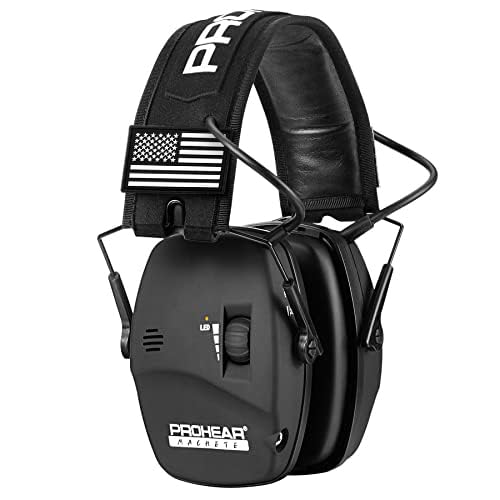
The PROHEAR is the practical starting point if you’re not sure electronic hearing protection is worth the upgrade over foam plugs. The advertised 0.0005-second reaction time is genuinely fast for the price tier, and the 5X amplification with two directional microphones does a solid job of letting normal shop conversation and ambient tool sound through clearly. PROHEAR’s own product listing specifically calls out woodworking, landscaping, and mowing as intended uses alongside shooting, so this isn’t a stretch application for the tool.

The honest limitation is the 23dB NRR, which sits on the lower end of the electronic earmuff range. That’s adequate for a mower, a shop vac, or general garage ambient noise, but it’s less margin than you’d want for sustained exposure to a planer, a table saw, or anything running well above 90dB for hours at a time. The low-profile ear cups are a real plus if you’re also wearing safety glasses or a hard hat, since bulkier cups tend to get in the way of both.
Pros: Fast 0.0005-second reaction time for the price tier; 5X amplification with two directional microphones; explicitly rated by the manufacturer for woodworking, landscaping, and mowing; low-profile cups work well alongside safety glasses or a hard hat.
Cons: 23dB NRR is the lowest in this guide, not enough margin for sustained exposure to a planer or table saw at close range.
Best for: budget-conscious buyers who want a genuine upgrade over foam plugs for mowing, general garage work, and moderate-noise power tools, without paying for the highest NRR available.
2. DEAKSHIE Electronic Hearing Protection, 4-Mic 6X Amplification – Best for Glasses / All-Day Wear
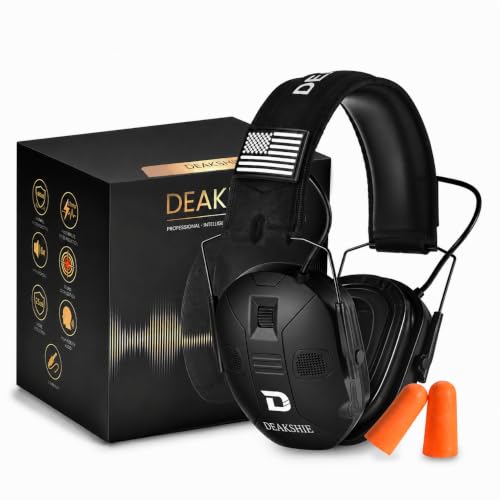
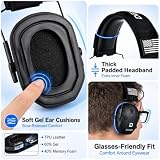
The DEAKSHIE’s standout feature for shop use is its glasses-friendly gel ear pads, which directly address the seal-breaking problem that standard foam cushions have around a safety glasses arm. If you wear eye protection for most of a shop session, which is standard practice for anyone running power tools, this is the single feature on this list most likely to actually change how well your hearing protection performs in practice rather than on paper. The 4-microphone array and 6X amplification also pick up directional sound better than the 2-mic setups on cheaper models, useful for locating where a shouted warning or an alarm is coming from in a shop with equipment running.
At 25dB NRR with a claimed 0.0002-second compression time, the DEAKSHIE lands ahead of the PROHEAR on both protection level and reaction speed. It’s a newer, less established brand than Walker’s or Peltor, so there’s less multi-year track record to point to, but the spec sheet and the glasses-focused design address a real, specific problem that generic shooting-market earmuffs usually ignore.
Pros: Glasses-friendly gel pads solve a real seal problem most competitors ignore; 25dB NRR with a fast 0.0002-second compression time, ahead of the PROHEAR on both counts; 4-microphone array aids locating directional sound.
Cons: A newer, less established brand than Walker’s or Peltor, with less multi-year reliability track record to point to.
Best for: anyone who wears safety glasses through most of a shop session and wants the ear seal to actually hold instead of leaking sound around the glasses arm.
3. Walker’s Razor Slim Electronic Muff – Best Low-Profile
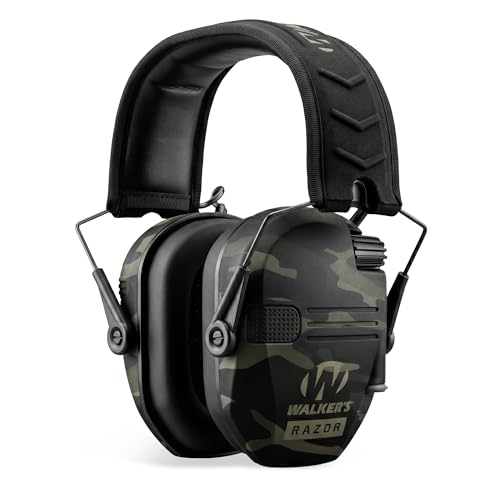
The Razor Slim’s defining feature is right in the name: it’s the thinnest electronic earmuff in this guide, with a folding design and sound-dampening composite housing that packs down small enough to toss in a tool bag rather than needing dedicated storage space. The 3.5mm audio input jack is a genuinely useful extra if you’d rather plug in a phone or handheld radio than rely on Bluetooth, and the two hi-gain omnidirectional microphones deliver clear, natural-sounding amplification rather than the tinny, over-processed sound some budget electronic muffs produce.

The trade-off for that slim profile is the slowest reaction time in this guide, a 0.02-second sound-activated compression, noticeably slower than the sub-millisecond circuits on the PROHEAR and DEAKSHIE. For steady noise like a running mower or shop vac, this is a non-issue. For an unpredictable sudden bang, like a board kicking back off a table saw, it’s meaningfully less protective in that specific split second. The 23dB NRR is also on the lower end of this list.
Pros: Thinnest, most compact design in this guide, folds flat for storage; 3.5mm audio input jack for a phone or radio; natural-sounding amplification from the two hi-gain microphones.
Cons: Slowest reaction time in this guide at 0.02 seconds, meaningfully less protective against a sudden impulse noise; 23dB NRR on the lower end.
Best for: buyers who prioritize a compact, storable design and want to plug in a phone or radio, and whose noise exposure is mostly steady rather than sudden impulse noise.
4. Peltor Sport Tactical 500 Bluetooth Hearing Protection – Best Overall
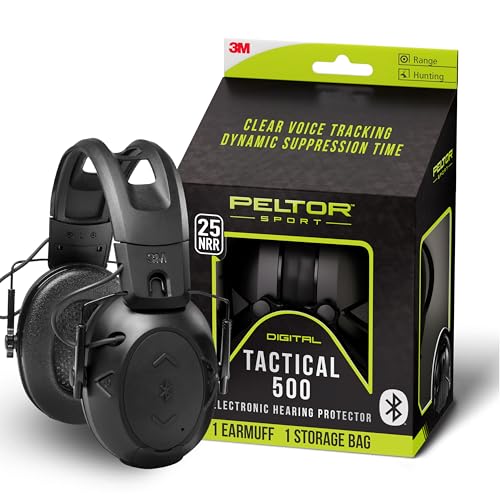
The Tactical 500 is the strongest all-around performer in this guide, built on 3M’s Dynamic Suppression Time and Clear Voice Tracking technology, which actively measures the energy in a loud noise spike and adjusts suppression time accordingly, rather than applying the same fixed clamp-down regardless of how loud or brief the sound actually was. Clear Voice Tracking specifically seeks out voice frequencies within background noise, which is a real, noticeable difference if you regularly need to hear a coworker over running equipment rather than just tolerate ambient sound in general.

Bluetooth connectivity lets you take phone calls or stream audio directly through the earmuffs, genuinely useful in a shop setting where pulling out a phone means stopping work and pulling off protection first. Note: 3M’s own spec sheet lists the NRR as 26dB while the current Amazon listing shows 25dB, likely a labeling update between product revisions, so treat either figure as approximately correct rather than a hard number to the decimal. It runs on standard AA batteries or an optional rechargeable pack sold separately, giving you flexibility on power source.
Pros: Dynamic Suppression Time and Clear Voice Tracking actively adapt to noise conditions rather than applying a fixed clamp-down; Bluetooth calls and audio streaming; flexible power options between AA batteries and an optional rechargeable pack.
Cons: Premium price; NRR labeling is inconsistent between 3M’s own spec sheet (26dB) and the current Amazon listing (25dB); rechargeable pack sold separately rather than included.
Best for: anyone who wants the most complete feature set, Bluetooth calls, adaptive suppression, and voice-tracking amplification, and doesn’t mind paying a premium price for it.
5. Pro Ears Gold Series Electronic Earmuffs – Best Made-in-USA / Premium
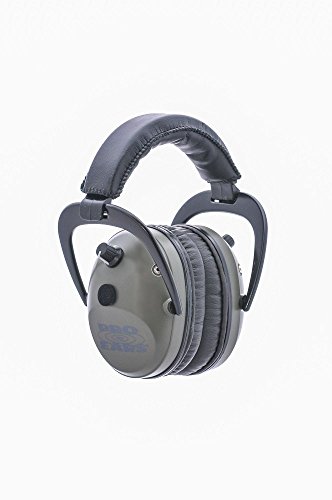
Pro Ears’ Gold Series is handmade in the USA with dual circuit board technology, a genuine differentiator since most competitors in this guide run a single shared circuit for both ears. The dual-board design lets you adjust amplification independently for each ear, which matters more than it sounds like it would if you have any asymmetric hearing loss, a common outcome of years of unprotected or under-protected shop and trade work. Pro Ears’ exclusive DLSC compression technology posts a 1.5-millisecond attack time, and the ProForm Leather ear seals with memory foam are noticeably more comfortable over a full workday than the synthetic foam cushions on the budget options in this guide.

The honest trade-off is battery type and price. The Gold Series runs on Lithium 123A batteries rather than the more universally available AAA cells, so keep a spare set on hand since you can’t grab a replacement at every hardware store. It’s also the most expensive option in this guide by a meaningful margin, a premium that buys genuine build quality, a 5-year manufacturer warranty, and per-ear adjustment, but is a real consideration if budget is a factor.
Pros: Dual circuit boards allow independent per-ear amplification adjustment, genuinely useful for asymmetric hearing loss; fast 1.5-millisecond DLSC attack time; ProForm Leather ear seals hold up better over a full workday than synthetic foam; 5-year warranty; made in the USA.
Cons: The most expensive option in this guide by a meaningful margin; Lithium 123A batteries aren’t as universally available as AAA cells, worth keeping a spare set on hand.
Best for: buyers who want the highest build quality and per-ear amplification control, are comfortable stocking Lithium 123A batteries, and value a USA-made product with a long manufacturer warranty.
6. Pro Ears Stalker Gold Electronic Hearing Protection – Best for All-Day Comfort

The Stalker Gold shares Pro Ears’ dual circuit board and DLSC compression technology with the Gold Series above, but in a lighter, chop-cut cup design originally intended for shouldering a long gun. That same low-bulk shape is a real practical advantage against a hard hat brim or a shoulder strap during extended shop or job-site wear, less to catch and less weight pressing on your head over a full day. Independent per-ear volume control carries over from the Gold Series, and the 250-hour battery life on a set of rechargeable lithium batteries means you’re not swapping batteries mid-project.

At 25dB NRR, it sits solidly in the middle of this guide’s protection range, not the highest available but well ahead of the budget options. Like the Gold Series, it carries a premium price and uses the less common Lithium 123A battery format, so the same stocking consideration applies.
Pros: Shares the Gold Series’ dual circuit board and DLSC compression tech in a lighter, lower-bulk chop-cut cup; 250-hour battery life on rechargeable lithium batteries; independent per-ear volume control.
Cons: Premium price; same less-common Lithium 123A battery format as the Gold Series; 25dB NRR is mid-pack rather than the highest available in this guide.
Best for: extended, full-day wear where comfort and low bulk against a hard hat or shoulder strap matter as much as the protection rating itself.
Frequently Asked Questions
Can electronic earmuffs replace hearing protection required for OSHA-regulated shop work?
Yes, as long as the specific model carries an NRR rating appropriate to your noise exposure level, calculated the same way as it would be for passive protection. The electronics add amplification of safe ambient sound; the underlying NRR-rated attenuation of harmful noise works the same way it does on a passive earmuff. Check your workplace’s specific noise exposure levels and required NRR against the model’s rating before relying on it for compliance.
Do electronic earmuffs work with a hard hat?
Most of the earmuffs in this guide use a standard over-the-head band design that fits under most hard hats, though bulkier ear cups can create pressure points against the hard hat’s suspension. The low-profile options in this guide, the Razor Slim and the Stalker Gold’s chop-cut design, are the more comfortable choices for extended hard hat wear. If you need hard-hat-mounted hearing protection specifically, look for earmuffs sold in a cap-mount configuration rather than the standard headband versions covered here.
Do the batteries drain when the earmuffs are off?
No, all six models in this guide include an auto shut-off feature that powers down the circuit after a period of inactivity, and the batteries don’t drain meaningfully while the unit is fully off. Bluetooth-enabled models like the Peltor Tactical 500 do use more battery during active streaming or calls than the base amplification circuit alone.
Why does the same product show different NRR numbers on different pages?
Manufacturers occasionally update a product’s official rating between revisions, or list NRR on one page and the European SNR equivalent on another, which reads a few decibels different due to differing test methodology. When you see a discrepancy, treat the Amazon listing’s current NRR figure as the one to rely on for US-based comparison, and don’t stack the difference as if it represents additional real protection.
Is a higher amplification number always better?
Not necessarily. Amplification (5X, 6X, 8X) describes how much the circuit boosts quiet ambient sound, not how much it protects you from loud noise, that’s what the NRR number measures. A higher amplification figure is useful if you need to hear very quiet sounds clearly, like a coworker speaking at a distance, but it doesn’t substitute for NRR when comparing actual hearing protection level.
Final Verdict
The right electronic earmuffs for shop use come down to which trade-off matters most to you, since every option here makes a different one:
- Best budget: PROHEAR Digital Electronic – a genuine upgrade over foam plugs at an accessible price, with a fast reaction time for the tier.
- Best for glasses / all-day wear: DEAKSHIE 4-Mic Electronic – glasses-friendly gel pads solve a real seal problem that most competitors ignore.
- Best low-profile: Walker’s Razor Slim – the most compact, storable option, best suited to steady rather than sudden noise.
- Best overall: Peltor Sport Tactical 500 – the most complete feature set, adaptive suppression, voice tracking, and Bluetooth, at a premium price.
- Best made-in-USA / premium: Pro Ears Gold Series – the strongest build quality and per-ear adjustment, for buyers who don’t mind Lithium 123A batteries.
- Best for all-day comfort: Pro Ears Stalker Gold – the lightest, lowest-bulk premium option for extended wear under a hard hat.
Whichever pair you choose, match the NRR to your actual noise exposure first, then weigh reaction time and glasses compatibility if sudden impulse noise or eye protection are part of your daily shop routine. A well-fitted mid-tier electronic earmuff protects you better in practice than a higher-rated pair that doesn’t seal properly around your glasses or hard hat. If your shop also generates fine dust alongside the noise, pairing this with a solid dust collection setup covers both major shop health hazards at once.