You found the bolt. You have the right socket. Then you try to swing the ratchet and the handle hits a hose after an inch of travel. You get half a click, reset, and scrape a knuckle. That is the tight-space problem, and a normal ratchet can’t solve it.
The fix is a ratchet built for the kind of tight you are dealing with. This guide explains the three specs that matter, then picks the best ratchet set for each tight-space job, from engine bays to under-sink plumbing.
- Best overall: GEARWRENCH 120XP 4-Piece Flex Head Ratchet Set (81230P)
- Best complete 1/4″ set: Milwaukee 48-22-9004 50-Piece Set
- Best value 3-drive set: TEKTON SRH91100 3-Piece
- Shortest flex head: ARES 42043 Flex Head Stubby
- Best flex set on a budget: ARES 42040 4-Piece Flex Head Set
- Best stubby set: TEKTON SRH91105 Stubby Set
- Finest swing arc for the money: ARES 42068 120-Tooth
Jump to: The 3 Specs That Matter | Comparison Table | Reviews | Which Type Do You Need? | Extensions and U-Joints | FAQ
The 3 Specs That Matter in Tight Spaces
Tight spaces cause three different problems, and each one has a different fix. Most people buy a flex head ratchet and still get stuck, because their real problem was handle length or head height.
| Your Problem | What Fixes It | What to Look For |
|---|---|---|
| The handle can only move a few degrees before it hits something | A finer ratchet mechanism | More teeth or positions, smaller swing arc |
| The handle is too long to fit at all | A shorter handle | Stubby ratchet (about 3 to 6 in.) |
| You can’t get straight in over the bolt | An angled head | Flex head (pivots up to 180 degrees) |
Swing arc: the number that matters most
The swing arc is how far you have to move the handle before the ratchet catches the next tooth. It comes straight from the tooth count: a 72-tooth ratchet needs about a 5-degree swing, a 90-tooth ratchet about 4 degrees, and a 120-position ratchet about 3 degrees. The smaller the number, the less room you need.
On a 10-inch handle, the difference between 5 degrees and 3 degrees is less than an inch of travel at the grip. In a packed engine bay, that inch often decides whether the ratchet works at all.
The trade-off: fine teeth are smaller teeth
Higher tooth counts mean smaller individual teeth. Quality brands get around this with designs that keep several teeth engaged at once (TEKTON’s single half-moon pawl keeps 9 teeth engaged; GEARWRENCH’s 120XP uses two stacked 60-tooth pawls). Even so, don’t use a fine-tooth ratchet as a breaker bar. Break stubborn fasteners loose with a longer tool first, then switch to the tight-space ratchet to spin them out.
Best Ratchet Sets for Tight Spaces: Comparison Table
| Ratchet Set | Drive Sizes | Teeth / Swing Arc | Head | Best For |
|---|---|---|---|---|
| GEARWRENCH 120XP 81230P | 1/4″, 3/8″ (x2), 1/2″ | 120 positions / 3° | Flex | Best overall |
| Milwaukee 48-22-9004 | 1/4″ + 49 sockets | 90 / 4° | Slim fixed | Complete 1/4″ kit |
| TEKTON SRH91100 | 1/4″, 3/8″, 1/2″ | 90 / 4° | Compact fixed | Value 3-drive set |
| ARES 42043 | 1/4″ | 72 / 5° | Flex, 4-9/16 in. long | Extreme confinement |
| ARES 42040 | 1/4″, 3/8″, 1/2″, 3/8″ stubby | 72 / 5° | Flex | Budget flex set |
| WORKPRO Flex Stubby Set | 1/4″, 3/8″ + bits | See listing | Flex stubby | Budget stubby kit |
| TEKTON SRH91105 | 1/4″, 3/8″ stubby | 90 / 4° | Compact fixed | Under-sink and cabinets |
| ARES 42068 | 1/4″ | 120 / 3° | Fixed, 5 in. long | Finest arc for the money |
The 8 Best Ratchets and Ratchet Sets for Tight Spaces
1. GEARWRENCH 120XP 4-Piece Flex Head Set (81230P) – Best Overall

The 120XP line is the tight-space benchmark, and this 4-piece set covers every drive size you will need. GEARWRENCH lists two double-stacked 60-tooth pawls that give 120 positions and a 3-degree swing arc, plus a head it says is up to 22% more compact than earlier designs (GEARWRENCH product page, retrieved 2026-09-30).
The set includes a 1/4″ drive (about 7 in.), two 3/8″ drives (a stubby at about 4-3/4 in. and a full-length at about 13-1/2 in.), and a 1/2″ drive at about 19 in. That spread matters: you get a flex stubby for cramped spots and long handles for leverage in the same box.

The flex heads do not lock, so the head can flop when you want it held at an angle. GEARWRENCH sells locking-flex 120XP versions separately if that bothers you. It is also the most expensive ratchet-only set here.
Skip this if: you only work in one drive size. A single 120XP ratchet costs far less.
Pros:
- 3-degree swing arc from 120 positions
- Compact head plus flex in every drive size
- Includes a 3/8″ flex stubby
- Long 1/2″ handle for leverage
Cons:
- Flex heads don’t lock
- Priciest ratchet-only set here
Buy it on Amazon today with FREE returns
2. Milwaukee 48-22-9004 1/4″ 50-Piece Set – Best Complete 1/4″ Kit
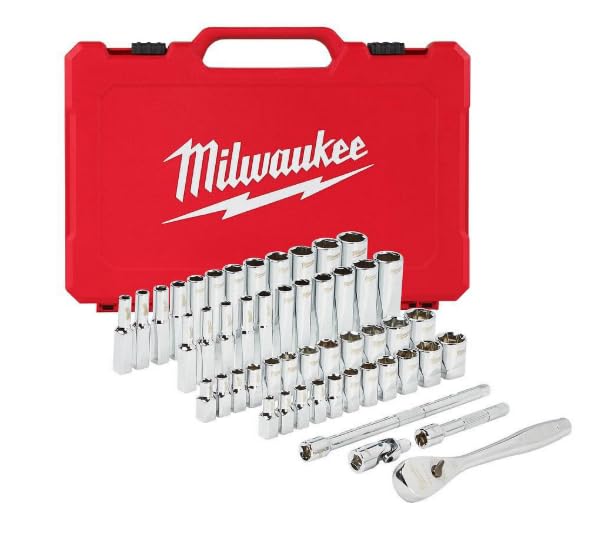
Most tight-space work on modern cars, appliances and electronics happens in 1/4″ drive. This Milwaukee kit gives you a slim-profile 90-tooth ratchet with a 4-degree swing arc, plus 49 SAE and metric sockets, 3-inch and 6-inch extensions and a universal joint, according to Milwaukee’s product page (retrieved 2026-09-30).
The sockets have four flat sides, which stops them rolling away and lets you turn one with a wrench when even the ratchet won’t fit. Sizes are stamped on the flats, and the set carries Milwaukee’s lifetime guarantee.

The ratchet has a fixed head, not a flex head. Amazon also shows several “for Milwaukee” copies of this set, so check that the seller and brand are Milwaukee before you buy.
Skip this if: you already own a 1/4″ socket set and only need a better ratchet.
Pros:
- Complete 1/4″ kit with sockets, extensions and U-joint
- 90-tooth, 4-degree ratchet with slim head
- Four-flat sockets that don’t roll
Cons:
- Fixed head, no flex
- Watch out for look-alike listings
Buy it on Amazon today with FREE returns
3. TEKTON SRH91100 3-Piece – Best Value 3-Drive Set
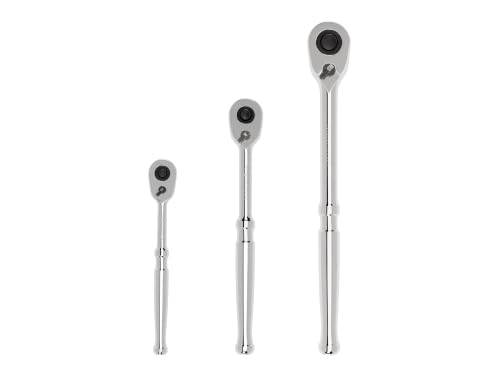
Three quick-release ratchets, one in each drive size: 1/4″ x 6 in., 3/8″ x 8 in. and 1/2″ x 10.5 in. Each has a 90-tooth gear with a 4-degree swing arc. TEKTON says it shrank the head in height, width and length, not just thickness, and its single half-moon pawl keeps 9 teeth engaged at all times so it resists slipping under load.

These are fixed-head ratchets, not flex heads. They solve the swing-room problem well, but won’t help when you need to come in at an angle. Pair them with a flex stubby like the ARES 42043 and you cover almost everything.
Skip this if: most of your fasteners are off-axis. Get a flex head set.
Pros:
- 90-tooth, 4-degree ratchets in all three drives
- Compact head in every dimension
- 9 teeth engaged for grip under load
Cons:
- No flex head
- No stubby in the set
Buy it on Amazon today with FREE returns
4. ARES 42043 1/4″ Flex Head Stubby – Best for Extreme Confinement

When there is room for neither a long handle nor a straight approach, you need both a short handle and a flex head. The ARES 42043 is only 4-9/16 inches long overall, with a head that flexes through 180 degrees and a 72-tooth, 5-degree mechanism. It has a quick-release button and a thumb switch on the back of the head.

The short handle gives you very little leverage, and 5 degrees is a coarser swing than the 90 and 120-tooth tools here. Use it to spin fasteners in and out, not to break them loose.
Skip this if: you need torque. Break the fastener loose with a longer tool first.
Pros:
- Just 4-9/16 in. long
- 180-degree flex head
- Low price
Cons:
- Little leverage
- 5-degree swing is coarser than 90/120-tooth tools
Buy it on Amazon today with FREE returns
5. ARES 42040 4-Piece Flex Head Set – Best Budget Flex Set
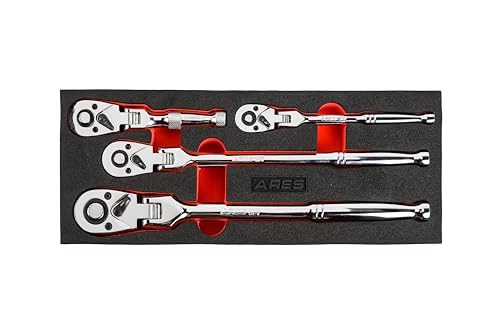
This is the budget alternative to the GEARWRENCH set, with the same smart layout. Per ARES (retrieved 2026-09-30), you get 1/4″ (7 in.), 3/8″ (11-3/8 in.) and 1/2″ (12-1/4 in.) flex head ratchets plus a 3/8″ stubby under 6 inches. All four use a 72-tooth, 5-degree mechanism, a 180-degree flex head and quick release.

You give up swing arc compared with the GEARWRENCH (5 degrees vs. 3), and the 1/2″ handle is shorter, so it has less leverage.
Skip this if: you regularly work with only a few degrees of swing room. The 120XP is worth the extra money there.
Pros:
- Flex heads in all three drive sizes
- Bonus 3/8″ stubby
- Quick release on every ratchet
Cons:
- 5-degree swing arc
- Shorter 1/2″ handle
Buy it on Amazon today with FREE returns
6. WORKPRO Flex Head Stubby Ratchet and Bit Driver Set – Best Budget Stubby Kit

This 16-piece WORKPRO kit pairs 1/4″ and 3/8″ drive flex head stubby ratchets with bits and adapters, so one small case handles both sockets and screws in tight spots. It is a good fit for a homeowner’s drawer or a kit that lives in the car.

WORKPRO is a value brand, and we could not confirm the tooth count and swing arc from a manufacturer spec sheet, so check the listing before buying if swing arc matters for your job. For daily professional use, TEKTON or GEARWRENCH are the safer bets.
Skip this if: you need the finest possible swing arc.
Pros:
- Flex stubby ratchets in two drive sizes
- Bits and adapters included
- Low price
Cons:
- Value-brand build
- Tooth count not confirmed by a spec sheet
Buy it on Amazon today with FREE returns
7. TEKTON SRH91105 Stubby Set – Best for Plumbing and Under-Sink Work
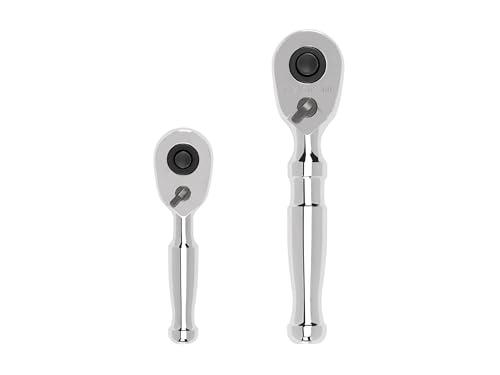
Under a sink or inside a cabinet, you can usually see the fastener straight on. The problem is purely that a normal handle won’t swing. This two-piece TEKTON stubby set (1/4″ and 3/8″ drive) is built for exactly that: a 90-tooth gear with a 4-degree working arc, quick-release, and TEKTON’s ultra-compact head.

They are fixed-head stubbies, so they won’t reach around corners, and short handles mean limited torque.
Skip this if: your fasteners are off-axis. Get a flex stubby like the ARES 42043.
Pros:
- 90-tooth, 4-degree mechanism in stubby form
- Two drive sizes
- Compact head
Cons:
- No flex head
- Limited leverage
Buy it on Amazon today with FREE returns
8. ARES 42068 1/4″ 120-Tooth Ratchet – Finest Swing Arc for the Money
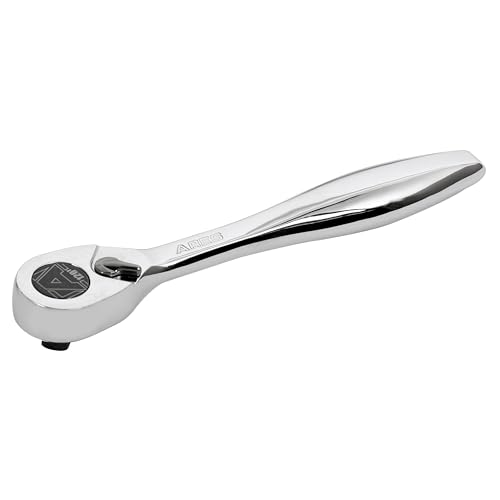
If the problem is swing room and nothing else, a 120-tooth ratchet is the cheapest fix. The ARES 42068 needs just a 3-degree swing arc, matching the GEARWRENCH 120XP, at a fraction of the price. It is 5 inches long overall with a gear-to-gear pawl design, and ARES says it meets ANSI and ASME torque standards.

It has a fixed head, and 1/4″ drive limits torque. It is a finesse tool for electronics, small engines, appliances and interior car trim.
Skip this if: you need a flex head or 3/8″ drive.
Pros:
- 3-degree swing arc
- Compact 5 in. length
- Very low price
Cons:
- Fixed head
- 1/4″ drive only
Buy it on Amazon today with FREE returns
Which Tight-Space Ratchet Do You Need?
| Job | Main Problem | Best Tool Type | Our Pick |
|---|---|---|---|
| Engine bay (alternator, intake, sensors) | Swing room and angle | Fine-tooth flex head | GEARWRENCH 120XP set |
| Behind the dash, interior trim | Handle length and angle | 1/4″ flex stubby | ARES 42043 |
| Under-sink plumbing, cabinets | Handle length | Fixed stubby | TEKTON SRH91105 |
| Appliances, electronics, small engines | Swing room | 120-tooth 1/4″ | ARES 42068 |
| Starting from scratch | All of the above | Complete kit | Milwaukee 48-22-9004 + a flex stubby |
1/4″ or 3/8″ drive for tight spaces?
Use 1/4″ drive whenever the fastener allows it: smaller heads, smaller sockets, more room. Step up to 3/8″ for mid-size automotive fasteners that need more torque. Save 1/2″ drive for suspension and lug nuts, where space is rarely the problem.
Extensions and Universal Joints in Tight Spaces
- Extensions move the ratchet out of the clutter to where you have swing room. Often a 3-inch extension on a normal ratchet beats a stubby ratchet jammed against the bolt.
- Wobble extensions let the socket tilt a few degrees, which helps when you can’t get perfectly straight on.
- Universal joints handle bigger angles but flex under load and can round fasteners. Use them to spin, not to break loose.
Buying Checklist
- Swing arc: 4 degrees or less (90+ teeth) if room to swing is your main problem.
- Head size: look for a compact head, not just a thin one.
- Flex head: needed when you can’t approach straight on. Locking flex heads hold their angle.
- Handle length: own at least one stubby.
- Quick release: makes socket changes one-handed, which matters when your other hand is holding a light.
- Warranty: GEARWRENCH, Milwaukee, TEKTON and ARES all back their ratchets with lifetime-style warranties. Check the terms for your model.
Building out a full kit? See our guides to the best mechanic tool sets for beginners, socket sets for beginners and torque wrenches. For stuck fasteners that a ratchet can’t shift, see impact wrench vs. breaker bar.
Frequently Asked Questions
What ratchet is best for tight spaces?
A fine-tooth flex head ratchet covers the most situations. The GEARWRENCH 120XP set is our top pick for its 3-degree swing arc and flex heads in every drive size. For the tightest spots, add a short flex stubby like the ARES 42043.
What tooth count do I need for tight spaces?
72 teeth (about 5 degrees) is fine for general work. 90 teeth (4 degrees) or 120 positions (3 degrees) make a real difference when you only have a few degrees of handle travel.
What is the difference between a stubby and a low-profile ratchet?
A stubby has a short handle, which helps when there is no room to swing a long one. A low-profile or compact head is thinner and smaller, which helps when there is little space above the fastener. Some tight spots need both.
Is a flex head ratchet weaker?
The pivot adds a joint, and a non-locking head can flop when you push hard at an angle. For stubborn fasteners, break them loose with a fixed ratchet or breaker bar, then use the flex head to spin them out.
Is 1/4″ or 3/8″ drive better for tight spaces?
1/4″ drive is smaller and fits more places. 3/8″ handles more torque. Most mechanics keep a tight-space ratchet in each.
Are cordless electric ratchets good for tight spaces?
They spin fasteners fast once they are loose, but their heads and bodies are usually bulkier than a manual stubby. Treat them as a speed tool, not a clearance tool.
Bottom Line: Which Ratchet Set for Tight Spaces?
- Best all-round tight-space set: GEARWRENCH 120XP 81230P
- Complete 1/4″ kit: Milwaukee 48-22-9004
- Value fixed-head set: TEKTON SRH91100
- Shortest flex head: ARES 42043
- Budget flex set: ARES 42040
- Under-sink and cabinets: TEKTON SRH91105
- 3-degree arc on a budget: ARES 42068