Most smoke detectors last 10 years from the date they were made. Not from the day you bought it, and not from the day you put it on the ceiling. If you just moved into a house, or an alarm started chirping at 3 a.m. and a new battery didn’t fix it, this guide shows you how to check the age of every alarm you own, what each chirp means, and what to replace them with.
Quick answer: Replace smoke alarms 10 years after the manufacture date printed on the back. Carbon monoxide (CO) and combination smoke/CO alarms can expire sooner, often around 7 years on older models. Replace any alarm right away if it fails the test button, keeps chirping after a fresh battery, or goes off for no reason.
Quick Picks
- Best budget 10-year sealed alarm: X-Sense SD2L0AX
- Best smoke and CO combo: X-Sense SC07
- Best hardwired replacement: Kidde 30CUA10-V
Comparison Table
Prices and ratings are from Amazon on 2026-11-18 and change often.
| Product | Detects | Power | Interconnect | Price | Rating |
|---|---|---|---|---|---|
| X-Sense SD2L0AX | Smoke (photoelectric) | Sealed 10-year lithium | No | $16.98 | 4.5 (785) |
| X-Sense SC07 | Smoke + CO | Sealed 10-year lithium | No (SC07-W version links) | $36.98 | 4.5 (4,482) |
| Kidde 30CUA10-V | Smoke + CO, voice alerts | 120V hardwired + sealed 10-year backup | Yes, with other Kidde alarms | $67.47 | 4.1 (1,806) |
How Long Do Smoke Detectors Last by Type?
Every smoke alarm type has the same 10-year limit. What changes is the battery chore along the way. A lot of guides blur those two things together, so here they are side by side.
| Alarm type | How long the alarm lasts | Battery job |
|---|---|---|
| 9V or AA battery smoke alarm | 10 years from manufacture | New battery at least once a year |
| 10-year sealed lithium smoke alarm | 10 years from manufacture | None. The battery can’t be replaced |
| Hardwired with replaceable backup battery | 10 years from manufacture | New backup battery at least once a year |
| Hardwired with sealed 10-year backup | 10 years from manufacture | None |
| Combination smoke + CO | Set by the CO sensor, often 7-10 years | Depends on the model |
The U.S. Fire Administration puts it plainly: smoke alarms need to be replaced 10 years from the manufacture date, and every type should be tested monthly. Alarms that run on a 9-volt battery need a new battery at least once a year (U.S. Fire Administration, retrieved 2026-11-18).
Why smoke alarms wear out
The sensor inside sits in open air for a decade. Dust, humidity, kitchen grease and the odd bug all build up in the sensing chamber. First Alert lists dust, environmental exposure, age and normal wear as the reasons alarms get replaced at 10 years, even if they still beep, flash or pass a button test (First Alert, retrieved 2026-11-18).
Age also shows up in the failure numbers. The Minnesota State Fire Marshal notes that after 20 years, only about 54% of alarms could be expected to work, and that 10 years was picked as a balance between cost and reliability (Minnesota State Fire Marshal, retrieved 2026-11-18).
Does the 10-year clock start at install or manufacture?
Manufacture. An alarm can sit in a warehouse and on a store shelf for months before it reaches your ceiling. That time counts. When you buy new alarms, check the date on the box so you don’t start with one that’s already a year old.
Carbon monoxide alarms are a little different. Many run an internal timer that starts when the unit is first powered up. Kidde, for example, says its CO alarms start chirping seven years after initial power-up (Kidde, retrieved 2026-11-18). Either way, the date on the label is your best guide.

How to Find Your Smoke Detector’s Age
This takes about a minute per alarm. Grab a step ladder and a marker.
- Take the alarm off its base. Most twist counterclockwise off the mounting plate. On a hardwired alarm, you’ll see a plug on a short wire. Unplug it, or just tilt the alarm enough to read the back.
- Find the label. It’s on the back or the side. Look for “Date Code,” “Manufactured” or “MFG Date.”
- Add 10 years. That’s your replace-by date. Some newer alarms print a “Replace by” date for you.
- Write it down. Put the replace-by year on the side of the alarm, where you can read it from the floor with a flashlight.
If you need a ladder that works well on stairs and landings, where a lot of alarms live, see our Gorilla Ladder breakdown.
No date, or you can’t read it?
Replace the alarm. Date labels have been standard for decades, so an alarm with no readable date is almost certainly past its 10 years.
Signs Your Smoke Detector Needs Replacing Now
Age is the main trigger, but don’t wait for year 10 if you see any of these.
It still chirps after a fresh battery
A new battery restores power. It does not reset the sensor’s age. First Alert says a new battery will not stop an end-of-life warning on an expired unit (First Alert, retrieved 2026-11-18).
It fails the test button
Hold the button for a few seconds. No sound, or a weak sound, means the alarm is done. Replace it the same day.
It goes off for no reason
False alarms with no smoke, steam or cooking nearby often point to a dirty or failing sensor. Clean it once. If it keeps happening, replace it.
The plastic has yellowed or cracked
Yellow plastic is a rough age clue on its own. If the housing is yellow, check the date. It’s usually old.
A passing test isn’t the whole story
The test button checks the battery, the electronics and the horn. It does not prove the sensor still picks up smoke as fast as it should. That’s why the 10-year rule applies even to alarms that pass every monthly test.
Low Battery Chirp vs End-of-Life Chirp
This is where most people waste a battery. Both sounds are short chirps, but they mean different things. The patterns below come from Kidde’s support pages and manuals. Other brands use similar patterns, but check your own manual, since timing varies by model.
| What you hear | What it usually means | What to do |
|---|---|---|
| Three long beeps, repeating | Smoke alarm. This is the real thing | Get everyone out. Troubleshoot later |
| Single chirp every 30-60 seconds on a 9V/AA alarm | Low battery (on some models, end of life) | Replace the battery, then check the date |
| Chirp every 30 seconds on a sealed-battery Kidde alarm | End of life | Replace the whole alarm |
| Double chirp every 30-60 seconds (some Kidde models) | End of unit life | Replace the whole alarm |
| Chirp every 30 seconds on a Kidde CO alarm about 7 years old | CO sensor end of life | Replace now. Kidde says the alarm will not respond to CO in this mode |
| “ERR” on a digital display | Error or fault | Check the manual. Replace if it returns |
On sealed-battery models, Kidde says the alarm chirps every 30 seconds when it’s time to replace it. For its CO alarms, Kidde says the end-of-life chirp starts seven years after initial power-up, won’t stop until the unit is powered off, and that the alarm can’t detect CO in that state (Kidde, retrieved 2026-11-18). Some Kidde manuals let you hush the end-of-life chirp for a while, but after 7 days it can’t be silenced anymore.
One more tip: low-battery chirps often start in the middle of the night. A battery near the end of its life drops voltage as the house cools down overnight, which is why the chirp tends to start at 3 a.m.

Should You Replace All Your Smoke Detectors at Once?
In most homes, yes. Two reasons.
First, alarms installed together expire together. If one alarm in the hallway is 10 years old, the ones in the bedrooms probably are too. One ladder day beats six separate ones.
Second, interconnected alarms usually need to match. On a hardwired system, the alarms talk to each other over a third wire. Most brands only interconnect with their own alarms. Mix a new brand into an old system and the alarms may not trigger each other, which defeats the point of linking them. Wireless interconnected alarms have the same limit: they only link within the same brand family.
Replacing a Hardwired Smoke Detector

If your alarms are wired into the house, the swap is usually a 10-minute job per alarm, as long as the old wiring is in good shape.
- Kill the power at the breaker. Smoke alarm circuits are often labeled. If not, find the right breaker and confirm it’s off with a non-contact voltage tester at the alarm.
- Remove the old alarm. Twist it off the base and unplug the wiring harness.
- Decide: new harness or adapter. New alarms come with their own harness, which means swapping wire connections at the box. Some brands sell adapters that plug the new alarm into the old harness so you don’t have to touch the wire nuts.
- Keep the interconnect wire. On most systems it’s the red wire (sometimes orange or yellow). It’s what lets one alarm set off the others.
- Mount, power up, test. Turn the breaker back on, press the test button on one alarm and make sure every alarm in the house sounds.
On adapters: Kidde sells a Quick Connect adapter (20-9003) that plugs new Kidde alarms into many older Kidde harnesses. It’s sold separately, and Kidde says it only works with Kidde-branded alarms (Kidde, retrieved 2026-11-18). Kidde also sells Quick Convert adapters for some competitor harnesses, like old Firex units. Check what’s on your ceiling before you buy.
Call an electrician if you find scorched wires, aluminum wiring, no power at the box, or if you want to add alarms where there’s no wiring yet.
How Many Smoke Detectors Do You Need?
The national fire code, NFPA 72, calls for interconnected smoke alarms in every bedroom, outside each sleeping area and on every level of the home (Connecticut State Fire Administrator, retrieved 2026-11-18). Local codes can add more, so check yours.
Here’s how that works out in a typical house. A two-storey home with three bedrooms upstairs and a basement needs about six alarms:
- 3 bedrooms: 3 alarms
- Upstairs hallway outside the bedrooms: 1 alarm
- Main floor: 1 alarm
- Basement: 1 alarm
Add CO alarms if you have gas appliances, a fireplace or an attached garage. Combination units cover both jobs with one alarm on the ceiling.
Best Smoke Detector Replacements on Amazon
These three cover the three most common replacement jobs: swapping battery alarms, adding CO protection, and replacing a hardwired system. All three use sealed 10-year batteries, so you’re done with yearly battery changes.
1. X-Sense SD2L0AX – Best Budget 10-Year Sealed Alarm
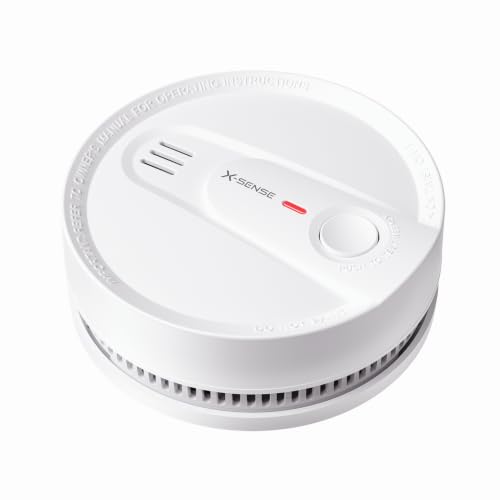
The SD2L0AX is the cheapest way to get every bedroom on a sealed 10-year battery. It was $16.98 for one on 2026-11-18, down from a $22.99 list price. It rates 4.5 stars across 785 ratings. If you’re doing the whole house, the 3-pack was $49.98.

Per the listing, it uses a photoelectric sensor that’s meant to tell real smoke apart from steam and cooking fumes. That makes it a good fit for hallways near a kitchen or bathroom. The lithium battery is built in and tamper-resistant. A self-test checks the alarm, and the test/silence button handles nuisance alarms. It screws to the ceiling. No wiring.
Key specs: photoelectric sensor; sealed 10-year lithium battery; ETL listed to the UL 217 standard; self-test; test/silence button (per listing).
Pros: Low price per alarm; no batteries to buy for 10 years; photoelectric sensor cuts down cooking false alarms.
Cons: Standalone. It won’t trigger the other alarms in the house. It’s ETL listed to UL 217 rather than UL listed, which is a normal, accepted route, but worth knowing if your local code names a specific lab.
Not the right fit if: you want all your alarms to sound together. X-Sense sells interconnected versions (SD19-W and SD20-W) for that.
2. X-Sense SC07 – Best Smoke and CO Combo
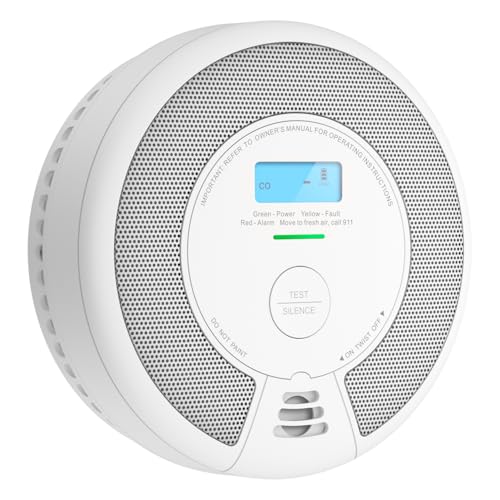
If you have a gas furnace, gas stove, fireplace or attached garage, a combo alarm covers both hazards from one spot. The SC07 was $36.98 on 2026-11-18, down from $42.99. It’s the most-reviewed pick here at 4.5 stars across 4,482 ratings.

The listing pairs a photoelectric smoke sensor with an electrochemical CO sensor, powered by a sealed lithium battery rated for 10 years. An LCD display shows readings. It’s certified to UL 217 for smoke and UL 2034 for CO. It mounts on a wall or ceiling with the included bracket and screws.
Key specs: photoelectric smoke + electrochemical CO sensors; sealed 10-year battery; LCD display; UL 217 and UL 2034 (per listing).
Pros: Two alarms in one; no battery changes; large review count with a strong rating.
Cons: X-Sense says the SC07 is a basic standalone unit with no wireless interconnect, Wi-Fi or base station support. The SC07-W is the linked version. And with a combo, both sensors retire together when the unit expires.
Not the right fit if: you want phone alerts or a whole-home linked system.
3. Kidde 30CUA10-V – Best Hardwired Replacement
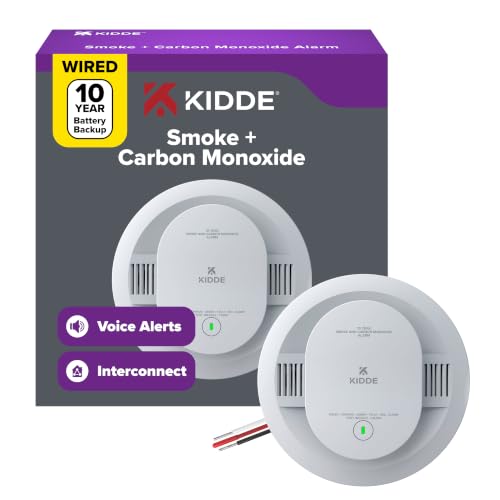
This is the swap for 10-year-old hardwired alarms, especially if you have Kidde on the ceiling now. It was $67.47 on 2026-11-18, down from $74.97. It rates 4.1 stars across 1,806 ratings, the lowest of the three.

Per the listing, it runs on 120V AC with a built-in 10-year battery backup, so you stop replacing backup batteries every year. It detects smoke and CO, and its voice alerts say “Fire” for smoke and “Warning, Carbon Monoxide” for CO, so nobody has to guess which hazard set it off. It’s tested to UL 217 10th Edition and UL 2034 5th Edition. It interconnects with other Kidde alarms, and the alarm itself is 85 decibels.
Key specs: 120V hardwired; sealed 10-year battery backup; smoke + CO; voice alerts; wired interconnect with Kidde alarms; 85 dB (per listing).
Pros: Ends the yearly backup battery chore; voice alerts name the hazard; covers smoke and CO in one box on the ceiling.
Cons: Interconnects with Kidde alarms only. If your old harness is an older Kidde style, you may need the 20-9003 adapter, which is sold separately. Lower rating than the X-Sense picks.
Not the right fit if: your house has a First Alert or BRK hardwired system and you don’t want to replace every alarm. The First Alert hardwired alarm with 10-year battery backup (4.4 stars, 1,029 ratings) is the easier swap there.
How to Make Your Smoke Detectors Last the Full 10 Years
- Test monthly. Press and hold the test button until it sounds.
- Vacuum the vents twice a year with a soft brush attachment.
- Keep them away from steam and airflow. Don’t mount alarms right next to bathroom doors, stoves, ceiling fans or HVAC vents.
- Never paint over an alarm. Paint can block the vents to the sensor.
Smoke alarms warn you. An extinguisher helps you deal with a small fire while you get out. If you’re updating alarms, it’s a good time to check what’s under the sink too. Our fire extinguisher guide covers which types fit a kitchen, garage and workshop.
How to Dispose of an Old Smoke Detector
It depends on the type. Look at the label on the back.
- Photoelectric: no hazardous material inside. Remove any loose battery, and the alarm can usually go in the trash (University of Wisconsin Extension, retrieved 2026-11-18).
- Ionization: contains a tiny amount of americium-241. Don’t take it apart. Many manufacturers take them back, and some local hazardous waste sites accept them. Words like “Ionization,” “Radioactive,” “Am-241” or a radiation symbol on the label mean it’s this type (Los Alamos National Laboratory OSRP, retrieved 2026-11-18).
- Sealed 10-year lithium: don’t try to pry the battery out. Follow the manual’s instructions for deactivating the unit, then take it to a battery or electronics recycler.
FAQ
Do smoke detectors expire if they’ve never been used?
Yes. The clock runs from the manufacture date, whether the alarm was in a box or on the ceiling. An alarm that sat in a drawer for six years has four years left, not ten.
Can I just replace the battery instead of the whole alarm?
Only if the alarm is under 10 years old. A new battery powers the alarm, but it doesn’t make an old sensor any better at picking up smoke.
How long do hardwired smoke detectors last?
Ten years, the same as battery alarms. Being wired into the house doesn’t make the sensor last longer. The backup battery needs replacing yearly unless it’s a sealed 10-year backup.
Do 10-year sealed battery alarms really last 10 years?
They’re designed to. When the battery or the unit reaches the end, the alarm chirps to tell you. If one starts chirping early, replace it. There’s no battery to swap.
How long do carbon monoxide and combo detectors last?
Older CO alarms often lasted 5-7 years. Kidde, for example, starts its CO end-of-life chirp at seven years. Many newer CO and combo alarms are rated for 10 years. Check the label and the manual for your model.
Why is my smoke detector chirping after I changed the battery?
Three common reasons: the battery isn’t seated properly, the wrong battery type was used, or the alarm has reached end of life. Reseat the battery and press the test button. If it keeps chirping, check the date.
Do photoelectric and ionization alarms last differently?
No. Both are covered by the same 10-year rule. They differ in what they detect best. Ionization reacts faster to flaming fires and photoelectric to smoldering fires, which is why fire agencies recommend both types or dual-sensor alarms.
Should I write the install date on my alarm?
Write the replace-by date instead. It’s 10 years from the manufacture date, and that’s the number you’ll actually need later.
Bottom Line
Check the back of every alarm in your house this weekend. Anything 10 years old, or with no readable date, comes down. Then pick the replacement by job:
- Battery alarms on a budget: X-Sense SD2L0AX, or the 3-pack for a whole floor.
- Gas appliances or an attached garage: X-Sense SC07 smoke and CO combo.
- Replacing a hardwired Kidde system: Kidde 30CUA10-V.
- Replacing a hardwired First Alert/BRK system: First Alert hardwired with 10-year backup.
Whatever you buy, test it once a month and write the replace-by year on the side.