Most “best for low pressure” nozzle guides just recommend whatever’s cheapest, without explaining why some nozzles handle weak flow so much better than others. The real answer is physics, not marketing: most multi-pattern nozzles create their spray effects by forcing water through a narrow opening, and that restriction is exactly what kills usable output when supply pressure is already marginal. This guide breaks down 10 real nozzles organized around what actually matters for low pressure, not just a list of “high pressure” nozzles with a low-pressure claim bolted on.
Why Most Nozzles Make Low Pressure Worse
A typical adjustable nozzle creates its shower, mist, or cone patterns by squeezing water through a small orifice. With strong supply pressure, that restriction barely matters, you’ve got water to spare. With weak supply pressure, the same restriction can cut your effective flow by half or more, turning a bad situation into a genuinely frustrating one. This is well-documented anecdotally by anyone who’s compared a multi-pattern nozzle’s “shower” setting against just running the hose with no nozzle at all, the bare hose often puts out more usable water. The fix isn’t finding a nozzle that claims a “low pressure mode,” it’s understanding which physical designs avoid heavy restriction in the first place.
What to Look For
Wide-bore or minimal-restriction designs. Water breaker nozzles (covered below) are the clearest example: instead of one small orifice, they use hundreds of larger holes, which spreads flow across more openings rather than forcing it through one narrow point. The result is a soft, gentle pattern that doesn’t sacrifice volume the way a tight adjustable nozzle does.
Brass fittings over plastic. A tighter seal at the hose connection means less pressure lost before water even reaches the nozzle. Plastic threads wear and loosen faster, which shows up as a weaker, less consistent spray over time even if the nozzle itself hasn’t changed.
Simple flow-control valves over dial/collar designs. A thumb-trigger or on/off valve doesn’t add the same ongoing resistance that a twist-collar adjustment ring does, since you’re not routing water through a narrowing mechanical path to get there.
Realistic expectations. No nozzle can create pressure that isn’t in your supply line. What separates a good low-pressure nozzle from a bad one is how little of your already-limited pressure it wastes, not some trick that manufactures pressure out of nothing.
Quick Comparison
| Product | Design Type | Material | Best For |
|---|---|---|---|
| Dramm 1000 Water Breaker | 1,000-hole water breaker | Plastic/aluminum, stainless disc | Max Flow for Garden Beds |
| Dramm 400 Water Breaker | 400-hole water breaker | Plastic | Seedlings and Containers |
| Dramm 12380 Brass Adjustable | Adjustable twist | Solid brass | Brass Adjustable |
| Gilmour 528T Brass Twist | Adjustable twist | Solid brass | Overall Multi-Purpose |
| Gilmour Pistol Grip | Trigger lock | Zinc/brass | Hands-Free / Trigger Lock |
| Dramm One Touch Fan | Thumb-control, no dial | Metal/plastic | Thumb-Control, No Dial Resistance |
| Melnor 65020-AMZ | Multi-pattern, rear trigger | Metal | Budget Multi-Pattern |
| Gilmour Jet Stream | Concentrated stream | Solid brass | Distance/Reach |
| Dramm Revolver | 9-pattern, thumb-control | Metal | Multi-Pattern That Still Performs |
| Flexzilla NFZG62 | Twist action | Metal, O-ring seal | Compact/Lightweight |
1. Dramm 1000 Water Breaker Nozzle – Best for Maximum Flow at Low Pressure

This is the clearest example of the design principle this whole guide is built around: instead of one small orifice, it uses 1,000 tiny holes across a stainless steel disc, rated at 11 GPM. Spreading flow across that many openings avoids the heavy restriction a single-orifice adjustable nozzle imposes, which means more of your limited supply pressure actually reaches your plants instead of getting choked at the nozzle. Originally designed for commercial greenhouse and nursery use, where growers can’t afford wasted time or water, it delivers a genuinely soft, even shower that won’t disturb soil or flatten seedlings despite the high flow rate.
Pros: Spreads flow across 1,000 holes instead of one restrictive orifice, avoiding the low-pressure penalty of adjustable nozzles; 11 GPM rated flow; soft, even shower won’t disturb soil or seedlings; originally engineered for commercial greenhouse use.
Cons: No adjustable spray patterns, it only does one thing (a gentle shower); larger and less compact than a standard nozzle.
Best for: garden beds and larger planting areas where you need real volume, not just a gentle pattern, and your supply pressure is already limited.
2. Dramm 400 Water Breaker Nozzle – Best for Seedlings and Containers
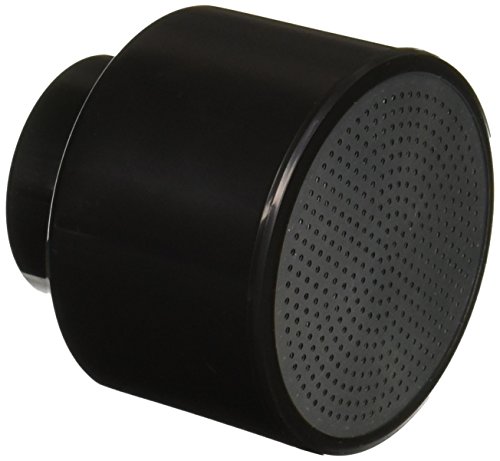
The smaller sibling to the 1000, with 400 holes instead of 1,000, delivering a gentler, lower-volume version of the same no-restriction principle. For container watering and delicate seedlings where you want a soft shower rather than maximum flow, this is the more appropriately scaled choice, still avoiding the single-orifice restriction problem, just calibrated for a smaller job.
Pros: Same no-restriction water breaker principle as the 1000, scaled down for gentler, lower-volume watering; ideal for delicate seedlings.
Cons: Not enough volume for larger garden beds; like the 1000, offers no adjustable spray patterns.
Best for: containers, seedlings, and smaller planting areas where gentleness matters more than raw volume.
3. Dramm 12380 Heavy-Duty Brass Adjustable Nozzle – Best Brass Adjustable
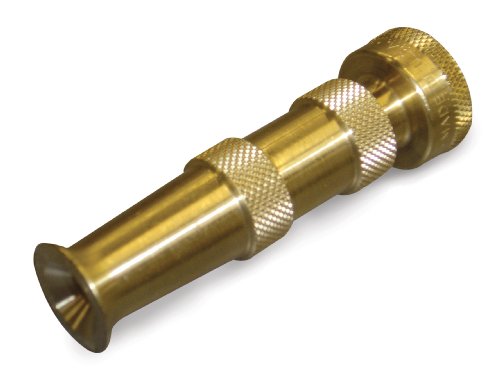
For situations where you do want pattern flexibility (cleaning walkways and patios in addition to watering), Dramm’s brass adjustable nozzle minimizes the downsides of a twist-adjustable design with solid brass construction and Dramm’s professional-grade manufacturing standards, backed by a lifetime guarantee. It won’t match a water breaker’s flow-through efficiency, but among adjustable nozzles, the tight brass seal and simple twist mechanism waste less pressure than cheaper plastic competitors.
Pros: Solid brass construction with a tighter seal than plastic adjustable nozzles; Dramm’s professional-grade manufacturing; backed by a lifetime guarantee.
Cons: As an adjustable-pattern design, it still can’t match a water breaker’s flow-through efficiency under genuinely low pressure.
Best for: buyers who need both watering and light cleaning capability from one nozzle and want to minimize how much pressure the adjustment mechanism costs them.
4. Gilmour 528T Medium Duty Solid Brass Twist Nozzle – Best Overall Multi-Purpose
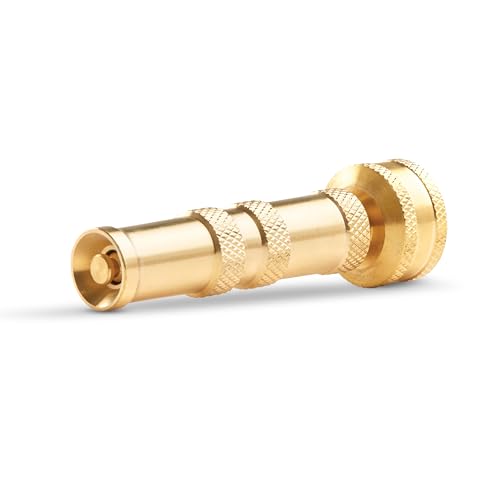
Gilmour has been manufacturing watering equipment since 1949, and this solid brass twist nozzle reflects that experience: a simple turn of the head adjusts from a powerful jet to a light rinse, with enhanced water flow relative to Gilmour’s plastic-bodied alternatives. The solid brass construction means a tighter seal at the connection than a comparable plastic nozzle, translating to less pressure lost before water even reaches the spray head.
Pros: Solid brass construction seals tighter than Gilmour’s plastic-bodied alternatives; simple twist adjustment from jet to light rinse; established brand manufacturing watering equipment since 1949.
Cons: Adjustable-pattern design still wastes more pressure than a dedicated water breaker under genuinely low supply.
Best for: general-purpose watering and cleaning tasks where you want one reliable, durable nozzle from an established brand.
5. Gilmour Full Size Zinc Pistol Grip Nozzle – Best Hands-Free / Trigger Lock
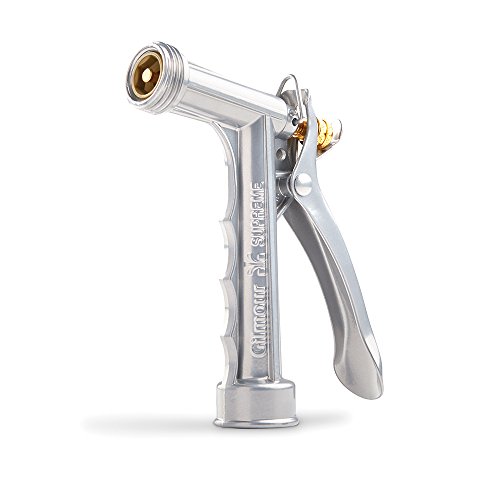
The standout feature here is the hold-open trigger lock clip, which lets you maintain continuous flow without squeezing the whole time, useful for extended watering sessions where hand fatigue becomes a real factor. Self-adjusting “duck” packing is designed for a lifetime leak-proof seal, and the concentrated stream setting is genuinely useful for reaching plants at a distance without the spray widening and losing force.
Pros: Hold-open trigger lock clip removes the need to squeeze continuously; self-adjusting “duck” packing designed for a lifetime leak-proof seal; concentrated stream setting reaches distant plants without losing force.
Cons: Zinc/brass construction is heavier than a compact nozzle; single concentrated-stream focus is less versatile than a multi-pattern design.
Best for: extended watering sessions where holding a trigger continuously isn’t practical, and for reaching plants further from where you’re standing.
6. Dramm One Touch Fan Nozzle – Best Thumb-Control (No Dial Resistance)
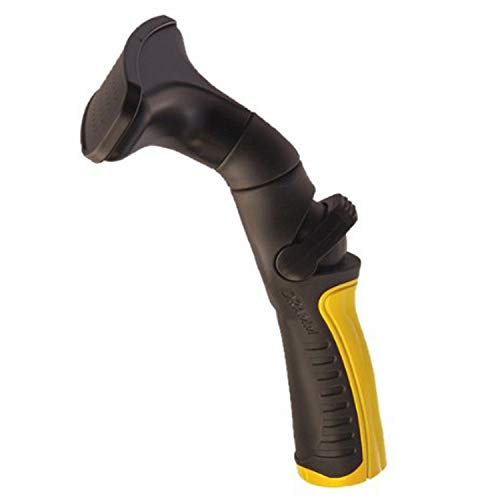
Rather than a twist collar that adds resistance as you adjust it, this nozzle uses a simple thumb-control lever, explicitly marketed by Dramm as suited to water-restricted areas and low-pressure situations. The fan pattern spreads water gently without the narrow-orifice restriction a pinpoint or jet setting would impose, a sensible middle ground between a full water breaker and a tight adjustable nozzle.
Pros: Thumb-control lever avoids the resistance a twist collar adds; explicitly marketed by Dramm for water-restricted areas; a sensible middle ground between a full water breaker and a tight adjustable nozzle.
Cons: Only one spray pattern (fan), no multi-setting versatility.
Best for: buyers who want simple one-handed flow control without a dial mechanism working against already-limited pressure.
7. Melnor 65020-AMZ Metal Nozzle with QuickConnect – Best Budget Multi-Pattern

A metal-bodied, rear-trigger multi-pattern nozzle at a genuinely accessible price, with a QuickConnect adapter set included. It won’t outperform a dedicated water breaker under low pressure, but among budget multi-pattern nozzles, the metal build and rear-trigger design (rather than a twist dial) keep it more usable than the plastic alternatives crowding this price tier.
Pros: Genuinely accessible price; metal body and rear-trigger design outperform the plastic twist-dial nozzles crowding this price tier; includes a QuickConnect adapter set.
Cons: Won’t match a dedicated water breaker’s performance under genuinely low pressure; multi-pattern design still relies on some restriction to create its spray effects.
Best for: buyers who want pattern versatility on a budget and are willing to accept some performance trade-off under genuinely weak pressure.
8. Gilmour Jet Stream Brass Nozzle – Best for Distance/Reach
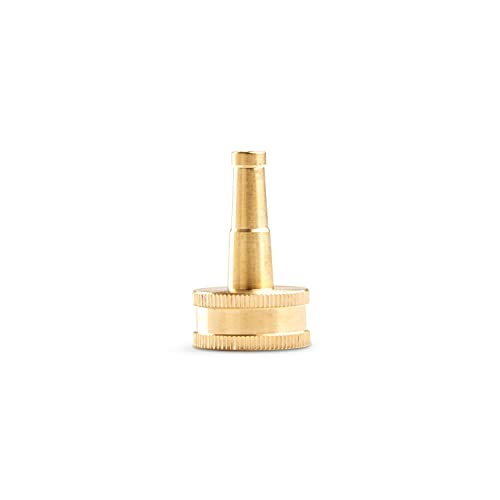
A dedicated concentrated-stream brass nozzle, built for situations where you need water to travel a real distance rather than spreading into a pattern. Under low pressure, a focused single stream is often more effective at actually reaching a target than a wide pattern would be, since you’re not splitting already-limited flow across a larger spray area.
Pros: Solid brass construction; a focused stream travels further under low pressure than a wide pattern would; genuinely useful for distant or elevated plants.
Cons: Single-purpose design, no wide-pattern watering option; not suited to covering a broad area quickly.
Best for: reaching hanging baskets, tall planters, or garden beds set back from where your hose reaches, where a wide pattern would lose too much force.
9. Dramm Revolver 9-Pattern Nozzle – Best Multi-Pattern That Still Performs
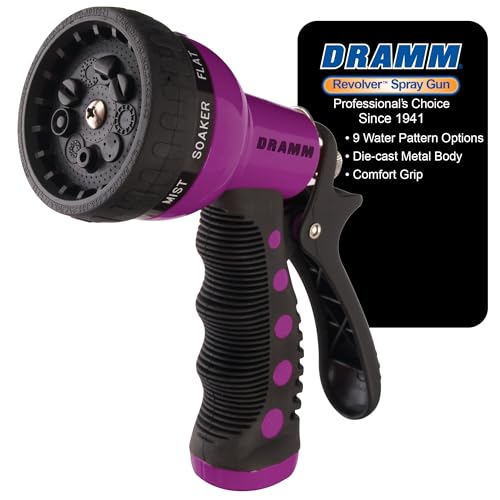
If you want genuine pattern variety (9 settings) without the worst of the low-pressure penalty, the Revolver’s thumb-control flow mechanism and Dramm’s professional-grade internals make it a meaningfully better performer under weak pressure than a typical big-box multi-pattern nozzle. It’s still an adjustable design, so it won’t match a water breaker’s raw efficiency, but it’s the strongest all-around performer in this guide if pattern flexibility genuinely matters to you.
Pros: 9 genuine spray patterns; thumb-control mechanism performs meaningfully better under weak pressure than a typical big-box multi-pattern nozzle; Dramm’s professional-grade internals.
Cons: As an adjustable design, still won’t match a dedicated water breaker’s raw efficiency; priced higher than single-purpose budget nozzles.
Best for: buyers who need real pattern variety for mixed tasks (watering, cleaning, car washing) and don’t want to own multiple single-purpose nozzles.
10. Flexzilla NFZG62 Heavy Duty Twist Action Nozzle – Best Compact/Lightweight

From the well-known kink-resistant hose brand, this compact metal nozzle uses a leak-free O-ring seal at the connection, which matters for low pressure the same way brass fittings do elsewhere in this guide, a tight seal means less pressure lost before it reaches the spray head. Its small, lightweight design makes it an easy nozzle to keep attached permanently without adding noticeable bulk to your hose end.
Pros: Leak-free O-ring seal at the connection minimizes pressure loss; genuinely compact and lightweight; from an established, trusted kink-resistant hose brand.
Cons: Compact size means a smaller spray head than the multi-pattern options in this guide; twist-action design still relies on some restriction like other adjustable nozzles.
Best for: buyers who want a genuinely compact, lightweight nozzle from a trusted hose brand, with a connection seal that doesn’t waste pressure.
Other Factors That Affect Pressure at the Nozzle
Before blaming the nozzle entirely, check the basics upstream: a kinked hose section anywhere along its length restricts flow regardless of what’s attached at the end, a spigot that isn’t fully open is a surprisingly common culprit, and an old hose with sediment buildup inside narrows the effective diameter over years of use. A hose that’s simply too long for your water pressure also loses more flow to friction along its length than a shorter run would. A great nozzle can minimize what it wastes, but it can’t fix a genuinely restricted supply line upstream of it.
Frequently Asked Questions
Why does my hose nozzle reduce water pressure?
Most nozzles create spray patterns by forcing water through a narrower opening than your hose’s own diameter, which restricts flow. With strong supply pressure this barely registers, but with already-weak pressure, that restriction can cut usable flow substantially. Wide-bore designs like water breaker nozzles avoid this by spreading flow across many larger openings instead of one narrow point.
Does hose diameter affect pressure?
Yes. A narrower hose (like a 1/2 inch diameter) restricts flow more than a standard 5/8 inch or 3/4 inch hose, which matters more the longer your hose run is. If you’re dealing with low pressure and using a narrow or very long hose, upgrading the hose itself can help as much as the nozzle choice.
Can a nozzle actually increase pressure?
No. A nozzle cannot create pressure your supply line doesn’t have. What a good low-pressure nozzle does is waste less of the pressure you already have, through wider bore designs, tighter seals, and simpler flow-control mechanisms, rather than manufacturing pressure that isn’t there.
Does hose length matter for pressure?
Yes, longer hose runs lose more pressure to friction along the interior walls, an effect that compounds with narrower-diameter hoses. If your pressure is already marginal, using the shortest practical hose length for the job helps preserve more usable pressure at the nozzle end.
Bottom Line
If raw watering volume matters most and you’re dealing with genuinely low pressure, a water breaker nozzle’s wide-bore, no-restriction design is the clearest fix available, not another adjustable nozzle with a “low pressure” label on the box. If you need pattern versatility for mixed tasks, prioritize brass fittings and thumb-control or trigger mechanisms over twist-dial designs, and accept that some performance trade-off versus a dedicated water breaker is the cost of that flexibility.
- Best for maximum flow: Dramm 1000 Water Breaker – 1,000 holes avoid the restriction that kills low pressure.
- Best for seedlings/containers: Dramm 400 Water Breaker – the same no-restriction principle, gently scaled down.
- Best brass adjustable: Dramm 12380 – pattern flexibility with a tighter seal than plastic.
- Best overall multi-purpose: Gilmour 528T – solid brass from a brand established since 1949.
- Best hands-free: Gilmour Pistol Grip – trigger lock for extended watering sessions.
- Best thumb-control: Dramm One Touch Fan – no dial resistance working against your pressure.
- Best budget multi-pattern: Melnor 65020-AMZ – metal build at an accessible price.
- Best for distance: Gilmour Jet Stream – a focused stream reaches further under weak pressure.
- Best multi-pattern performer: Dramm Revolver – 9 patterns without the worst of the low-pressure penalty.
- Best compact/lightweight: Flexzilla NFZG62 – a leak-free seal in a genuinely compact body.
Check your hose length, diameter, and connections before assuming the nozzle alone is the problem, our guides to garden hose reels and lightweight garden hoses cover the other half of the equation.