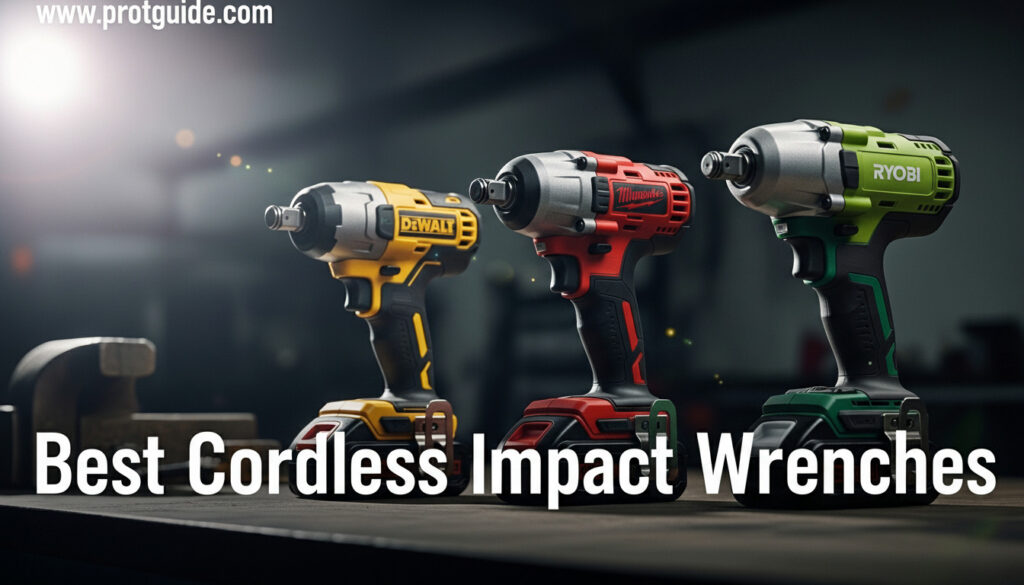
An air compressor and impact gun used to be the price of admission for serious automotive work. Today, cordless impact wrenches deliver equivalent torque — and in many cases better torque — from a battery that fits in your tool bag. The category has matured to the point where a $150 Ryobi ONE+ wrench can crack loose a seized lug nut that would have required shop equipment five years ago, and a Milwaukee M18 FUEL produces 1,400 ft-lbs of breakaway torque that puts it in direct competition with professional-grade pneumatic tools.
This guide covers the full cordless impact wrench market across three buyer types:
- Home DIYers & tire changers: Seasonal lug nut work, occasional brake jobs, want reliable performance at a fair price within their existing battery ecosystem
- Serious home mechanics: Weekly garage use, brake work, suspension, multiple processes — need mid-torque precision with the right battery platform investment
- Professional tradespeople & auto techs: Daily use across all torque demands, need warranty backing, battery ecosystem depth, and tools that outlast the job
All 7 picks are available on Amazon with verified ASINs and current affiliate links. Every product has been selected based on verified specs, real-world community feedback, and honest trade-off analysis across torque class, battery ecosystem, and price.

🏆 Quick Picks — Best Cordless Impact Wrenches (2026)
| Best Overall | DeWalt DCF891B — 4-speed + Precision Wrench mode, right-sized for 95% of automotive work |
| Best High Torque | Milwaukee 2767-20 — 1,400 ft-lbs breakaway, bolt removal mode, trusted by diesel mechanics |
| Best Mid-Torque | Milwaukee 2962-20 — Most compact M18 mid-torque, 650 ft-lbs, 5-year FUEL warranty |
| Best Precision | Makita XWT11Z — Reverse auto-stop, 3-speed, lightest full-size wrench for engine bay precision |
| Best Compact | Milwaukee 2555-20 — 4.9″ head, 2.4 lbs, fits where no full-size wrench can reach |
| Best Value | Ryobi PBLIW01B — 1,170 ft-lbs breakaway, 4-Mode, compatible with 300+ Ryobi ONE+ tools |
| Best Heavy Duty | DeWalt DCF900B — 1,400 ft-lbs breakaway, FLEXVOLT-compatible, DeWalt ecosystem max torque |
For most home mechanics and DIYers, the DeWalt DCF891B covers 95% of real-world jobs with precision controls that prevent the most common impact wrench mistakes. Milwaukee users get the same mid-torque in an even more compact package with the 2962-20. And if your lug nuts are rusted solid or you’re working on a truck, the Milwaukee 2767-20 is the tool that makes the problem go away.
Compact vs. Mid-Torque vs. High Torque — Which Class Do You Actually Need?
Every impact wrench buying guide lists products. Almost none of them explain why buying the wrong torque class is an expensive and sometimes dangerous mistake. Here’s the complete picture.
Cordless impact wrenches fall into three torque classes. The class you need is determined by your primary job — not by which number sounds most impressive on the product page.
Compact / Light
Sensor work, interior fasteners, light lug nuts on standard passenger cars
- Makita XWT11Z (210 ft-lbs)
- Milwaukee M12 2555-20 (250 ft-lbs)
- Shortest head length (4.9″–5.75″)
- Lightest weight (2.4–3.8 lbs)
Mid-Torque
All passenger car lug nuts, brake jobs, suspension on standard vehicles — the 90% use case
- DeWalt DCF891B (600 ft-lbs)
- Milwaukee 2962-20 (650 ft-lbs)
- Ryobi PBLIW01B (700 ft-lbs)
- Precision modes most important here
High Torque
Trucks, SUVs, rusted & seized fasteners, heavy equipment, construction
- Milwaukee 2767-20 (1,000 ft-lbs)
- DeWalt DCF900B (1,200 ft-lbs)
- Bolt removal mode critical at this class
- Always finish with a torque wrench
Compact / Light Class — Precision Over Power
The compact class is for the mechanic who needs to get a wrench into places a full-size tool physically won’t reach. The Milwaukee M12 Stubby’s 4.9-inch head length and 2.4-pound weight are not incremental improvements — they are the reason the tool exists. Modern engine bays are designed around compactness, and half the fasteners a mechanic encounters are in positions where a 7-inch tool simply isn’t going to fit. The Makita XWT11Z adds reverse auto-stop technology: the tool stops within two seconds when it detects a fastener has broken loose, preventing the bolt from flying across the shop. Both tools handle standard passenger car lug nuts (spec torque typically 80–100 ft-lbs) with headroom to spare.
What these tools are not: suspension bolt tools, truck lug nut tools, or anything involving heavily corroded hardware. The 210–250 ft-lbs fastening torque at this class is adequate for clean, standard-torque fasteners. Any amount of corrosion or overtightening beyond spec and you need the next class up.
Mid-Torque Class — The Right Tool for 90% of Home Mechanics
The 600–700 ft-lbs fastening torque class is where the vast majority of home mechanics and DIYers belong. Every passenger car lug nut, every brake caliper bolt, every standard suspension fastener is well within this range. The precision modes — DeWalt’s Precision Wrench, Milwaukee’s 4-Mode Drive Control, Ryobi’s Auto Mode — matter more at this class than raw torque because these tools are powerful enough to overtighten aluminum wheel lug nuts if you run them at max setting without care. Torque-limiting modes solve that problem. They are not optional features — they are the reason these tools are safe for aluminum wheel work.
High Torque Class — When You Actually Need It
High torque is for situations where mid-torque simply doesn’t have enough headroom: truck lug nuts (typically spec’d at 140–165 ft-lbs and often corroded to far beyond that), suspension components on heavy vehicles, large construction fasteners, and any hardware that has seized due to rust or overtightening. The Milwaukee 2767-20’s 1,400 ft-lbs of breakaway torque means it can loosen hardware that was torqued to 1,400 ft-lbs — an extreme that covers virtually everything short of heavy equipment bolts.
⚠ The Most Common and Expensive Impact Wrench MistakeRunning a high-torque wrench at maximum setting on standard passenger car lug nuts. Aluminum OEM wheels have a softer seat area than aftermarket steel wheels. Full-torque impact on an aluminum wheel cracks the stud hole and strips the lug stud. The repair costs more than the wrench. Use torque-limiting mode for all lug nut work, and always finish with a calibrated torque wrench to the vehicle manufacturer’s specification.
Fastening Torque vs. Breakaway Torque — Read the Label Correctly
Every impact wrench listing advertises a single large torque number. Almost every time, that number is breakaway torque — the maximum force the tool applies in the loosening direction. Fastening torque (how hard the tool tightens) is always 30–40% lower. The Milwaukee 2767-20’s famous 1,400 ft-lbs is breakaway torque. Its fastening torque is 1,000 ft-lbs. The DeWalt DCF900B’s 1,400 ft-lbs breakaway corresponds to 1,200 ft-lbs fastening. For every product in this guide, both numbers are provided in the spec bars below — always check both before assuming a tool meets your fastening requirements.
What Actually Matters When Choosing a Cordless Impact Wrench
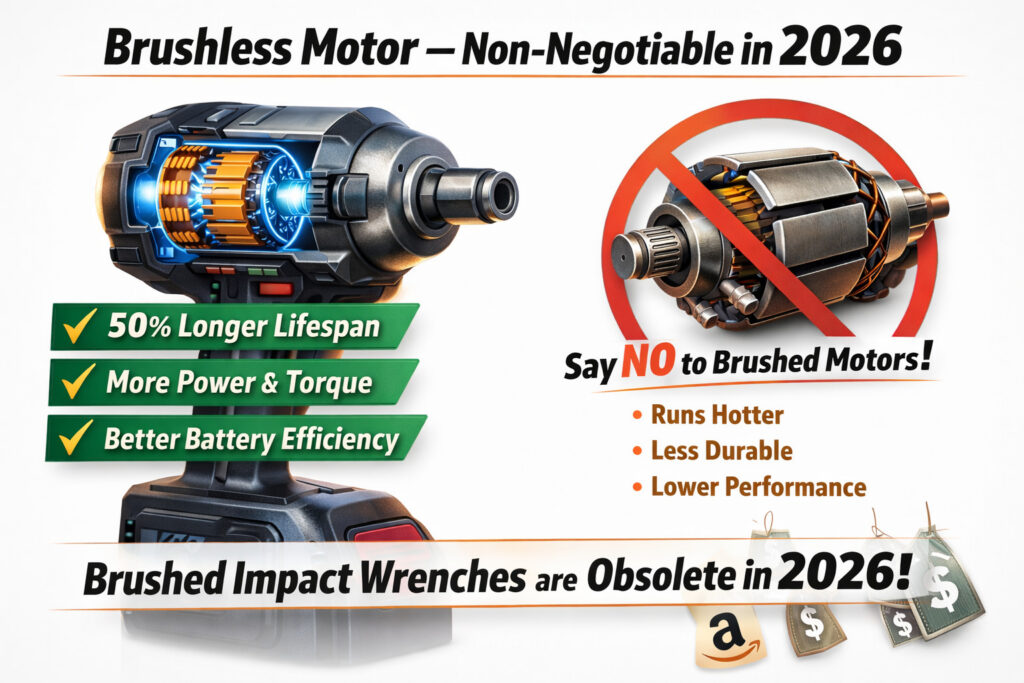
Brushless Motor — Non-Negotiable in 2026
Every product in this guide uses a brushless motor. Do not buy a brushed cordless impact wrench. Brushless motors run cooler, last 50% or longer than brushed equivalents, use battery power more efficiently, and deliver more torque per pound. Brushed impact wrenches are still listed on Amazon at lower prices — the lower price reflects genuinely lower capability and shorter lifespan. There is no price point at which a brushed impact wrench makes sense in 2026.
Battery Ecosystem — The Real Purchase Decision
The most important buying decision isn’t the wrench — it’s the battery platform. Every battery, charger, and compatible tool you own locks you into an ecosystem where adding tools costs less over time. Switching ecosystems means buying new batteries and a new charger, which commonly adds $80–$150 to the effective tool cost.
| Platform | Standard Charge (5Ah) | Rapid Charge (5Ah) | Runtime & Power Notes |
|---|---|---|---|
| Milwaukee M18 | ~60 min | 35 min (SuperCharger) | Best sustained power under heavy continuous load |
| DeWalt 20V MAX | ~60 min | ~45 min (rapid charger) | Best runtime efficiency on standard-draw applications |
| Ryobi ONE+ 18V | ~55 min (4Ah) | Not offered (standard HP) | Lower energy density per cell — adequate for home use; more swaps on heavy jobs |
| Makita LXT 18V | ~45 min (rapid charger) | Fastest standard charge in class | Good balance of charge speed and runtime; narrower tool ecosystem |
If you’re starting fresh with no existing battery investment: Milwaukee M18 offers the broadest professional ecosystem and best sustained power. Ryobi ONE+ offers the broadest value ecosystem with 300+ compatible tools. DeWalt 20V MAX sits between the two in price and performance. Makita LXT is the right choice only if you’re already invested in that platform.
🔄 IPM vs. Torque
Impacts Per Minute (IPM) determines how fast the tool works; torque determines how hard each impact hits. High IPM at moderate torque often removes standard lug nuts faster than high torque at low IPM. DeWalt DCF891B at 3,250 IPM clears standard lug nuts quickly and cleanly. Milwaukee 2767-20 at 2,100 IPM hits harder per impact — the right tool for seized hardware, not for speed on clean bolts.
🔩 Hog Ring vs. Detent Pin Anvil
Hog ring: spring retention ring holds sockets, fast changes without removing a pin — ideal for high-volume work where you change sockets constantly. Detent pin: a locking pin holds the socket more securely — better for overhead work or any situation where a dropped socket is dangerous. Most tools in this guide use hog ring. DeWalt DCF892B (detent variant of DCF891B) exists if your work requires pin retention.
⚙️ Torque Limiting & Precision Modes
DeWalt’s Precision Wrench mode pauses before each impact in forward — preventing overtightening — and slows in reverse to prevent fastener run-off. Milwaukee’s 4-Mode Drive Control lets you select exactly the torque class for the job. Ryobi’s Auto Mode prevents overtightening on reassembly. These modes matter more than raw peak torque for all-day mechanical work where damage prevention is as important as removal power.
📏 Weight & Head Length
For overhead and engine bay work, tool weight compounds over time. 2.4 lbs (M12 Stubby) vs. 5.36 lbs (Milwaukee 2767-20) is a 3-lb difference that becomes significant fatigue over a full shift. Head length determines engine bay access: 4.9″ (M12 Stubby) vs. 8.25″ (Ryobi PBLIW01B) is the difference between fitting in a tight access point and not fitting at all. Know your primary work position before choosing.
🛡 Warranty Comparison
Milwaukee FUEL tools: 5-year warranty — the best in class and a genuine value differentiator for professional purchase decisions. DeWalt: 3 years. Makita: 3 years. Ryobi: 3 years. For a professional using an impact wrench daily, the warranty gap between Milwaukee and the field is real money. A 5-year guarantee on a $250 tool is worth more than a 3-year on the same price tool.
✅ Safety Certifications
All seven products in this guide are ANSI-compliant and meet UL safety standards. Impact-rated accessories (sockets, extensions) are a separate requirement — the tool certification doesn’t cover accessories. Chrome vanadium sockets shatter under impact forces. All socket and extension work with impact wrenches requires black oxide CR-Mo impact-rated accessories. This is a safety requirement, not a recommendation.
The Best Cordless Impact Wrenches — Detailed Reviews
1. DeWalt DCF891B 20V MAX 1/2″ Mid-Torque
The most user-adjustable mid-torque wrench in the guide — Precision Wrench mode sets it apart
⭐ Best Overall

Breakaway Torque: 800 ft-lbs
IPM: up to 3,250
Weight (bare): 3.49 lbs
Head Length: 5.67″
Battery: DeWalt 20V MAX
Anvil: Hog ring
Speeds: 4 + Precision Wrench
Warranty: 3 years
Price Tier: $$

The DeWalt DCF891B earns the top position through a combination that the competition at this torque class hasn’t matched: four speed settings plus a dedicated Precision Wrench mode in a 3.49-pound bare tool. The four speed settings alone make it the most adjustable mid-torque wrench in this guide. But Precision Wrench mode is the feature that makes it genuinely safer for aluminum wheel work than any of its competitors — it pauses before each impact in the forward direction, preventing the unconscious overtightening that cracks aluminum lug seats, and slows the reverse sequence so fasteners don’t fly off and roll under the car. For anyone who learned impact wrench work on a more aggressive tool, Precision Wrench mode represents a fundamental improvement in how the tool operates.
At 600 ft-lbs fastening and 800 ft-lbs breakaway, it sits correctly in the mid-torque class — right-sized for every passenger car, light truck, and SUV job where you’re dealing with clean or moderately corroded hardware. The 3,250 IPM rate means it moves fast on standard lug nuts without needing to pull the trigger more than once. The 5.67-inch head length fits cleanly in most engine bay access points. LED work light is built in. This is the bare tool — it runs on any DeWalt 20V MAX battery, which means anyone already in the DeWalt ecosystem can put this to work immediately.
✓ What It Does Well
- Precision Wrench mode — pauses before impact in forward, prevents aluminum wheel overtightening
- 4 speed settings — most user-adjustable mid-torque wrench in this guide
- 3,250 IPM — fastest impact rate in the guide, quick on clean standard lug nuts
- 3.49 lbs bare — lighter than most mid-torque competitors
- Drop-in for any DeWalt 20V MAX battery owner
✗ Where It Falls Short
- 800 ft-lbs breakaway — not enough for heavily corroded truck lug nuts or seized suspension bolts
- 3-year warranty vs. Milwaukee FUEL’s 5-year
- Hog ring only — no detent pin variant under this ASIN (DCF892B is the detent version)
The DCF891B is the right first impact wrench for anyone in the DeWalt ecosystem doing standard automotive work. Precision Wrench mode prevents the most common and expensive impact wrench mistakes. Four speed settings give you the control to match the tool to the job. For hardware that needs more than 800 ft-lbs, step up to the DCF900B within the same battery platform.
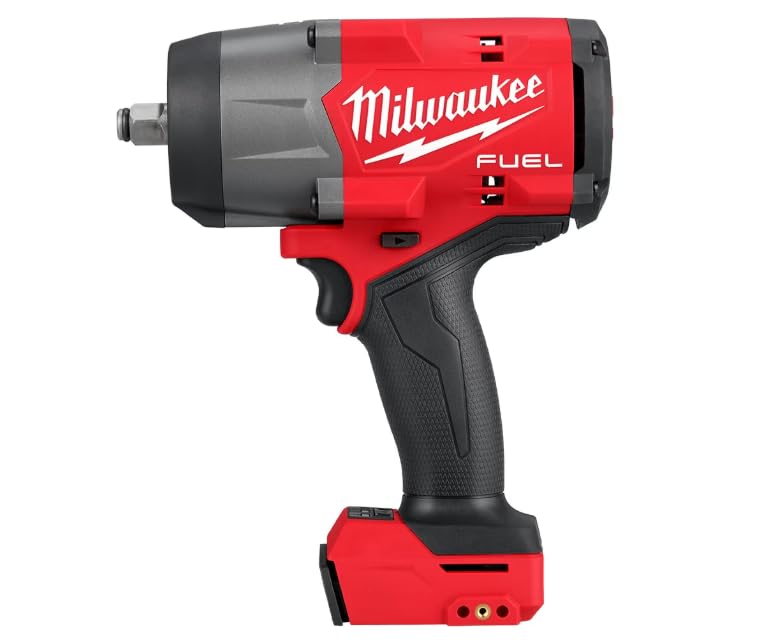
2. Milwaukee 2767-20 M18 FUEL 1/2″ High Torque
1,400 ft-lbs breakaway, bolt removal mode, and 5-year warranty — the professional’s high-torque standard
💪 Best High Torque
Breakaway Torque: 1,400 ft-lbs
IPM: up to 2,100
Weight (bare): 5.36 lbs
Head Length: 7.0″
Battery: Milwaukee M18
Anvil: Hog ring (Friction Ring)
Modes: 4-Mode Drive Control
Warranty: 5 years (FUEL)
Price Tier: $$$
The Milwaukee 2767-20 is the cordless impact wrench that diesel mechanics, fleet shops, and serious truck owners reach for when the job needs to be done without question. 1,000 ft-lbs of fastening torque and 1,400 ft-lbs of breakaway — verified by Milwaukee and corroborated across years of professional use reviews — gives it the headroom to loosen hardware that has been rusted, seized, or overtightened to failure point. The POWERSTATE brushless motor maintains torque output even as the battery depletes, which means the last lug nut on the fifth wheel gets the same treatment as the first one.
The 4-Mode Drive Control is where this tool separates itself from dumb brute-force wrenches. Modes 1–3 cover fine, medium, and high output. Mode 4 is Bolt Removal Mode: the tool automatically slows to a controlled speed once it detects the fastener has broken loose, preventing the bolt from flying across the shop — a genuinely dangerous and common event when running high-torque wrenches on a standard setting. Milwaukee’s 5-year FUEL warranty is the best in this guide and reflects the company’s confidence in a product that professionals use every day for years. At 5.36 lbs and 7 inches, it is a large, heavy tool — not the right choice for engine bay precision work, but exactly right for any removal and installation job where you need the job done on the first attempt.
✓ What It Does Well
- 1,400 ft-lbs breakaway — handles every rusted, seized, or overtightened fastener in the passenger vehicle range
- Bolt Removal Mode — auto-slows when fastener breaks loose, prevents dangerous bolt ejection
- POWERSTATE motor maintains torque through the full battery discharge curve
- 5-year FUEL warranty — best in the guide by two years
- M18 ecosystem — pairs with every M18 battery, charger, and tool
✗ Where It Falls Short
- 5.36 lbs — noticeably heavy for sustained overhead or engine bay work
- 7.0″ head — won’t fit in tight engine bay positions; use the M12 Stubby for confined access
- Premium price — overkill for home mechanics who only do passenger car tire changes
The Milwaukee 2767-20 is the professional benchmark for high-torque cordless impact wrenches. If you work on trucks, SUVs, or any vehicle with seized hardware regularly, this is the tool that removes the problem on the first attempt. The 5-year FUEL warranty and M18 ecosystem depth make it the strongest long-term investment in this guide for daily professional use.
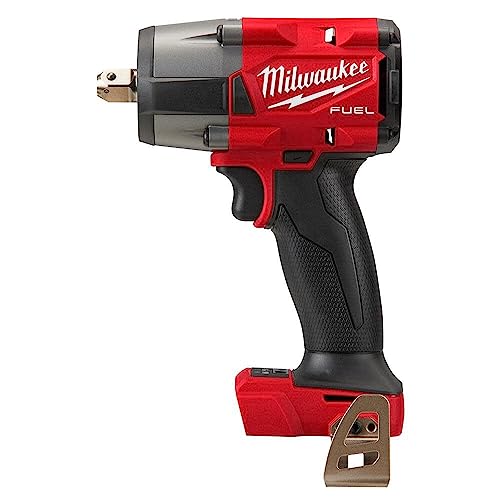
3. Milwaukee 2962-20 M18 FUEL 1/2″ Mid-Torque Gen 2
The most compact M18 mid-torque wrench — 650 ft-lbs in the smallest package Milwaukee makes
🥈 Best Mid-Torque
Breakaway Torque: 1,000 ft-lbs
IPM: up to 2,400
Weight (bare): 3.61 lbs
Head Length: ~5.5″
Battery: Milwaukee M18
Anvil: Friction Ring (hog ring)
Modes: 4-Mode Drive Control
Warranty: 5 years (FUEL)
Price Tier: $$$
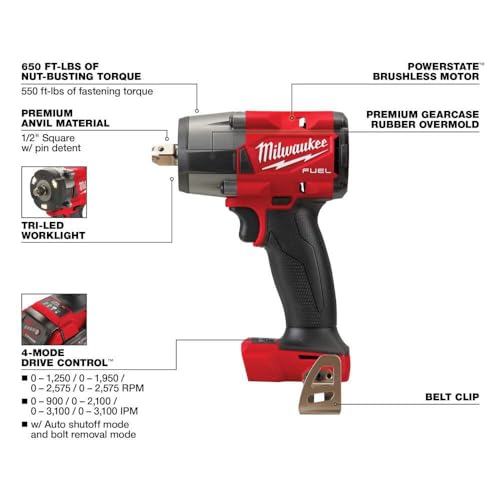
The Milwaukee 2962-20 Gen 2 is the right answer for Milwaukee M18 users who need mid-torque performance in the most compact package the platform offers. At 650 ft-lbs fastening and 1,000 ft-lbs breakaway, it delivers meaningfully more torque than the DeWalt DCF891B (800 ft-lbs breakaway) while maintaining a more compact head profile — important for mechanics who work on a variety of vehicles and occasionally need to reach into tighter engine bay spaces. The Gen 2 refinements over the original 2962-20 include improved motor efficiency and a revised impact mechanism that reduces vibration feedback on sustained use.
The 4-Mode Drive Control carries over from the rest of the Milwaukee FUEL lineup: Mode 1 for delicate fasteners, Mode 2 for standard work, Mode 3 for high-output automotive applications, and Mode 4 for maximum fastening and removal. The friction ring anvil provides fast socket changes for high-volume work. At 3.61 lbs bare, it is heavier than the DCF891B but meaningfully lighter than the 2767-20 — the middle ground for M18 mechanics who want one wrench that handles most jobs. The 5-year FUEL warranty remains the best in the guide. Runner-up to the DCF891B only for buyers not already in the Milwaukee ecosystem — ecosystem lock-in is the honest reason for the ranking order.
✓ What It Does Well
- 1,000 ft-lbs breakaway — 200 ft-lbs more than DCF891B for the same torque class
- Most compact M18 mid-torque housing — shorter head than the 2767-20
- Gen 2 motor refinements — reduced vibration on sustained fastening
- 5-year FUEL warranty — two years longer than DeWalt equivalent
- Drop-in for any M18 battery owner
✗ Where It Falls Short
- Premium price makes it harder to justify vs. DCF891B for non-Milwaukee users
- M18 battery required — ecosystem lock-in is a real cost for anyone not already invested
- No Precision Wrench equivalent mode for the ultra-controlled forward impacting the DCF891B offers
The Milwaukee 2962-20 is the natural upgrade for anyone already in the M18 ecosystem who needs a compact mid-torque wrench with more breakaway headroom than the DCF891B provides. The Gen 2 refinements, 5-year warranty, and 1,000 ft-lbs breakaway make it a compelling all-day tool for professional mechanics doing mixed automotive work.
4. Makita XWT11Z 18V LXT 3-Speed 1/2″ Brushless
Reverse auto-stop technology and 3-speed control — the precision-first wrench for engine bay and sensor work
🎯 Best Precision

Breakaway Torque: 295 ft-lbs
IPM: 1,800 / 2,600 / 3,500 (3-speed)
Weight (w/ battery): 3.8 lbs
Head Length: 5.75″
Battery: Makita LXT 18V
Reverse Auto-Stop: Yes — unique in this guide
LED: Independent on/off
Warranty: 3 years
Price Tier: $$
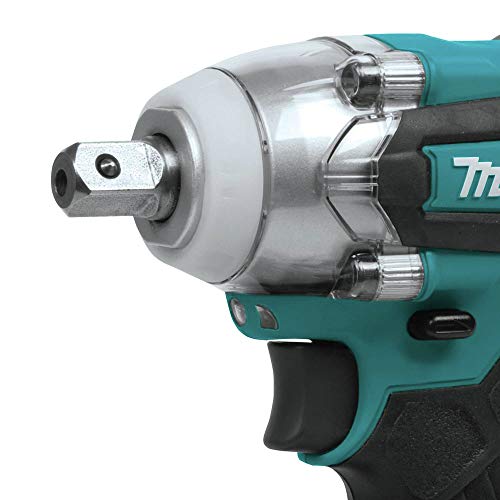
⚠ Important: Light-Duty Torque RatingThe XWT11Z is rated at 210 ft-lbs fastening / 295 ft-lbs breakaway. This is a light-to-medium duty tool. It handles standard passenger car lug nuts (80–100 ft-lbs spec) cleanly, but has no headroom for rusted hardware, truck lug nuts, or seized suspension bolts. Know your application before buying.
The Makita XWT11Z exists for a specific type of mechanic: one who spends most of their time in the engine bay on sensor work, injector removal, intake manifold bolts, and precision fastener work where the tool that removes a fastener cleanly without stripping the thread is worth more than one that applies maximum force. The defining feature — and the one that appears nowhere else in this guide — is reverse auto-stop: the tool automatically detects when a fastener breaks loose and stops within two seconds, preventing the fastener from being ejected. For mechanics who have spent time hunting for a bolt that flew off a reverse-direction impact, this is a quality-of-life feature that pays for itself quickly.
The 3-speed selector (1,800 / 2,600 / 3,500 IPM) lets you match the impact rate to the fastener type and access position. The independent LED on/off switch means you can light the work area without engaging the tool — genuinely useful when you’re positioning for a blind reach. The XPT dust and moisture resistance adds durability for engine bay conditions. The 3-battery gauge on the tool body saves the trip to check the battery state separately. At 3.8 lbs with battery and 5.75 inches, it’s light and compact enough for sustained overhead use. One genuine limitation: with 210 ft-lbs fastening torque, it can only take on passenger car lug nuts and lighter fasteners. It is not a truck tool, it is not a seized hardware tool, and it should not be represented as one.
✓ What It Does Well
- Reverse auto-stop: only wrench in this guide to stop automatically when the fastener breaks loose
- 3-speed IPM control: match impact rate to application with precision
- Independent LED on/off: illuminate without engaging the tool
- 3.8 lbs with battery: light enough for sustained overhead and engine bay work
- XPT sealing: dust and moisture resistance for real shop conditions
✗ Where It Falls Short
- 210 ft-lbs fastening — no headroom for rusted lug nuts, truck hardware, or seized suspension
- Makita LXT ecosystem only — separate batteries from Milwaukee M18 and DeWalt 20V MAX
- 3-year warranty vs. Milwaukee’s 5-year on FUEL tools
The XWT11Z is not the right impact wrench if your primary job is removing lug nuts from trucks or cracking loose seized fasteners. It is the right impact wrench if you’re doing precision engine bay work on passenger cars where reverse auto-stop, speed control, and light weight matter more than brute torque. Buy it for what it’s designed for and it delivers — attempt to use it beyond its torque rating and you’ll need a second tool.
5. Milwaukee 2555-20 M12 FUEL 1/2″ Stubby Impact Wrench
4.9 inches long, 2.4 lbs — the tool that fits where nothing else does
🔲 Best Compact
Breakaway Torque: 550 ft-lbs
RPM: up to 2,500
Weight (bare): 2.4 lbs
Head Length: 4.9″
Battery: Milwaukee M12 (separate from M18)
Modes: 4-Mode Drive Control
Warranty: 5 years (FUEL)
Price Tier: $$
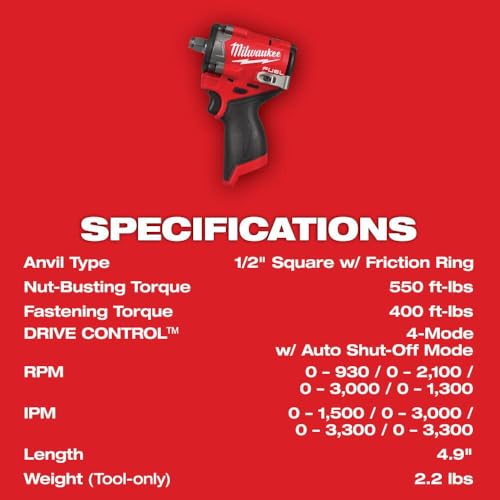
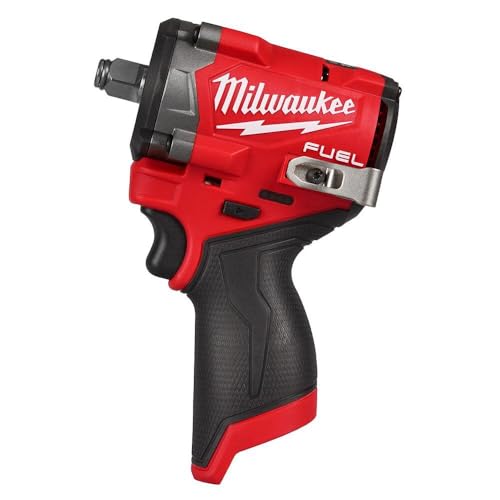
The Milwaukee M12 FUEL Stubby exists because modern engine bays are designed by engineers who were not thinking about tool access. At 4.9 inches from the rear of the tool to the anvil, it is 2+ inches shorter than any other impact wrench in this guide. In practice, those two inches are the difference between fitting in a confined access point and requiring a combination of extensions, swivel adapters, and creative positioning that doesn’t actually work. Professional mechanics who own one don’t think of it as a specialty tool — they think of it as the impact wrench that handles everything the full-size wrenches can’t reach.
At 2.4 lbs bare, it is also the lightest tool in this guide by a significant margin. For sustained overhead work — underbody work, cylinder head fasteners, exhaust manifolds — weight reduction translates directly to fatigue reduction over a full shift. The 4-Mode Drive Control carries Milwaukee’s full precision mode suite into a smaller package, including auto-stop to prevent overtightening on precision reassembly. At 250 ft-lbs fastening and 550 ft-lbs breakaway, it handles every passenger car lug nut (typically 80–100 ft-lbs spec) and most light truck bolts cleanly. One critical note: M12 is a separate battery platform from Milwaukee M18 — the batteries are not interchangeable. The M12 Stubby and M18 2767-20 use different batteries. The professional setup is to own both platforms for the specific jobs each handles best.
✓ What It Does Well
- 4.9″ head — the shortest impact wrench in this guide; reaches positions nothing else can
- 2.4 lbs bare — lightest in the guide, reduces overhead fatigue meaningfully
- 550 ft-lbs breakaway — enough for passenger car lug nuts and most light-duty bolts
- 4-Mode Drive Control with auto-stop — precision reassembly protection in a small tool
- 5-year FUEL warranty on an M12 platform tool
✗ Where It Falls Short
- M12 battery — a separate ecosystem from M18; batteries not interchangeable
- 250 ft-lbs fastening — not for trucks, heavily seized hardware, or large construction fasteners
- Adds a second battery platform cost if you don’t already own M12 tools
The Milwaukee M12 Stubby is the tool professional mechanics pair with a full-size high-torque wrench. The 2767-20 handles all the heavy removal; the M12 Stubby handles everything in tight quarters that the 2767-20 can’t reach. If you do engine bay work regularly, the Stubby eventually becomes the tool you reach for first — it’s that useful in close-quarters situations.
6. Ryobi PBLIW01B 18V ONE+ HP 4-Mode 1/2″ High Torque
1,170 ft-lbs breakaway at value pricing — the home mechanic’s high-torque option
💰 Best Value

Breakaway Torque: 1,170 ft-lbs
IPM: up to 2,800
Weight (w/ 4Ah battery): 6.63 lbs
Head Length: 8.25″
Battery: Ryobi ONE+ 18V (300+ tool ecosystem)
LED: Tri-beam (3 LEDs around drive)
Modes: 4 (Low / Med / High / Auto)
Warranty: 3 years
Price Tier: $
The Ryobi PBLIW01B makes a case that is difficult to argue with on paper: 700 ft-lbs fastening torque, 1,170 ft-lbs breakaway, 4-Mode operation including Auto Mode (which prevents overtightening in forward and controls removal speed in reverse), and a die-cast aluminum gear case — at a price that is substantially below Milwaukee and DeWalt equivalents. The tri-beam LED system, with three LEDs positioned around the drive rather than a single foot-mounted light, provides better coverage of the work area than most of its competitors. The Ryobi ONE+ ecosystem compatibility — over 300 tools on the same battery — is the platform’s defining advantage for anyone who already owns Ryobi tools.
The honest trade-offs are real and should be stated clearly. At 6.63 lbs with the 4Ah battery and 8.25 inches head length, it is the heaviest and longest tool in this guide — the body is sized around the ONE+ battery format, which is larger than M18 or 20V MAX cells at equivalent amp-hour ratings. Ryobi ONE+ batteries are less energy-dense per cell than Milwaukee M18 or DeWalt 20V MAX, which means more battery swaps on sustained high-demand work. For a professional using an impact wrench eight hours a day, these trade-offs add up. For a home mechanic doing seasonal tire swaps, annual brake jobs, and occasional suspension work — the performance is entirely adequate and the price advantage is genuine.
✓ What It Does Well
- 1,170 ft-lbs breakaway at value pricing — high-torque performance without premium cost
- Auto Mode — prevents overtightening in forward, controlled reverse — smart feature at this price
- Tri-beam LED — better work area coverage than single-point lights on competitors
- Die-cast gear case — more durable than plastic housing in this price tier
- Ryobi ONE+ compatibility — 300+ tools, same battery platform
✗ Where It Falls Short
- 6.63 lbs with battery — heaviest tool in the guide; fatiguing for overhead or sustained use
- 8.25″ head — longest in guide; won’t fit in tight engine bay positions
- ONE+ batteries less energy-dense — more swaps on high-demand professional work
- 3-year warranty vs. Milwaukee FUEL’s 5-year
The Ryobi PBLIW01B is the right choice for Ryobi ONE+ ecosystem users who want genuine high-torque performance for home automotive work. 1,170 ft-lbs breakaway handles truck lug nuts and seized hardware that mid-torque tools can’t touch. The weight and head length are the honest trade-offs for the price — if you’re welding on a creeper or doing engine bay work regularly, the Milwaukee or DeWalt options are worth the premium.
7. DeWalt DCF900B 20V MAX 1/2″ High Torque Brushless
1,400 ft-lbs breakaway, FLEXVOLT-compatible — maximum torque within the DeWalt 20V MAX ecosystem
🔨 Best Heavy Duty

Breakaway Torque: 1,400 ft-lbs
IPM: up to 2,400
Weight (bare): 4.6 lbs
Head Length: 7.3″
Battery: DeWalt 20V MAX / FLEXVOLT compatible
Modes: 4 + Precision Wrench
Warranty: 3 years
Price Tier: $$
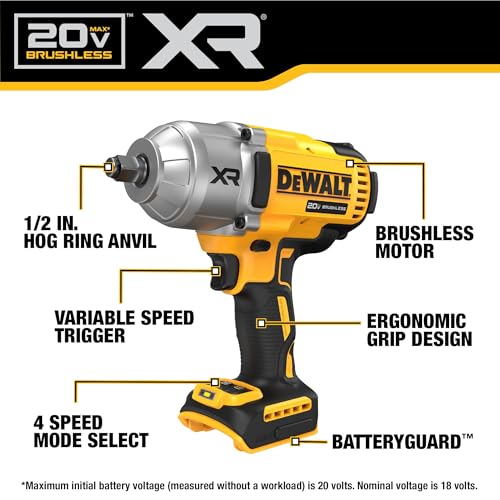
The DeWalt DCF900B is the within-ecosystem answer to the Milwaukee 2767-20 for DeWalt 20V MAX users who need maximum torque without starting a new battery platform. At 1,200 ft-lbs fastening and 1,400 ft-lbs breakaway, it ties the 2767-20 on breakaway torque and exceeds it on fastening torque — numbers that cover every passenger vehicle application and most light commercial and construction fastening scenarios. The FLEXVOLT compatibility is the key feature for heavy users: a FLEXVOLT 60V battery running in 20V MAX compatibility mode delivers more runtime than a standard 20V MAX 5Ah cell, extending the tool’s capacity for sustained high-demand sessions significantly.
Precision Wrench mode carries over from the DCF891B — the same pause-before-impact forward mode that prevents overtightening on standard lug work — which is a meaningful addition to a high-torque tool. Most high-torque wrenches are removal-only tools in practice because running them at maximum torque on reassembly destroys the hardware. Precision Wrench mode makes the DCF900B a legitimate two-way tool: demolition power in reverse, controlled installation in forward. At 4.6 lbs and 7.3 inches, it is a full-size wrench — lighter than the Ryobi PBLIW01B but not an engine bay tool. The honest comparison to the Milwaukee 2767-20: equivalent or better torque, Precision Wrench mode advantage, 3-year warranty vs. Milwaukee’s 5-year — the warranty gap is the trade-off for staying in the DeWalt ecosystem.
✓ What It Does Well
- 1,400 ft-lbs breakaway — ties the Milwaukee 2767-20 at maximum torque
- Precision Wrench mode — controlled forward impacting on a high-torque tool is rare and genuinely useful
- FLEXVOLT compatible — significantly extended runtime on demanding sessions with FLEXVOLT batteries
- 4.6 lbs — lighter than the Ryobi PBLIW01B at equivalent torque
- Drop-in for any DeWalt 20V MAX / FLEXVOLT ecosystem owner
✗ Where It Falls Short
- 3-year warranty vs. Milwaukee’s 5-year FUEL — a real gap for professional daily use
- 7.3″ head — large tool, not for tight engine bay access
- No Bolt Removal Mode equivalent — Milwaukee 2767-20’s auto-slowdown on bolt release is more controlled
The DCF900B is the correct high-torque choice for DeWalt 20V MAX users who need maximum removal power without switching battery platforms. FLEXVOLT compatibility, Precision Wrench mode on a high-torque tool, and 1,400 ft-lbs breakaway make it a legitimate professional option. The 3-year warranty is the honest reason to consider the Milwaukee 2767-20 if you’re choosing between platforms fresh.
Quick Comparison — All 7 Cordless Impact Wrenches
| Model | Fastening / Breakaway | IPM (max) | Weight (bare) | Warranty |
|---|---|---|---|---|
| DeWalt DCF891B | 600 / 800 ft-lbs | 3,250 | 3.49 lbs | 3 yr |
| Milwaukee 2767-20 | 1,000 / 1,400 ft-lbs | 2,100 | 5.36 lbs | 5 yr |
| Milwaukee 2962-20 | 650 / 1,000 ft-lbs | 2,400 | 3.61 lbs | 5 yr |
| Makita XWT11Z | 210 / 295 ft-lbs | 3,500 | 3.8 lbs* | 3 yr |
| Milwaukee 2555-20 | 250 / 550 ft-lbs | 2,500 | 2.4 lbs | 5 yr |
| Ryobi PBLIW01B | 700 / 1,170 ft-lbs | 2,800 | 6.63 lbs* | 3 yr |
| DeWalt DCF900B | 1,200 / 1,400 ft-lbs | 2,400 | 4.6 lbs | 3 yr |
* Makita weight includes battery. Ryobi weight includes 4Ah battery. All other weights are bare tool.
Which Impact Wrench for Which Job?
The torque class you need is determined by your primary job — not by which spec sounds most capable. Here’s the scenario-driven breakdown:
🚗 Passenger Car Tire Changes & Routine Maintenance
- Lug nuts: 80–100 ft-lbs typical spec
- Brake caliper bolts, sensor work
- Aluminum OEM wheels — overtightening risk
Mid-torque with precision modes is the right class. 600–700 ft-lbs gives you headroom; Precision/Auto mode prevents aluminum seat damage.
🚛 Trucks, SUVs & Seized/Rusted Fasteners
- Lug nuts: 140–165 ft-lbs typical spec, often corroded beyond
- Suspension components, axle nuts
- Any hardware seized by rust or overtightening
High torque is required. Breakaway torque over 1,000 ft-lbs plus bolt removal mode. Mid-torque won’t get the job done on heavily corroded hardware.
🔧 Engine Bay, Tight Spaces & Precision Work
- Sensor removal, intake manifold bolts
- Anything inside the engine compartment
- Overhead work where weight matters
Head length and weight win here. The M12 Stubby at 4.9″ fits where nothing else reaches. Makita XWT11Z adds reverse auto-stop for precision reassembly work.
6 Mistakes That Cost Mechanics Money and Bolts
Running max torque on aluminum wheelsAluminum OEM wheel lug seats are softer than steel. Running a 1,400 ft-lb wrench at max setting on a standard passenger car with aluminum wheels cracks the stud hole and strips the thread. The repair — stud replacement or worse, wheel replacement — costs more than the wrench. Use the lowest effective torque mode for lug nut removal, and always finish tightening with a calibrated torque wrench. Precision Wrench mode (DeWalt) and Auto Mode (Ryobi) exist specifically to prevent this.
Buying a bare tool without pricing in the batteryThe bare tool listing price is not the true cost if you don’t already own a compatible battery. A Milwaukee M18 5Ah battery adds $80–$100 to the effective purchase price. A DeWalt 20V MAX 5Ah adds a similar amount. Always price the bare tool plus one battery plus charger — then compare that total against kit prices on the same product. You will frequently find that the kit is cheaper than the components separately. If you already own the battery and charger, the bare tool is the obvious choice.
Confusing fastening torque with breakaway torqueProduct listings advertise the single largest torque number — almost always the breakaway (loosening) torque. Fastening torque, which is what you actually care about for tightening, is always 30–40% lower. The Milwaukee 2767-20’s advertised 1,400 ft-lbs is breakaway torque. Its fastening torque is 1,000 ft-lbs. If your application requires a specific minimum fastening torque, check the product spec sheet — not the headline number — before purchasing. Both numbers are provided in every review card in this guide.
Skipping the torque wrench after impact wrench useAn impact wrench is the correct tool for removing lug nuts and running them down quickly. It is never the correct tool for final torquing to specification. Lug nuts must be finished to the vehicle manufacturer’s specification with a calibrated torque wrench — every single time. This is a safety issue, not a time preference. An overtightened lug nut can crack a wheel, warp a brake rotor, or strip a stud. An undertightened lug nut can come loose at speed. The 60 seconds with a torque wrench after every tire job is non-negotiable.
Buying a full-size wrench for engine bay workA 7–8 inch head length physically won’t fit into a large portion of modern engine bay access points. Intake manifold bolts, sensor locations, and components near the firewall frequently require a tool under 6 inches to avoid extension stacking that reduces torque transmission and increases the risk of rounding fasteners. If you’re doing engine work regularly, the Milwaukee M12 Stubby’s 4.9-inch head is not an optional upgrade — it’s the tool that physically reaches the job. Attempting the same work with a full-size wrench and extensions is slower, less effective, and more likely to damage fasteners.
Ignoring the multi-year battery ecosystem costBuying a Milwaukee wrench when you own all DeWalt tools means investing in new M18 batteries, a new M18 charger, and beginning a second parallel battery platform. Over three years, this typically adds $200–$350 in battery and charger costs that make the originally cheaper “better tool” significantly more expensive in practice. The ecosystem decision should be made first, before evaluating tools. The only exception: a specific tool capability — like the M12 Stubby’s head length or the 2767-20’s bolt removal mode — that is genuinely unavailable on your current platform and worth the platform investment.
Setup & Pro Tips
Impact-rated sockets only, always. Black oxide CR-Mo (chrome molybdenum) sockets are impact-rated. Chrome vanadium sockets — the standard silver-finish sockets in most home socket sets — are not. Under impact forces, chrome vanadium sockets can shatter, sending fragments at face and hand speed. Every impact wrench in this guide requires impact-rated black sockets. This is not a preference — it is a safety requirement. Replace any chrome socket in your impact kit.
Impact-rated extensions, short length preferred. Standard extensions are not rated for impact use and can fail under torque. Impact-rated extensions are available in the same sizes but rated for the torsional forces these tools generate. Prefer short extensions (1–3 inches) over long ones — longer extensions flex under torque, reducing effective torque transmission and increasing the chance of a socket being ejected. If a long extension is required, use a wobble extension rated for impact and keep the extension angle minimal.
Cold weather battery management. Lithium-ion cells lose 20–30% of their rated capacity temporarily when below 40°F (4°C). A 5Ah battery in freezing temperatures effectively performs like a 3.5–4Ah battery. In cold conditions, run the battery through a few light use cycles before expecting peak torque performance on heavy fasteners. Some Milwaukee M18 batteries have a built-in cold weather indicator. Storing batteries indoors overnight before winter use is the simplest preventive step.
Anvil lubrication on a schedule. Apply one drop of light machine oil to the anvil/socket interface every 50 hours of use. The friction ring retention and anvil wear are the two most common mechanical failure points on cordless impact wrenches. A drop of oil reduces friction wear and keeps the hog ring retention crisp. Excess oil attracts debris and gums the mechanism — one drop on a clean anvil, wipe the excess, done.
Long-term battery storage at 40–60% charge. Lithium-ion cells stored at full charge or completely discharged for extended periods degrade faster than cells stored at partial charge. For seasonal storage — winter tools stored from November through March, or summer tools stored through winter — charge to approximately 40–60% capacity (2 of 4 indicator bars) before storing. Most Milwaukee, DeWalt, and Ryobi chargers have a storage mode that charges to this level automatically.
Torque wrench after every lug nut job — no exceptions. The calibrated torque wrench is the only tool that confirms lug nuts are actually torqued to specification. Impact wrenches don’t measure torque — they apply it. A click-type torque wrench set to the vehicle’s lug nut specification (found in the owner’s manual or door jamb sticker) is the final step of every tire job. This applies to all seven tools in this guide, regardless of their precision mode features.
Frequently Asked Questions
Final Recommendations by Buyer Type
| Buyer Type | Best Pick | Why | Link |
|---|---|---|---|
| Home DIYer — DeWalt ecosystem | DeWalt DCF891B | Precision Wrench mode, 4-speed, right-sized for all passenger car work | View → |
| Home DIYer — Ryobi ecosystem | Ryobi PBLIW01B | 1,170 ft-lbs breakaway, Auto Mode, 300+ ONE+ tool compatibility | View → |
| Milwaukee M18 user — mid-torque | Milwaukee 2962-20 | Compact M18 mid-torque, 1,000 ft-lbs breakaway, 5-year FUEL warranty | View → |
| Truck / SUV / seized hardware | Milwaukee 2767-20 | 1,400 ft-lbs breakaway, Bolt Removal Mode, 5-year warranty | View → |
| Professional daily use (two-tool setup) | 2767-20 + M12 2555-20 | High torque removal + tight-space access — the professional combination | Stubby → |
| Engine bay / precision / light automotive | Makita XWT11Z | Reverse auto-stop, 3-speed, 3.8 lbs — precision-first engine bay tool | View → |
| DeWalt user needing max torque | DeWalt DCF900B | 1,400 ft-lbs breakaway, Precision Wrench, FLEXVOLT-compatible | View → |
The right impact wrench is the one matched to your primary job and your existing battery ecosystem. For most home mechanics doing passenger car work, the DeWalt DCF891B handles everything cleanly with the safety controls that prevent the most common damage. For professional daily use or any vehicle with heavily corroded hardware, the Milwaukee 2767-20 is the tool that gets the job done on the first attempt. And for any mechanic who spends time in tight engine bay spaces, the Milwaukee M12 Stubby eventually becomes indispensable.