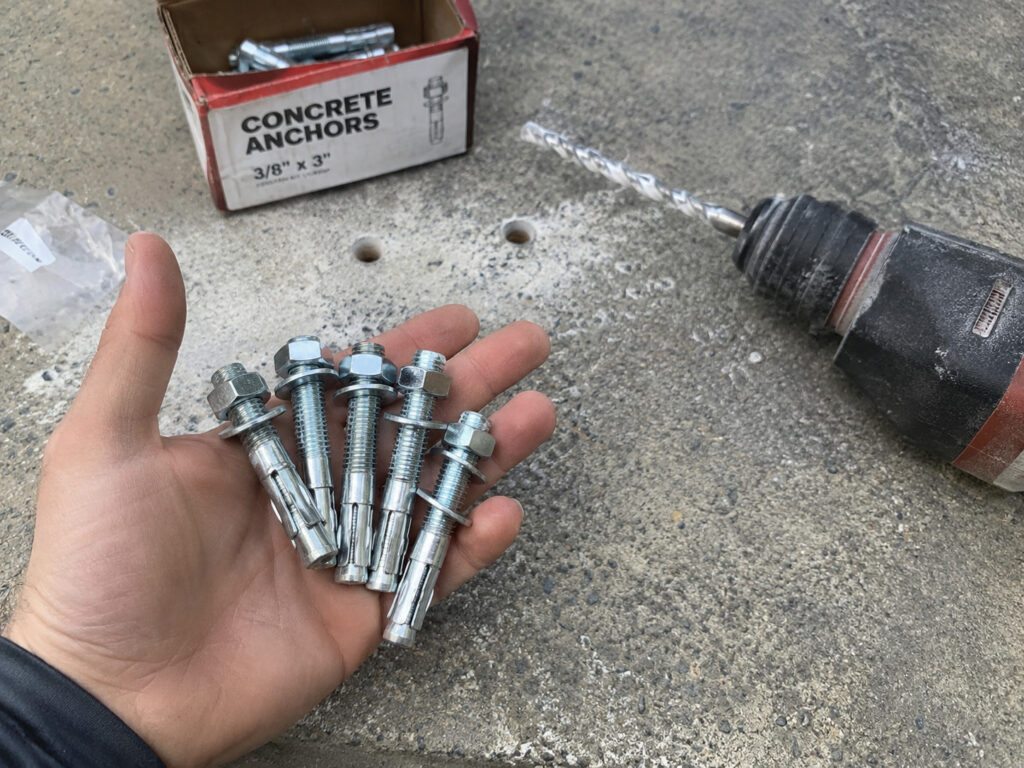
Picking a concrete anchor comes down to two questions: how heavy is the thing you’re mounting, and what are you drilling into? For light loads like furring strips, electrical boxes and shelf brackets, a Tapcon-style concrete screw is the fastest option. For medium loads, or anything going into brick or block, use a sleeve anchor. For heavy loads in solid concrete, use a wedge anchor or a heavy-duty screw anchor like the Simpson Titen HD. Hanging something from a concrete ceiling? A drop-in anchor sits flush and takes a bolt. This guide covers every common type, the hole sizes and spacing to use, and the anchors worth buying.
Quick Picks
- Best concrete screw: Tapcon 3/16″ x 2-1/4″ Star Head Blue Climaseal (75 pcs)
- Best heavier concrete screw: Tapcon 1/4″ x 2-3/4″ Hex Head Climaseal (75 pcs)
- Budget concrete screw kit: kvohlum 3/16″ x 1-1/4″ with drill bit (100 pcs)
- Best wedge anchor: CONFAST 3/8″ x 3″ Zinc Wedge Anchors (50)
- Best heavy-duty screw anchor: Simpson Strong-Tie Titen HD 3/8″ x 4″ (30)
- Best for brick and block: Hillman Sleeve Anchors 3/8″ x 3″ (50)
- Best for overhead: CONFAST 3/8″ Drop-In Anchors with Setting Tool (50)
- Fastest light-duty: CONFAST 1/4″ x 1-1/2″ Hammer Drive Anchors (100)
- Best adhesive anchor: Sika AnchorFix-2 Anchoring Epoxy
Which Concrete Anchor Do You Need?
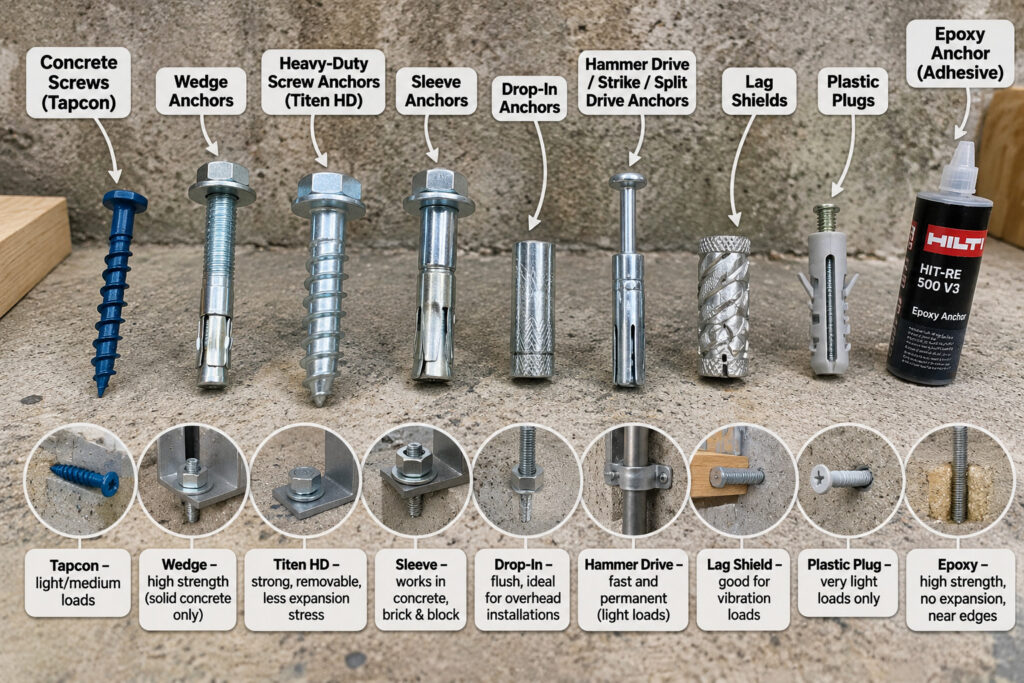
| Anchor | Load | Base material | Removable? | Hole size | Typical use |
|---|---|---|---|---|---|
| Concrete screw (Tapcon) | Light to medium | Concrete, brick, block | Yes | Smaller than screw (5/32″ for 3/16″, 3/16″ for 1/4″) | Furring strips, window and door frames, electrical boxes |
| Wedge anchor | Heavy | Solid concrete only | Nut comes off, stud stays | Same as anchor | Machinery, racking, posts, sill plates |
| Heavy-duty screw anchor (Titen HD) | Heavy | Concrete, masonry | Yes | Same as anchor | Ledgers, sill plates, heavy brackets |
| Sleeve anchor | Light to medium | Concrete, brick, block, mortar | Nut comes off | Same as anchor (check box) | Railings, grab bars, fixtures on block walls |
| Drop-in anchor | Medium to heavy | Solid concrete only | Bolt removable, anchor stays | Larger than bolt | Overhead: threaded rod, pipe hangers, garage door openers |
| Hammer drive / strike | Light | Concrete | No | Same as anchor | Conduit straps, light brackets |
| Lag shield | Light to medium | Concrete, brick, block | Lag removable | Exact size critical | Lag screws into masonry, vibration |
| Adhesive (epoxy) | Heavy | Concrete, solid masonry | No | Per adhesive maker | Threaded rod, rebar, near edges |
Concrete Anchor Types Explained
Concrete screws (Tapcon)
A hardened screw with high-low threads that cut into the concrete. You drill a hole slightly smaller than the screw and drive it in with a drill or impact driver. No expansion, no nut, and it can come back out. That makes it the default for light and medium work: furring strips on basement walls, window frames, ledger trim, junction boxes. Tapcon is the best-known brand, and its blue Climaseal coating adds corrosion resistance.
Wedge anchors
A threaded stud with a clip around the bottom. You drill a hole the same diameter as the anchor, tap it in, and tighten the nut. That pulls the clip up and wedges it against the wall of the hole. Wedge anchors are among the strongest mechanical anchors and work in solid concrete only. In brick or hollow block, the expansion can crack the material or just spin.
Heavy-duty screw anchors (Titen HD)
A large-diameter screw anchor that installs like a Tapcon but holds like a wedge anchor. Simpson Strong-Tie’s Titen HD is the best-known example and is qualified for static and seismic loads. It’s removable, and it puts less expansion stress on the concrete than a wedge anchor, so it’s more forgiving near edges.
Sleeve anchors
A bolt surrounded by a split metal sleeve. Tightening the nut pulls a cone into the sleeve and expands it against the hole. The sleeve spreads the pressure along its length, so it works in brick, block and mortar as well as concrete. This is the right anchor for most jobs on block walls.
Drop-in anchors
A short internally threaded sleeve. You drop it in the hole and drive a setting tool into it with a hammer, which expands the bottom. Then you thread in a bolt or threaded rod. It sits flush with the surface, so it’s the standard choice for overhead work like hanging threaded rod for pipes or ductwork. Solid concrete only.
Hammer drive, strike and split drive anchors
One-piece anchors you hammer in. Fast, cheap and permanent. Fine for conduit straps and light brackets in concrete. Not for anything you might want to remove, and not for real loads.
Lag shields
A soft metal sleeve that expands as you drive a lag screw into it. Zoro notes lag shields handle vibration well, but hole size is critical: an oversized hole lets the shield spin, and an undersized hole crushes it.
Plastic plugs
Ribbed plastic anchors are made for drywall and very light loads. In concrete they work for a picture hook, not a TV mount. Use a real concrete anchor.
Adhesive (epoxy) anchors
A two-part adhesive you inject into a cleaned hole before pushing in threaded rod or rebar. It cures into a bond with no expansion stress at all, so it works closer to edges than mechanical anchors. It needs a caulk-style applicator gun, a clean hole and cure time before loading.
Base Material Matters
The same anchor can be rock-solid in a poured slab and useless in a hollow block wall. Zoro’s material suitability guide is a good reference:
| Anchor | Solid concrete | Hollow block | Grout-filled block | Brick | Mortar |
|---|---|---|---|---|---|
| Wedge | Very suitable | – | May be suitable | – | – |
| Sleeve | Very suitable | Very suitable | Very suitable | Very suitable | Very suitable |
| Drop-in | Very suitable | – | May be suitable | – | – |
| Machine screw anchor | May be suitable | Very suitable | May be suitable | Very suitable | Very suitable |
Concrete screws like Tapcon are rated by the maker for concrete, brick and block. In brick, drill into the brick itself rather than the mortar joint when you can.
Also check the age of the concrete. Angi advises against drilling into concrete less than 28 days old, because it hasn’t reached full strength.

Anchor Size, Hole Size and Embedment
Match the anchor diameter to the load. Zoro’s rough guide: 3/16″ or 1/4″ for light items, 3/8″ to 5/8″ for medium items, and 5/8″ to 1″ for heavy items.
Tapcon sizing (from Confast’s Tapcon technical specifications):
| Tapcon size | Drill bit | Min. embedment | Max. embedment |
|---|---|---|---|
| 3/16″ | 5/32″ | 1″ | 1-3/4″ |
| 1/4″ | 3/16″ | 1″ | 1-3/4″ |
To choose a Tapcon length, add the thickness of the thing you’re fastening to the embedment. A 3/4″ furring strip needs at least a 1-3/4″ screw (3/4″ + 1″) and at most 2-1/2″ (3/4″ + 1-3/4″).
Wedge anchor reference loads (Zoro, ultimate values in 2,000 psi concrete):
| Size | Min. embedment | Drill bit | Pull-out (lbs) | Shear (lbs) |
|---|---|---|---|---|
| 1/4″ | 1-1/8″ | 1/4″ | 877 | 1,082 |
| 3/8″ | 1-1/2″ | 3/8″ | 1,525 | 3,238 |
| 1/2″ | 2-1/4″ | 1/2″ | 2,999 | 5,564 |
| 5/8″ | 2-3/4″ | 5/8″ | 3,749 | 6,198 |
| 3/4″ | 3-1/4″ | 3/4″ | 4,978 | 9,378 |
These are ultimate (failure) loads, not safe working loads. Confast notes that a 4:1 safety factor is generally accepted, so a safe working load is roughly a quarter of the ultimate figure. Always use the manufacturer’s data for the specific anchor you buy.
Drill the hole a little deeper than the embedment so dust and the anchor tip have somewhere to go. The anchor’s packaging gives the exact hole depth.
Edge Distance and Spacing
Anchors too close to an edge or to each other crack the concrete and lose holding power. Confast’s Tapcon data for normal-weight concrete:
| Tapcon | Edge distance (full capacity) | Spacing (full capacity) |
|---|---|---|
| 3/16″ | 1-7/8″ (tension), 2-1/4″ (shear) | 3″ |
| 1/4″ | 2-1/2″ (tension), 3″ (shear) | 4″ |
You can go closer, down to about half these distances, but with reduced capacity. For a 3/8″ x 3″ wedge anchor, CONFAST lists 3-3/4″ minimum center-to-center spacing and 1-7/8″ minimum distance from an unsupported concrete edge. Check the box for the anchor you buy.
How to Install Concrete Anchors
The universal steps:
- Drill with a carbide-tipped masonry bit of the size the anchor maker specifies, in hammer mode.
- Drill slightly deeper than the embedment depth.
- Clean the hole. Blow out the dust with a bulb or compressed air, or vacuum it. Concrete dust left in the hole is one of the most common reasons anchors spin or pull out.
- Install the anchor per its type (below).
Concrete screws: drill through the fixture and into the concrete, then drive the screw with a drill or impact driver. Stop when the head seats. Overdriving strips the threads you just cut.

Wedge anchors: thread the nut on flush with the top so you don’t mushroom the threads, then tap the anchor through the fixture into the hole until the washer is snug. Tighten the nut. CONFAST lists 25 to 30 ft-lbs for its 3/8″ anchor.
Sleeve anchors: insert through the fixture into the hole and tighten the nut until snug. Don’t crank past firm, especially in brick.
Drop-in anchors: drop the anchor into the hole, flush with the surface. Drive the setting tool into it with firm hammer blows until the tool’s shoulder meets the anchor. Then thread in your bolt or rod.
What Drill Do You Need?
For 3/16″ and 1/4″ holes, a cordless hammer drill handles the job. For lots of holes at 3/8″ and up, an SDS-plus rotary hammer drills far faster and with less effort. Our best hammer drill for concrete guide covers both. If you’re unsure which you need, see rotary drill vs hammer drill. For a cordless SDS option, see our DEWALT 20V MAX SDS rotary hammer review.
Use carbide-tipped masonry bits sized to the anchor maker’s spec. A worn bit drills an undersized hole, and that can snap concrete screws.
Two carbide sets that cover the anchor sizes in this guide:
- Pro Edge 15-Piece Carbide Masonry Drill Bit Set: carbide tips from 1/8″ to 1/2″, with doubles of the small sizes, including 5/32″ for 3/16″ Tapcons. $12.99, with 4.5 stars across 180 ratings. Check the shank type on the listing if you plan to use an SDS rotary hammer.
- Tech Hyren 14-Piece Masonry Bit Set, Hex Shank: 7 sizes from 5/32″ to 1/2″ with YG8X carbide tips on a 1/4″ hex shank that fits impact drivers and quick-change chucks. $23.99, with 4.6 stars, but only 28 ratings so far.
The Best Concrete Anchors
1. Tapcon 3/16″ x 2-1/4″ Star Head Blue Climaseal (75 pcs) – Best Concrete Screw
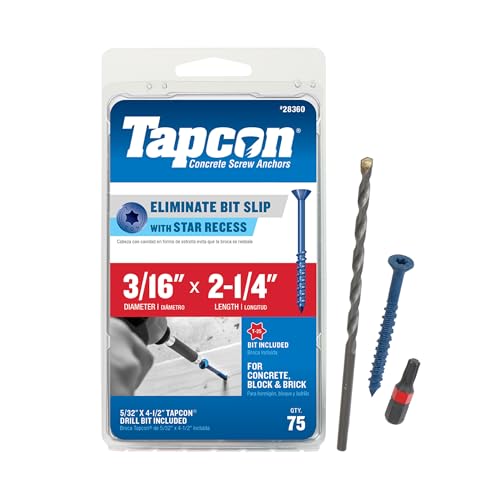
The 3/16″ x 2-1/4″ size is the one most homeowners need: it fastens a 3/4″ furring strip or a 1x board with embedment to spare. The star recess grips the driver bit better than Phillips, so you strip fewer heads in hard concrete.
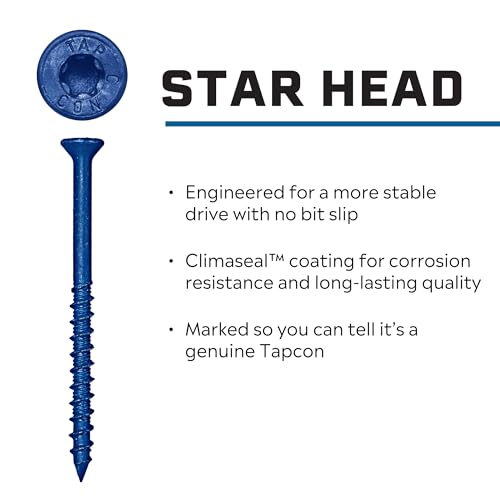
Tapcon lists ICC-ES recognition (ESR-2202 and ESR-1671) for concrete and masonry, and a blue Climaseal coating for corrosion resistance. It’s rated for concrete, brick, block and stone. 75 pieces cost $20.97, with 4.6 stars across 462 ratings.
Pros: Removable; code-recognized; star drive resists cam-out; works in brick and block too.
Cons: You need a 5/32″ masonry bit, which isn’t in this box. Light to medium loads only. Overdriving strips the threads in the concrete.
Not the right fit if: you’re mounting something heavy like a ledger or a post base. Use the Titen HD or a wedge anchor.
2. Tapcon 1/4″ x 2-3/4″ Hex Head Climaseal (75 pcs) – Best Heavier Concrete Screw

The 1/4″ diameter holds more than the 3/16″, and the hex head drives with a nut driver socket instead of a bit. Tapcon describes it for solid concrete, brick or hollow block, with a black finish for shutters, door and window frames and screened enclosures.
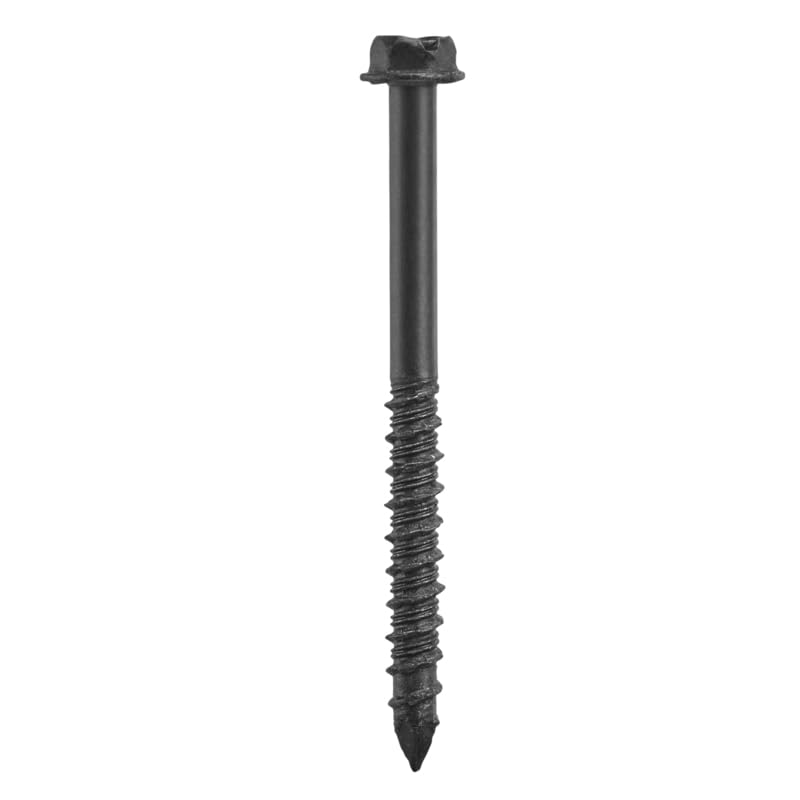
75 pieces cost $27.59, with 4.5 stars across 107 ratings. Drill with a 3/16″ masonry bit.
Pros: More holding power than 3/16″; hex head drives fast with a socket; black finish blends with dark fixtures.
Cons: Costs more per screw. The 2-3/4″ length is too long for thin fixtures, since max embedment is 1-3/4″.
Not the right fit if: you need a flush head. Tapcon’s flat-head versions countersink.
3. kvohlum 3/16″ x 1-1/4″ Concrete Screws with Drill Bit (100 pcs) – Budget Kit

For a first project, this kit has everything in one box: 100 blue hex washer head screws, a drill bit and a hex socket. At $7.99 it costs less than a single Tapcon box.
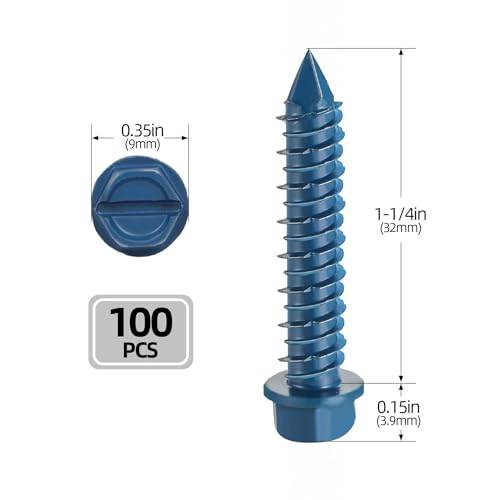
The listing gives a 0.21″ thread size, 1-1/4″ length, carbon steel with a blue anti-rust coating, and a high-low thread. It rates 4.4 stars across 861 ratings.
Pros: Includes the bit and socket; very cheap; good review count.
Cons: No ICC-ES code listing, unlike Tapcon. At 1-1/4″, it’s only long enough for thin fixtures (about 1/4″ thick with 1″ of embedment). Unknown long-term corrosion performance.
Not the right fit if: the job needs code-recognized fasteners, or you’re fastening anything thicker than sheet metal or thin brackets.
4. CONFAST 3/8″ x 3″ Zinc Wedge Anchors (50) – Best Wedge Anchor
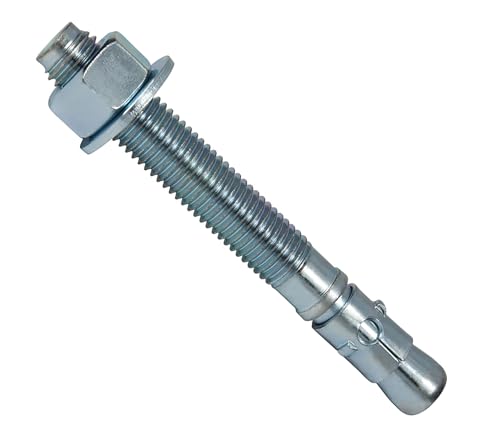
The most reviewed wedge anchor box we found, at 4.7 stars across 2,000+ ratings and $31.19 for 50. The 3/8″ x 3″ size covers most garage and shop jobs: racking, workbenches, equipment bases.
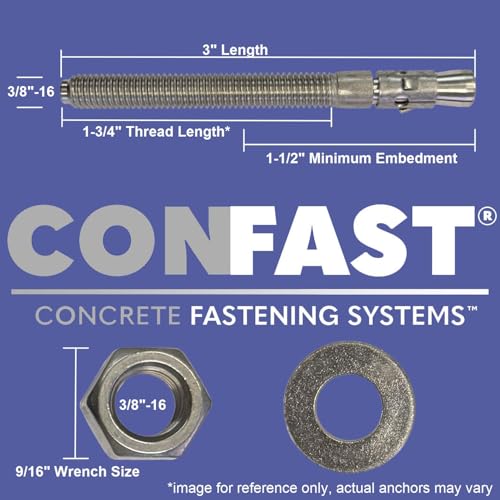
CONFAST publishes the full install data on the listing. It needs a 3/8″ hole and a 1/2″ fixture hole, a carbide bit with a hammer drill, 1-1/2″ minimum embedment, up to 1-1/8″ fixture thickness, and 25 to 30 ft-lbs of torque. Keep anchors 3-3/4″ apart and 1-7/8″ from unsupported edges. Zinc-plated carbon steel, for dry concrete only.
Pros: Clear published install specs; high holding power; strong reviews; good value per anchor.
Cons: Solid concrete only. Zinc plating is for dry locations, so go stainless or hot-dip galvanized outdoors. The stud can’t be removed, only cut flush.
Not the right fit if: you’re drilling into block or brick. Use the Hillman sleeve anchors instead.
5. Simpson Strong-Tie Titen HD 3/8″ x 4″ (30) – Best Heavy-Duty Screw Anchor

The Titen HD is a common spec-grade choice when you want screw-anchor convenience with heavy-duty capacity. Simpson lists it as qualified for static and seismic loading. Its thread undercuts the concrete to transfer load, and it installs with standard ANSI-tolerance bits, so no special bit is needed.
The hex-washer head needs no separate washer. Simpson heat-treats the tip for cutting while keeping the body ductile. 30 anchors cost $34.99. It rates 5.0 stars, but on only 17 Amazon ratings, so this pick rests more on its spec reputation than on Amazon reviews.
Pros: Heavy-duty capacity; removable; seismic qualified; no expansion stress like a wedge anchor.
Cons: Thin Amazon review base. Costs more than wedge anchors. Zinc version is for dry interior use. Simpson sells galvanized and stainless versions for outdoors.
Not the right fit if: you’re only fastening light trim. A Tapcon is cheaper and easier.
6. Hillman Sleeve Anchors 3/8″ x 3″ (50) – Best for Brick and Block

Sleeve anchors are the most versatile mechanical anchor, and this is the size most block-wall jobs need. Hillman describes them for solid concrete, brick and block. Tightening the hex nut expands the sleeve against the hole walls, which also resists loosening from vibration.

Zinc-plated carbon steel, for interior and light-duty exterior use. 50 pieces cost $45.99, with 4.8 stars across 236 ratings.
Pros: Works in brick, block and mortar; hex head installs with a socket; very good reviews.
Cons: Lower capacity than a wedge anchor in solid concrete. Overtightening in brick can crack it. Costs more per anchor than the CONFAST wedge anchors.
Not the right fit if: you need maximum capacity in a poured slab. Wedge anchors or the Titen HD hold more.
7. CONFAST 3/8″ Drop-In Anchors with Setting Tool (50) – Best for Overhead

Hanging threaded rod from a concrete ceiling for pipes, ductwork or a garage storage rack? Drop-ins are the standard. They mount flush, so nothing sticks out, and you can remove the bolt later without disturbing the anchor.

These take a 3/8″-16 bolt or threaded rod (the size refers to the inside thread), and a setting tool is included. CONFAST lists them for solid concrete and dry indoor use. 50 pieces cost $34.79, with 4.5 stars across 243 ratings.
Pros: Flush mount; bolt is removable; setting tool included; good value.
Cons: Solid concrete only. The hole is larger than the 3/8″ thread, so check the box for the exact bit size. If you don’t drive the setting tool fully, the anchor isn’t set and won’t hold.
Not the right fit if: you’re anchoring into block or brick. Use sleeve anchors.
8. CONFAST 1/4″ x 1-1/2″ Hammer Drive Anchors (100) – Fastest Light-Duty

Drill a 1/4″ hole, push the anchor through the fixture, and hammer the pin. Done. For conduit straps, cable clips and light brackets, nothing is faster.
The anchor diameter equals the hole diameter, and CONFAST notes the fastening is permanent. 100 per box at $42.35, with 4.8 stars across 540 ratings.
Pros: Very fast; no driver or wrench needed; strong reviews.
Cons: Permanent, so you can’t remove the fixture cleanly. Light loads only.
Not the right fit if: you might move the fixture later. Use Tapcon screws instead.
9. Sika AnchorFix-2 Anchoring Epoxy – Best Adhesive Anchor

For threaded rod or rebar in concrete, especially close to an edge where a wedge anchor could crack it, adhesive anchoring is the safer route. Sika describes AnchorFix-2 for threaded bars in uncracked concrete and solid masonry, with fast curing.

The cartridge fits most standard applicator guns. You cut the film, screw on the static mixer and dispense. Sika notes it’s free of styrene and solvents and certified safe for drinking water systems. $31.87, with 4.1 stars across 531 ratings.
Pros: No expansion stress, so better near edges; holds threaded rod and rebar; fits standard guns.
Cons: Needs a clean, dust-free hole and cure time before loading. The static mixer is single use, so once you start a cartridge, plan to use it. Lowest rating in this list.
Not the right fit if: you need to load the fixture immediately. Use a mechanical anchor.
Indoor vs Outdoor: Zinc, Galvanized or Stainless?
Zinc-plated anchors are fine for dry indoor use. Outdoors they’ll eventually rust. For outdoor and wet locations, Zoro recommends stainless steel, which resists rust best and suits submerged or wet outdoor use. Hot-dip galvanized is the middle ground for exterior work like decks and fences. Tapcon’s blue Climaseal coating adds corrosion resistance, but stainless is still the safer pick in coastal areas.
How to Remove a Concrete Anchor
- Concrete screws and Titen HD: back them out with the same driver. Don’t reuse a concrete screw in the same hole for anything that matters, because the threads it cut are worn.
- Wedge anchors: remove the nut and grind or cut the stud flush. You can also drive it deeper if the hole is deep enough.
- Sleeve anchors: loosen the nut a few turns and tap the bolt to release the cone. They often pull out, but sometimes need to be cut.
- Drop-ins and hammer drive anchors: effectively permanent. Remove the bolt and leave the drop-in, or grind the hammer drive flush.
Common Mistakes
- Wrong bit size: an oversized hole lets anchors spin, and an undersized one snaps concrete screws.
- Dirty holes: dust reduces holding power. Blow out every hole.
- Too close to an edge: follow the spacing tables above.
- Wedge anchors in brick or block: they’re for solid concrete only.
- Drilling green concrete: wait 28 days after the pour.
- Overtorquing: you can crack the concrete or strip the threads. Follow the maker’s torque spec.
When to Call a Pro
Hire a contractor or engineer for structural connections, deck ledgers into foundations, guardrails and handrails people lean on, and heavy loads hung overhead where people walk underneath. Building codes often require specific listed anchors and inspection for these. Manufacturer load tables assume proper installation in sound concrete, which isn’t always what you have.
FAQ
What is the strongest concrete anchor?
Among common mechanical anchors, wedge anchors and heavy-duty screw anchors like the Titen HD hold the most in solid concrete. Adhesive anchors with threaded rod can match or beat them, especially near edges.
Wedge anchor vs sleeve anchor: which should I use?
Wedge anchors for heavy loads in solid concrete. Sleeve anchors for light to medium loads, and for brick, block and mortar, where wedge anchors don’t work.
What size drill bit for a 3/16″ or 1/4″ Tapcon?
5/32″ for 3/16″ Tapcon and 3/16″ for 1/4″ Tapcon, per Confast’s Tapcon specs.
Can I use concrete anchors in brick or block?
Yes, but choose the right type. Sleeve anchors and concrete screws work in brick and block. Wedge and drop-in anchors are for solid concrete.
How much weight can a concrete anchor hold?
It depends on size, type, embedment and concrete strength. As a reference, Zoro lists a 3/8″ wedge anchor at 1,525 lbs ultimate pull-out in 2,000 psi concrete. With a 4:1 safety factor, plan on roughly a quarter of that. Always check the manufacturer’s data.
Can you reuse or remove concrete anchors?
Concrete screws and Titen HDs can be removed. Wedge and hammer drive anchors are permanent, and the bolt in a drop-in can be removed while the anchor stays.
How deep should a concrete anchor go?
At least the manufacturer’s minimum embedment. For Tapcon that’s 1″ (max 1-3/4″). For a 3/8″ wedge anchor it’s 1-1/2″. Drill the hole a bit deeper than the embedment.
How soon can I drill into new concrete?
Wait 28 days after the pour so the concrete reaches full strength.
Bottom Line
- Light fixtures, furring, frames: Tapcon 3/16″ or Tapcon 1/4″.
- Heavy loads in a slab: CONFAST wedge anchors or the removable Simpson Titen HD.
- Brick or block walls: Hillman sleeve anchors.
- Overhead: CONFAST drop-ins.
- Conduit and clips: CONFAST hammer drive anchors.
- Threaded rod near edges: Sika AnchorFix-2.
- First project on a budget: kvohlum kit with bit.