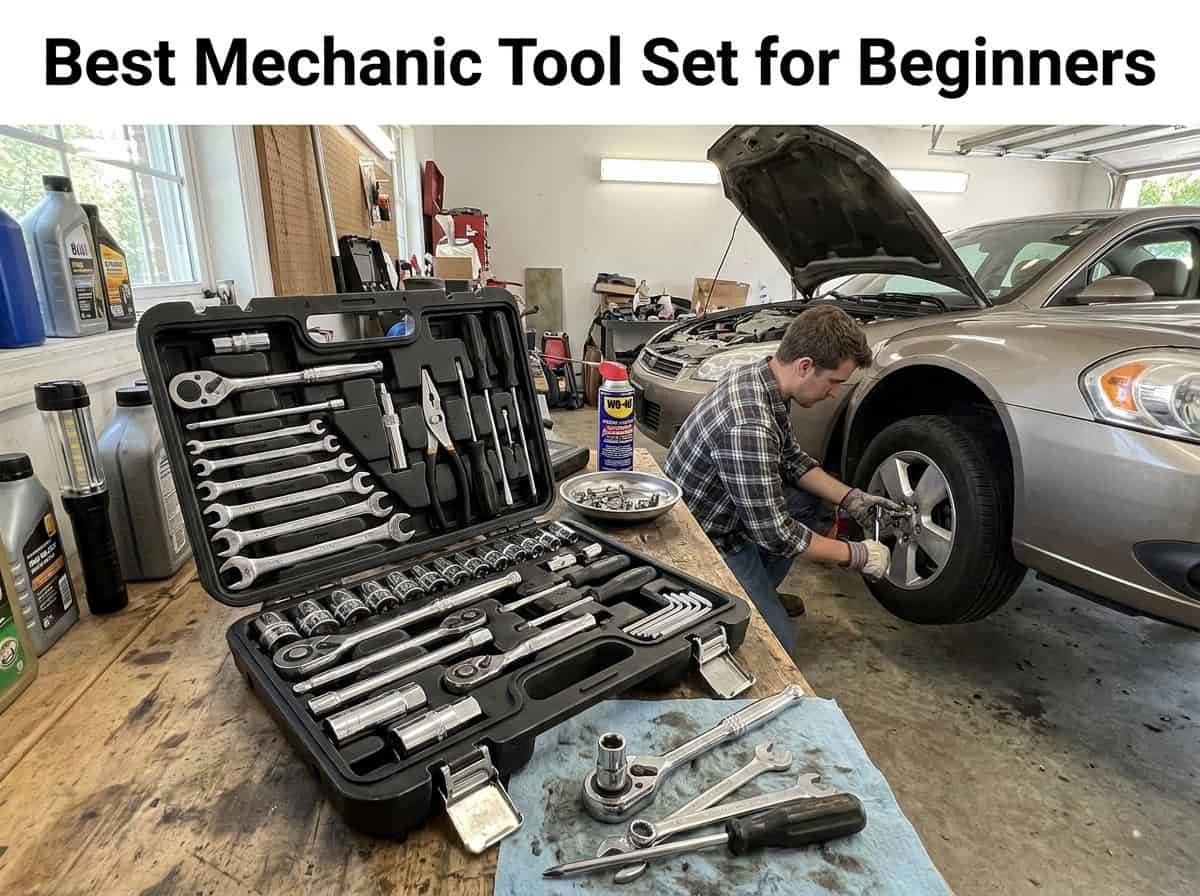
Buying your first mechanic tool set is harder than it should be. One kit has 150 pieces, another claims 262, and a third includes 300, but the number on the box doesn’t tell you whether it has the sockets, ratchets, wrench sizes, extensions, and storage you actually need for your car. Piece count isn’t the main buying criterion, socket coverage is. Metric coverage matters for most modern vehicles, but SAE still matters for some older vehicles, US-built equipment, and general garage jobs. A 3/8-inch ratchet is the core everyday drive size, while 1/2-inch drive covers wheels, suspension, and higher-torque fasteners.
One important note before we start: if you already know you just need a good set of sockets and don’t need a full mixed-tool kit, our guide to the best socket sets for beginners covers drive sizes, 6-point vs. 12-point, and chrome vs. impact sockets in depth. This guide is for the next step up: a complete starter foundation with ratchets, wrenches, hex keys, and screwdrivers together in one organized case, meant to cover your first oil change, brake job, battery swap, and general repairs, not just sockets alone. We won’t re-explain the socket fundamentals here, we’ll link you to that guide where it matters and focus on what’s genuinely different about building a complete kit.
For most beginners, the best mechanic tool set includes 1/4-inch, 3/8-inch, and 1/2-inch drive ratchets; metric and SAE sockets; shallow and deep sockets; combination wrenches; extensions; adapters; and a usable storage case. Start with a recognized brand and prioritize socket coverage, ratchet quality, warranty, and organization over the largest piece count. Add a torque wrench, impact sockets, floor jack, jack stands, and diagnostic tools separately as your projects expand.
Quick Picks
| Set | Best For | Drive Sizes | Buy |
|---|---|---|---|
| Craftsman 262-Piece VERSASTACK | Best Overall | 1/4″, 3/8″, 1/2″ | Check Price |
| Husky 270-Piece | Best Full Drive Coverage | 1/4″, 3/8″, 1/2″ | Check Price |
| DeWalt 168-Piece | Best Portable | 1/4″, 3/8″ | Check Price |
| Craftsman 189-Piece | Best Value | 1/4″, 3/8″, 1/2″ | Check Price |
| GearWrench 232-Piece | Best 3/8″ Depth | 1/4″, 3/8″ | Check Price |
| Amazon Basics 201-Piece | Best Budget | 1/4″, 3/8″, 1/2″ | Check Price |
What Should a Beginner Mechanic Tool Set Include?

| Tool Category | What a Beginner Needs | Why It Matters |
|---|---|---|
| Ratchets | 1/4″, 3/8″, and ideally 1/2″ drive | Covers small, general-purpose, and higher-torque fasteners |
| Sockets | Metric and SAE, shallow and deep, six-point preferred | Modern vehicles are heavily metric, but mixed coverage avoids gaps |
| Extensions | Short and medium, ideally a wobble/universal-joint option later | Reaches recessed bolts and awkward engine-bay fasteners |
| Adapters | 1/4″-to-3/8″, 3/8″-to-1/2″ as needed | Bridges drive sizes carefully |
| Combination wrenches | Metric core sizes, SAE if needed | Useful where a socket can’t reach |
| Screwdrivers | Phillips, flathead, common bit options | Interior, clamps, sensors, trim, general repair |
| Pliers | Slip-joint, needle-nose, cutting | Hoses, clips, wiring, small parts |
| Hex keys / bits | Metric and SAE hex, Torx added early | Common on modern vehicles and accessories |
| Spark plug sockets | Common sizes for your vehicle | Needed for spark-plug service |
| Storage case | Labeled, secure, easy to reset after a job | Prevents missing sockets and keeps the kit usable |
Metric vs. SAE
Most newer passenger vehicles use mostly metric fasteners, but SAE coverage is still useful for certain US vehicles, older equipment, trailers, lawn equipment, and general garage projects. If budget is tight and you mostly work on a modern vehicle, prioritize a complete metric set first. Don’t force near-match sizes, an SAE socket on a metric fastener (or the reverse) can round the corners.
Ratchet Tooth Count
A higher tooth-count ratchet generally needs less handle swing to engage the next tooth, which helps in tight engine bays and under-dash areas. Tooth count alone doesn’t guarantee ratchet durability though, check build quality, warranty, comfort, and replacement support too. For the deeper breakdown of six-point vs. twelve-point and shallow vs. deep, see our socket set guide, the fundamentals are the same whether you’re buying sockets alone or as part of a full kit.
The Five Best Mechanic Tool Sets
1. Craftsman 262-Piece Mechanics Tool Set with VERSASTACK (CMMT45309) – Best Overall

Broad coverage across all three drive sizes, suitable for maintenance, brakes, basic suspension work, battery replacement, spark plugs, and general DIY. The VERSASTACK 3-drawer system is a real organizational advantage, drawers nest on top of the box for easy access and lock closed with a one-handed dial when not in use, and the whole system is compatible with other VERSASTACK modules if you expand later. A 72-tooth ratchet delivers a 5-degree arc swing and a genuinely thinner head for tight spaces, backed by Craftsman’s Full Lifetime Warranty.
Pros: Genuine 1/4″, 3/8″, and 1/2″ drive coverage in one kit; modular VERSASTACK storage grows with your garage; recognizable brand with wide availability and accessible warranty support.
Cons: Bigger investment and bulkier than a portable kit; still doesn’t replace an impact socket set or torque wrench, budget for those separately.
2. Husky 270-Piece Mechanics Tool Set – Best Full Drive Coverage
Home Depot’s house brand covers all three drive sizes with organized storage trays built for the Husky build-out system, sized markings make identifying and returning tools genuinely easy. 72-tooth ratchets need only a 5-degree arc swing, sockets and wrenches use an off-corner loading design to resist rounding fasteners, and hex keys and bits are made from heat-treated S2 tool steel.
Pros: Complete 1/4″, 3/8″, and 1/2″ drive coverage; off-corner loading design genuinely helps resist rounding fasteners; wide big-box retail availability for warranty support.
Cons: Availability and exact configuration can vary by store and season; still needs a torque wrench and impact sockets added separately.
3. DeWalt 168-Piece Mechanics Tool Set (DWMT73803) – Best Portable

Good for a first kit that lives in a car, truck, apartment, or small garage, and for DIYers who value portability over maximum coverage. Sockets use DirectTorque technology to help prevent rounding fasteners, and 72-tooth ratchets provide the same 5-degree arc swing as the larger sets on this list, packed into a genuinely compact molded case.
Pros: Portable molded case, easy to store in a vehicle or small space; familiar brand; good entry point for basic maintenance and roadside repairs.
Cons: 1/4″ and 3/8″ drive only, no 1/2″ coverage, less ideal for stubborn lug nuts, suspension work, or heavy-duty repairs; will likely need quick expansion with a breaker bar and 1/2″ impact set.
4. Craftsman 189-Piece Mechanics Tool Set (CMMT12134) – Best Value

A sensible middle ground between a budget set and a large garage-expansion system: genuine 1/4″, 3/8″, and 1/2″ drive coverage with 6-point and 12-point sockets, combination wrenches, hex keys, and specialty bits, all in a blow-mold case designed to fit into Craftsman’s metal storage boxes later. The same 90-tooth, 5-degree-arc ratchet design as the pricier 262-piece set, just in a more focused, less bulky package.
Pros: All three drive sizes without paying for the largest VERSASTACK system; recognized brand with Full Lifetime Warranty; genuinely good starting point for gradual expansion.
Cons: Case is a simpler blow-mold design, not the drawer-based organization of the 262-piece set; you’ll likely still add pliers or a dedicated screwdriver set depending on what’s in the exact current configuration.
5. GearWrench 232-Piece Mechanics Tool Set (GW72LLCBMTS) – Best for 3/8″ Depth
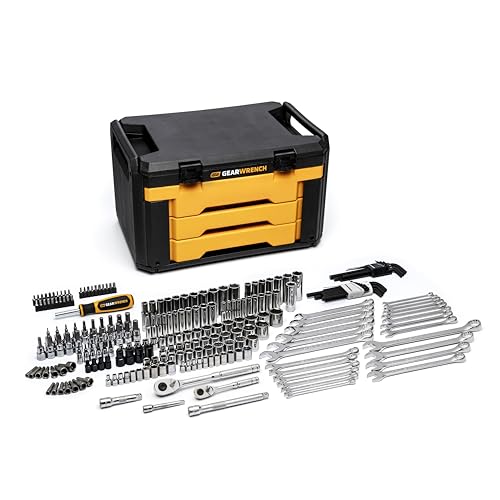
Worth being direct about this one before you buy it expecting what a typical “232-piece mechanic set” implies: this specific GearWrench configuration covers 1/4″ and 3/8″ drive only, and real buyer feedback confirms it does not include 1/2″ drive sockets or a ratchet, and doesn’t include ratcheting combination wrenches, somewhat surprising given that GearWrench is specifically known for ratcheting wrenches elsewhere in its lineup. What it does deliver is genuine depth within the 1/4″ and 3/8″ range, a large wrench and hex key assortment, and GearWrench’s mechanic-focused reputation for ratchet quality where it does apply.
Pros: Strong depth of coverage specifically within 1/4″ and 3/8″ drive; large wrench and hex key assortment; a genuine step-up ratchet feel within its covered range.
Cons: No 1/2″ drive sockets or ratchet included, a real gap if you plan on any wheel or suspension work; no ratcheting combination wrenches despite the brand’s reputation for them elsewhere. Confirm current contents directly before buying if 1/2″ coverage matters to you.
6. Amazon Basics 201-Piece Mechanic’s Socket Tool Set – Best Budget
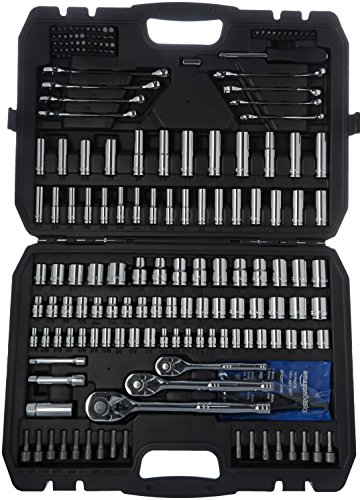
A legitimate low-cost entry point for occasional DIY, with 1/4″, 3/8″, and 1/2″ drive coverage, both metric and SAE sizes, and a chrome-vanadium steel forged body with a polished-chrome finish for corrosion resistance. This is a genuinely reasonable set to learn which tools you use most before investing further.
Pros: Full drive-size coverage at a meaningfully lower price than the branded sets above; large enough assortment to actually get started; over 12,000 customer reviews at a strong average rating.
Cons: Some buyers report quality-control issues, including tools arriving defective, and describe the included carry case as sub-par. Inspect socket fit, ratchet smoothness, and case security carefully after it arrives, and don’t expect daily-professional-grade durability.
Best Brand for a Beginner Mechanic
| Brand | Best For | Strengths | Watch-Outs |
|---|---|---|---|
| Craftsman | Most home mechanics | Widely available, practical kit options, accessible warranty, good starter-to-growth path | Confirm exact kit contents; some sets may need specialty add-ons quickly |
| Husky | Home Depot shoppers wanting full drive coverage | Complete 1/4″-3/8″-1/2″ range, off-corner loading design, wide retail support | Exact configuration can vary by store and season |
| GearWrench | Serious DIY wanting depth in one drive range | Mechanic-focused reputation, strong ratchet feel where it applies | Verify drive-size coverage carefully, not every configuration includes 1/2″ |
| DeWalt | Portable home/roadside kits | Familiar brand, compact sets, wide retail availability | Kits often emphasize portability over complete drive coverage |
| Amazon Basics | Very tight budgets and occasional work | Low entry price, broad starter assortment | Verify quality, storage, and warranty carefully, real buyer QC complaints exist |
For most beginners, choose Craftsman or Husky if you want full drive-size coverage from an accessible mainstream brand. Choose GearWrench if you specifically want depth in the 1/4″-3/8″ range and plan to buy 1/2″ tools separately anyway. Choose DeWalt if portability matters most. Choose Amazon Basics only if budget is the primary constraint and you’re prepared to inspect what arrives closely.
What a Beginner Should Buy Separately
| Add-On Tool | Why a Basic Set May Not Include It | Priority |
|---|---|---|
| Torque wrench | Essential for correct final tightening of wheel, brake, and engine fasteners | Buy early |
| Breaker bar | Helps break loose stubborn, rusted, or overtightened fasteners | Buy early |
| 1/2″ impact socket set | Required if using a cordless or pneumatic impact wrench | Buy early if doing wheel work |
| Floor jack | Needed to raise a vehicle safely | Buy before under-car work |
| Jack stands | Required to support a raised vehicle safely | Buy before under-car work |
| Oil drain pan and funnel | Needed for clean oil changes | Buy early |
| OBD2 scanner | Reads diagnostic trouble codes on modern vehicles | Buy after basic tools |
| Multimeter | Checks batteries, fuses, voltage, continuity, basic wiring | Buy after basic tools |
| Work light | Makes under-hood and under-car work safer and easier | Buy early |
A mechanic tool set does not make under-vehicle work safe by itself. Before working beneath a car, use a properly rated floor jack, jack stands, wheel chocks, and a stable level surface. Never rely on a hydraulic jack alone.
Our guides on impact sockets vs. regular sockets, why an impact wrench won’t remove lug nuts, and how to use a multimeter for beginners cover three of the most common early add-ons in depth.
Beginner Mechanic Tool Set by Job
| First DIY Job | What a Core Set Should Cover | Additional Tools Usually Needed |
|---|---|---|
| Battery replacement | Basic sockets, ratchet, extension, pliers | Battery terminal cleaner, multimeter optional |
| Oil change | Socket or wrench for drain plug | Oil-filter wrench, drain pan, funnel, ramps or jack if needed |
| Brake pad replacement | Sockets, ratchet, combination wrenches | Torque wrench, brake piston tool, jack stands, lug-nut socket |
| Spark plug replacement | Ratchet, extension, socket coverage | Correct spark-plug socket, gap tool if required |
| Tire rotation | Sockets, ratchet | Floor jack, jack stands, wheel chocks, torque wrench |
| Checking a blown fuse | Pliers, small screwdrivers | Multimeter or test light, replacement fuses |
| Basic code reading | No major hand tools needed | OBD2 scanner |
How Many Pieces Do You Really Need?
A 200-piece set can be less useful than a 150-piece set if the larger one counts screwdriver bits individually, includes duplicates but misses common deep sockets, lacks 1/2″ drive, omits combination wrenches, or doesn’t include the metric sizes your specific vehicle uses. The GearWrench pick above is a direct example: 232 pieces sounds larger than the 189-piece Craftsman set, but it’s missing an entire drive size the smaller set includes.
| Buyer Type | Ideal Set Size | What Matters More Than Count |
|---|---|---|
| Occasional DIYer | 100-170 pieces | Common metric sockets, 3/8″ ratchet, screwdrivers, pliers, portable case |
| Home mechanic | 150-250 pieces | 1/4″, 3/8″, and 1/2″ drives; deep sockets; wrenches; extensions; organization |
| New technician | 200-300+ pieces | Continuous size coverage, ratchet quality, replacement support, modular storage |
Tools Not to Buy First
- Huge professional tool chests with thousands of pieces.
- Expensive scan tools before you understand basic maintenance.
- Multiple redundant socket sets before checking what your starter kit already covers.
- Very cheap universal wrench gimmicks.
- Large specialty puller kits “just in case.”
- A 3/4-inch impact wrench for normal passenger-car work.
- SAE-only kits for a modern, metric-focused vehicle.
- Twelve-point-only socket sets for a first automotive kit.
- Cheap torque wrenches with no calibration information or clear instructions.
- A floor jack without correctly rated jack stands and wheel chocks.
Buying Guide
Start With the Vehicle You Own
Identify your make, model, and year, and check whether your lug nuts are metric, what your spark-plug requirements are, whether the vehicle uses Torx, hex, or specialty fasteners, and whether you need a low-profile jack or a specific oil-filter wrench type.
Choose Drive Sizes Correctly
1/4″ is useful for small fasteners and tight spaces but isn’t sufficient alone. 3/8″ is the most important first drive size for general maintenance and engine-bay work. 1/2″ is strongly recommended for lug nuts, suspension, and larger bolts. 3/4″ isn’t needed for most beginners, that’s a heavy truck and commercial equipment size.
Buy the Case You’ll Actually Use
A case that keeps tools in place is worth more than a fancy piece count. Socket labels reduce frustration, molded cases are portable but can become annoying if tools fall out, and drawer systems are better for a permanent garage setup. If you’ll work outdoors or in an apartment car park, a portable case is the more practical choice.
Warranty and Replacement Support
Lifetime warranty language varies by brand and retailer, read the exclusions and proof-of-purchase rules directly. The ability to replace one lost or broken common socket is genuinely valuable over years of ownership, not every item in every set carries identical warranty terms, verify the exact product before assuming full coverage.
Frequently Asked Questions
What is the best mechanic tool set for beginners?
For most beginners, the best set has 1/4″, 3/8″, and preferably 1/2″ drive ratchets, metric and SAE sockets, shallow and deep sockets, combination wrenches, extensions, and a durable case. Craftsman and Husky both offer a balanced mainstream starting point with full drive coverage.
Is a 200-piece mechanic tool set enough?
It can be, if it includes the right socket sizes, ratchets, deep sockets, extensions, wrenches, and storage. Don’t judge a kit by piece count alone, some high-count sets contain many small bits and accessories but omit a useful drive size entirely.
Which drive size should a beginner mechanic buy first?
A 3/8″ ratchet and socket set is the most useful all-around starting point for routine automotive work. Add 1/4″ for smaller fasteners and tight spaces, and 1/2″ for wheel, suspension, and high-torque work.
Should I buy metric or SAE mechanic tools?
Most modern vehicles use primarily metric fasteners, so metric coverage should be the priority for many beginners. SAE tools are still useful for some older vehicles, US-made equipment, trailers, and general garage work.
Do mechanic tool sets include a torque wrench?
Usually not. A torque wrench is commonly a separate purchase and should be added early if you plan to remove wheels, service brakes, replace spark plugs, or work on any fastener with a manufacturer torque specification.
Do I need impact sockets if I own an impact wrench?
Yes. Use impact-rated sockets with an impact wrench, impact driver with a socket adapter, or pneumatic impact tool. Never use ordinary chrome hand sockets with impact tools, see our guide on impact sockets vs. regular sockets for the full explanation.
What tools do I need to change oil at home?
A core tool set may provide the socket or wrench needed for the drain plug. You’ll usually also need the correct oil-filter wrench or socket, a drain pan, a funnel, gloves, oil, a replacement filter, and possibly ramps or safe lifting equipment.
Is Craftsman or GearWrench better for a beginner mechanic?
Craftsman is often the more practical all-around starting brand because its kits are accessible and broadly available with full drive-size coverage. GearWrench can be a strong choice too, but confirm the exact configuration includes the drive sizes you need, some GearWrench sets skip 1/2″ drive entirely.
Final Verdict
For most first-time home mechanics, start with the Craftsman 262-piece VERSASTACK or the Husky 270-piece set if you want broad, genuine drive-size coverage from an accessible brand you can expand over time. Choose the Craftsman 189-piece set if you want the same drive coverage in a more focused, less bulky package. Choose the DeWalt 168-piece kit if portability matters most, just know you’ll add 1/2″ tools separately. Choose the GearWrench 232-piece set only if you specifically want depth in the 1/4″-3/8″ range and plan to buy 1/2″ coverage elsewhere. Choose the Amazon Basics 201-piece set only if budget is the main constraint and you’re ready to inspect what arrives closely.
The best first upgrade after your main kit is usually a torque wrench, followed by a breaker bar, a 1/2″ impact socket set, and safe lifting equipment. Those additions turn a basic socket-and-ratchet collection into a genuinely useful home-garage foundation.
A breaker bar is one of the first add-ons to buy after a starter kit – see our comparison of impact wrench vs. breaker bar.