Updated February 2026
For years, I’ve watched contractors operate with nothing just a flashlight and experience. Then some smart ones picked up a basic thermal gun and caught loose connections that would have become fires. That’s still valid today.
But the game has fundamentally shifted, and here’s why.
- The pressure is on equipment. Data demands are growing faster than cooling capacity. Power consumption in buildings and data centers is rising. Equipment runs hotter. Failure points emerge faster. You can’t catch a problem if you’re not looking for it systematically.
- NFPA 70B now mandates thermal inspection. For electrical contractors and facility managers, this isn’t optional—it’s a legal requirement. Critical equipment must be inspected thermally every six months. That creates a baseline revenue opportunity: $800–$2,000 per inspection.
- Moisture damage is accelerating. Home inspectors are encountering more moisture intrusion than ever. Combining thermal imaging with a moisture meter improves detection accuracy by 83% compared to thermal imaging alone.
- The technology finally caught up. In 2025–2026, prices have fallen 40%. Entry-level cameras now deliver 160×120 resolution—perfectly adequate for professional work.
The contractors, electricians, and inspectors who make the leap in early 2026 will own their market for the next two years.

WHAT CHANGED: THE REAL WORLD TEST
Here’s what the marketing brochures don’t tell you, but what actually matters on the job site.
You can’t manage what you can’t measure.
I’ve watched home inspectors work two ways. The first group walks a house visually and reports what they see. The second group brings thermal imaging and a moisture meter. Same house. Same day. Opposite outcomes.
Example: A home in Atlanta. Standard visual inspection found nothing unusual. Thermal image at evening revealed a 5-degree temperature differential on the exterior wall. Follow-up with the moisture meter confirmed wet insulation behind the drywall. Cost to remediate before foundation damage: $2,800. Cost to fix after structural compromise: $18,000. The homebuyer paid the inspector’s thermal fee ($300) and saved $15,000.
That’s not luck. That’s methodology.
The electrical contractor story is similar.
One mid-sized commercial contractor in Arizona was contracted to perform NFPA thermal inspections. First audit cycle: he identified three breakers showing 12-15-degree elevated temperatures. Repairs cost $4,200. Prevented equipment failure cost: estimated $180,000. His client now pays him $1,600 per facility, twice yearly. Annual recurring revenue from that one initiative: $64,000.
THE SPECIFICATIONS EXPLAINED: WHAT ACTUALLY MATTERS
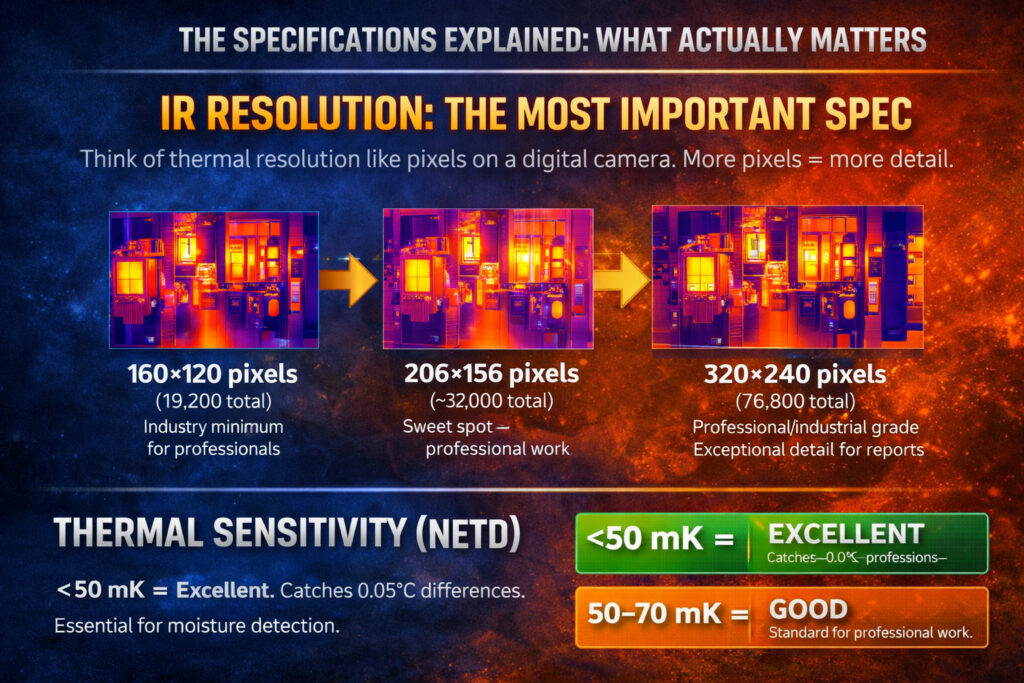
IR Resolution: The Most Important Spec
Think of thermal resolution like pixels on a digital camera. More pixels = more detail.
- 160×120 pixels (19,200 total) = Industry minimum for professionals. Adequate for spotting hotspots.
- 206×156 pixels (~32,000 total) = Sweet spot for professional work. You see patterns, not just hot blobs.
- 320×240 pixels (76,800 total) = Professional/industrial grade. Exceptional detail for reports.
Thermal Sensitivity (NETD)
- <50 mK = Excellent. Catches 0.05°C differences. Essential for moisture detection.
- 50–70 mK = Good. Standard for professional work.
Image Enhancement Technology
FLIR MSX (Multi-Spectral Dynamic Imaging) is the game changer. It embosses visible light detail (like text on a breaker) onto the thermal image. In a crowded electrical panel, MSX shows you exactly which breaker is overheating. Without it, you’re guessing.
Listen, if you’re a solo electrician or home inspector just starting out, you don’t need the premium option. Grab a FLIR TG267 ($450) and your toolkit will be complete. You’ll recoup the cost in your first month of thermal add-on services.
But if you’re managing electrical systems for commercial clients under NFPA 70B compliance, running HVAC diagnostics that pay $400–$800 per inspection, or identifying moisture intrusion before it becomes a five-figure repair bill, thermal imaging isn’t optional anymore—it’s the difference between success and failure.
Here’s what matters: the thermal imaging market is at an inflection point. What cost $3,000 five years ago now sells for under $500 with better image quality. Artificial intelligence is improving detection rates by 30%, and professionals are starting to build recurring revenue around these tools. If you’re not capturing that opportunity in 2026, you’re leaving money on the table.
THE 6 TOP THERMAL IMAGING CAMERAS
1. FLIR TG267 — Best Overall Value & Reliability

- Product 1: IDENTIFY PROBLEMS QUICKLY: Measure a wide range of temperatures from -25°C to 380°C (-13°F to 716°F) with a true 160 × 120 IR pixel imager (19,200 pixels).
- Product 1: PRODUCE CRISP THERMAL IMAGES: Display and record MSX-enhanced thermal images or visual images with temperature readings.
- Product 1: WORK WITH CONFIDENCE IN RUGGED ENVIRONMENTS: Work safely and worry-free knowing that the IP54 enclosure can withstand a 2-meter drop and protect against dust and water.
- Product 1: ACCURACY: ±1.5°C (2.7°F) for temperatures 50°C to 100°C (122°F to 212°F); up to ±3°C (±5.4°F) for -25°C to 50°C (-13°F to 122°F) and 100°C to 380°C (212°F to 716°F).
- Product 2: HUMIDITY SENSOR: Our handy meter tool can quickly determine what level of remediation is needed to keep your family safe from black mold. High levels of dampness that go untreated are the leading cause of harmful fungus growth in the home.
Best for: Home inspectors, electricians, HVAC technicians
Price: ~$450–500 USD
| Specification | Value |
|---|---|
| IR Resolution | 160×120 (19,200 pixels) |
| Image Enhancement | MSX Technology |
| Battery Life | 5 hours continuous |
What professionals like:
MSX technology is the real differentiator here. When you’re scanning a crowded electrical panel, you instantly know which breaker is hot. The 5-hour battery life covers a full workday. The 160×120 resolution is the industry minimum but perfectly adequate for finding insulation gaps and hotspots.
Real-world example: A home inspector in Dallas charges an extra $150 for thermal imaging. At 30% adoption, she added $450/month in revenue. The camera paid for itself in month one.
Verdict: The safest choice for professionals entering thermal imaging. If you use it three times, it pays for itself.
2. FLIR E8-XT — Professional Standard

- Model E8-XT: Handheld IR camera measures temperatures from -20 to 550°C (-4 to 1022°F)
- FLIR IGNITE CLOUD: Save time by connecting to the cloud for automatically storing, editing and sharing images in FLIR Ignite App. OTA (Over The Air) updates will always keep your camera equipped with the latest features
- IDENTIFY AND TROUBLESHOOT - Quickly find hidden faults and reduce diagnostic time with high resolution 320 × 240 (76,800 pixels) thermal resolution with MSX technology
- PATENTED TECHNOLOGY - Patented MSX embosses visual details on the thermal image to create sharper, easier to understand picture
- 2-10 Thermal Camera Warranty from FLIR, 2 Years parts and labor coverage on the camera, 10 Years coverage on the detector – the most vital part of the whole camera.
Best for: NFPA 70B compliance, industrial maintenance
Price: $2,999–3,399 USD
| Specification | Value |
|---|---|
| IR Resolution | 320×240 (76,800 pixels) |
| Temp Range | -20°C to +550°C |
| Connectivity | WiFi + Cloud Reporting |
What professionals like:
The jump to 320×240 resolution is the difference between binoculars and a telescope. But the game changer is WiFi integration. Capture an image, and it syncs to FLIR Tools. You can generate a compliance report before you even leave the parking lot.
Verdict: If you bill $800+ per inspection, this camera justifies your fees. If you’re a solo electrician doing $300 spot checks, stick to the TG267.
3. Seek Shot Series — Best High-Res Value

- 【Must-Have Household Tool】Detect heat loss, air leaks, water leaks, electrical issues, pests, and more with this thermal imager for comprehensive home maintenance, ensuring optimal energy efficiency. Extend the versatility of your thermal camera beyond home maintenance by utilizing it for everyday activities to see the world of thermal energy, spot objects in complete darkness, and enjoy outdoor activities like camping & hiking to spot wildlife in the dark.
- 【High Resolution Thermal Imager 】Experience the Seek Thermal difference with smoother picture quality at over 25hz and detailed high resolution 320 X 240 image, providing a clearer thermal image for more accurate analysis and better decision-making. Simultaneously view phone camera images to compare thermal pictures to your smartphone’s visual camera image.
- 【High Accuracy Temperature Measurement】Cover a wide temperature range from -4°F to 626°F (-20°C to 330°C), with high sensitivity of <35 mk & accuracy of ±5%. Instantly view the image's center spot temperature, as well as the hottest and coldest temperatures on screen. No matter the environmental conditions, this infrared imager can accurately capture thermal data for a wide variety of applications.
- 【Image & Video Capture 】Capture and record high resolution images and videos with the Nano temperature imager and save recordings directly to your smartphone to easily share your photos and videos with friends, family and co-workers. With a wide field of view of 57° x 42° you can capture the entire scene and record more detail in each image or video.
- 【Broad Compatibility with Apple Devices】Easily connect this highly compatible thermal camera to all iPhones with Lightning connectors (iPhone 14 and older). Experience seamless thermal imaging on-the-go by downloading the Seek Nano app, plugging in your device, and instantly transforming your iPhone into a powerful infrared camera.
Best for: Building inspectors, energy auditors
Price: $600–$1,000 USD
| Specification | Value |
|---|---|
| IR Resolution | 206×156 (~32,000 pixels) |
| Tools | On-device analysis, Tripod Mount |
Verdict: Exceptional value. It delivers 5–15× more resolution than budget cameras. Recommended if you want to maximize detail without paying FLIR E-Series prices.
4. FLIR C5 — Professional Compact
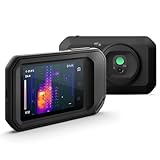
- C5: Handheld IR camera measures temperatures from -20 to 400°C (-4 to 752°F)
- IDENTIFY AND TROUBLESHOOT: Quickly find hidden faults and reduce diagnostic time with MSX and 160 x120 true thermal imaging (19,200 pixels)
- PATENTED TECHNOLOGY: Patented MSX software embosses visual details on the thermal image to create a sharper, easier to understand picture
- DOCUMENT AND SHARE: Directly upload images using FLIR Ignite cloud connectivity, then create professional reports and email them to customers
- WARRANTY: 2-10 Thermal Camera Warranty from FLIR, 2 Years parts and labor coverage on the camera, 10 Years coverage on the detector - the most vital part of the whole camera
Best for: Contractors needing portability & video
Price: $1,200–1,500 USD
Why it leads: It fits in your shirt pocket and has Cloud Connectivity. Snap a photo, and it uploads to FLIR Ignite instantly. No more losing SD cards.
Verdict: Solid mid-tier option if you need cloud integration in a pocket-sized tool.
5. Fluke PTi120 — Best Portable for Maintenance

- The new Fluke pocket Thermal Imager puts the power to minimize downtime in everyone’s hands. The first line of defense for easy troubleshooting. Stop fighting fires on the job, start preventing them. Now enhanced infrared inspections are right in your pocket for quick temperature scans of electrical equipment, machinery and other assets.
- With Fluke Connect asset tagging you eliminate the tedium of sorting and organizing your infrared images by simply scanning your asset’s QR code or bar code, your infrared image and all of your date and time stamped information will be stored to your predefined folder
- Small enough to carry every day without worry, always at hand, stands up to dirt and water, and can survive a 1-meter drop
- The 3.5” LCD touchscreen offers IR-fusion to blend a visible light image with an infrared image to more easily locate problems, simply slide your finger across the screen to adjust the setting
Best for: Industrial maintenance, quick checks
Price: ~$850–1,000 USD
Why it leads: It’s a Fluke. Drop-tested, IP54 rated, and features Asset Tagging. Scan a QR code on a machine, and the camera files the image to that asset automatically.
Verdict: The best choice if portability and durability are your top priorities.
6. Hikmicro E1L — Best for Spot Measurement

- 【Dual Camera】HIKMICRO exclusive SuperIR technology upscales the resolution of captured thermal images from 256 x 192(49,152 pixels) to 320 x 240(76,800 pixels).With < 40mK thermal sensitivity and Fusion mode by 2MP visual camera, the B10 thermal scanner has finer details on thermal images.The 25Hz frame rates offers clear and smooth thermal imaging while panning view.
- 【Accurate Measurement】With thermal sensitivity < 40mK thermal sensor, B10 thermal imaging camera controls accuracy of temperature readings discrepancy within 2%(±3.6°F). Adjustable emissivity settings and distance are designed to get greater accuracy for improved results.
- 【Fast Trouble Shooting】Blending with 2MP visual light, B10 thermal imager supports thermal, optical, fusion and PIP 4 image modes and 6 Color Palettes help to identify temperature differences efficiently. Automatic Center Spot, Hot Spot, Cold Spot 3 measurement presets, 3 user-defined spots show abnormal points more promptly, and -4°F to 1022°F wide temperature range adapts to various environments.3.2" LCD display screen shows clear imagery can quickly locate the fault area.
- 【Easy to Use】Built-in Li-Ion rechargeable battery support 6 hrs of continuous operation.16G eMMC flash storage has room for >90,000 images. Ergonomic grip handle. Audio Alarm & Warning Light remind you when the temperature is out of range. LED Work Light allows you to reach dark and hard-to-reach area. 2 meters drop resistance design.
- 【Durable and Hassle-Free Warranty】Designed with IP54 waterproof & dustproof case,and undergone 2m drop test, B10 has a long using lifespan. 3 Years for the Entire Device /10 Years for the Sensor. Lifetime Firmware Updates and Technical Support are included.
Best for: Diagnosticians, DIY, Specialists
Price: Mid-range budget
Why it leads: 25Hz Refresh Rate. Most budget cameras are 9Hz (choppy video). This is smooth, making it great for scanning moving machinery/fans.
Verdict: Excellent second tool or specialist device. Not the best ecosystem for a primary business tool, but great hardware.
THE ROI BREAKDOWN: WHAT THIS ACTUALLY COSTS
You don’t buy these cameras because they’re cool. You buy them because they pay for themselves.
Scenario: Home Inspector
- Investment: $1,050 (Camera + Meter + Training)
- Revenue: +$450/month (3 inspections/mo)
- Payback Period: 2.3 Months
- Year 1 Profit: $4,350
Scenario: Electrician (NFPA)
- Investment: $3,900 (Pro Camera + Training)
- Revenue: $8,000/year (Just 5 clients)
- Payback Period: ~6 Months
- Year 3 Revenue: $40,000+ (Recurring)
FINAL VERDICT: WHICH CAMERA FOR YOUR SITUATION?
- You’re a home inspector, starting out:
→ FLIR TG267 ($450). Proven standard. Start charging thermal premium within 30 days. - You’re an electrician with NFPA 70B compliance work:
→ FLIR E8-XT ($3,400). You need the WiFi reporting to justify $800+ fees. - You’re an HVAC tech adding diagnostics:
→ Seek Shot Series ($600–$1,000). Detail matters for ductwork. - You’re exploring without a clear use case:
→ FLIR TG267. Lowest risk. If you use it 3 times, it pays for itself.
THE BOTTOM LINE
The thermal imaging market in 2026 is where LED flashlights were in 2010. The technology is proven. Early adopters own the market. Late adopters compete on commodity pricing.
If you can’t afford to miss one electrical failure or one moisture intrusion that costs five figures, you buy the camera.
Disclaimer: ProtGuide doesn’t take money from manufacturers to write favorable reviews. We evaluate equipment based on professional utility. This guide reflects January 2026 market conditions.