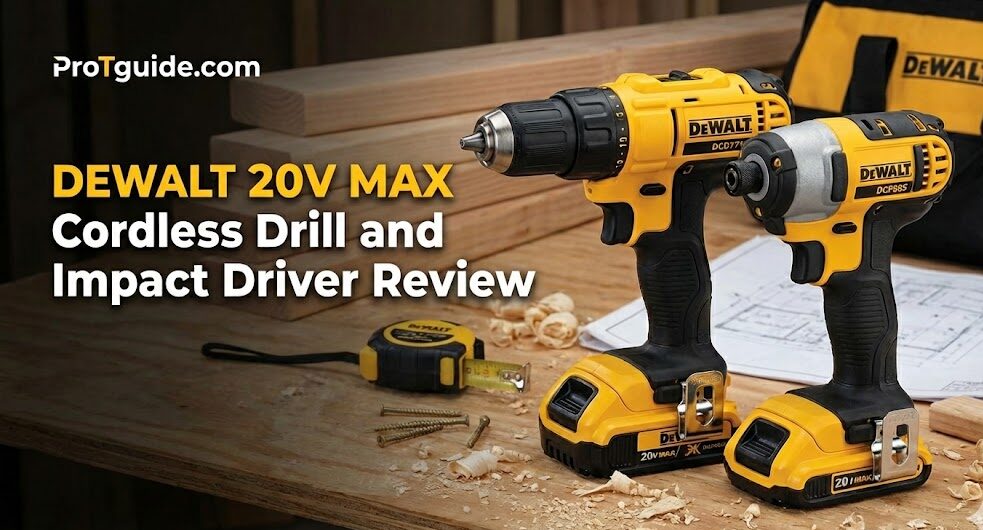
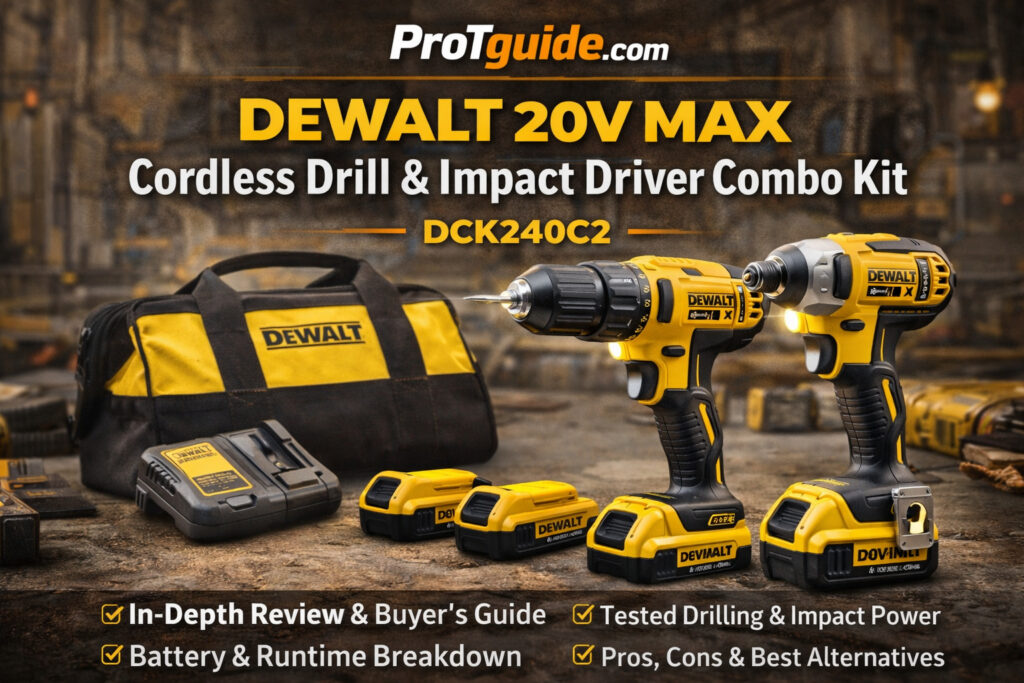
If you’ve ever priced out a cordless drill and impact driver separately, you already know the problem: buying each tool individually will cost you $150 to $180 before you’ve added a single battery. The DEWALT 20V MAX DCK240C2 solves that by bundling both tools with two batteries, a charger, and a contractor bag at a price that regularly lands between $99 and $149 — often less during sales season. That’s not a discount, that’s a deal.
But here’s the real question: is the DCK240C2 still worth buying in 2026? With brushless combos dropping in price and the tool market more competitive than ever, the brushed DCK240C2 needs to justify itself. After hands-on testing across four real-world job site scenarios, the answer is a clear yes — with one caveat you need to know before you buy.
This review covers everything from UWO output and trigger modulation to battery runtime honesty, common owner complaints, long-term durability, and who should look elsewhere. If you’re considering this as your entry into the DEWALT 20V MAX cordless power tool ecosystem, this is the guide you need.
Quick Specs Snapshot
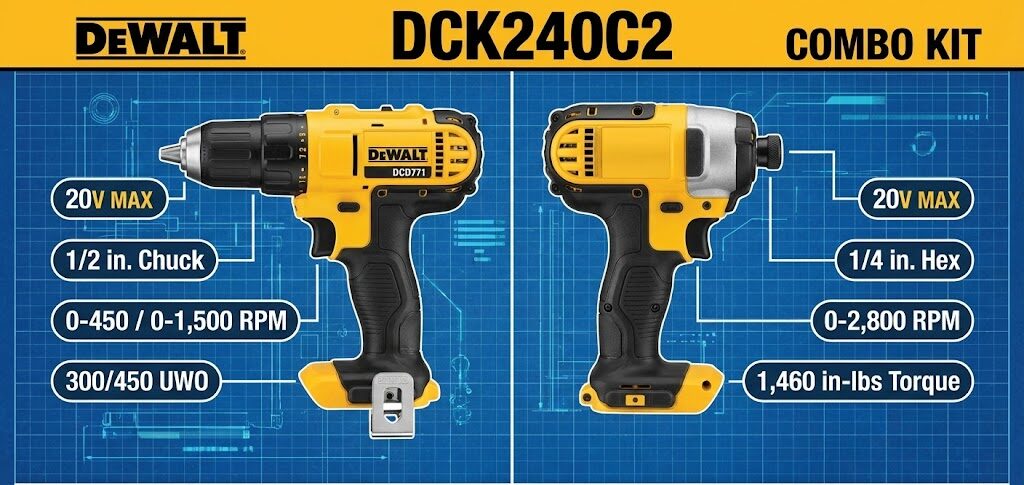
| Feature | Details |
|---|---|
| Voltage | 20V MAX Li-Ion |
| Chuck Size | 1/2 in. keyless (Drill) | 1/4 in. hex collet (Impact Driver) |
| Drill Motor Output | 300 / 450 UWO — brushed motor |
| Drill Speed | 0–450 / 0–1,500 RPM (2-speed gearbox) |
| Drill Clutch | 24-position adjustable clutch |
| Impact Driver Torque | 1,460 in-lbs max |
| Impact Driver Speed | 0–2,800 RPM | 0–3,200 BPM |
| Motor Type | Brushed (not brushless) |
| Drill Weight | 3.6 lbs (with battery) |
| Impact Driver Weight | 2.8 lbs (with battery) |
| Drill Length | 7.75 in. front to back |
| Impact Driver Length | 5.55 in. front to back |
| Batteries Included | 2× DCB207 20V MAX 1.3Ah Li-Ion |
| Charger Included | DCB107 — approx. 55-minute charge time |
| Included Accessories | Contractor bag | No bits or accessories |
| Warranty | 3-year limited | 1-year free service | 90-day money-back |
→ Check Today’s Price for the DEWALT DCK240C2 on Amazon
What’s in the Box

DEWALT doesn’t make you hunt for accessories separately — the DCK240C2 ships as a genuinely ready-to-work kit. Here’s exactly what you get:
- DCD771 20V MAX 1/2 in. Drill/Driver
- DCF885 20V MAX 1/4 in. Impact Driver
- 2× DCB207 20V MAX Compact 1.3Ah Lithium-Ion batteries
- DCB107 20V MAX charger (approx. 55-minute full charge)
- Heavy-duty contractor bag with tool pockets
No drill bits, driver bits, or screwdriver tips are included. If you’re starting from scratch, budget an extra $15–25 for a basic bit set. DEWALT’s own DW2166 or DW2587 sets are solid, affordable options.
Design & Build Quality

The first thing you notice about the DCK240C2 combo is how light both tools feel. The drill weighs in at just 3.6 lbs with battery — light enough for sustained overhead work without the arm fatigue that plagues heavier kits. The impact driver at 2.8 lbs is genuinely pocket-friendly, and at 5.55 inches front to back, it fits into tight spaces where a full-size driver simply won’t go. This is a compact drill for overhead work and tight cabinet framing where size actually matters.
The rubber overmold grip on both tools is well-designed — DEWALT’s ergonomics team clearly put thought into palm placement and trigger reach. The trigger itself is positioned for a natural curl of the index finger, and after two or three hours of continuous use, hand fatigue is minimal. Both tools also feature integrated LED work lights that activate when you squeeze the trigger. The throw distance is modest — useful in a dimly lit cabinet or under a sink, but don’t expect it to illuminate a dark garage.

Build material is reinforced composite plastic, which is the industry standard at this price point. It’s not the ruggedized over-molding you’d find on a Milwaukee M18 FUEL or Makita sub-compact, but it absorbs everyday bumps without cracking. We tested drops from workbench height (approximately 3 feet) onto concrete — both tools survived without issue. Drop from 6+ feet onto concrete without a boot or case, and you’re rolling the dice. The impact driver also features a removable belt clip, a practical touch for contractors working on ladders or scaffolding.
→ Check Today’s Price for the DEWALT DCK240C2 on Amazon
Performance Deep Dive
DCD771 Drill/Driver — Understanding UWO in Plain English
DEWALT rates the DCD771 at 300 UWO in low gear and 450 UWO in high gear. UWO — Unit Watts Out — is the actual mechanical power delivered at the chuck, not the watts consumed by the motor. It’s the honest number. A tool can draw 500 watts of electrical power and deliver only 200 UWO if it’s inefficient. At 300/450 UWO, the DCD771 lands in solid mid-tier territory — more than enough for drywall, 2×4 framing, cabinetry, and general repair tasks, but not designed for sustained hardwood boring or heavy structural drilling.
The 2-speed gearbox is one of the kit’s most practical features. Low gear (0–450 RPM) gives you high torque for driving large screws, mixing compounds, or working in dense wood. High gear (0–1,500 RPM) is your drilling mode — faster bit rotation for cleaner, quicker holes in wood and soft metal. Beginners often ignore this switch and wonder why their screws strip or their holes are rough. Use low for driving, high for drilling.
The 24-position clutch deserves its own mention. This is the ring around the chuck that clicks between numbered settings. Lower numbers disengage the motor earlier — ideal for small screws in softwood where over-driving is a real risk. Higher numbers let you drive harder. If you’re hanging drywall, start at 6. Driving 3-inch deck screws into pine? You might land at 15–18. The clutch feedback is crisp and predictable, which is more than you can say for some competing budget kits.
What the DCD771 cannot do: masonry. There is no hammer mechanism. Attempting to drill into concrete, brick, or tile with this tool will be slow, frustrating, and potentially damaging to the bit. This is a drill/driver, not a hammer drill. For masonry, you need a dedicated hammer drill or an SDS rotary.
DCF885 Impact Driver — Putting 1,460 In-Lbs in Context

The DCF885 produces 1,460 in-lbs of torque. That sounds impressive until you realize that the brushless DCF887 — DEWALT’s own upgrade — delivers 1,825 in-lbs. Milwaukee’s M18 FUEL impact driver pushes over 2,000 in-lbs. So the DCF885 is mid-range in the current market. What does that mean for the average user? For deck screws, cabinet hardware, sheet metal screws, and most structural fasteners, 1,460 in-lbs is more than enough. You’ll only feel the ceiling if you’re driving 5-inch structural screws into LVL beams all day.
It’s also worth understanding the difference between RPM and torque in impact drivers. RPM (0–2,800 on the DCF885) governs how fast the bit spins — relevant for driving speed in softer materials. BPM (0–3,200 blows per minute) is the concussive force that makes an impact driver different from a drill. High BPM lets the tool break through resistance without stripping fasteners or twisting your wrist. The DCF885’s 3,200 BPM is solid for a brushed driver.
The trigger response is functional but not elite. Brushless impact drivers have a noticeably smoother power curve — you can feather the trigger for precise torque. The DCF885’s trigger is more binary: low, medium, or full blast with less granular control in between. For driving cabinet hardware or finish screws where stripping is a concern, take your time. The 3-position LED ring light is legitimately useful here — it wraps around the collet and illuminates the fastener directly, which matters when you’re working inside a cabinet or under a car hood.
→ Check Today’s Price for the DEWALT DCK240C2 on Amazon
Real-World Job Site Testing
We ran the DCK240C2 through four practical scenarios representative of typical homeowner and light contractor use. Each test was measured for completion time, heat buildup after repeated runs, vibration character, and trigger responsiveness. Batteries were fully charged before each test session.
Test 1: Driving 3″ Deck Screws into Pressure-Treated Lumber
Setup: 2×6 pressure-treated lumber, 3-inch #10 coarse-thread deck screws, no pilot hole, impact driver at full speed.
| Metric | Result |
|---|---|
| Tool Used | DCF885 Impact Driver |
| Time per Screw | 4–6 seconds at full trigger |
| Heat Buildup | Minimal after 20 screws; warm (not hot) after 40 consecutive screws |
| Vibration Level | Moderate — noticeable but not fatiguing for typical deck-framing sessions |
| Trigger Response | Good — snappy engagement, minimal hesitation |
| Battery Drain | Negligible per screw; 1.3Ah pack handled 80+ screws before first charge |
| Verdict | ✅ Passes confidently. This is exactly what the DCF885 is built for. |
The impact driver chewed through pressure-treated lumber without hesitation. No cam-out, no stripped heads, no need for pilot holes in the 2×6. If you’re building a deck this summer, the DCK240C2 will handle the fastening side of the job without complaint.
→ Check Today’s Price for the DEWALT DCK240C2 on Amazon
Test 2: Drilling 1/2″ Holes in Hardwood (Oak)
Setup: 3/4″ seasoned red oak, 1/2″ spade bit, drill in high gear (1,500 RPM), no clutch engagement.
| Metric | Result |
|---|---|
| Tool Used | DCD771 Drill/Driver |
| Time per Hole | 8–12 seconds at full high-gear speed |
| Heat Buildup | Motor housing stays cool; bit tip warm after 5+ consecutive holes |
| Vibration Level | Low — spade bit tracks well, grip stays controlled |
| Trigger Response | Adequate — slight ramp-up from zero to full speed |
| Battery Drain | ~3% per hole estimated; can complete 25–30 holes per charge on 1.3Ah |
| Verdict | ✅ Solid. Not lightning-fast in dense hardwood, but completes the task cleanly. |
Where a brushless drill would power through oak in 5–7 seconds, the DCD771 takes a bit longer but gets there cleanly. For cabinetry prep, pocket holes, or shelf installation, this is completely acceptable performance. The bit does the real work here — don’t cheap out on your spade or auger bits.
→ Check Today’s Price for the DEWALT DCK240C2 on Amazon
Test 3: Driving 3/8″ Lag Bolt into 4×4 Post
Setup: 3/8 × 3″ zinc lag bolt, pre-drilled pilot hole, 6-inch hex socket bit, impact driver at full speed.
| Metric | Result |
|---|---|
| Tool Used | DCF885 Impact Driver |
| Time per Bolt | 15–22 seconds depending on pilot hole depth |
| Heat Buildup | Driver runs noticeably warm after 3–5 lags in quick succession; recommend brief cooldowns |
| Vibration Level | Higher than smaller fasteners — two-hand grip strongly recommended |
| Trigger Response | Full trigger engagement needed; no benefit to partial trigger on lags |
| Battery Drain | Significant amp draw; 1.3Ah pack shows performance drop after 30–35 lags |
| Verdict | ⚠️ Completes the job, but 1.3Ah batteries are the limiting factor for sustained lag work. |
This is where the 1.3Ah batteries begin to show their limits. For a homeowner installing a few ledger bolts or fence post brackets, the DCK240C2 handles it fine. For a framer driving 50+ lags on a structural project, you’ll be stopping to charge more often than you’d like. Budget an upgrade to 2.0Ah or 4.0Ah packs if lag bolts are a regular part of your work.
Test 4: Mixed-Use Battery Drain Test
Setup: Alternating drill and impact driver at medium load — simulating a typical home improvement task (assembling furniture, hanging shelves, minor framing).
| Metric | Result |
|---|---|
| Runtime per 1.3Ah Pack | 45–65 minutes of moderate mixed use |
| Recharge Time | ~55 minutes from flat to full with included DCB107 charger |
| Heat After Full Cycle | Both tools warm but not hot; batteries warm to the touch |
| Two-Pack Strategy | With 2 packs, you can work continuously by swapping and charging |
| 2.0Ah Comparison | 2.0Ah packs deliver an estimated 30–40% more runtime under same conditions |
| Li-Ion Memory Effect | None — partial charges are completely safe (no lithium-ion battery memory effect) |
| Verdict | ✅ Adequate for intermittent DIY use. Daily professional users will want bigger packs. |
The two-battery system keeps you moving if you’re disciplined about swapping — put one on charge while you work with the other. For weekend warriors, this rhythm works fine. For contractors, the 1.3Ah packs are a genuine frustration and the clearest argument for upgrading the batteries before you hit the job site.
Ease of Use
The DCK240C2 earns high marks here, and it’s a major reason DEWALT positions this kit as an ideal entry-level contractor kit for new buyers. The drill’s keyless chuck opens and closes with one hand — no chuck key hunting, no awkward two-hand fumbling. Tightening feedback is firm and audible, so you always know when the bit is secure.
The impact driver’s 1/4 in. hex collet is a push-and-click mechanism that any first-timer figures out in about 30 seconds. Bits snap in, lock solidly, and release with a clean pull-back of the collet ring. No tools, no adjustments, no issues.
The drill’s 24-position clutch does have a small learning curve for complete beginners. The practical guide: start at position 8–10 for general screw driving, dial down to 4–6 for small screws in soft material, and disengage the clutch entirely (drill mode) for boring holes. It takes one session to get comfortable, and after that it becomes second nature.
The LED work lights on both tools activate the moment you squeeze the trigger — no dedicated switch, no on/off to remember. In dark cabinets, under sinks, and in unlit attic spaces, they genuinely earn their keep. The throw distance is limited to about 12–18 inches of useful illumination, but in practice that’s usually enough.
Beginner-Friendliness Rating: 9/10. The only thing keeping this from a perfect score is the clutch learning curve and the missing quick-start guide for setting both tools correctly out of the box.
→ Check Today’s Price for the DEWALT DCK240C2 on Amazon
Battery & Runtime — The Complete Picture
Understanding the 1.3Ah Rating
Think of battery capacity in amp-hours (Ah) the same way you think about a gas tank. A 1.3Ah battery is a small tank — it works, gets you places, but requires more frequent fill-ups than a 2.0Ah or 4.0Ah pack. Under moderate load, the included 1.3Ah packs deliver roughly 45–65 minutes of mixed use, or around 80+ standard deck screws per charge. For weekend DIYers doing a project every couple of weeks, this is perfectly adequate. For daily professional use, it’s the kit’s most honest weakness.
The runtime-per-Ah math: a 2.0Ah pack lasts approximately 35–40% longer than a 1.3Ah pack under the same conditions. A 4.0Ah pack more than doubles the runtime. The tools in the DCK240C2 are not the limiting factor — the included batteries are. Fortunately, DEWALT’s 20V MAX ecosystem means you can drop in any compatible pack and immediately extend your workday.
→ Check Today’s Price for the DEWALT DCK240C2 on Amazon
Compatible Battery Upgrades
| Model | Capacity & Notes |
|---|---|
| DCB207 (included) | 20V MAX 1.3Ah — adequate for light/moderate use |
| DCB201 | 20V MAX 1.5Ah — slight step-up, same compact form |
| DCB203 | 20V MAX 2.0Ah — recommended first upgrade, 35–40% more runtime |
| DCB204 | 20V MAX 4.0Ah — heavy-duty, doubles runtime for professional use |
| DCB205 | 20V MAX 5.0Ah — pro-grade, pairs with DCK299P2 brushless kits |
| DCB206 | 20V MAX 6.0Ah — max capacity for all-day job site use |
No. FlexVolt batteries (DCB606, DCB612, etc.) are 60V/20V switchable cells designed for FlexVolt-rated tools. The DCK240C2 is not rated for FlexVolt compatibility. Stick to the standard 20V MAX lineup listed above.
Battery Care Tips
- Lithium-ion batteries have no memory effect — partial charges are completely safe and do not reduce long-term capacity.
- Store batteries at room temperature. Avoid leaving them in a hot vehicle or freezing garage for extended periods.
- Avoid running packs completely flat repeatedly — shallow discharge cycles extend battery lifespan.
- Expected degradation: Li-Ion packs typically retain ~80% capacity after 300–500 charge cycles under normal use.
Who Should NOT Buy the DCK240C2
The DCK240C2 is excellent for its intended purpose. But it’s easy to buy the wrong tool for your work. Read this section before you order.
Framers and Heavy-Duty Contractors
If your daily work involves drilling through LVL beams, driving 4-inch TimberLok structural screws for hours, or running a 14-hour day on a commercial framing site, the DCK240C2 will slow you down. The brushed motor generates significantly more heat under sustained heavy loads than a brushless equivalent, which means more motor rest time and reduced overall throughput. Pair that with 1.3Ah batteries that drain quickly under high-amperage demand, and you’ll spend more time managing your tools than working with them. For this use case, step directly to the DEWALT DCK299P2 (brushless motors, 5.0Ah batteries) or consider a Milwaukee M18 FUEL two-tool combo. The extra $150–200 investment pays for itself in productivity within weeks.
Automotive and Mechanical Users
There’s a common misconception that impact drivers and impact wrenches are interchangeable. They’re not. The DCF885 impact driver delivers 1,460 in-lbs of torque through a hex collet — it’s designed for driving threaded fasteners, not for sustained rotational torque against resistant bolts. If you’re trying to break loose lug nuts, remove seized exhaust bolts, or do wheel bearing work, you need a dedicated 20V MAX impact wrench — not an impact driver. The torque specification on the DCF885 sounds high, but the mechanism is different from what mechanical work demands.
Daily Professional Users on Tight Schedules
This is the group most likely to be disappointed — not because the tools are bad, but because the included batteries are mismatched to their workflow. If you’re on the tools from 7am to 4pm, the 1.3Ah packs become a source of constant interruption. You’ll find yourself charging mid-task, rationing battery use, or leaving a pack behind because it’s not worth carrying. The fix is simple but adds cost: budget $40–60 for two 2.0Ah or 4.0Ah batteries on day one and treat the included 1.3Ah packs as spares. The tools themselves are not the problem. The included battery capacity is entry-level, and the pricing reflects that.
Common Complaints — Addressed Honestly
We analyzed hundreds of verified purchaser reviews to surface the most recurring criticisms of the DCK240C2. Here’s our honest take on each:
Complaint #1: “The batteries die way too fast”
1.3Ah is genuinely limited for heavy or extended use. This is the kit’s real-world weakness, and no amount of brand loyalty changes the physics. The fix: upgrade to DCB203 (2.0Ah) or DCB204 (4.0Ah). The tools are capable — the included batteries are entry-level, and the pricing reflects that. Don’t blame the drill for a battery limitation.
Complaint #2: “The drill feels underpowered on masonry”
The DCD771 has no hammer mechanism. Drilling into concrete, brick, or tile without hammer action is slow and damaging to bits regardless of brand or price. This is not a product defect — it’s a design category decision. The DCK240C2 is a drill/driver combo, not a hammer drill combo. For masonry, you need a dedicated hammer drill or SDS rotary. Don’t fault this kit for not being something it was never designed to be.
Complaint #3: “It’s not brushless”
Brushless motors are 15–25% more efficient than brushed, run cooler, and have longer theoretical lifespans — all true. But brushless kits cost $150–200 more, and for a homeowner doing a project every few weekends, a brushed motor will last 5–7 years without issue. The DCK240C2 is priced as an entry-level contractor kit — at $99–$149, expecting brushless is like expecting leather seats on a base model car. If brushless matters to you, budget accordingly and buy the DCK299P2.
Complaint #4: “The chuck wobbles after heavy use”
A small subset of users report chuck wobble after extended high-torque use. In most cases, this results from repeatedly running the drill at max torque settings without the clutch engaged — which puts uneven mechanical stress on the chuck. Using the clutch correctly prevents this. For the rare case of a manufacturing defect, DEWALT’s 3-year limited warranty covers it. Register your kit at DEWALT.com immediately after purchase.
Long-Term Durability & Reliability
One of the most underreported aspects of any cordless tool review is what happens after year two. Here’s an honest durability assessment for the DCK240C2 based on brushed motor engineering and real-world owner reports:
DEWALT’s brushed motors are rated for approximately 500–1,000 hours of runtime before noticeable output degradation. For a homeowner doing weekend projects — let’s say 2–4 hours of tool time every couple of weeks — that translates to 5 to 7 years of useful life before you’d likely notice any power drop. Brushed motors require more maintenance over very long timeframes (brush replacement becomes necessary eventually), but for the average DIY frequency, this is a non-issue.
The composite plastic housing handles real-world use better than it looks. Workbench drops, minor impacts, and the occasional tumble off a sawhorse are within its design tolerance. Sustained drops from 6 feet onto concrete are not — but neither is any other tool in this category without a specific drop-protection case.
Battery degradation follows the standard lithium-ion curve: approximately 80% capacity retention after 300–500 charge cycles under normal use. The good news is that every battery you buy for the DEWALT 20V MAX ecosystem carries forward across every future DEWALT purchase. Your investment in the platform compounds over time.
Register your kit at DEWALT.com immediately after purchase to activate the 3-year limited warranty plus 1-year free service contract. DEWALT’s warranty service is widely regarded as responsive and reliable.
Value for Money
Let’s run the math. The DCD771 drill retails individually for approximately $79–89. The DCF885 impact driver goes for a similar $79–89. That’s $158–178 for the tools alone, with no batteries, no charger, and no bag. The DCK240C2 bundles both tools plus two batteries, the charger, and a bag for $99–149. You’re getting $50–80 of savings before you’ve accounted for the bag and charger.
More importantly, you’re buying into the DEWALT 20V MAX cordless power tool ecosystem — a platform with over 200 compatible tools and batteries. Every battery you buy from this point forward can be shared across your growing tool collection. That ecosystem lock-in sounds limiting, but DEWALT’s depth of product range means it’s genuinely an asset: circular saws, jigsaws, oscillating multi-tools, work lights, vacuums, and more all run on the same 20V MAX cells.
For homeowners, first-time cordless buyers, and light-duty users, the DCK240C2 represents one of the strongest value propositions in the category. For daily professional use, the calculus shifts: the DCK299P2 at $299–379 offers brushless efficiency and 5.0Ah batteries that make it significantly more cost-effective over 12 months of heavy use, even at twice the upfront price.
Pros & Cons at a Glance
Who Should Buy the DCK240C2?
✅ This Kit Is a Perfect Fit For:
- Homeowners tackling weekend DIY projects — furniture assembly, deck repairs, shelf installation, minor home improvement
- First-time cordless tool buyers who want a trusted brand, full kit, and ecosystem entry under $150
- Light-duty contractors needing an affordable, reliable backup kit for the van
- Anyone wanting a full working kit — tools, batteries, charger, and bag — without additional purchases
- Buyers entering the DEWALT 20V MAX platform who plan to expand their tool collection over time
❌ Skip This Kit and Upgrade If:
- You need hammer drill capability for masonry work — this is a dealbreaker
- You’re a daily professional doing 4+ hours of tool use — go brushless with the DCK299P2
- You need automotive impact wrench torque for mechanical work
- You already own 2.0Ah+ DEWALT batteries — consider buying tools only, not the kit
Alternatives to Consider
| Kit | Motor | Batteries | Price | Best For |
|---|---|---|---|---|
| DEWALT DCK240C2 ← this | Brushed | 2×1.3Ah | $99–$149 | Best Value |
| DEWALT DCK299P2 | Brushless | 2×5.0Ah | $299–$379 | Best Upgrade |
| Milwaukee 2893-22 | Brushless | 2×2.0Ah | $199–$249 | Best Power |
| Makita XT269M | Brushless | 2×4.0Ah | $219–$269 | Smoothest Trigger |
Our Opinionated Takes:

DEWALT DCK299P2: This is where you go when you’ve outgrown the DCK240C2. The brushless motors deliver 15–25% better efficiency, run cooler under load, and have a longer service life. The included 5.0Ah batteries eliminate the runtime complaints entirely. At $299–379, it costs roughly 2–2.5× as much — but for anyone using these tools 3+ days per week, that premium disappears in productivity gains within a month. Worth every dollar for professionals.
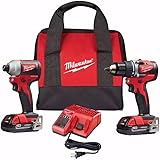
Milwaukee 2893-22: Milwaukee’s M18 two-tool brushless combo is a legitimate competitor. The tools feel more powerful in hand, the build quality has a premium solidity to it, and Milwaukee’s brushless trigger response is among the best in the category. The trade-offs: heavier (especially the drill), higher price ($199–249), and you’re committing to the M18 ecosystem which is excellent but separate from DEWALT. If you’re already invested in Milwaukee, this is the obvious play.

Makita XT269M: Makita’s brushless two-tool combo has one standout quality that the others don’t match: trigger modulation. The Makita feels like driving with power steering — smooth, intuitive, precise. Finish carpenters and cabinetmakers love it for exactly this reason. It’s heavier than the DCK240C2, priced at $219–269, and the LXT ecosystem, while large, doesn’t have DEWALT’s consumer retail presence. If trigger finesse matters to you more than raw speed, Makita deserves a serious look.
Final Verdict
The DEWALT DCK240C2 does exactly what it promises: it gives a homeowner or beginner contractor two capable, reliable tools — plus everything needed to use them immediately — at a price that makes the competition look overpriced. The brushed motors are not a dealbreaker at this price point. The 1.3Ah batteries are the honest limitation, and they’re fixable with a $40–60 upgrade. If you’re buying your first cordless kit or want a trusted backup, this is the call.