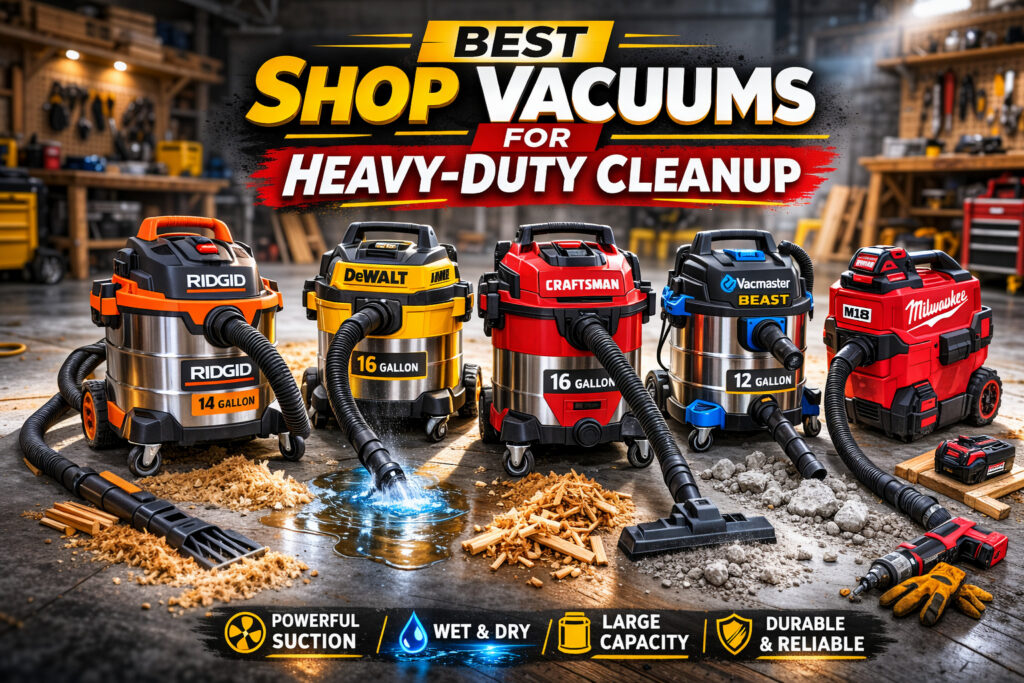
Let’s be honest: whether you’re a contractor in Phoenix or a DIYer in Seattle, your standard household vacuum isn’t going to cut it in the garage or on a job site. If you try to suck up drywall dust, wood chips, or a flooded basement with a regular upright, you’re going to kill the motor—or at the very least, clog it instantly.
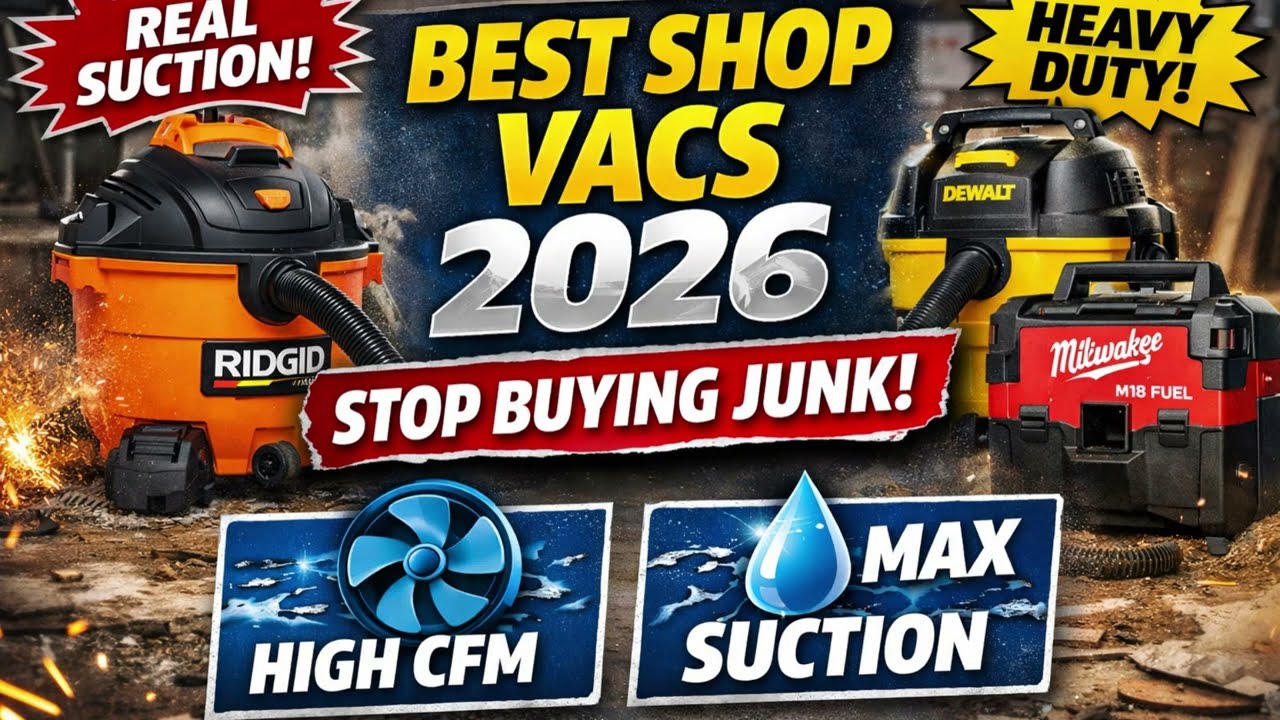
When you’re dealing with “heavy-duty” messes—we’re talking chunks of concrete, wet sludge, or gallons of water—you need a machine built for abuse. A true shop vac (wet/dry vacuum) handles the stuff that would destroy a Dyson. Whether you are a contractor, a woodworker, or just a homeowner who takes DIY seriously, this guide breaks down the best heavy-duty options available right now from trusted brands like RIDGID, DeWalt, Milwaukee Tool, Craftsman, Shop-Vac, and Vacmaster.
🔧 Quick Picks: At-a-Glance Recommendations
If you just want the gear and want to get back to work, here are the top performers based on testing and specs:
- Best Overall: RIDGID 14-Gallon NXT (HD1400) — Ideally balanced power, durability, and the industry-best lifetime service agreement. $179-199
- Best for Construction Sites: DeWalt 16-Gallon Poly Wet/Dry Vac (DXV16PA) — Massive suction power (water lift) and tough build quality. $249-279
- Best for Large Workshops: Craftsman 16-Gallon 6.5 Peak HP (CMXEVBE17595) — Incredible airflow (CFM) for moving huge piles of sawdust quickly. $199-229
- Best Value: Vacmaster Beast Series 14-Gallon (VBV1210) — High suction power for a price that beats the big brands. $129-149
- Best Cordless: Milwaukee M18 FUEL 6-Gallon (0880-20) — The go-to for pros already on the Milwaukee battery platform; excellent portability. $249 (tool only)
- Best for Fine Dust: Shop-Vac 12-Gallon Stainless Steel (5761311) — A classic design that pairs well with high-efficiency bags for drywall dust. $189-209
What Makes a Shop Vacuum “Heavy-Duty”? Understanding CFM vs. Water Lift
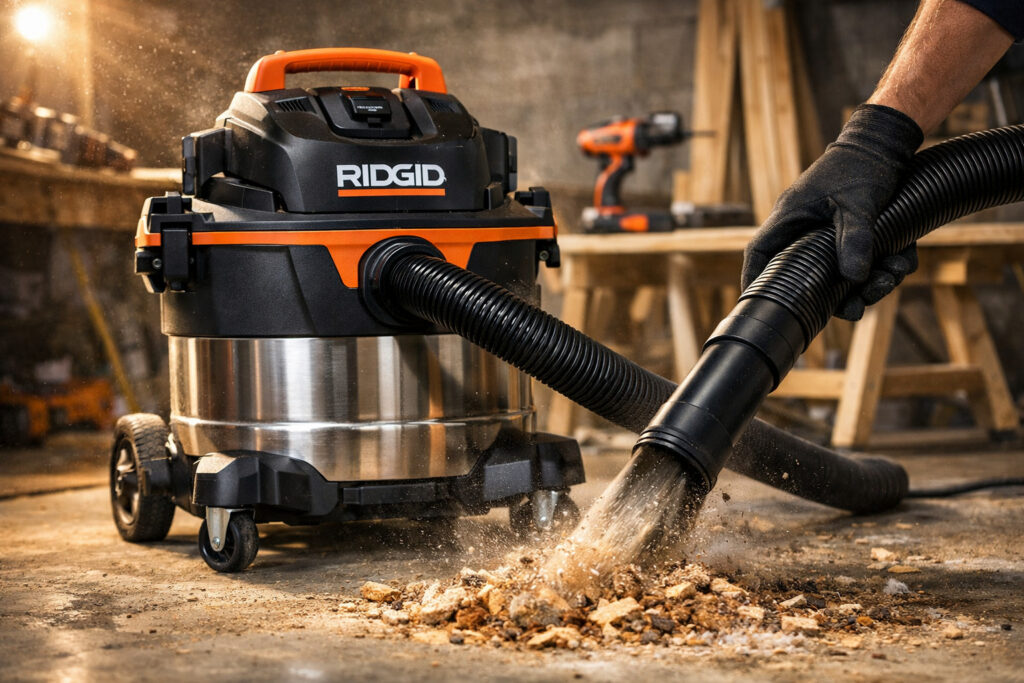
You see “Peak Horsepower” plastered all over the boxes, but that number is largely marketing fluff. It represents the power the motor draws for a split second at startup with no load before it settles into operating mode—not what it runs at continuously. If you want to know if a vac can actually handle a heavy job, look at these two numbers instead:
1. CFM (Cubic Feet per Minute): Airflow Volume
This measures airflow volume—how much air the vacuum moves. Think of it as the speed of the wind. High CFM is what you need to move light, bulky debris like sawdust, leaves, and wood chips quickly. The Craftsman 16-gallon, for example, hits a massive 274 CFM, making it a beast for general sweeping and clearing large volumes of dry debris.
Why CFM matters: Higher CFM means faster pickup of bulk materials. If you’re cleaning a workshop floor covered in sawdust or clearing out a garage full of leaves, CFM is your friend.
2. Water Lift (Sealed Suction): Suction Force
This measures the pure “muscle” of the vacuum—its suction force. It’s usually measured in inches of water column. You need high water lift to pull heavy stuff—like water, wet sand, bolts, embedded dirt, or sludge—up through the hose. The DeWalt DXV16PA excels here with exceptional water lift performance, whereas many competitors sit around 4-5 pounds of pull force.
Why water lift matters: When you’re extracting water from a flooded basement, pulling concrete slurry, or vacuuming embedded debris from carpet, water lift is what gets the job done.
The Bottom Line: Peak HP is often measured at startup with no load. It is not sustained operating power. Brands like RIDGID, DeWalt, and Milwaukee focus on real-world CFM and water lift performance because those numbers actually matter when you’re grinding concrete or sanding drywall for hours.
Tank Material: Plastic vs. Stainless Steel
You might think stainless steel is tougher, but high-quality polypropylene (plastic) tanks are often better for heavy-duty use. Plastic tanks bounce back when you bang them into a doorframe; stainless steel dents. However, stainless steel is easier to clean out if you are dealing with nasty liquids, oil spills, or biological messes. Shop-Vac and some RIDGID models offer stainless steel tanks specifically for commercial cleaning applications.
Filtration Systems: What You Need to Know
The filtration system determines what materials you can safely vacuum without destroying the motor or contaminating your workspace:
- Standard cartridge filters: Good for general debris, wood chips, and dry materials
- HEPA filters: Required for drywall dust, concrete dust, and fine particles (Shop-Vac offers true HEPA models)
- Foam sleeves: Used for wet pickup; remove paper/cartridge filters before vacuuming liquids
- High-efficiency dust bags: Capture fine particles before they hit the filter, extending filter life
Heavy-Duty Durability Features
What separates a heavy-duty shop vac from a homeowner model:
- Hose diameter: 2.5″ diameter prevents clogging with large debris (standard on DeWalt and Milwaukee professional models)
- Anti-static hoses: Prevent static buildup when vacuuming electronics or in dry environments
- Reinforced wheels and casters: Milwaukee’s all-terrain wheels handle job site conditions
- Drain ports: Essential for wet cleanup—avoid lifting 16 gallons of water (130+ lbs)
- Auto-shutoff float valves: Prevent overfilling when vacuuming liquids
- Blower function: Many models reverse airflow for clearing debris from garages or workshops
- Accessory storage: Onboard storage keeps attachments organized (Craftsman excels here)
Power Source & Electrical Requirements: What Contractors Need to Know
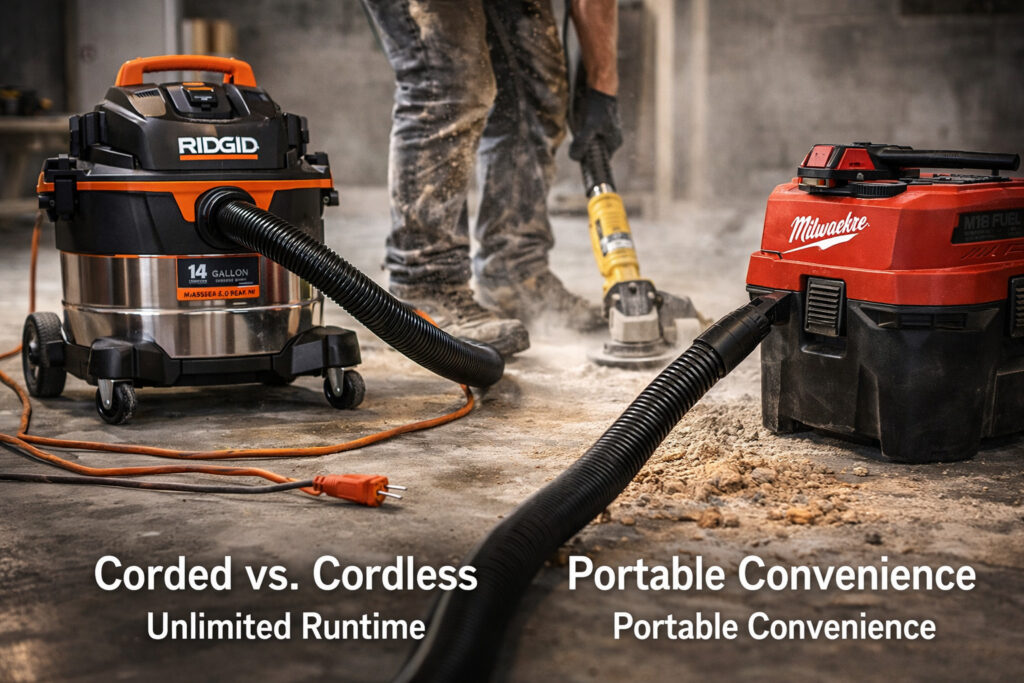
For true heavy-duty work, corded models are still king. Battery-powered vacs have come a long way, but they trade runtime for convenience. A corded model gives you consistent high suction from start to finish, which is critical when you are grinding concrete or sanding drywall for hours.
Corded vs. Cordless: The Real Trade-Offs
Corded advantages:
- Unlimited runtime for all-day jobs
- Consistent power delivery—no fade as batteries drain
- Higher sustained CFM and water lift numbers
- Lower cost per hour of operation
Cordless advantages (Milwaukee M18, DeWalt 20V MAX):
- Perfect for quick cleanup or punch-list items
- No outlet hunting on large job sites
- Excellent portability between floors or buildings
- Integration with existing tool battery platforms
However, for quick cleanup or punch-list items, cordless is unbeatable. If you are just cleaning up a quick spill or vacuuming a truck, a unit like the Milwaukee M18 FUEL is perfect because you aren’t hunting for an outlet.
Job Site Electrical Considerations
Professional contractors need to consider these electrical factors:
- Amp draw: Most heavy-duty shop vacs draw 10-12 amps. On a 15-amp circuit, you can’t run power tools simultaneously without tripping breakers.
- Extension cord requirements: Use 12-gauge or heavier for runs over 50 feet to prevent voltage drop and motor damage
- Generator compatibility: For remote job sites, verify your generator can handle the startup surge (often 2-3x running amps)
- Circuit sharing: Plan your power layout—don’t run multiple shop vacs on the same circuit
- Cold weather starting: DeWalt and RIDGID motors are designed for reliable cold-weather performance on winter job sites
120V vs. 240V Models
While rare in the portable shop vac market, some industrial facilities use 240V models for higher power output with lower amp draw. These are typically stationary systems rather than portable units. For 99% of contractors and workshops, standard 120V models from RIDGID, DeWalt, and Craftsman provide all the power you’ll need.
Top Heavy-Duty Shop Vacuum Recommendations: In-Depth Reviews
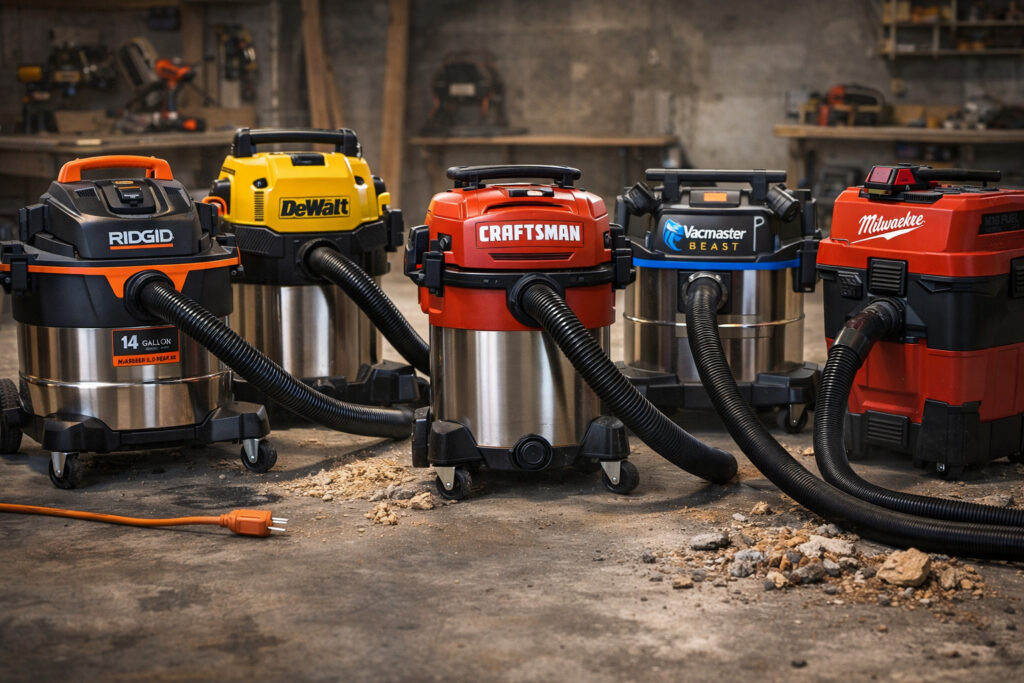
1. Best Overall: RIDGID 14-Gallon NXT (HD1400)

Specs: 6.0 Peak HP | 14 Gallons | ~165 CFM | 75 inches water lift
Price: $179-199 (Home Depot)
Warranty: Full Lifetime Service Agreement (LSA)
Filter: Standard cartridge (VF4000 style), HEPA upgrade available
This is the workhorse you see on almost every job site, and for good reason. RIDGID vacs are renowned for their durability and the industry’s best warranty program. The polymer drum is thick and resists cracking, and the “NXT” design features locking accessories, so the hose doesn’t fly off while you’re dragging it around.
Why it’s the best overall: The combination of solid performance, proven reliability, and RIDGID’s Lifetime Service Agreement makes this the safest long-term investment. When something breaks (and eventually something will on any shop vac), you can walk into any Home Depot for free service—no receipts required after registration.
Pros:
- Large drain port for easy liquid disposal
- Locking hose connection prevents disconnection during use
- RIDGID’s legendary Full Lifetime Warranty covers parts, service, and labor
- Wide stance provides excellent stability
- Strong CFM and water lift balance for all-around performance
Cons:
- Can be bulky to store in smaller workshops
- Moderate noise level (typical for this class)
Best for: Contractors and serious DIYers who want a reliable workhorse backed by the best warranty in the industry. Ideal for general construction, renovation work, and workshop cleanup.
Replacement filter cost: $15-20 for standard cartridge, $35-45 for HEPA upgrade
2. Best for Construction Sites: DeWalt 16-Gallon Poly Wet/Dry Vac (DXV16PA)
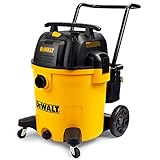
Specs: 6.5 Peak HP | 16 Gallons | 116 CFM | Exceptional water lift
Price: $249-279
Warranty: 3-year limited warranty
Filter: Fine dust cartridge included
While the CFM is lower than the Craftsman, the suction pressure (water lift) on this DeWalt is massive. This means it won’t clog as easily when pulling heavy debris like wet concrete slurry, metal fasteners, or nails. It features a rubberized hose strap for management and unmatched build quality that handles the abuse of daily construction work.
Why it’s best for construction: The exceptional water lift makes this vacuum ideal for the toughest job site conditions—concrete cutting dust, wet cleanup after drilling, and heavy debris that would choke other vacuums. DeWalt’s Stealthsonic technology also makes it significantly quieter than competitors, which matters when working in occupied buildings.
Pros:
- Extremely high suction pressure prevents clogging with heavy debris
- Very quiet operation for its class (Stealthsonic technology)
- Rugged wheels designed for rough terrain and job site conditions
- Integrated cord wrap and accessory storage
- Built to DeWalt’s professional tool standards
Cons:
- Lower airflow volume (CFM) means it cleans light dust slightly slower than high-CFM models
- Higher price point than competitors
- Heavier when full due to larger tank capacity
Best for: Professional contractors working on construction sites, renovation projects, and demolition work. Ideal when you need maximum suction force for heavy, wet, or embedded debris.
Replacement filter cost: $18-25 for standard fine dust cartridge
TCO Note: DeWalt backs this with a 3-year limited warranty—longer than most competitors but shorter than RIDGID’s lifetime coverage. However, the superior build quality often means fewer repairs needed.
3. Best for Large Workshops: Craftsman 16-Gallon 6.5 Peak HP (CMXEVBE17595)

Specs: 6.5 Peak HP | 16 Gallons | 274 CFM | 64 inches water lift
Price: $199-229
Warranty: 3-year limited warranty
Filter: Standard cartridge filter
If your primary enemy is sawdust, this is your vacuum. With an airflow rating of 274 CFM, it moves more air than almost anything else in its class—making it exceptionally fast at clearing large volumes of dry debris. It features a “Dual-Flex” hose that resists kinking and a blowing port that can blast leaves out of a garage door in seconds.
Why it’s best for workshops: The industry-leading CFM rating means this vacuum clears workshop floors faster than any competitor. When you’re done with a day of woodworking and have piles of sawdust and shavings everywhere, this vacuum makes cleanup quick.
Pros:
- Industry-leading 274 CFM airflow for rapid bulk debris pickup
- Excellent for dry materials: sawdust, wood chips, leaves, and general shop mess
- Good onboard tool storage keeps accessories organized
- Powerful blower function for garage and workshop cleanup
- Large tank capacity reduces emptying frequency
Cons:
- It is loud—wear ear protection (80+ dB)
- Lower water lift than DeWalt means slightly less effective for wet/heavy debris
- Hose can be stiff in cold weather
Best for: Woodworkers, workshops with table saws and planers, and anyone dealing with high volumes of lightweight dry debris. Also excellent for garage cleanup and leaf removal.
Replacement filter cost: $12-18 for standard cartridge
4. Best Value: Vacmaster Professional Beast Series 14-Gallon (VBV1210)

Specs: 5.0 Peak HP | 12 Gallons | High suction (94 inches water lift)
Price: $129-149
Warranty: 2-year limited warranty
Filter: Cartridge filter included
Don’t let the price tag fool you; the “Beast” series punches above its weight. In tests, it showed exceptional water lift (94 inches), making it surprisingly good at extracting liquid from carpets, upholstery, or flooded areas. While not as refined as RIDGID or DeWalt, it delivers genuine heavy-duty performance at a budget-friendly price.
Why it’s the best value: You get professional-grade suction power at nearly half the price of premium brands. For homeowners who need heavy-duty performance a few times a month rather than daily, this is an excellent choice.
Pros:
- Exceptional suction-to-price ratio
- Stable wide-stance caster design prevents tipping
- Strong water lift performance rivals more expensive models
- Good build quality for the price point
- Includes multiple attachments
Cons:
- The hose can be a bit short for some users (6 feet standard)
- Loud operation (no sound dampening technology)
- Shorter warranty than premium brands
- Less refined accessory storage
Best for: Budget-conscious homeowners and DIYers who need genuine heavy-duty performance without the premium price tag. Ideal for occasional professional use or frequent home workshop tasks.
Replacement filter cost: $10-15 for standard cartridge (affordable long-term)
5. Best Cordless Heavy-Duty: Milwaukee M18 FUEL 6-Gallon

Specs: 18V Battery | 6 Gallons | 87 CFM
Price: $249 (tool only), $349 (with 6.0Ah battery and charger)
Warranty: 3-year limited warranty
Runtime: 20-30 minutes continuous with 6.0Ah battery
If you are already on the Red Team (Milwaukee battery platform), this is a no-brainer. It effectively bridges the gap between a portable toolbox vacuum and a full-sized unit. It cleans up wet messes quickly and the stackable design (compatible with Milwaukee PACKOUT) keeps your truck or workshop organized.
Why it’s the best cordless: Milwaukee’s M18 FUEL line delivers genuinely impressive power for a battery-powered vacuum. The 87 CFM rivals some corded models, and the convenience factor for quick cleanups on large job sites is unmatched.
Pros:
- Runs on the same batteries as your Milwaukee drills, saws, and other tools
- Modular PACKOUT design stacks with other Milwaukee storage
- Easy foot-release canister for quick emptying
- Genuine heavy-duty performance without cords
- Onboard hose and accessory storage
- Quick cleanup between tasks without hunting for outlets
Cons:
- Expensive if you don’t already own Milwaukee M18 batteries ($100+ per battery)
- Limited runtime compared to corded (20-30 minutes per battery)
- Smaller 6-gallon capacity requires more frequent emptying
- Suction power decreases as battery drains
Best for: Contractors and professionals already invested in the Milwaukee M18 ecosystem. Perfect for mobile work, quick cleanups, truck detailing, and job sites where running extension cords is impractical.
Replacement filter cost: $15-22 for Milwaukee-branded filters
Battery ecosystem note: If you’re running 10+ Milwaukee tools, the battery interchangeability justifies the investment. If you’re in a different ecosystem (DeWalt, Makita), consider their cordless options instead.
6. Best for Fine Dust: Shop-Vac 12-Gallon Stainless Steel (5761311)

Specs: 6.5 Peak HP | 12 Gallons | 180 CFM
Price: $189-209
Warranty: 2-year limited warranty
Filter: High-efficiency cartridge, HEPA compatible
A classic design from the company that invented the shop vac. Shop-Vac Corporation specializes in filtration, and this model pairs perfectly with high-efficiency dust bags for capturing drywall dust, concrete dust, and other fine particles that would clog and ruin standard vacuums.
Why it’s best for fine dust: Shop-Vac’s expertise is in filtration engineering. This model, when paired with proper high-efficiency bags and optional HEPA filters, can handle OSHA Table 1 silica dust compliance requirements for small tools—critical for contractors cutting or grinding concrete.
Pros:
- Stainless steel tank is easy to clean and chemical-resistant
- Excellent compatibility with high-efficiency dust bags
- Optional HEPA filter upgrade for maximum fine particle capture
- Balanced CFM and water lift for versatile performance
- Shop-Vac’s proven reliability and parts availability
Cons:
- Stainless steel tank can dent if dropped or hit hard
- Higher noise level than DeWalt’s Stealthsonic models
- Shorter warranty than RIDGID or premium brands
Best for: Drywall contractors, concrete workers, and anyone dealing with fine dust that requires superior filtration. Essential when OSHA silica dust compliance matters.
Replacement filter cost: $18-25 for high-efficiency cartridge, $45-60 for true HEPA filter
Dust bag cost: $12-18 for pack of 2-3 high-efficiency bags (highly recommended for fine dust work)
Key Features to Consider When Buying a Heavy-Duty Shop Vac
Power and Performance: Matching to Your Needs
How much suction do you actually need? It depends entirely on what you’re cleaning:
- Light dry debris (sawdust, leaves): Prioritize CFM over water lift. Craftsman’s 274 CFM excels here.
- Heavy wet debris (water, sludge, concrete slurry): Prioritize water lift over CFM. DeWalt’s exceptional suction force wins.
- Mixed use (most people): Balanced specs like RIDGID’s 165 CFM and 75″ water lift handle everything well.
- Fine dust (drywall, concrete): Filtration matters more than raw power. Shop-Vac with HEPA is your answer.
Remember: More peak HP doesn’t always mean better performance. A 5.0 HP motor with excellent CFM and water lift beats a poorly-designed 6.5 HP motor every time.
Capacity Requirements: Size Matters
- 6-9 gallons: Sufficient for quick cleanups, car detailing, small projects. Milwaukee cordless models fit here.
- 12-14 gallons: Sweet spot for most contractors and workshops. RIDGID 14-gallon and Vacmaster 12-gallon.
- 16-20+ gallons: For all-day cleanup or high-volume debris. Craftsman and DeWalt 16-gallon models. Less frequent emptying but heavier when full.
Weight consideration: A 16-gallon tank full of water weighs over 130 lbs. Always use the drain port rather than lifting to dump.
Filtration Needs by Material Type
Using the wrong filter for your material is the #1 way people destroy shop vac motors:
| Material | Required Filter | Additional Notes |
|---|---|---|
| Drywall dust | HEPA or high-efficiency bags | Standard filters clog instantly; use dust bags |
| Concrete dust | HEPA (OSHA silica compliance) | Health hazard; proper filtration required |
| Sawdust/wood chips | Standard cartridge filter | Clean filter regularly for best performance |
| Metal shavings | Standard filter or bag | Consider dust bags to protect filter |
| Water/liquids | Foam sleeve or NO FILTER | Remove paper filters before wet use |
OSHA silica compliance: If you’re cutting or grinding concrete, OSHA requires dust control measures. Shop-Vac and some RIDGID models, when equipped with HEPA filters and high-efficiency bags, can meet OSHA Table 1 requirements for handheld tools. This protects your lungs and keeps you compliant on job sites.
Portability vs. Stability: Finding the Balance
Wheel considerations:
- Small hard plastic wheels (3-4″): Good for smooth surfaces, poor on rough terrain
- Large rubber wheels (6-8″): Milwaukee and DeWalt models handle job site conditions, stairs, and uneven ground
- Swivel casters: Improve maneuverability in tight spaces
- Fixed rear wheels: Prevent tipping when pulling heavy loads
Weight and balance: RIDGID’s wide stance design prevents tipping when the hose pulls. DeWalt’s low center of gravity improves stability on slopes. Craftsman’s top-heavy design can tip more easily—be aware when working on uneven surfaces.
Accessories and Attachments: What Actually Matters
Essential attachments:
- Crevice tool: For tight spaces and corners
- Wide floor nozzle: Speeds up large area cleanup
- Extension wands: Reach ceilings, rafters, HVAC ducts
- Brush attachment: For upholstery, car interiors, delicate surfaces
Professional attachments:
- Gulper nozzle: Wide opening for large debris (bolts, wood scraps)
- Tool-triggered auto-start adapters: Vacuum turns on when you activate your power tool
- Anti-static hoses: Prevent static discharge around electronics
- Extension hoses: Reach second floors or large vehicles without moving the vac
Brand ecosystem note: DeWalt, Milwaukee, and RIDGID accessories within each brand’s ecosystem are often interchangeable across their tool lines—worth considering if you’re already invested in one platform.
Noise Level: Decibels Matter
Shop vacs are loud. Here’s what you’re dealing with:
- 70-75 dB: DeWalt Stealthsonic models—quieter than most, suitable for occupied buildings
- 78-82 dB: RIDGID, Shop-Vac, Vacmaster—typical for the category
- 83-87 dB: Craftsman high-CFM models—wear hearing protection
Context: 85 dB is OSHA’s threshold for requiring hearing protection. Most shop vacs approach or exceed this. For indoor use or occupied buildings, DeWalt’s quieter models are worth the premium.
Cost of Ownership: The Real Price Beyond Purchase
The sticker price is just the beginning. Smart buyers consider total cost of ownership over 5-10 years of use.
Filter Replacement Costs
| Brand/Model | Standard Filter | HEPA Filter | Replacement Frequency |
|---|---|---|---|
| RIDGID HD1400 | $15-20 | $35-45 | 6-12 months |
| DeWalt DXV16PA | $18-25 | $40-50 | 6-12 months |
| Craftsman CMXEVBE17595 | $12-18 | $35-40 | 6-12 months |
| Vacmaster Beast | $10-15 | $30-35 | 6-12 months |
| Milwaukee M18 | $15-22 | N/A | 6-12 months |
| Shop-Vac 5761311 | $18-25 | $45-60 | 6-12 months |
Pro tip: For heavy drywall or concrete work, use disposable high-efficiency dust bags ($12-18 for a pack of 2-3) to protect your expensive cartridge filter. The bag captures 99% of fine dust, dramatically extending filter life.
Warranty Comparison: What’s Actually Covered
RIDGID Lifetime Service Agreement (LSA): Industry-leading. Covers parts, service, and labor for life. No receipts required after registration. Walk into any Home Depot for free service. This alone can justify the purchase price—over 10 years, you’ll save $200-400 in repairs compared to other brands.
DeWalt 3-Year Limited Warranty: Solid coverage for a premium brand. Covers defects in materials and workmanship. DeWalt service centers are widely available. After 3 years, you’re on your own, but DeWalt’s build quality means fewer repairs needed.
Craftsman 3-Year Limited Warranty: Similar to DeWalt. Covers manufacturing defects. Service through Lowe’s or authorized centers. Good for a mid-range price point.
Milwaukee 3-Year Limited Warranty: Standard for Milwaukee Tool. Covers defects and failures. Milwaukee’s reputation for standing behind products is excellent, but battery failures are typically separate (2-year battery warranty).
Shop-Vac 2-Year Limited Warranty: Shorter than competitors but adequate for a proven design. Parts readily available. Company has been making shop vacs since 1953—parts availability is excellent even for older models.
Vacmaster 2-Year Limited Warranty: Budget-friendly warranty matches the budget price. For occasional use, this is sufficient. For daily professional use, consider upgrading to RIDGID or DeWalt.
Long-Term Durability: What Breaks First
After analyzing hundreds of user reviews and repair data:
- Hoses crack and split (2-5 years): Replacement cost $20-40. Store properly to extend life.
- Wheels break or fall off (3-7 years): Especially on cheaper models. RIDGID and DeWalt have better wheel assemblies.
- Power switches fail (5-10 years): $15-30 part, usually easy DIY fix.
- Motors burn out (7-15 years): Most expensive repair ($80-150). RIDGID’s lifetime warranty covers this; others don’t.
- Float valves stick or break (3-8 years): Prevents auto-shutoff for wet pickup. $10-20 part.
The RIDGID advantage: All these repairs are free under their LSA. Over a decade, this saves $150-300 compared to buying replacement parts for other brands.
Bag vs. Bagless: Ongoing Costs
Bagless (standard):
- Lower ongoing cost (just filter replacements)
- More frequent filter cleaning required
- Dust exposure when emptying
- Filter clogs faster with fine dust
With disposable bags:
- Added cost: $6-9 per bag (lasts 2-6 uses depending on debris)
- Dramatically extends filter life (saves $20-40/year on filter replacements)
- Less dust exposure when emptying
- Essential for drywall and concrete dust work
- Net cost: roughly equal to bagless after accounting for filter savings
Recommendation: Use bags for fine dust work (drywall, concrete), skip them for coarse debris (sawdust, leaves). All models reviewed support both bag and bagless operation.
When a Shop Vac Is NOT Enough: Understanding the Limits
It is important to know the limit. A shop vac is not a dust collector, and trying to use one as such will lead to frustration, clogged filters, and poor results.
Shop Vacuum vs. Dust Collector: The Critical Differences
| Feature | Shop Vacuum | Dust Collector |
|---|---|---|
| CFM (Airflow) | 100-200 CFM | 400-1,200+ CFM |
| Pressure | High (strong suction) | Low (gentle air movement) |
| Best For | Cleanup, handheld tools, wet pickup | Stationary machinery, capturing airborne dust |
| Typical Use | After-work cleanup, spills, debris | During operation of table saw, planer, jointer |
| Run Time | Intermittent (15-30 min bursts) | Continuous (hours) |
| Examples | RIDGID, DeWalt, Shop-Vac | JET Tools, Grizzly, Oneida |
Airflow Volume: Why It Matters
Dust collectors move massive volumes of air (400–1,200+ CFM) at low pressure. They are designed to capture floating dust particles from table saws, planers, and jointers before that dust enters the air. Brands like JET Tools and Grizzly Industrial specialize in this equipment.
Shop vacs move less air (100–200 CFM) at high pressure. They are for cleaning up piles of mess after work or connecting to small handheld sanders and routers. Even the Craftsman with 274 CFM can’t compete with a basic dust collector’s airflow.
When Shop Vacs Can and Can’t Keep Up
✅ Shop vacs work well for:
- Handheld routers, sanders, circular saws
- Miter saws (if you’re cutting intermittently)
- Cleanup after woodworking sessions
- Wet sawdust from outdoor projects
- Small workshop without space for a dust collector
❌ Shop vacs cannot keep up with:
- Table saws (produce too much volume too quickly)
- Thickness planers (massive chip volume)
- Jointers running continuously
- Production woodworking environments
- Capturing airborne dust from multiple machines
The reality: If you are running a planer or a jointer for more than a few minutes, a shop vac cannot keep up with the volume of chips produced. You need a dedicated dust collector (400+ CFM minimum) for stationary machinery. Shop vacs are supplementary cleanup tools, not primary dust extraction systems.
The Hybrid Approach: Using Both
Most professional woodworkers use both systems strategically:
- Dust collector: Connected to table saw, jointer, planer
- Shop vac: For handheld tools (routers, sanders) and cleanup
This combination provides comprehensive dust control. The dust collector handles high-volume stationary tools during operation, while the shop vac (like the RIDGID or Craftsman) handles everything else and cleanup.
Heavy-Duty Cleanup Applications: Matching Vac to Job
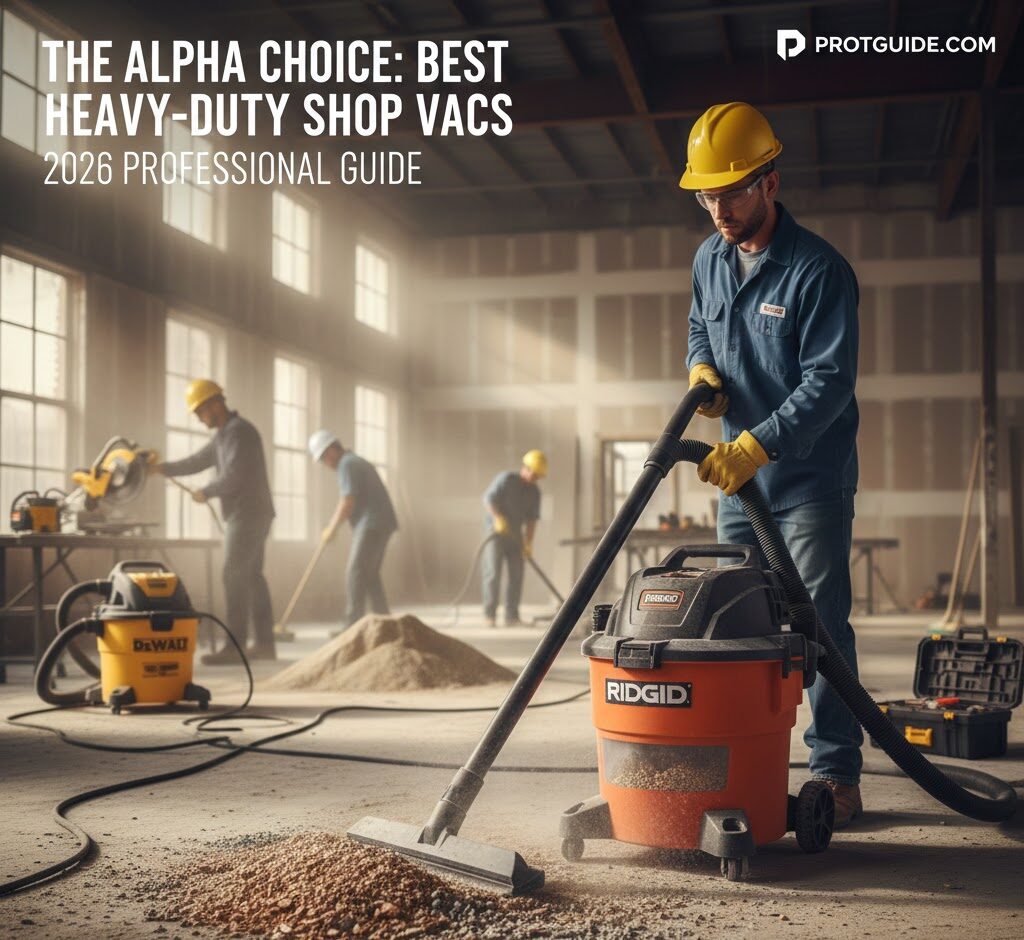
Construction and Renovation Sites
Typical challenges: Drywall dust, concrete slurry, wet cleanup after plumbing work, nails and screws, heavy debris volumes
Recommended model: DeWalt DXV16PA for maximum water lift and durability. The exceptional suction force handles wet concrete cleanup, and the fine dust filtration captures drywall dust without clogging. Stealthsonic technology keeps noise reasonable in occupied buildings.
Alternative: RIDGID HD1400 if you want lifetime warranty protection and more balanced performance for mixed construction tasks.
Essential accessories: Gulper nozzle for large debris, fine dust filter, dust bags for drywall work, extension wands for ceiling cleanup.
Woodworking Shops and Workshops
Typical challenges: Massive sawdust volumes, wood chips, shavings, need for rapid floor clearing
Recommended model: Craftsman CMXEVBE17595 for industry-leading 274 CFM airflow. Clears workshop floors faster than any competitor. Large 16-gallon capacity reduces emptying frequency when dealing with planer shavings or table saw dust.
Alternative: RIDGID HD1400 for better all-around performance if you also do some wet cleanup or need to vacuum metal shavings from metalworking projects.
Essential accessories: Wide floor nozzle, brush attachment for equipment cleanup, tool-triggered auto-start adapter for power tool integration.
Important note: For stationary machinery (table saws, planers), invest in a proper dust collector system from JET Tools or similar. Use the shop vac for handheld tools and cleanup only.
Auto Shops and Garages
Typical challenges: Oil and coolant spills, metal shavings, tire debris, car interior detailing, wet and dry mixed cleanup
Recommended model: Shop-Vac 12-Gallon Stainless Steel (5761311). The stainless steel tank handles automotive chemicals and oil without absorbing odors. Easy to clean after messy jobs. Strong suction for embedded dirt in car carpets and upholstery.
Alternative: Milwaukee M18 FUEL if you’re already in the Milwaukee ecosystem—perfect for mobile detailing or cleaning multiple vehicles without running extension cords across the shop.
Essential accessories: Crevice tool for tight spaces between seats, brush attachment for upholstery, extension hose for reaching truck beds, foam sleeve filter for wet pickup.
Industrial and Manufacturing Facilities
Typical challenges: Continuous high-volume use, multiple shifts, harsh environments, need for reliability and easy maintenance
Recommended model: RIDGID HD1400 for the lifetime warranty—critical in industrial settings where downtime costs money. The ability to get free service and parts forever justifies the investment in a multi-shift environment.
Alternative: DeWalt DXV16PA for maximum durability and quieter operation in facilities where noise levels matter (shared spaces, quality control areas).
Essential accessories: Multiple filter sets for quick swaps, replacement hoses (keep spares on hand), anti-static hoses for electronics manufacturing, drum liners for hazardous material containment.
Flood and Water Damage Restoration
Typical challenges: Large volumes of water, need for continuous wet pickup, drain capability essential, biological hazards
Recommended model: DeWalt DXV16PA or RIDGID HD1400—both feature large drain ports. The 16-gallon capacity combined with bottom drain means you can extract hundreds of gallons of water without lifting the tank. Crucial for basement flooding or pipe burst scenarios.
Critical feature: ALWAYS use the bottom drain port when emptying water. A 16-gallon tank full of water weighs 130+ lbs—lifting this is dangerous and unnecessary. Position the vac near a floor drain or outside, then open the drain valve.
Essential accessories: Foam sleeve filter (remove paper filter before wet use), squeegee attachment for flat surfaces, long hoses for reaching distant puddles.
Maintenance Tips for Maximum Longevity
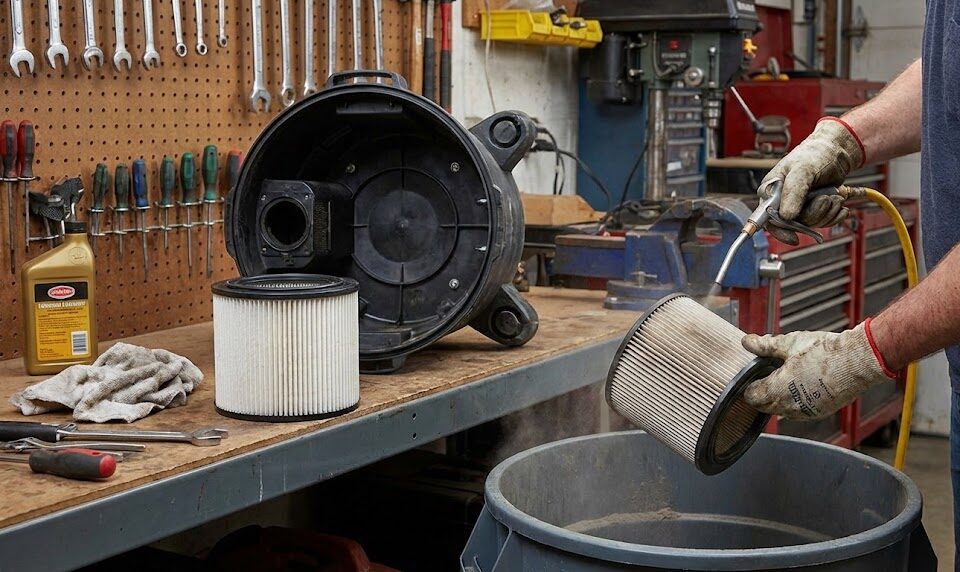
To keep your heavy-duty vac running for years—not months—follow these rules religiously:
Filter Care: The Most Important Maintenance Task
1. Use a bag for drywall and concrete dust: Fine dust clogs filters instantly, killing suction and potentially damaging the motor. A high-efficiency filter bag protects the main filter and keeps suction strong. This isn’t optional—it’s essential. The bag captures 99% of fine particles before they reach the cartridge filter.
2. Remove the filter for wet work: Unless you have a specialized wet filter or foam sleeve, take the paper cartridge filter out before sucking up water. A soggy filter ruins the motor by restricting airflow and can develop mold. Most manufacturers void warranties if you use paper filters for wet pickup.
3. Clean filters properly: Don’t just bang it on the trash can—this compacts dust into the pleats and reduces effectiveness. Use compressed air to blow out the filter from the inside (outdoors), or wash it (if it’s a washable filter) with water and let it dry completely (24-48 hours) before reinstalling. A damp filter will cause motor damage.
4. Replacement schedule by material:
- Heavy drywall/concrete work: Every 2-3 months with proper bag use; every 2-3 weeks without bags
- General workshop use: Every 6-12 months
- Occasional home use: Annually or when suction noticeably decreases
Tank Cleaning Best Practices
Stainless steel tanks (Shop-Vac, some RIDGID models):
- Rinse with water and wipe dry after messy jobs
- Use mild detergent for oil or chemical spills
- Dry thoroughly to prevent rust around seams
- Inspect gasket seals annually and replace if cracked
Polymer/plastic tanks (RIDGID, DeWalt, Craftsman, Milwaukee):
- More resistant to damage but can absorb odors
- Clean with baking soda solution for odor removal
- Avoid harsh solvents that can degrade plastic
- Sun-dry to naturally eliminate biological odors
Motor Maintenance and Longevity
Cooling vent cleaning: Shop vac motors rely on airflow for cooling. Dust buildup on cooling vents causes overheating and premature failure. Every 3-6 months, blow out the motor housing vents with compressed air.
Thermal overload protection: If your vac shuts off unexpectedly, it likely triggered the thermal overload protection due to overheating. This is usually caused by: clogged filters restricting airflow, blocked cooling vents, or running continuously for too long. Let it cool for 30-60 minutes, clean the filter and vents, then resume.
Running time limits: While these are “heavy-duty” vacs, they’re designed for intermittent use, not 8-hour continuous operation. After 20-30 minutes of continuous use, give the motor a 10-minute break to cool down. This simple practice extends motor life dramatically.
Hose and Accessory Care
Preventing cracks and splits:
- Store hoses loosely coiled, not kinked or bent sharply
- Avoid running over hoses with carts or vehicles
- Keep hoses out of direct sunlight (UV degradation)
- In cold weather, let hoses warm up before use (cold plastic cracks easily)
Anti-static hose care: If you’re using anti-static hoses for electronics work, test conductivity annually with a multimeter. The conductive coating can degrade, losing effectiveness.
Accessory storage: Use onboard storage when available. Loose accessories get lost, stepped on, or crushed. Models like Craftsman with integrated storage keep everything organized.
Warning Signs Your Vac Needs Service
Don’t ignore these symptoms—they indicate problems that will worsen:
- Reduced suction despite clean filter: Motor wearing out, gasket seal failure, or hose damage. Check gaskets first (cheap fix), then consider motor service.
- Unusual motor sounds (grinding, squealing): Bearing failure or debris in motor fan. Stop using immediately and inspect. Continued use will destroy the motor.
- Motor runs but no suction: Fan blade broken or motor shaft failure. Requires motor replacement.
- Burning smell: Motor overheating or electrical issue. Stop immediately, let cool, clean cooling vents, and check filter. If smell persists, motor failure is imminent.
- Water leaking from tank: Gasket deterioration or crack in tank. Replace gasket ($5-10) or entire tank if cracked.
- Float valve not shutting off: Valve stuck or damaged. Replace float assembly ($10-20) before you overfill and flood the motor.
RIDGID advantage: Under the Lifetime Service Agreement, all of these repairs are free at Home Depot service centers. For other brands, factor in $80-200 for motor service or $50-100 for other major repairs.
Common Mistakes to Avoid: Learn From Others’ Errors
1. Chasing Peak HP Numbers Instead of Real Performance
Peak HP is a marketing number measured at startup with no load. What matters is CFM and water lift. A 5.0 HP motor with excellent CFM (like Craftsman’s 274) and water lift (like DeWalt’s exceptional suction) outperforms a poorly-designed 6.5 HP motor every time. Focus on the specs that matter.
2. Undersizing Tank Capacity for Your Actual Needs
A 6-gallon vac is great for quick jobs, but if you’re cleaning up after drywall installation or workshop sessions, you’ll empty it every 10 minutes. Constantly stopping to empty the tank kills productivity. For regular heavy use, 12-16 gallons is the sweet spot. Yes, it’s bigger and bulkier, but you’ll thank yourself when you’re not emptying it six times per project.
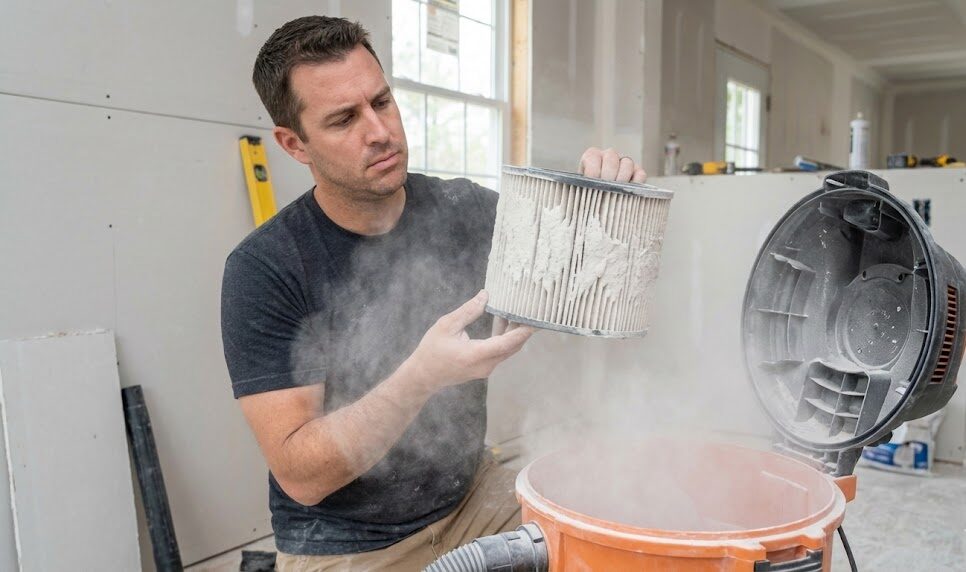
3. Using Standard Filters for Fine Dust (The #1 Mistake)
If you’re vacuuming drywall dust or concrete dust with a standard cartridge filter and no dust bag, you’re making a critical error. Fine dust will:
- Clog the filter in minutes, destroying suction
- Pass through the filter and blow back into your workspace
- Damage the motor over time by restricting airflow
- Create a respiratory hazard (silica dust is OSHA-regulated for good reason)
Solution: ALWAYS use HEPA filters or high-efficiency dust bags for fine dust work. This isn’t optional. Shop-Vac and RIDGID both offer proper filtration solutions.
4. Neglecting Filter Maintenance
Cleaning your filter after every use takes 2 minutes. Not cleaning it causes:
- Progressively weaker suction until the vac is useless
- Motor overheating due to restricted airflow
- Premature motor failure (an expensive repair)
Get in the habit: after each significant use, tap out or blow out the filter. Once a month, do a thorough cleaning. This simple practice extends motor life by years.
5. Overlooking Noise Levels for Indoor Use
If you’re using a shop vac indoors—especially in occupied homes or buildings—noise matters. An 85 dB vacuum (typical for Craftsman and others) is uncomfortably loud for extended use and requires hearing protection. DeWalt’s Stealthsonic models run at 70-75 dB—much more tolerable for indoor work. The premium price pays off in comfort and hearing preservation.
6. Ignoring Warranty Differences
A 2-year warranty vs. a lifetime warranty is a huge difference. Over 10 years:
- RIDGID with LSA: Free repairs, free parts, free service = $0 out-of-pocket
- Others with 2-3 year warranties: After warranty expires, you’re paying $80-200 for motor service, $20-40 for hose replacements, $10-30 for parts = easily $200-400 over the life of the vac
The RIDGID might cost $30-50 more upfront, but it saves significantly over time. Do the math based on how long you plan to use the tool.
7. Buying the Wrong Voltage for Your Setup
Most portable shop vacs are 120V and draw 10-12 amps. On a standard 15-amp household circuit, you cannot run the vacuum and a power tool simultaneously without tripping breakers. Plan your electrical setup accordingly. If you’re on a job site with limited power, consider a lower-amp model or dedicate a circuit to the vacuum.
8. Skipping Accessory Quality
The vacuum might be bulletproof, but cheap aftermarket hoses crack, cheap attachments break, and cheap extension wands don’t seal properly (causing suction loss). Stick with manufacturer accessories or high-quality third-party options. A $12 hose that splits in 6 months costs more than a $30 OEM hose that lasts 5 years.
9. Misunderstanding Corded vs. Cordless Trade-Offs
Cordless shop vacs like the Milwaukee M18 FUEL are amazing for convenience, but they’re not replacements for corded models in heavy-duty applications. Battery-powered vacs have:
- Limited runtime (20-30 minutes per battery)
- Decreasing suction as batteries drain
- High cost if you’re not already in that battery ecosystem
They’re perfect for quick jobs and mobile work, but for all-day construction cleanup or workshop sessions, corded is still superior.
10. Forgetting Cost of Ownership
The cheapest shop vac isn’t always the best deal. Factor in:
- Filter replacement costs
- Warranty coverage (or lack thereof)
- Availability of replacement parts
- Durability and expected lifespan
A $129 Vacmaster might be tempting, but if you replace it in 3 years, you’ve spent $258 over 6 years. A $179 RIDGID with lifetime warranty lasts 15+ years with free repairs = $179 total. The RIDGID is actually cheaper in the long run.
Frequently Asked Questions (FAQ)
What’s the difference between peak HP and sustained HP?
Peak HP is measured at motor startup with no load—essentially the split-second power surge when you flip the switch. It’s largely a marketing number. Sustained HP is what the motor actually delivers during continuous operation under load. This is the number that matters for real-world performance, but manufacturers don’t always advertise it because it’s lower and less impressive. Instead, look at CFM (airflow) and water lift (suction force)—these are the specs that determine actual cleaning performance.
Can I use a shop vac for drywall dust?
Yes, but only with proper fine dust filtration. Standard cartridge filters will clog immediately with drywall dust, and the fine particles will pass through and blow back into your workspace. You MUST use either:
- HEPA filters (Shop-Vac and RIDGID offer these)
- High-efficiency dust bags that capture 99% of fine particles
- Both for maximum protection
For heavy drywall work, the bag-and-filter combination is essential. The bag does most of the work, dramatically extending filter life. Without proper filtration, you’ll clog your filter in minutes and create a respiratory hazard.
How often should I replace filters?
It depends on what you’re vacuuming and how often:
- Heavy drywall or concrete work: Every 2-3 months (with bags); every 2-3 weeks (without bags—don’t do this)
- Regular workshop use (sawdust, general debris): Every 6-12 months
- Occasional home use: Annually, or when suction noticeably decreases
Pro tip: Clean your filter after each significant use by blowing it out with compressed air or washing it (if washable). This extends replacement intervals significantly. Replace the filter when cleaning no longer restores full suction or when you see tears, holes, or significant pleating damage.
Are expensive shop vacs worth it?
For professional daily use: Absolutely yes. A RIDGID with lifetime warranty or a DeWalt with exceptional build quality will outlast three cheap shop vacs and save you money over time through fewer repairs and better performance. The upfront premium pays for itself.
For occasional home use: Maybe not. If you’re vacuuming your garage once a month, a mid-range Craftsman ($199) or budget Vacmaster ($129) will serve you well for years. You don’t need to spend $250+ on a DeWalt for light duty use.
The break-even calculation: If you use a shop vac 2-3+ times per week, invest in RIDGID or DeWalt. If you use it 2-3 times per month, mid-range is fine. If you use it 2-3 times per year, buy the budget option.
Can shop vacs replace dust collection systems?
No. Shop vacs and dust collectors serve different purposes:
Shop vacs: 100-200 CFM, high suction force, for cleanup and handheld tools
Dust collectors: 400-1,200+ CFM, gentle airflow, for stationary machinery
A shop vac cannot keep up with the chip volume from a table saw, planer, or jointer running continuously. These machines produce more debris per minute than a shop vac can handle. You need a proper dust collector (brands like JET Tools, Grizzly, or Oneida) for stationary woodworking equipment.
The hybrid approach: Use a dust collector for your table saw and stationary tools, and a shop vac for handheld tools (routers, sanders) and cleanup. This combination provides complete dust control.
What size hose is best for heavy-duty use?
2.5-inch diameter is optimal for heavy-duty applications. This size:
- Maximizes airflow (doesn’t restrict CFM)
- Handles large debris (wood scraps, screws, rocks) without clogging
- Is standard on professional models (DeWalt, Milwaukee, RIDGID)
1.25-1.5 inch hoses are common on homeowner models but significantly restrict airflow and clog easily with construction debris. They’re fine for car detailing or light home use, but not for job sites or workshops.
Note: Larger hoses are heavier and less maneuverable. If you need precision work (car detailing, electronics cleaning), keep a smaller diameter hose as a secondary option. Most professional models include multiple hose sizes or adapters.
Do I need HEPA filtration?
Yes, for these materials:
- Drywall dust (very fine particles, respiratory irritant)
- Concrete dust containing silica (OSHA-regulated carcinogen)
- Mold spores or biological contaminants
- Allergen control (pet dander, dust mites) in homes
No, for these materials:
- Wood chips and sawdust (standard cartridge filters work fine)
- Leaves, grass clippings, general yard debris
- Metal shavings, bolts, screws
- General workshop cleanup
Cost consideration: HEPA filters cost $35-60 vs. $12-20 for standard cartridge filters. Only invest in HEPA when you actually need it—but when you need it, don’t skimp. Your lungs will thank you.
What about OSHA silica compliance?
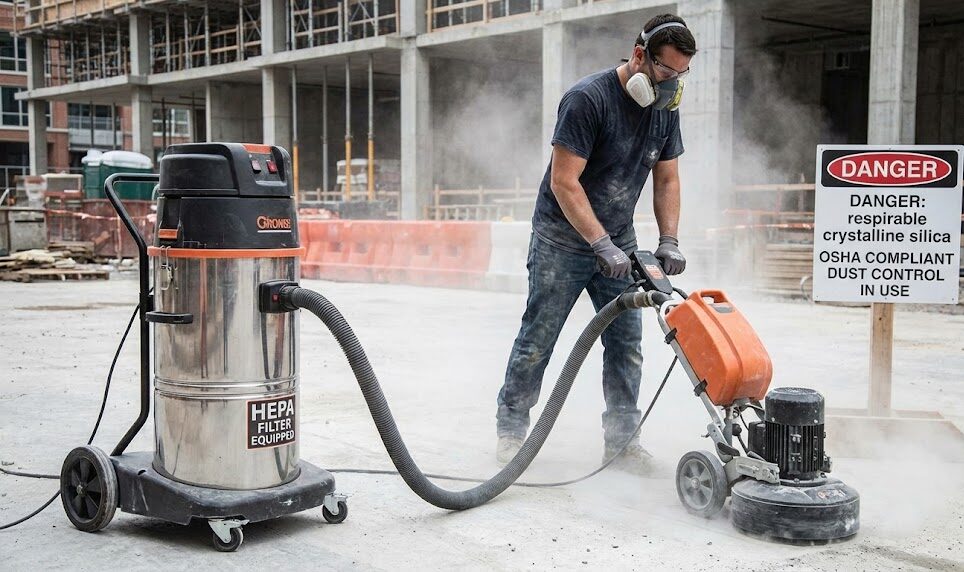
If you’re cutting or grinding concrete, OSHA requires employers to implement dust control measures to limit worker exposure to respirable crystalline silica. Some Shop-Vac and RIDGID models, when equipped with HEPA filters and used properly, can meet OSHA Table 1 requirements for handheld tools.
Key requirements:
- HEPA filter (captures 99.97% of particles 0.3 microns and larger)
- Proper ventilation and work practices
- Regular filter maintenance and replacement
- Worker training on proper use
Important: A shop vac alone doesn’t guarantee OSHA compliance—it’s part of a comprehensive dust control program. Consult OSHA’s Table 1 (29 CFR 1926.1153) for specific requirements and verify your vacuum meets the standard. For large commercial jobs, consider dedicated HEPA industrial vacuums from specialized manufacturers.
Comparison Table: Quick Spec Reference
| Model | Peak HP | Capacity | CFM | Water Lift | Price | Warranty | Best For |
|---|---|---|---|---|---|---|---|
| RIDGID HD1400 | 6.0 | 14 gal | 165 | 75″ | $179-199 | Lifetime | Overall Best Value |
| DeWalt DXV16PA | 6.5 | 16 gal | 116 | High | $249-279 | 3-year | Construction Sites |
| Craftsman CMXEVBE17595 | 6.5 | 16 gal | 274 | 64″ | $199-229 | 3-year | Large Workshops |
| Vacmaster Beast VBV1210 | 5.0 | 12 gal | ~130 | 94″ | $129-149 | 2-year | Budget Choice |
| Milwaukee M18 0880-20 | 18V | 6 gal | 87 | — | $249 | 3-year | Cordless Mobility |
| Shop-Vac 5761311 | 6.5 | 12 gal | 180 | — | $189-209 | 2-year | Fine Dust Filtration |
Final Verdict: Which Heavy-Duty Shop Vac Should You Buy?
After analyzing specs, real-world performance, warranty coverage, and long-term value, here are the clear winners for different use cases:
Best Overall: RIDGID 14-Gallon NXT (HD1400) – $179-199
The combination of solid balanced performance (165 CFM, 75″ water lift), proven reliability, and RIDGID’s industry-leading Lifetime Service Agreement makes this the smartest investment for most contractors and serious DIYers. Over 10-15 years of use, the free lifetime service and parts will save you $200-400 compared to other brands. It’s not the most powerful in any single category, but it’s excellent at everything—and that versatility, backed by the best warranty, makes it the safest choice.
Buy if: You want the best long-term value, plan to use it regularly for 5+ years, and want peace of mind with lifetime warranty coverage.
Best for Professionals: DeWalt 16-Gallon DXV16PA – $249-279
If you’re a professional contractor working daily on construction sites, the DeWalt’s exceptional water lift (best-in-class suction force), Stealthsonic quiet operation, and rugged build quality justify the premium price. It handles the toughest conditions—wet concrete slurry, heavy debris, and embedded dirt—better than any competitor. The 3-year warranty is solid, and DeWalt’s reputation for standing behind their tools is excellent.
Buy if: You’re a professional contractor, work on occupied job sites where noise matters, or need maximum suction force for heavy wet debris.
Best for Woodworking: Craftsman 16-Gallon CMXEVBE17595 – $199-229
For woodworkers drowning in sawdust, the Craftsman’s industry-leading 274 CFM airflow clears workshop floors faster than anything else. The large 16-gallon capacity and powerful blower function make post-project cleanup quick and efficient. Yes, it’s loud (wear hearing protection), but the performance-to-price ratio is excellent.
Buy if: You run a woodworking shop, deal with massive sawdust volumes, or need rapid bulk debris clearing. Not ideal for fine dust or quiet environments.
Best Value: Vacmaster Beast Series 14-Gallon – $129-149
For homeowners and occasional users who need genuine heavy-duty performance without the premium price, the Vacmaster delivers exceptional value. The 94″ water lift rivals models costing twice as much, and the build quality is solid for the price point. The 2-year warranty is shorter than premium brands, but if you’re using it monthly rather than daily, this is plenty.
Buy if: You’re a homeowner or DIYer who needs heavy-duty performance occasionally, not daily. Excellent for weekend projects, home workshops, and seasonal cleanup tasks.
Final Recommendation Summary
Match your vacuum to your actual use case:
- Daily professional use: RIDGID (lifetime warranty) or DeWalt (maximum performance)
- Weekly workshop use: Craftsman (high CFM) or RIDGID (balanced performance)
- Monthly home use: Vacmaster (best value) or RIDGID (if you want lifetime coverage)
- Cordless convenience: Milwaukee M18 (if already in that ecosystem)
- Fine dust work: Shop-Vac with HEPA filtration
Remember these critical points:
- CFM and water lift matter—peak HP is marketing fluff
- Use proper filtration—HEPA or dust bags for fine particles, or you’ll destroy your motor and your lungs
- Warranty differences are huge—RIDGID’s lifetime coverage saves hundreds over time
- Match the filter to the mess—wrong filter = immediate failure
- Maintain your vac—clean filters after each use, empty promptly, use the drain port for liquids
For most heavy-duty applications, the RIDGID 14-Gallon NXT offers the best balance of price, performance, and warranty protection. If you are dealing with dense debris or need a quieter machine for an occupied job site, the DeWalt DXV16PA is worth the extra investment. Just remember: match the filter to the mess, maintain it properly, and your shop vac will survive the toughest jobs you throw at it for years to come.