
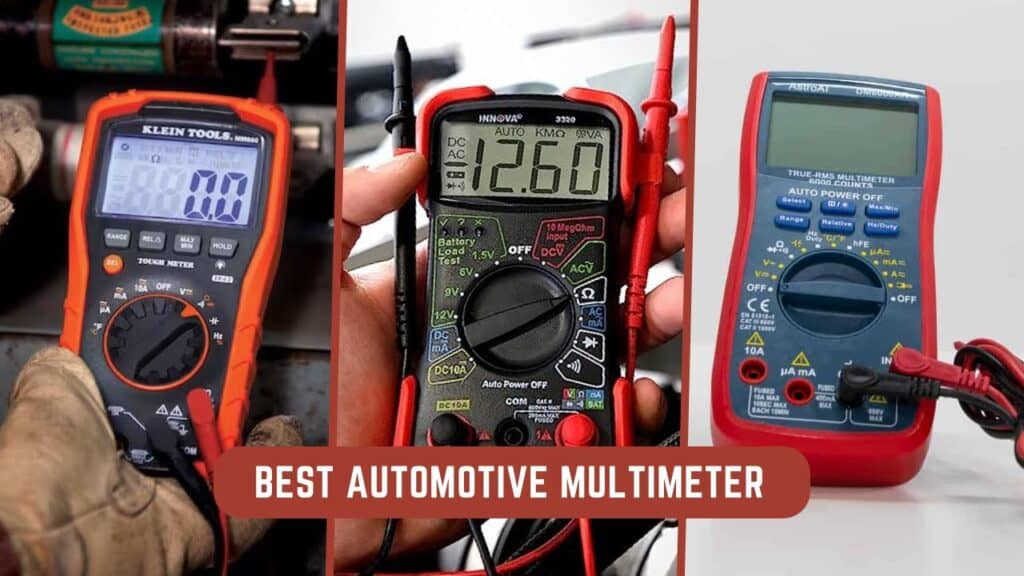
In the fast-paced world of automotive diagnostics, having the right tools is the difference between a confident diagnosis and an expensive guessing game. Automotive multimeters remain the most indispensable instrument in a mechanic’s toolkit — enabling you to measure voltage, current, and resistance across every electrical system your vehicle runs on. Modern cars have only become more complex: hybrid battery systems, CAN bus networks, and advanced ECU modules demand a multimeter that can keep pace without damaging sensitive electronics.
Whether you’re chasing a dead battery, a failing alternator, a rogue circuit pulling parasitic drain, or a temperature sensor throwing false codes — the right automotive multimeter makes the diagnosis fast, accurate, and safe. In this updated 2026 guide, we’ve re-evaluated the same trusted lineup of multimeters to confirm they remain the best options available, with current specs, updated pricing context, and real-world performance notes.
Understanding the Essence
Your car’s electrical health is paramount, and issues ranging from a dead battery to a malfunctioning alternator are challenging to diagnose without accurate measurement tools. An automotive multimeter — a handheld device capable of measuring voltage, current, and resistance — becomes your diagnostic ally. With it, you can assess battery state-of-charge, pinpoint wiring faults, troubleshoot sensors and solenoids, test charging system output, and verify continuity across circuits before you start replacing parts.
⚠ Critical: High-Impedance Input for Modern VehiclesAny multimeter used on a modern vehicle with an ECU, ABS module, or airbag system must have a minimum 10 MegOhm input impedance. Low-impedance meters can damage sensitive control modules and trigger false fault codes. All five meters in this guide meet this requirement.
What an Automotive Multimeter Actually Tests
The primary use case is diagnosing why a car refuses to start — but that’s a fraction of what a good automotive DMM handles. Battery state-of-charge and cold cranking capacity, alternator output voltage and diode ripple, sensor resistance values (O2, coolant temp, MAF), injector duty cycle and pulse width, ignition system dwell angle, parasitic battery drain identification, and continuity testing across suspect wiring harnesses — all of these jobs require a multimeter, and many of them require an automotive-specific one with RPM and duty cycle functions.
🏆 Quick Picks — Best Automotive Multimeters (2026)
| Best Overall | Fluke 115 — True RMS, 600V CAT III, compact field-ready design that professionals trust |
| Best Under $100 | Innova 3340 — Automotive-specific: RPM, dwell, duty cycle, and 10 MegOhm ECU-safe impedance |
| Best Under $50 | AstroAI DM6000AR — True RMS, 6000 counts, temperature probe, magnetic mount at entry price |
| Best for Professionals | Fluke 88V — 1000V CAT III, MIN/MAX/AVG recording, built for heavy-duty fleet and shop work |
| Best Build Quality | Klein Tools MM400 — 1-meter drop rating, CAT III 600V, temperature probe, auto-ranging |
Best Picks in the Automotive Multimeter Arena
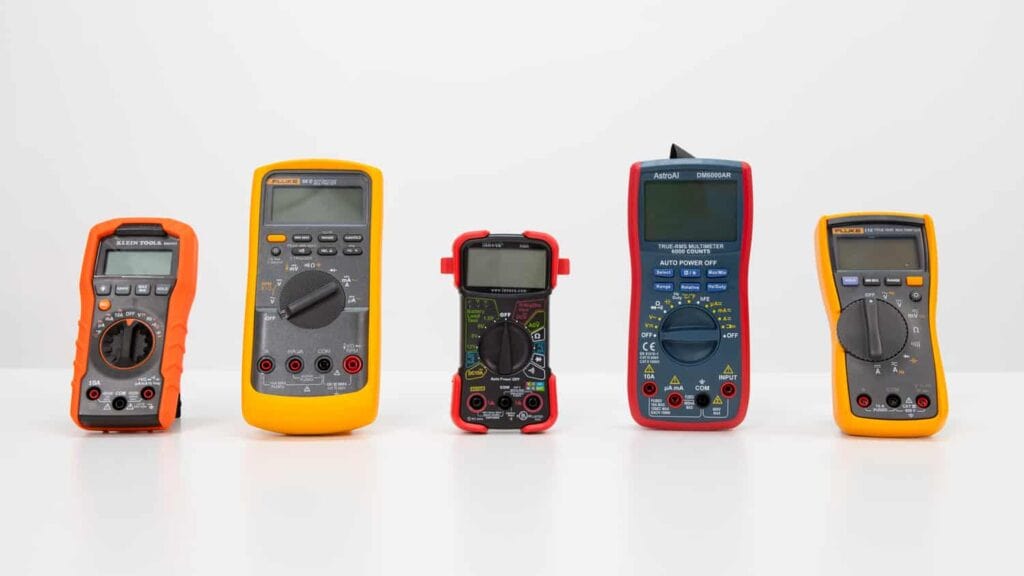
Let’s navigate through the best automotive multimeters of 2026 — tested criteria, honest trade-offs, and clear picks for every budget and skill level.
Fluke 115 — Best Overall
The compact field multimeter that professional technicians reach for first
⭐ Best Overall

Current: 10A DC / 10A AC
True RMS: Yes
Auto-Range: Yes
Safety Rating: CAT III 600V
Input Impedance: 10 MΩ
Dimensions: 6.57″ × 3.31″ × 1.82″
Weight: 1.2 lbs
Fluke has manufactured precision measurement instruments since 1948, and the Fluke 115 represents the company’s distillation of what a field technician actually needs in a compact, carry-everywhere multimeter. True RMS measurement — the most accurate way to read voltages in modern vehicles with non-sinusoidal waveforms — is standard on the 115, where it’s still an upsell on many competitors at this price tier. The LoZ (Low Impedance) mode prevents ghost voltage readings on high-impedance circuits: a genuine diagnostic advantage when chasing intermittent electrical faults on modern vehicles where phantom voltages can mislead diagnosis entirely.

The automatic AC/DC voltage detection eliminates the mode-selection error that causes misreadings and, in worst cases, meter damage. Min/Max/Average recording captures transient electrical events — voltage spikes during starting, charging system fluctuation under load — that a single static measurement would miss entirely. At CAT III 600V rated, it meets or exceeds the safety classification required for automotive and light industrial electrical work. The compact form factor and included holster make it a go-anywhere, use-on-everything instrument that earns its place at the top of this guide year after year.
✓ What It Does Well
- True RMS accuracy on non-linear automotive waveforms — no false readings
- LoZ mode eliminates ghost voltages — essential for modern vehicle diagnostics
- Automatic AC/DC detection — one less step, one less potential error in the field
- Compact and lightweight — fits in a tool bag alongside everything else
- Fluke’s 3-year warranty and industry-leading reliability track record
✗ Where It Falls Short
- No automotive-specific RPM or dwell angle measurement — Innova 3340 covers that use case better
- Premium pricing vs. budget alternatives like AstroAI
- No temperature probe included in the standard kit

The Fluke 115 remains the benchmark automotive multimeter for field technicians and serious DIYers in 2026. True RMS, LoZ ghost-voltage elimination, and automatic AC/DC detection in a compact, CAT III-rated body — it’s the one meter that handles every automotive diagnostic task accurately and safely.
- Compact True-rms digital multimeter for field technicians
- Measures True-rms voltage and current with plus resistance, continuity, frequency, and capacitance
- Min/Max/Average to record signal fluctuations
- Safety rated CAT III 600V
- Large white LED Backlight to work in poorly lit areas
Innova 3340 — Best Under $100
The automotive-specific multimeter built for diagnosing engine and charging system problems
💰 Best Under $100
Current: 15A DC / 15A AC
RPM Range: 0–10,000 RPM
Auto-Range: Yes
Input Impedance: 10 MΩ
Duty Cycle: Yes
Dimensions: 12.5″ × 4.5″ × 6.5″
Weight: 0.6 lbs
Where the Fluke 115 is a precision general-purpose instrument, the Innova 3340 is a purpose-built automotive diagnostic tool — and that distinction matters. The 3340 measures RPM (0–10,000 RPM, including coil-on-plug ignition systems with the inductive pickup), dwell angle, duty cycle, and pulse width — functions the Fluke 115 simply doesn’t have. For diagnosing ignition timing, injector duty cycles, alternator diode ripple, and solenoid performance, these automotive-specific measurements are what make the 3340 genuinely useful in ways a standard DMM isn’t.
The 10 MegOhm input impedance is ECU-safe — this is non-negotiable for modern vehicles, and Innova includes it at this price point where some budget competitors don’t. Hands-free design with built-in lead holders and a kickstand means you can have the meter running in the engine bay while you operate components. Auto-ranging, auto-shutoff, overload protection, and reverse polarity protection make it forgiving for users who don’t use a multimeter every day. Min/Max and Hold functions save retrieved data for logging readings over time. The temperature probe (Celsius and Fahrenheit) and included inductive RPM pickup and carry case complete a package that offers impressive breadth for the price.
✓ What It Does Well
- RPM, dwell angle, duty cycle, pulse width — automotive-specific measurements the Fluke 115 lacks
- 10 MΩ impedance — ECU-safe on all modern vehicle control modules
- Hands-free design with lead holders and kickstand — works in the engine bay unattended
- Temperature probe and inductive RPM pickup included in the box
- Auto-ranging, overload protection, reverse polarity — safe for all skill levels
✗ Where It Falls Short
- No True RMS — less accurate on non-sinusoidal AC waveforms vs. Fluke 115
- Bulkier form factor than compact meters like the Fluke 115

The Innova 3340 is the right multimeter for the vehicle-focused user who needs RPM, dwell, and duty cycle measurement alongside standard voltage and resistance testing. It does things the Fluke 115 cannot — at a lower price. For the home mechanic or professional who lives in the engine bay, this is the more practical daily tool.
- Designed to pinpoint engine problems; tests alternator diodes, duty cycle, solenoids, breaker points, wiring, switches and more
- Features auto-ranging, auto shut-off and over-load protection
- Measures up to 15 amps for device testing
- 10 MegOhm input impedance; safe for electrical and automotive use; prevents damage to the vehicle’s ECU
- Includes temperature probe, inductive RPM clamp and carrying case

AstroAI DM6000AR — Best Under $50
True RMS, 6000 counts, temperature probe, and magnetic mount at entry price
🛒 Best Under $50

Current: 10A DC / 10A AC
Display Count: 6000
True RMS: Yes
Auto-Range: Yes
Measures: Voltage, current, resistance, capacitance, frequency, temperature, diode, continuity
Dimensions: 8.66″ × 2.28″ × 6.69″
Weight: 1.3 lbs
The AstroAI DM6000AR is the strongest argument for the proposition that entry-level doesn’t have to mean entry-capability. True RMS measurement — which most budget meters omit — is standard here, giving it accuracy on modern vehicle electrical systems that non-True RMS meters simply cannot match. The 6000-count display provides resolution that’s genuinely useful for precise resistance and voltage measurements: you can read 0.001V increments that a 2000-count budget meter rounds away. Capacitance and frequency measurement are included alongside the expected voltage, current, and resistance — a feature breadth that rivals meters costing twice as much.
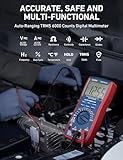
The magnetic hanging strap is a practical detail that earns its place in the engine bay: clip the meter to a strut tower or hood hinge, have both hands free for probing, and read the display without holding anything. The easy-access fuse replacement — called out consistently in reviews as simpler than on most competitors — reduces the inevitable fuse-blow frustration that comes with learning automotive diagnostics. The temperature probe covers sensor testing and cooling system diagnostics. Over 90% of verified reviews rate it 4 stars or higher, a consensus that reflects the product genuinely delivering on its feature list.
✓ What It Does Well
- True RMS at entry price — rare and genuinely valuable for modern vehicle diagnostics
- 6000-count display — significantly better resolution than 2000-count budget meters
- Magnetic hanging strap — both hands free for engine bay work
- Measures capacitance, frequency, and temperature alongside standard functions
- Easy fuse replacement — practical detail competitors overlook
✗ Where It Falls Short
- No automotive-specific RPM or duty cycle — Innova 3340 for those measurements
- AstroAI brand doesn’t carry Fluke’s long-term reliability track record

The AstroAI DM6000AR proves that affordability and genuine capability aren’t mutually exclusive. True RMS, 6000 counts, magnetic mount, and a full measurement suite at sub-$50 pricing makes it the clear recommendation for budget-conscious buyers who don’t want to sacrifice accuracy on the spec that matters most.
- Versatile Digital Multimeter - Accurately measures AC/DC Current, AC/DC Voltage, Capacitance, Frequency, Duty Cycle, Resistance, Diode, Continuity and Temperature.
- Thoughtful Design - Support Data Hold, Large LCD Backlit Screen, Auto Shut-off and Kickstand make the process of measurements easier. Professional level is reflected in some features include Auto-Ranging capability, and True RMS for measuring both AC Current and Voltage.
- Suitable For Many Occasions - This Multimeter is a golden partner to help to troubleshoot a variety of automotive and household electrical problems safely and accurately.
- Ensure Safety - Double ceramic fuse is anti-burn and protects from overloading,and it will be more secure and reliable; F400mA/600V and F10A/600V explosion-proof ceramic fuse tubes can protect the multimeter effectively.
- Additional Tips - Please take off the cap before using the test leads. Check the manual for more usage information.
Fluke 88V — Best for Professionals
Heavy-duty 1000V automotive multimeter built for fleet shops, large vehicles, and high-stakes diagnostics
🔧 Best for Professionals

Current: 10A DC / 10A AC
True RMS: Yes
Auto-Range: Yes
Safety Rating: CAT III 1000V / CAT IV 600V
Recording: MIN / MAX / AVG
Dimensions: 7.93″ × 2.06″ × 3.86″
Weight: 1.4 lbs
The Fluke 88V is built for the professional electrical environment that the Fluke 115 isn’t rated to handle: heavy equipment, large commercial vehicles, high-voltage hybrid and EV systems, and industrial machinery where voltage exceeds 600V and measurement errors carry serious consequences. The 1000V CAT III / CAT IV 600V dual safety rating — the most demanding classification in this guide — means it handles diesel-electric locomotives, agricultural equipment, and transit buses with the same margins that the 115 applies to standard automotive systems. For a fleet shop, heavy equipment service operation, or a shop that handles hybrid and early EV systems, this safety overhead is not optional.
The MIN/MAX/AVG recording function captures electrical events in real time — voltage spikes during start cycles, charging fluctuations under varying load, transient drops during accessory activation — that single-point measurements permanently miss. Frequency and duty cycle measurement covers ignition timing, injector pulse, and solenoid operation. Fluke’s automotive-specific design choices include a low-pass filter for accurate measurements on variable frequency drive systems, and the 88V’s legendary durability — Fluke meters regularly outlast the vehicles they diagnose by decades in professional shop environments.

✓ What It Does Well
- 1000V CAT III / CAT IV 600V — highest safety rating in this guide, covers heavy equipment and HV systems
- MIN/MAX/AVG recording — captures transient electrical events that static readings miss
- True RMS with low-pass filter — accurate on VFD and non-sinusoidal automotive waveforms
- Frequency and duty cycle — covers ignition and injector diagnostic work
- Fluke legendary build quality — meters that outlast careers in professional shop use
✗ Where It Falls Short
- Premium price — hard to justify for home mechanics or occasional use
- More capability than most standard passenger vehicle diagnostic tasks require

The Fluke 88V is the professional-grade investment for technicians working on heavy equipment, commercial vehicles, hybrid systems, or any application where 600V-rated meters don’t provide adequate safety margin. For standard passenger vehicle work, the Fluke 115 is sufficient — but for the professional who needs the maximum safety and capability headroom, the 88V is the right tool.
- True-RMS accuracy with all functions of 87v and upgraded test leads.
- Fully waterproof and dustproof with IP67 rating and 4-meter drop proven. Built to take too harsh and extreme environments.
- Safety rated CAT III 1000 V, CAT IV 600 V meter to get you home safely from the job.
- Lifetime, backed by a brand you trust.
Klein Tools MM400 — Best Build Quality
Drop-tested to 1 meter, CAT III 600V, built for demanding environments where meters take abuse
🏗 Best Build Quality

Drop Rating: 1 meter tested
Auto-Range: Yes
Temp Probe: Yes (to 1000°F)
Backlight: Yes
Measures: AC/DC voltage, current, resistance, capacitance, frequency, duty cycle, temperature, diode, continuity
Overall Rating: 4.3 / 5.0 stars
Price Tier: $$
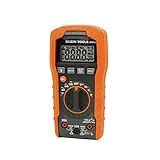
Klein Tools has manufactured electrical tools for professional tradespeople since 1857, and the MM400 reflects that heritage in one specific way: it’s built to survive the environments where electricians and automotive technicians actually work. Drop-tested to 1 meter and CAT III 600V rated, the MM400 handles the concrete floors, confined spaces, and general rough-handling of daily professional use in ways that thinner-housed competitors don’t. The rubber overmold housing isn’t decorative — it’s functional impact protection that keeps the meter working after the drops that happen on real job sites.
The feature set covers everything a professional automotive technician needs: auto-ranging AC/DC voltage and current, resistance, capacitance, frequency, duty cycle, continuity, diode testing, and a temperature probe rated to 1000°F — hot enough for exhaust system and engine temperature measurements. The backlight makes it usable in the dark spaces under dashboards and in engine bays where natural light is limited. Klein’s reputation for consistent quality and the brand’s widespread availability mean replacement leads, cases, and accessories are easy to source anywhere in North America.
✓ What It Does Well
- 1-meter drop rating — genuine drop protection for real-world job site use
- CAT III 600V safety rating — appropriate for all standard automotive and light industrial work
- Temperature probe to 1000°F — covers exhaust, coolant, and engine surface measurements
- Full measurement suite: capacitance, frequency, duty cycle in addition to standard functions
- Klein Tools brand reliability — consistent quality backed by a 166-year manufacturing reputation
✗ Where It Falls Short
- Display backlight less bright than Fluke equivalents — harder to read in very low light
- Some users report wanting longer, more flexible test leads than the included set

The Klein Tools MM400 is the right multimeter for hobbyists and professionals working in harsh environments where drops, grease, and tight spaces are the norm. The 1-meter drop rating and CAT III 600V certification in a full-featured package at a mid-range price makes it an excellent alternative to Fluke for buyers who prioritize physical durability over the Fluke 115’s True RMS accuracy.
- Multimeter measures up to 600V AC/DC voltage, 10A AC/DC current and 40 MOhms resistance
- Electrical tester measures temperature, capacitance, frequency, duty-cycle, and test diodes and continuity
- CAT III 600V safety rating
- Built to withstand a 3.3-foot (1 m) drop and withstand daily wear and tear on the job site
- Low battery indicator and easily accessible battery compartment
Quick Comparison Table
| Model | Max Voltage | True RMS | Auto-Range | Best For |
|---|---|---|---|---|
| Fluke 115 | 600V | ✓ Yes | ✓ Yes | General automotive & field use |
| Innova 3340 | 600V | ✗ No | ✓ Yes | RPM, dwell, duty cycle — engine work |
| AstroAI DM6000AR | 600V | ✓ Yes | ✓ Yes | Best value under $50 |
| Fluke 88V | 1000V | ✓ Yes | ✓ Yes | Heavy equipment & professional shops |
| Klein Tools MM400 | 600V | ✓ Yes | ✓ Yes | Best physical durability |
Automotive Multimeter Buying Guide
📡 True RMS vs. Average-Responding
Modern vehicles produce non-sinusoidal waveforms — alternator output, PWM signals, variable frequency drives. An average-responding meter reads these incorrectly. True RMS meters (Fluke 115, AstroAI DM6000AR, Fluke 88V, Klein MM400) give accurate readings on any waveform. The Innova 3340 lacks True RMS — acceptable for standard battery and sensor testing, but not for precise AC measurements on modern charging systems.
🔢 Display Count Resolution
Display count determines measurement resolution. A 2000-count meter reads 0.01V increments on the 20V range. A 6000-count meter reads to 0.001V on the same range — six times more resolution. For sensor resistance values (O2 sensors measure in small ohm ranges) and precise voltage measurements, 6000 counts is meaningfully better. The AstroAI DM6000AR and Fluke 115 both deliver this resolution. The Innova 3340 at 4000 counts is adequate for most automotive work.
🛡 Safety Ratings
CAT ratings define the electrical environment a meter is safe to use in. CAT III 600V covers standard automotive and residential electrical work — all meters in this guide meet this minimum. The Fluke 88V adds CAT IV 600V and CAT III 1000V for commercial vehicles, heavy equipment, and high-voltage systems. Never use a meter in an environment that exceeds its safety rating — the consequences of arc flash on an under-rated meter are severe.
⚡ Input Impedance
All five meters in this guide have 10 MegOhm input impedance — the minimum required for modern vehicle diagnostics. Lower impedance meters can damage ECUs, ABS modules, airbag systems, and transmission control modules by loading the circuit they’re measuring. Never use a non-automotive-rated meter on a modern vehicle control module. The 10 MΩ specification is listed in each product spec — verify before buying any meter not on this list.
📏 Auto-Ranging
Auto-ranging automatically selects the correct measurement range, eliminating the need to know the expected value before measuring. All five meters in this guide are auto-ranging. Manual-ranging meters require the user to select the range before probing — selecting too low a range blows the protection fuse; too high a range gives poor resolution. For automotive use, auto-ranging is a practical safety requirement, not an optional convenience.
⚖ Size and Portability
The Fluke 115 is the most compact and lightest meter in this guide — genuinely fits in a shirt pocket. The Innova 3340 is the largest, with a form factor designed for hands-free engine-bay use with its kickstand. The AstroAI and Klein MM400 sit between these extremes. For a technician moving between vehicles all day, the compact Fluke 115 is the preferred carry. For dedicated engine-bay diagnostic sessions, the Innova 3340’s hands-free design earns its larger footprint.
💡 Which meter for which job?Chasing a dead battery or alternator fault → Fluke 115. Diagnosing engine RPM, dwell, or injector duty cycle → Innova 3340. First multimeter on a budget → AstroAI DM6000AR. Fleet shop or heavy equipment → Fluke 88V. Rough environments and drop risk → Klein MM400.
Frequently Asked Questions
Conclusion
In the 2026 automotive multimeter market, the five meters in this guide represent the best options across every price tier and use case. The Fluke 115 remains the overall benchmark — True RMS, LoZ, and automatic AC/DC detection in a compact, CAT III-rated body that professional technicians have trusted for years. The Innova 3340 earns its place by doing things the Fluke 115 cannot: RPM, dwell, and duty cycle measurements that make it the purpose-built automotive diagnostic choice. The AstroAI DM6000AR proves that True RMS accuracy doesn’t require a premium budget. The Fluke 88V stands alone as the professional-grade instrument for heavy equipment and high-stakes diagnostics. And the Klein Tools MM400 delivers the most durable body in the guide for professionals working in demanding environments.
Make your decision based on your primary use case: if you’re primarily testing batteries, alternators, and sensors on standard passenger vehicles, the Fluke 115 or AstroAI DM6000AR cover everything you need. If you’re diagnosing engines with RPM and duty cycle work, the Innova 3340 is the better-fitted tool. And if your shop handles heavy equipment or high-voltage systems, the Fluke 88V’s headroom is worth the premium.
New to multimeters entirely? See our guide on how to use a multimeter for beginners before picking a model.


