Updated January 2026
I’m not here to sell you a gadget that looks pretty in a pristine workshop. I’m here to stop you from wasting cash on junk that drifts after one ride in the bed of your truck. If a laser level can’t survive a 4-foot drop or work when it’s freezing outside, it belongs in a toy box, not on a job site.
Every recommendation here is based on jobsite accuracy, durability, battery ecosystem compatibility, and real-world visibility—not spec-sheet hype.
If you don’t have time to read the manual, here is the cheat sheet for 2026:
- If you move dirt (Foundations/Excavation): Buy the Topcon RL-H5A. It’s the industry standard for a reason—it works when it’s freezing, and you can hose the mud off it.
- If you frame interiors or hang ceilings: Buy the Milwaukee M12 3PL. It runs on the batteries you already own and the micro-control knob saves hours of frustration.
- If you are an Electrician: Buy the Klein Tools 93LCLG. It has plumb spots for transferring floor-to-ceiling layouts, which generic cross-lines lack.
The 2026 Shift: Power & Speed
The game has changed. We are done feeding AA batteries to hungry green lasers.
1. The Death of Alkaline
The pro market has moved to Lithium-Ion platforms. If your laser doesn’t run on your drill battery, you are burning money.
- Milwaukee M12: The current king of form factor. Compact enough to clamp onto suspended ceiling grid clips without sagging.
- DeWalt 20V: Incredible runtime (24+ hours), but the lasers are physically massive. Unless you need that runtime, the bulk can be a hindrance for delicate interior work.
2. Green vs. Red: The Physics
Green lasers are up to 4x brighter to the human eye. If you work indoors with windows or bright LED temporary lighting, you need green. Red is only for maximizing battery life or if you are working in pitch-black environments.
3. Self-Leveling: Pendulum vs. Electronic Servo
- Pendulum (Standard): Uses gravity and magnets. If a door slams nearby, the line wobbles for 5-10 seconds.
- Electronic Servo (Pro): Uses motors to level the laser. It re-levels instantly. If you are working on an active deck with vibration, you want servo leveling.
The Top 6 Professional Picks
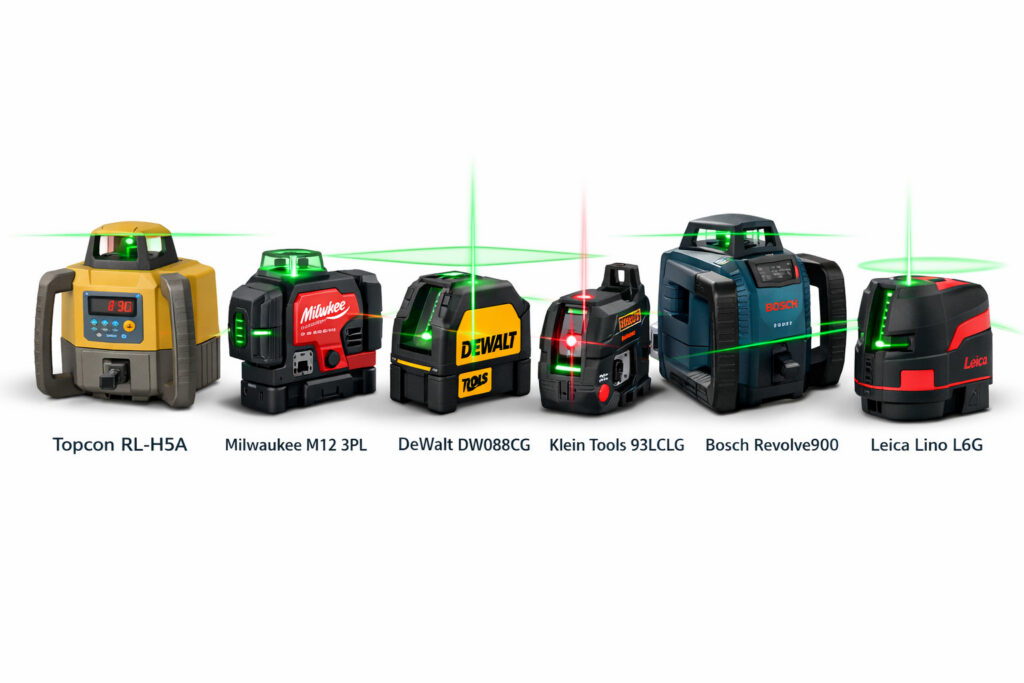
1. Best Exterior Rotary: Topcon RL-H5A

Role: Grading, Excavation, Concrete pours.
This is the workhorse. You see it on every highway project for a reason. Topcon specs this at accuracy of ±10 arc seconds (approximately ±1/16″ at 100 ft).
Durability: IP66 rating (dust-tight, handles powerful water jets).
Warranty: Backed by a 5-Year Guarantee.
Receiver Note: Works with universal receivers, but the included Topcon LS-80 provides finer detection bandwidth.
The Verdict: If you pour concrete, this is the only option.
2. Best Interior 360°: Milwaukee M12 3PL (Green 3-Plane)

Role: Framing, Suspended Ceilings, HVAC.
Milwaukee took over the interior market by integrating the M12 battery. You get 15+ hours of runtime on a 4.0Ah battery (compared to ~4 hours on AA alternatives).
The Feature That Matters: The Integrated Micro-Control. Most lasers are a pain to line up with a mark—you tap it, it moves too far. The M12 has a knob that pivots the laser on a point so you can dial in your square instantly.
Warranty: 3-Year Tool Warranty.
The Ugly Truth: It’s an investment (approx $549). If you only frame a basement once a year, it’s overkill. If you run commercial interiors daily, it pays for itself in a week.
3. Best Simple Cross-Line: DeWalt DW088CG (Green)

Role: Tile, Cabinets, Quick finish work.
Note: This is NOT a 360° laser. It projects two lines (front only). Why buy it? Because the DW088 platform has been the “Ol’ Reliable” industry standard since 2015. It fits in a small tool bag and the magnetic bracket is legendary for sticking to steel corner bead.
Real World Utility: It’s half the price of a 360° unit. If you are just installing cabinets or tiling a backsplash, you don’t need to laser the entire room. IP54 rated (rain and dust resistant) and survives the inevitable kicks and drops.
Warranty: 3-Year Limited Warranty.
The Verdict: The dependable choice for finish carpenters.
4. Best for Electricians: Klein Tools 93LCLG

Role: Conduit runs, Switch box alignment, Lighting.
Electricians have a specific problem: transferring can light locations from marks on the floor to the ceiling deck. Generic cross-line lasers don’t do this efficiently.
- Why it wins: Plumb Up/Down Spots. This unit shoots a physical red dot on the floor and ceiling, combined with green cross-lines. In our testing, the red dots are often easier to define than green at close range on concrete floors.
- Durability: Klein knows electricians are rough on gear. This unit is drop-tested for 3.3 ft (1m).
- Warranty: 2-Year Warranty.
5. Best “Complete Kit” Value: Bosch Revolve900

- COMPREHENSIVE KIT: includes GRL900-20HV rotary laser, laser receiver, remote control, head unit case, 8ft. grade rod, wall mount, laser glasses, target card, and hard carrying case.
- VERTICAL-BEAM FUNCTIONALITY: The laser provides a vertical beam and a 90 degree point for layout, squaring and plumb applications.
- RELIABLE ACCURACY: The rotary laser delivered +/- 1/8 inch accuracy at 100 feet for confidence in the job setup.
- LONG-RANGE: The tool provides up to 1,000 feet working range.
- CLASS II LASER: 635 nm; <5 mW
Model: GRL900-20HVK
Role: Residential GCs doing flatwork and foundations.
Topcon is the heavy-civil king, but Bosch is the residential value king.
- The Difference: This kit comes with the tripod and grade rod in the box. You don’t have to hunt down accessories.
- Pro Insight: Unlike the Topcon RL-H5A (which is horizontal only), the Bosch has a vertical mode. You can lay it on its side to square up foundation forms or align fence posts.
- Warranty: 2-Year (Standard) / 1-Year (Pro) – check registration requirements.
6. Best Precision Optics: Leica Lino L6G
Role: High-end finish carpentry, Glazing, Architectural detail.
Leica optics are simply the crispest at distance. Where other green lines get noticeably fuzzy at 50ft, the Leica line stays razor thin (approx 2mm).
Who it’s for: If you are installing high-end millwork where a 1/8″ gap is unacceptable, the clarity of the Leica line allows for tighter tolerances than the DeWalt or Milwaukee.
Warranty: 3-Year Warranty (requires registration).
Buyer’s Guide: The Specs That Matter
Ignore the marketing jargon. Here is what actually matters on the job site.
| Spec | Why it Matters |
|---|---|
| Operating Temperature | If you pour concrete in January in Minnesota, you must buy the Topcon (-4°F). Others die at 14°F. |
| IP Rating | IP66 (Topcon) can be hosed off. IP54 (DeWalt/Bosch) resists rain but don’t submerge it. |
| Pulse Mode | Mandatory for outdoors. You cannot see the beam in sunlight; the receiver needs “Pulse Mode” to detect the laser. |

Application Guides (Methodology)
1. Leveling a Foundation (One-Man Operation)
Tool: Topcon RL-H5A + LS-80 Receiver.
Method: Set the laser to your benchmark. Set the receiver to “On Grade.” Walk the site checking high/low spots.
Common Mistake: Failing to pack the tripod legs into the dirt. If the tripod settles, your laser sinks, and your pour will be off.
2. Hanging a Suspended Ceiling
Tool: Milwaukee M12 3PL + Wall Clip.
Method: Determine your perimeter height. Magnetically mount the laser to the wall angle. Project the 360° horizontal plane to set all hanger wires simultaneously.
ROI: Saves ~2 hours per room compared to snapping chalk lines or using a water level.
3. Electrical Rough-in (Box Alignment)
Tool: Klein 93LCLG.
Method: Set laser height to 18″ (or spec). Shoot the line down the entire 40ft wall. Mount all boxes to the laser line.
Pro Tip: Use the Plumb Up/Down spots to transfer can light locations from floor markings to the ceiling deck without climbing a ladder.
ROI & Business Case
- Time: These tools save 30–60 minutes per setup. At $75/hr labor cost, that’s $37–$75 saved per day. A $300 laser pays for itself in one week of steady use.
- Labor: The “One-Man Rule.” A rotary laser eliminates the “instrument man” needed for optical transits, saving one entire salary on the grading crew.
- Quality: Prevents the “Cabinet Disaster.” Installing cabinets on a wavy floor leads to cracked granite countertops. A laser identifies the high spot instantly so you can shim correctly from the start.
Maintenance & Myths
The “FLIR Correction”
Myth: “Does FLIR make a laser level?”
Truth: No. They make thermal cameras. Use a DeWalt/Milwaukee for lines, use FLIR for heat/insulation checks.
The “Two-Point Test” (Calibration Check)
Don’t trust the factory calibration forever. Check it monthly:
- Mark a wall 20ft away with the laser.
- Spin the laser 180 degrees.
- If the mark moves vertically by more than 1/8″, it needs service.
Real Service Costs
Professional calibration typically costs $75–$150 and takes 3–5 business days. Don’t wait until the day before a big pour to check your gear.
Don’t overcomplicate this. Match the tool to the environment:
If you dig dirt, buy Topcon. If you frame walls, buy Milwaukee. If you pull wire, buy Klein.
Frequently Asked Questions
What is the best professional laser level in 2026? The best model depends on the work. Rotary lasers like the Topcon RL-H5A dominate excavation and foundations, while 360° green lasers like the Milwaukee M12 3PL excel at interior layout and framing.
Are green laser levels worth the extra cost? Yes. Green lasers are significantly more visible indoors and reduce setup time. For professionals working under bright lights, green beams are the standard.
Can I use a laser level outside in daylight? Yes, but only with a laser receiver. The human eye cannot see the beam in sunlight, so the receiver detects the laser’s pulse signal to maintain accuracy outdoors.
What accuracy do professionals actually need? For finish work, ±1/8″ at 30 ft is acceptable. For concrete, grading, and foundations, ±1/16″ at 100 ft is the professional baseline.
Are professional laser levels overkill for homeowners? Not always. Homeowners doing full remodels, insulation upgrades, or long cabinet runs benefit greatly from the speed and precision of pro-grade lasers.
How do I know if my laser level is out of calibration? Perform a two-point test by marking a wall, rotating the laser 180°, and checking for deviation. If the difference exceeds 1/8″, calibration is required.