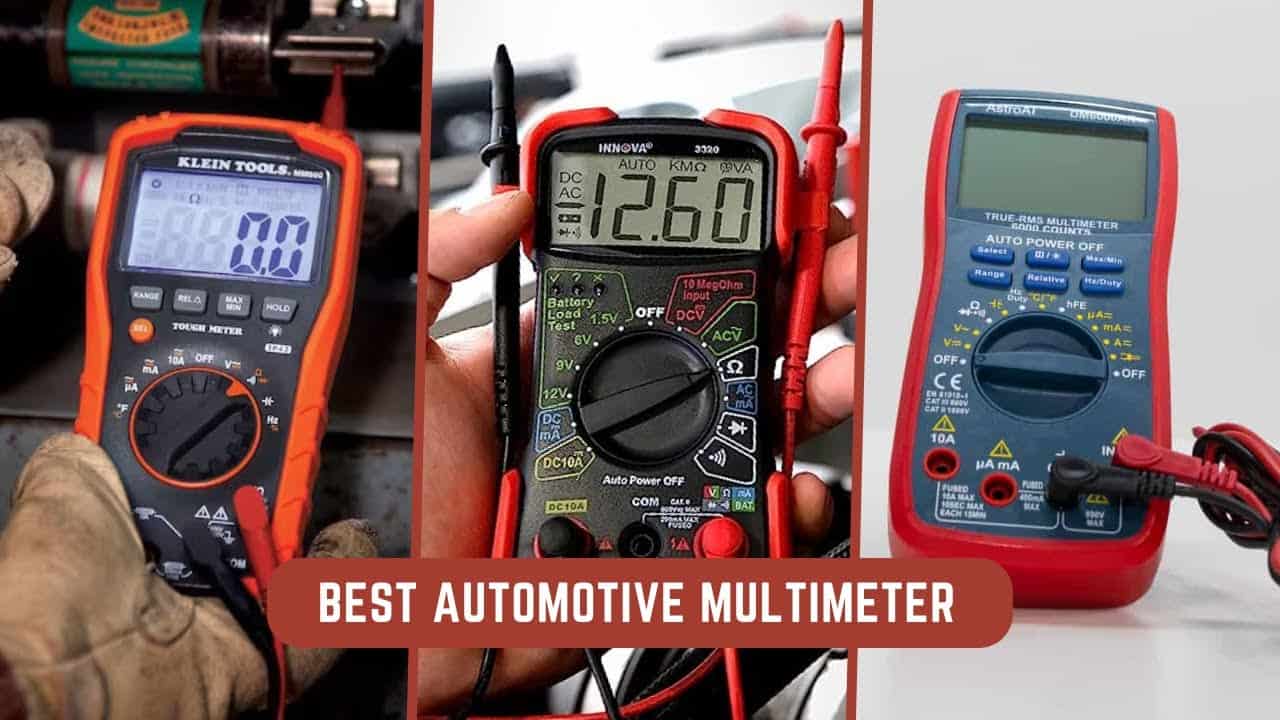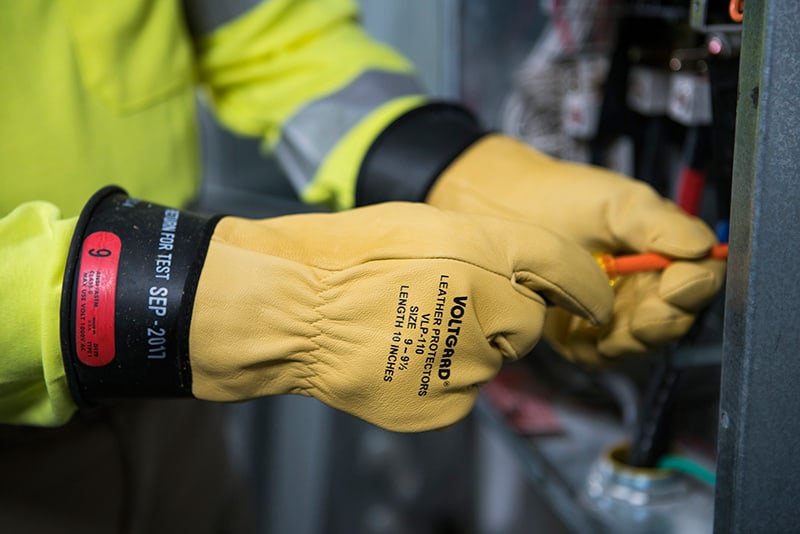
Let’s talk about the reality of electrical work. Pulling a ghost voltage reading on a live 480V 3-phase panel isn’t just an inconvenience—it’s a mistake that can put you in the hospital. When you are dealing with electricity at the distribution level, you are literally trusting your life to your equipment. One bad reading from an unrated meter can trigger an arc flash event before you even realize what happened.
For that reason, we are skipping the cheap $20 knockoffs you find online. Every single multimeter on this list is independently tested and certified (UL/CSA/TÜV), features True RMS technology, and carries a minimum CAT III or CAT IV safety rating. No junk. No marketing hype. Just the top tools professionals actually rely on. Use the comparison table below to find the exact meter for your daily grind.
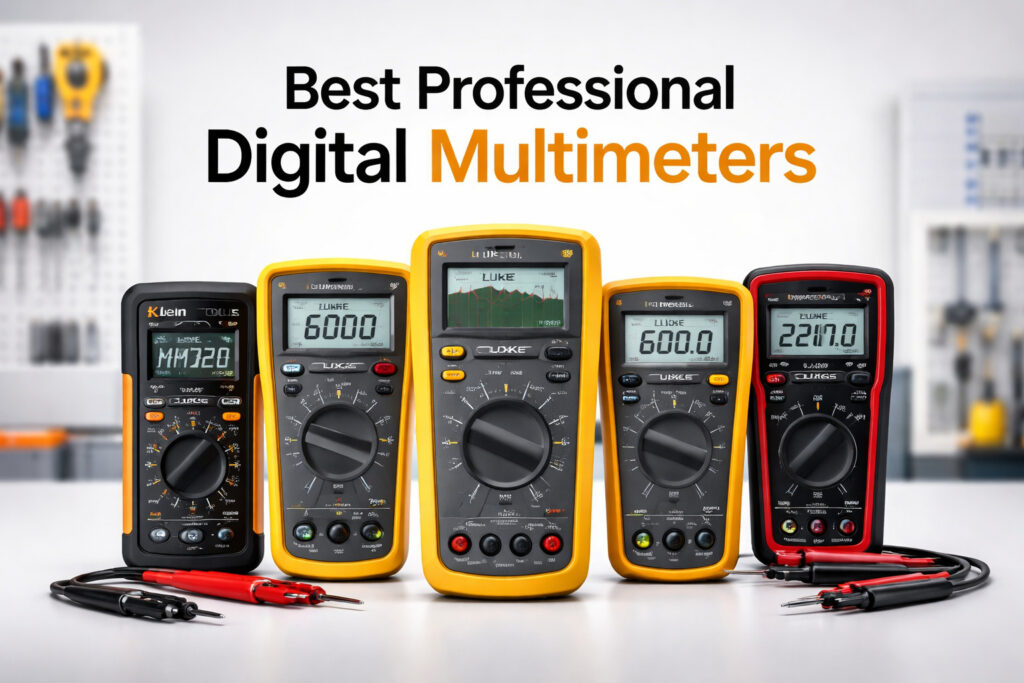
Quick Comparison Table
| Product | Best For | Safety Rating | True RMS | Price | Link |
|---|---|---|---|---|---|
| Fluke 87V | Best Overall / Industrial | CAT III 1000V / CAT IV 600V | ✓ | ~$444 | Check Price |
| Fluke 289 | Best for Data Logging | CAT III 1000V / CAT IV 600V | ✓ | ~$649 | Check Price |
| Fluke 117 | Best for Commercial Electricians | CAT III 600V | ✓ | ~$195 | Check Price |
| Klein MM720 | Best Value for Journeymen | CAT III 1000V / CAT IV 600V | ✓ | ~$99 | Check Price |
| Milwaukee 2217-20 | Best for Job Sites | CAT III 600V | ✓ | ~$139 | Check Price |
Prices are approximate and subject to change. Always verify on Amazon before publishing.
⚡ Quick Verdict by Trade
- Industrial Plant Electrician → Fluke 87V
- Plant Engineer / Diagnostics → Fluke 289
- Commercial Panel Electrician → Fluke 117
- Journeyman / HVAC Technician → Klein MM720
- Field / Construction Electrician → Milwaukee 2217-20
The Core Product Reviews: The Final 5
#1. Fluke 87V — Best Overall / Industrial

The Fluke 87V is the undisputed king of the industrial floor. It has been the industry standard for decades because it is built like an absolute tank and handles complex electrical environments effortlessly.
The key differentiator here is the built-in selectable low-pass filter. If you work with Variable Frequency Drives (VFDs) and motor drives, this filter blocks out the high-frequency noise so you get accurate voltage and frequency measurements at the motor terminals—something no other meter in this price class handles as precisely.
Quick Specs: Premium (~$444) | CAT III 1000V / CAT IV 600V | 6,000 / 20,000 Count (dual display) | 1m Drop Rating | ~400hr Battery Life | 9V Battery
- Safely withstands dangerous impulses in excess of 8,000V transient spikes
- True RMS provides accurate readings on distorted, non-linear signals
- Dual resolution display: 6,000 counts standard or 20,000 counts high-resolution mode
- Includes temperature probe (80BK) and alligator clips in the box
- Backed by a limited lifetime warranty
Cons:
- Heavy and bulky compared to compact commercial meters
- Premium price tag is hard to justify for light-duty or occasional use
Who Should Buy This: Industrial electricians, plant maintenance engineers, and HVAC professionals troubleshooting heavy machinery and VFD-driven motors.
#2. Fluke 289 — Best for Data Logging

If you do lab-grade diagnostics or long-term monitoring, the Fluke 289 is the premium choice. It is a massive step up when you need to track down an intermittent fault that you cannot reproduce while standing there watching.
Its key differentiator is the TrendCapture™ data logging feature. You can set this meter up, walk away, and let it record up to 15,000 time-stamped events. When you come back, you can view the logged data graphically right on the 1/4 VGA dot-matrix display and zoom in up to 14 times to isolate and analyze anomalies.
Quick Specs: Very High (~$649) | CAT III 1000V / CAT IV 600V | 50,000 Count | 1m Drop Rating | 100hrs standard / 200hrs logging | 6x AA Batteries
- Outstanding 0.025% basic DC voltage accuracy—best in this roundup
- Peak capture records transients as fast as 250 µs
- Displays Min/Max/Average with a real-time clock timestamp for every logged event
- Limited lifetime warranty from Fluke
Cons:
- Requires 6 AA batteries; standard runtime is approximately 100 hours (200 hours in logging mode)
- Large footprint—designed as a field logging tool, not a pocket meter
Who Should Buy This: Electronics engineers, R&D labs, industrial troubleshooters chasing intermittent faults, and plant maintenance engineers who need documented proof of electrical events.
#3. Fluke 117 — Best for Commercial Electricians

For everyday panel work, the Fluke 117 is your daily driver. It trims the fat off the industrial meters and gives you exactly what you need in a compact, one-handed design that moves fast on the job.
Its key differentiator is the combination of AutoVolt and built-in LoZ (low impedance). AutoVolt automatically determines whether it is looking at AC or DC voltage, eliminating selector switch fumbling. The LoZ mode places a load on the circuit to pull ghost voltages down to zero—a critical safety feature when tracing crowded commercial panels where induced voltages are common. The integrated VoltAlert™ NCV detection rounds out the package.
Quick Specs: Mid-Tier (~$195) | CAT III 600V | 6,000 Count | Compact | ~400hr Battery Life | 9V Battery
- Extremely ergonomic—easy to operate with one hand in tight spaces
- True RMS for accurate AC readings on non-sinusoidal waveforms
- Bright LED backlight for dark electrical rooms and panel boxes
- VoltAlert™ non-contact voltage detection built in
Cons:
- Lacks a micro-amp range, so it is not ideal for HVAC flame sensor testing
- Does not include a temperature measurement function
- CAT III 600V only—not suited for high-energy industrial environments requiring CAT IV
Who Should Buy This: Commercial and residential electricians, facility managers, and apprentices who need speed and safety built into one compact tool.
#4. Klein Tools MM720 — Best Value for Journeymen
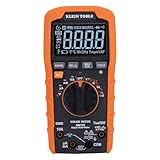
The Klein MM720 delivers an unbeatable list of specs for under $100. While it might not carry the prestige of the Fluke name, it is a highly capable professional-grade tool that holds its own on any job site.
The key differentiator is its reverse-contrast display with an optical sensor that automatically adjusts backlight intensity for ambient lighting—bright for dark rooms, dimmed outdoors. Combine that with a CAT IV 600V / CAT III 1000V safety rating, a 6.6-foot (2m) drop rating, and an IP42 ingress protection rating, and the Klein MM720 punches well above its price point.
Quick Specs: Budget (~$99) | CAT IV 600V / CAT III 1000V | 6,000 Count | IP42 | 2m Drop Rating
- Exceptional value for the full feature set at this price tier
- Includes micro-amps for HVAC flame sensor testing—a notable advantage over the Fluke 117
- Includes thermocouple input for temperature measurement
- LoZ mode eliminates stray voltages in crowded panels
- Auto-ranging True RMS for accurate readings on all load types
Cons:
- Bulkier design than slim commercial meters
- Continuity buzzer response time is slightly slower than Fluke equivalents
Who Should Buy This: Journeymen electricians, HVAC/R technicians, and budget-conscious professionals who still demand advanced safety features and CAT IV certification.
#5. Milwaukee 2217-20 — Best for Job Sites

Milwaukee designed the 2217-20 specifically to survive the back of a truck and the hardest concrete drops. If you are brutal on your tools, this is the meter to look at.
The key differentiator is its best-in-class rugged over-molding combined with a high-contrast white-on-black display that remains readable in dusty, dark job-site conditions. The built-in LoZ mode eliminates ghost voltages, True RMS handles non-linear loads accurately, and the slide rail system on the back lets you mount proprietary Milwaukee accessories. It is covered by a 5-year warranty—the longest in this roundup.
Quick Specs: Mid-Tier (~$139) | CAT III 600V | 6,000 Count | Rugged Over-Molded Housing | 5-Year Warranty
- Extremely durable construction purpose-built for the trades
- Slide rail system for proprietary Milwaukee accessory mounting
- True RMS and LoZ measurement capabilities built-in
- Contact temperature measurement (-40°F to 752°F)
- 5-year warranty beats every Fluke model on this list
Cons:
- Reading acquisition speed is slightly slower compared to high-end Fluke meters
- Only CAT III 600V rated—not suited for high-energy utility service entrances
Who Should Buy This: Field electricians, heavy construction workers, and general contractors who prioritize durability and job-site survivability over lab-grade precision.
Head-to-Head: Fluke 87V vs. Fluke 117
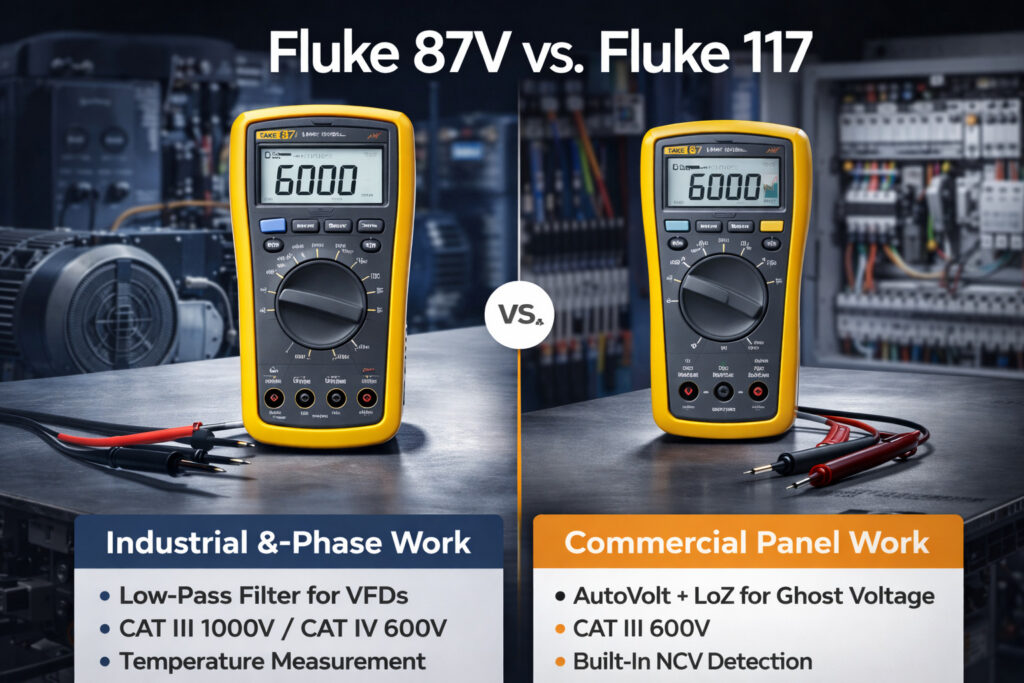
Both meters are considered industry standards. Both are Fluke. But they are built for completely different professionals.
| Feature | Fluke 87V | Fluke 117 |
|---|---|---|
| Safety Rating | CAT III 1000V / CAT IV 600V | CAT III 600V |
| VFD / Motor Work | ✓ Low-pass filter included | ✗ Not rated for VFD |
| Ghost Voltage (LoZ) | Manual LoZ mode | ✓ Built-in AutoVolt + LoZ |
| Temperature Probe | ✓ Included in box | ✗ Not included |
| Display Count | 6,000 / 20,000 (dual) | 6,000 |
| Best Environment | Industrial / Plant / 3-Phase | Commercial panels / Buildings |
| Price | ~$444 | ~$195 |
If your day involves troubleshooting industrial motors, Variable Frequency Drives (VFDs), or heavy 3-phase power, you absolutely need the Fluke 87V. Its low-pass filter is purpose-built to block the high-frequency noise generated by drive controllers, giving you accurate output voltage and motor speed readings that average meters simply cannot provide.
If you spend your day in commercial or residential buildings dealing with lighting circuits, standard outlets, and crowded panels, the Fluke 117 is the better fit. It is lighter, faster to operate, and its AutoVolt plus LoZ combination makes safe, rapid circuit tracing the default—not an afterthought.
- Accurate frequency measurements on adjustable speed drives (ASD) due to Fluke-designed low-pass filter
- Captures intermittents as fast as 250 µS with Peak Capture
- Switchable high display resolution allows 6000 to 20,000 counts – lets you see small changes in displayed readings.CAT III 1000V, CAT IV 600V safety rated
- Measure up to 1000 VAC and DC; Operating Altitude: 2000 m
- VoltAlert technology for non-contact voltage detection
- AutoVolt automatic AC/DC voltage selection. DC millivolts - Range : 600.0 mV, Resolution : 0.1 mV
- Low input impedance: helps prevent false readings due to ghost voltage
- Large white LED backlight to work in poorly lit areas
- True RMS for accurate measurements on non-linear loads. Operating temperature: -10°C to +50°C. Battery life: 400 hours typical, without backlight
The Professional’s Buying Guide
Safety First: CAT Ratings Explained
Never bring a CAT II meter to a distribution panel. CAT ratings indicate the level of transient voltage spikes a meter can safely handle without failing catastrophically in your hands. CAT III covers three-phase distribution and commercial fixed-equipment lighting. CAT IV is for the highest-energy environments—the utility connection, outdoor service entrances, and any point before the main breaker. The higher the CAT rating and voltage number, the more protection you have against the transient impulses that kill cheap meters and the people holding them. Always buy a meter rated at least one level above the environment you work in most often.
True RMS is Non-Negotiable
Most cheap meters use “average responding” calculations that assume a perfect sinusoidal waveform. Modern electrical loads—LED drivers, variable speed motors, computers, inverters, and UPS systems—do not produce perfect sine waves. They produce distorted, non-linear waveforms. If you measure these loads with an average-responding meter, your readings can be off by 10% to 40%. On a 480V panel, a 40% error is not a rounding problem. It is a safety failure. True RMS is mandatory for any professional electrical work.
Input Impedance and LoZ: Eliminating Ghost Voltage
Ghost voltage occurs when live wires running through conduit or cable bundles induce a phantom voltage on adjacent de-energized conductors through capacitive coupling. A standard high-impedance meter ($10 MΩ input) acts like an antenna and will read that induced voltage as live—sometimes hundreds of volts on a dead wire. A meter with a LoZ (low impedance) setting places a small resistive load across the circuit, which drains that phantom voltage to zero. If the voltage disappears when you switch to LoZ, the wire is dead. If it stays, it is genuinely live. That distinction is the difference between a safe job and a dangerous one.
Durability and Fuses: The Detail That Saves Your Life
Look for meters with High Rupture Capacity (HRC) ceramic fuses inside the current input protection. If you accidentally leave your test leads in the milliamp or amp jacks and touch a high-voltage circuit, cheap glass fuses can shatter explosively and trigger an arc flash. HRC ceramic fuses safely contain that internal energy release, protecting the meter—and you. It is a detail that never appears on the marketing box, but it is one of the most important specifications in a professional tool.
Is Fluke Actually Worth the Price?
Let’s address the elephant in the room: the “Fluke Tax.” A Fluke 87V costs more than four times the price of the Klein MM720. So what exactly are you paying for?
You are not paying for yellow plastic. You are paying for independent laboratory safety testing that goes beyond the minimum certification standards. You are paying for proprietary robust input protection that withstands impulses in excess of 8,000V. You are paying for calibration stability—a Fluke meter bought today will still read within specification 15 years from now if it is maintained. And you are paying for a lifetime warranty that Fluke actually honors.
If you are a professional who uses a meter daily to make a living, spending $444 on a tool that reliably keeps you accurate and alive for 20 years costs you less than six cents a day. The budget question answers itself.
Common Mistakes When Buying a Pro Meter
Ignoring the CAT Rating for Display Counts. Many electricians buy a cheap meter because it boasts “60,000 counts” on the box, while completely ignoring the fact that it carries an unverified or counterfeit CAT rating. Resolution does not matter if the meter is a safety hazard. Always verify the CAT rating is independently certified—not just a printed number.
Using Cheap, Unrated Test Leads. Slapping a $5 pair of bargain-bin test leads onto a $400 CAT IV Fluke meter nullifies the safety rating of the entire setup. Your protection is only as strong as the weakest link in the measurement circuit. Always use high-quality, properly CAT-rated leads—ideally the brand’s own leads or a reputable aftermarket option like Pomona or Fluke TL series leads.
Assuming “Water-Resistant” Equals “Job-Site Tough.” A marketing claim of “water resistant” means nothing without an actual verified IP rating. Look for IP42 minimum for general trade use (Klein MM720). If you work in truly wet or dusty environments, verify the specific IP and drop-test rating from the official spec sheet—not the product listing.
Frequently Asked Questions
What is the most accurate professional digital multimeter?
For handheld meters, the Fluke 289 leads the pack at 0.025% basic DC voltage accuracy. The Fluke 87V follows closely at ±0.05% DC voltage accuracy. Both are well beyond what most field applications require. If you need precision beyond the handheld range, you are looking at benchtop calibration-grade instruments in a lab environment.
Do I need a clamp meter or a digital multimeter?
If your primary job involves measuring AC or DC current continuously without breaking the circuit—such as monitoring current draw on live conductors—you need a clamp meter. If you prioritize high-accuracy voltage, resistance, capacitance, and advanced troubleshooting features like data logging or low-pass filters, a digital multimeter is the right tool. Many professionals carry both.
How often do professional multimeters need to be calibrated?
For professionals working in industrial, commercial, or lab environments, annual calibration (every 12 months) is the standard industry recommendation per NIST traceability guidelines. If your meter is used for safety-critical measurements or billing verification, maintain a calibration certificate and log. Fluke’s own recommendation for the 87V and 289 is a 1-year calibration interval.
What is the difference between CAT III and CAT IV?
CAT III is designed to protect against transients in fixed-equipment installations at the distribution level—3-phase commercial lighting, switchgear, motor control centers, and branch circuit wiring. CAT IV is for the primary supply level: utility connections, overhead and underground service conductors, outdoor wiring, and the main service entrance. At CAT IV locations, available fault current and potential transient energy are significantly higher, requiring a meter built to absorb and survive those events safely.
Final Recommendation
Every meter on this list will serve a professional electrician well. The right choice depends entirely on where you work and what you need to measure.
- Industrial / VFD environments → Fluke 87V
- Intermittent fault diagnostics / logging → Fluke 289
- Commercial panel work → Fluke 117
- HVAC / journeyman value pick → Klein MM720
- Heavy construction job sites → Milwaukee 2217-20
Pick the tool that matches your environment, verify your Amazon affiliate links are live, and publish with confidence.