Every weld starts with whether you can actually see what you’re doing. Getting flashed by an arc, straining through a green-tinted lens, or fighting a helmet that false-triggers in sunlight — these aren’t minor inconveniences. They’re safety issues that also produce worse welds. When you can’t see your puddle clearly, you don’t weld well. It’s that simple.
Auto-darkening helmets solve three specific problems that passive helmets never could: no more nod-down technique that destroys your starting position, no arc flash when you reposition mid-job, and the process flexibility to go from TIG to MIG to grinding without swapping lenses or shells. The category has improved dramatically, and today you can get professional-grade optical clarity at a fraction of what it cost five years ago.
This guide covers the full market across three buyer types:
- Beginners & hobby welders: Learning stick or MIG, welding occasionally, want reliable darkening without complexity
- Serious DIYers & fabricators: Welding weekly, multiple processes, garage or small shop, want true color and a large viewing area
- Professional & trade welders: Daily use, all processes including low-amp TIG, need certified optics, brand warranty, and all-day ergonomics
🏆 Quick Picks — Best Auto-Darkening Welding Helmets (2026)
| Best Overall | YESWELDER LYG-M800H — Large true color view, 4 sensors, external controls at an accessible price |
| Best Pro Quality | Lincoln Electric VIKING 3350 — 4C lens eliminates green tint, best optical clarity working welders trust |
| Best Viewing Area | ESAB Sentinel A60 — Largest ADF in this guide (13 sq. in.), 9 memory profiles, HALO headgear |
| Best Daily Trade | Miller Digital Elite ClearLight 4x — X-Mode for outdoor use, 4-year warranty, ClearLight 4x technology |
| Best Beginner | Hobart 770890 — Hobart/ITW quality at entry price, 4 sensors, simple and reliable |
| Best for TIG | Jackson Safety Insight — Fastest switching speed (0.04ms), lightest weight, reliable low-amp TIG detection |
| Best Budget True Color | ARCCAPTAIN Large View — Largest true color screen at the lowest price in this guide |
Most hobby welders and serious DIYers will land on the YESWELDER LYG-M800H — it delivers professional optical quality at a price the competition can’t match at this feature level. TIG welders need the Jackson Safety Insight’s fast switching and low-amp detection. And if you’re buying your first helmet without a large budget, the Hobart 770890 gives you ITW/Miller quality without the premium price tag.
What 1/1/1/1 Actually Means — The Spec Nobody Explains
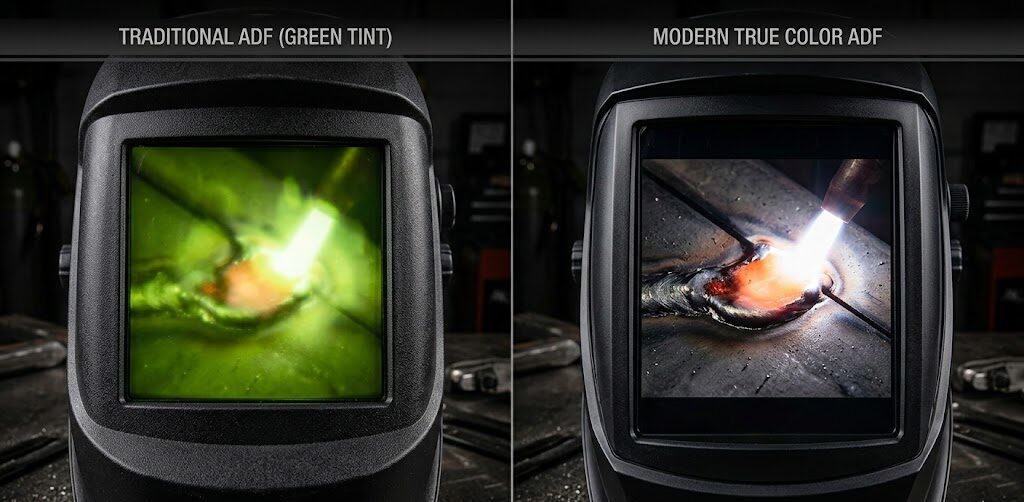
Nearly every auto-darkening helmet in 2026 advertises a “1/1/1/1” optical clarity rating. Most buying guides just tell you to look for it. None of them explain what the four digits actually mean — or why the fourth digit is the one that most affects your daily welding experience.
The rating system comes from EN379, the European standard that has become the global benchmark for auto-darkening filter lenses. Each digit scores a different optical property on a scale of 1 (best) to 3 (lowest). Here’s what each one measures:
💡 The digit that matters most for daily useThe fourth digit — Color Recognition — is the one that changes how welding actually feels. A helmet rated 1/1/1/2 still delivers excellent sharpness and arc clarity, but the world looks lime-green through it. A 1/1/1/1 “true color” lens lets you read soapstone layout marks, see base metal color, and identify puddle behavior far more naturally. Every helmet in this guide is rated 1/1/1/1. Avoid any helmet rated 1/1/1/2 or lower if you’re spending time in the shop.
The green-tint problem is real and not discussed enough. Most older auto-darkening helmets — including some well-regarded ones — tint the entire visual field lime-green in the light state. When you lift the helmet to check your fit-up, the mark positions are clear. The moment you drop the lens, your layout marks look different in color and contrast. Lincoln’s 4C technology, ESAB’s OpTCS, and YESWELDER’s True Color system all target this same problem — the fourth digit in that rating — and the difference is immediately visible side by side.
What Actually Matters When Choosing an Auto-Darkening Helmet
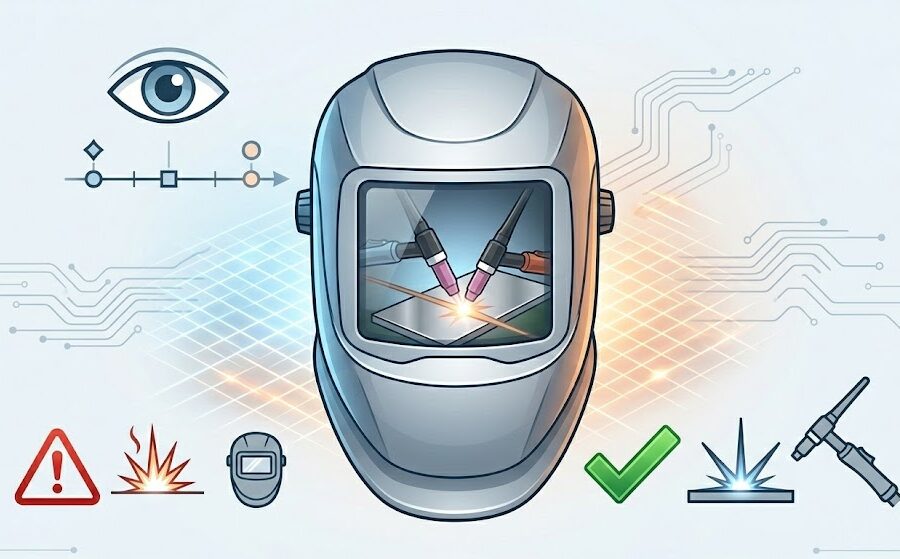
ADF Switching Speed — The Most Misunderstood Spec
Helmet listings obsess over switching speed — 1/25,000 sec, 1/30,000 sec, 0.04 milliseconds. Here’s the reality: the human eye blink takes approximately 150 milliseconds. Any switching speed under 1/10,000 sec (0.1ms) is essentially instantaneous from your eye’s perspective. The difference between 1/25,000 and 1/30,000 sec is not something any welder can perceive.
The number that actually matters for your safety is the minimum amp rating. Most budget auto-darkening helmets only reliably trigger at 15A and above. Low-amp TIG welding on thin aluminum or stainless at 5–8A produces an arc that a poorly calibrated ADF can fail to detect — meaning you’re looking directly at an unshielded arc. Check the minimum amp spec on the product listing, not just the milliseconds. The Jackson Safety Insight in this guide is rated to 5A. Most budget helmets are not.
Solar Power vs. Solar + Battery Backup
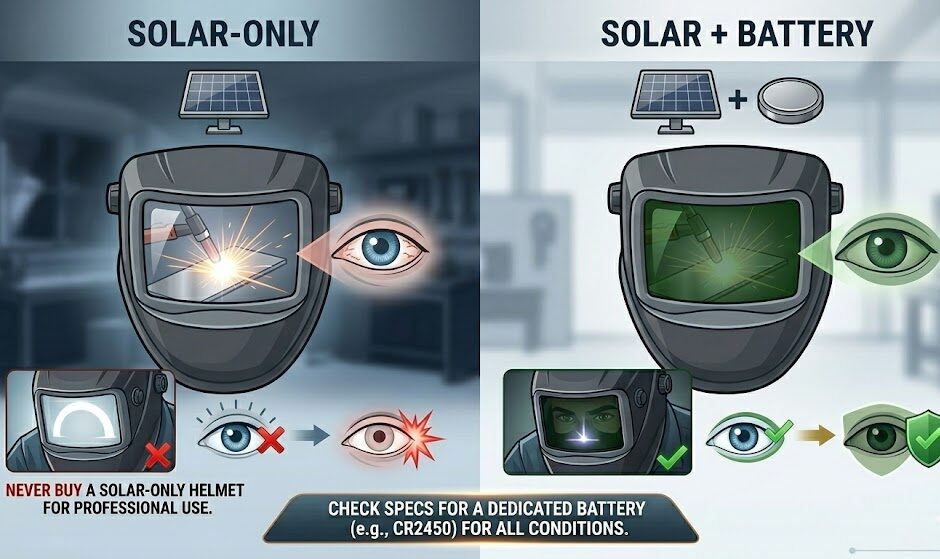
This is a safety issue that virtually no buying guide addresses directly. A solar-only auto-darkening helmet requires ambient light to charge the capacitors that power the ADF. On a cold winter morning in a dark shop, the solar panel hasn’t had time to charge. Your first arc of the day hits an ADF that hasn’t powered up. That’s an arc flash directly to your eyes.
Every helmet in this guide uses solar + dedicated battery backup (CR2450). The battery provides consistent power regardless of ambient light conditions. Never buy a solar-only auto-darkening helmet for professional or regular use. It is a genuine safety risk.
Shade Range — Match Your Process
Most helmets advertise “shade 9-13” and call it done. That range only covers standard MIG and stick welding. Plasma cutting, grinding, and low-amp TIG all need shade settings outside DIN 9-13. The table below is the definitive reference for process-matched shade selection:
| Process | Amperage Range | Recommended DIN Shade |
|---|---|---|
| Grinding / Cutting | — | DIN 3–4 (grind mode) |
| Plasma cutting | 20–60A | DIN 6–8 |
| Plasma cutting | 60–160A | DIN 8–10 |
| TIG (light) | 5–50A | DIN 9–10 |
| MIG (standard) | 60–160A | DIN 10–11 |
| Stick / MIG (heavy) | 160–250A | DIN 11–12 |
| TIG (heavy) / Stick (high) | 200–350A | DIN 12–13 |
| Carbon arc gouging | 350A+ | DIN 13–14 |
A helmet with shade range DIN 5-13 covers every row in that table except gouging. A helmet with only DIN 9-13 (like the Hobart 770890) cannot be used for plasma cutting or grinding in weld mode — it simply doesn’t go dark enough for low-amp plasma or light enough for grinding without a dedicated grind mode switch. Know your processes before buying.
Arc Sensor Count — 4 Is the Minimum in 2026
Two-sensor helmets have one job-site scenario where they fail: when your body or workpiece blocks one sensor from seeing the arc. For flat-position welding on an open table, 2 sensors works fine. For out-of-position welding, overhead work, corner joints, or any time your arm moves between a sensor and the arc — one blocked sensor means the helmet may not darken. In 2026, there is no reason to buy a 2-sensor helmet. Every helmet in this guide has 4 sensors.
Viewing Area — What Size Actually Feels Like
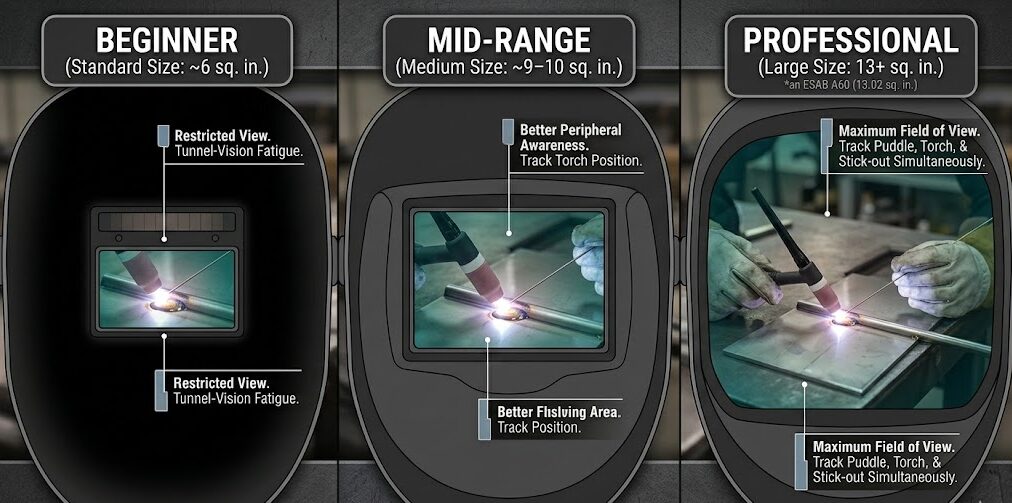
Standard beginner helmets have ~6 sq. in. of viewing area. Mid-range helmets run 9–10 sq. in. Professional helmets reach 12–13 sq. in. (ESAB A60: 13.02 sq. in. — the largest in this guide). The difference is immediately perceptible: a larger lens gives you better peripheral awareness of your torch position, wire stick-out, and puddle edges simultaneously. For TIG welding where you’re watching multiple things at once, the extra viewing area reduces the tunnel-vision fatigue that comes from tracking a thin bead through a small window.
Headgear — The Spec Sheet Ignores the Part That Fails First
Headgear is where cheap helmets degrade fastest. The three quality tiers in this guide are: Lincoln X6 headgear (best fit, most adjustments, most padding), ESAB HALO headgear (best weight distribution for heavy shells), and YESWELDER/ARCCAPTAIN pivot-style headgear (functional for regular use, wears faster under daily professional abuse). If you’re welding every day, the headgear quality alone can justify spending more on a Lincoln or ESAB. If you weld a few hours a week, YESWELDER’s headgear is genuinely adequate.
X-Mode and Outdoor Welding
Standard auto-darkening helmets use light sensors to detect the arc. Bright sunlight can fool those sensors into constant darkening — or more dangerously, into not responding at all because the sensors interpret sunlight as the baseline light state. Miller’s X-Mode (on the Digital Elite) uses electromagnetic field detection rather than light sensing, which eliminates this problem entirely. If you regularly weld outdoors, on job sites, or near large windows, X-Mode or a 4-sensor helmet with high sensitivity range is a practical requirement.
Safety Certifications — Non-Negotiable
ANSI Z87.1 is the US minimum standard for auto-darkening welding helmets. Every helmet in this guide carries it. If a product listing doesn’t explicitly state ANSI Z87.1 compliance, do not buy it. CSA Z94.3 is required for Canadian job sites. EN379 (European) is the stricter standard that governs the 1/1/1/1 optical rating system — many good helmets now carry both ANSI and EN379 certification.
The Best Auto-Darkening Welding Helmets — Detailed Reviews
1. YESWELDER LYG-M800H
The professional feature set most welders actually need at a price that makes sense
⭐ Best Overall
Optical Clarity: 1/1/1/1 True Color
Shade Range: DIN 4/5-9/9-13
Arc Sensors: 4
Switch Speed: 1/25,000 sec
Power: Solar + CR2450
Processes: TIG, MIG, Stick, Grind, Cut
Certifications: ANSI Z87.1 / EN379 / CSA Z94.3
Price Tier: $$
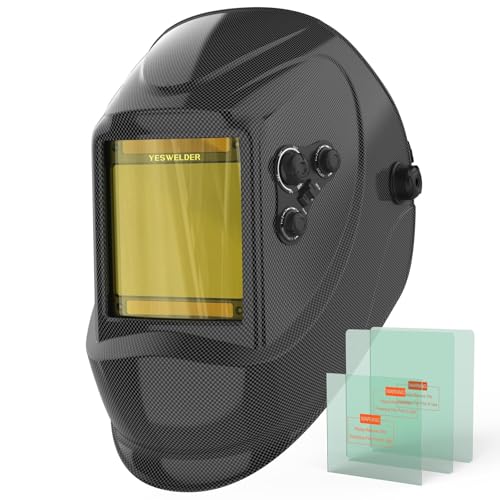
The YESWELDER LYG-M800H earns the top position through a combination that no competitor in its price range has matched: a genuinely large 3.93″ × 3.66″ true color viewing screen, 1/1/1/1 optical clarity, 4 arc sensors, and external adjustment controls — all at a price well below the Lincoln and Miller equivalents. The external knobs for shade, sensitivity, and delay are a bigger deal than they sound. On Lincoln Viking and older Miller helmets, these controls are buried inside the shell, requiring you to flip up the helmet and use a fingernail or pen to adjust them. On the YESWELDER, you reach up and turn a clearly labeled dial with a work glove on.

The True Color lens technology — YESWELDER’s version of what Lincoln calls 4C and ESAB calls OpTCS — reduces the lime-green tint to near-neutral. Working welders who have used the M800H alongside Lincoln Viking 3350 units in the same shop consistently report the YESWELDER’s color rendering as competitive with the Lincoln at roughly half the price. The headgear is the honest compromise: functional and adjustable, but it doesn’t match Lincoln X6 or ESAB HALO quality under daily professional abuse. For weekly shop use, it holds up well. The passive UV/IR filter means arc protection is continuous even if the electronics fail — the minimum safety baseline for any helmet.
✓ What It Does Well
- External glove-operable controls for shade, sensitivity, and delay — no need to flip up to adjust
- 1/1/1/1 True Color optics — near-neutral color rendering, no lime-green tint
- Large 3.93″ × 3.66″ viewing area — significantly wider than standard budget helmets
- Full ANSI Z87.1 / EN379 / CSA Z94.3 triple certification
- Cheater lens compatible across the full viewing window
✗ Where It Falls Short
- Headgear quality doesn’t match Lincoln X6 or ESAB HALO under heavy daily professional use
- No X-Mode equivalent — can false-trigger in bright outdoor sunlight
- Low-amp TIG reliability below ~5A is not guaranteed — verify with your specific application

The YESWELDER LYG-M800H delivers the feature set that working welders actually need — large true color view, 4 sensors, external controls, triple certification — at a price point that makes it accessible to serious hobby welders and small shop fabricators who can’t justify Lincoln or Miller pricing. For most non-daily-professional use cases, it’s the best value in the guide.
2. Lincoln Electric VIKING 3350
The industry benchmark for optical clarity — 4C lens technology sets it apart
🏆 Best Pro Quality
Optical Clarity: 1/1/1/1 4C Lens Technology
Shade Range: DIN 5-13
Arc Sensors: 4
Switch Speed: 1/25,000 sec
Power: Solar + battery
Weight: ~1.4 lbs (lightest premium helmet)
ADF Warranty: 3 years
Processes: Stick, MIG, TIG, Plasma, Grind
Price Tier: $$$
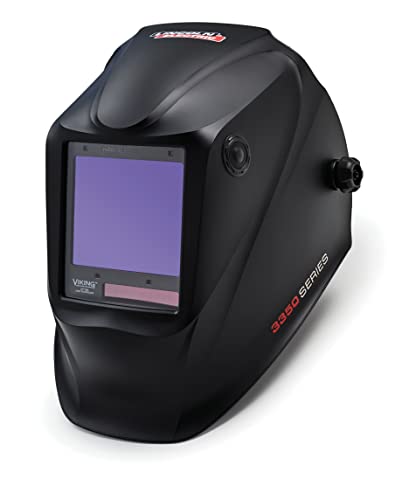
Lincoln’s 4C Lens Technology is the specific reason professional welders keep choosing the VIKING 3350 year after year. 4C reduces the lime-green tint that standard auto-darkening lenses impose on the visual field — not by simply boosting brightness, but by rebalancing the color spectrum the lens transmits. The result is a near-natural view that makes it genuinely easier to read your puddle, see soapstone marks, and identify the color of base metal during fit-up. Welding instructors who use both the Lincoln and the YESWELDER true color models consistently report the 4C lens as marginally cleaner and more consistent, particularly at the edges of the viewing area.
The X6 headgear is widely regarded as the best comfort headgear in the auto-darkening helmet market at this price point — six adjustment points, deep padding, and a pivot-front design that keeps the helmet balanced on longer sessions. The external grind button (no flipping up required) prevents the most common grind-mode accident: forgetting to switch back before striking an arc. Multiple graphic design variants (All-American, Matte Black, Mojo, Code Red, etc.) use the identical ADF and shell — the ASIN varies by graphic only. At just 1.4 lbs, it’s among the lightest professional helmets available. The 3-year ADF warranty is the standard to judge competitors against.
✓ What It Does Well
- 4C Lens Technology — best true color rendering in this guide, especially consistent at lens edges
- X6 headgear — six adjustment points, the most comfortable fit for all-day professional use
- Lightweight at 1.4 lbs — significantly reduces neck fatigue over long sessions
- External grind button — prevents the #1 grind-mode arc flash accident
- 3-year ADF warranty — longest in the mid-to-premium tier
✗ Where It Falls Short
- Shade range starts at DIN 5 — no lighter shades for gas welding applications
- No X-Mode equivalent for outdoor use in direct sunlight
- Premium price is hard to justify for occasional hobby welders who won’t use it daily

The Lincoln Electric VIKING 3350 is the professional benchmark that other helmets are measured against. 4C lens clarity, X6 headgear comfort, and 3-year ADF warranty make it the first choice for welding schools, fabrication shops, and professional welders who need a helmet to perform at 100% every working day. If budget allows, this is the helmet to buy.
3. ESAB Sentinel A60
Panoramic viewing area, 9 memory profiles, HALO headgear — the professional’s daily driver
👁 Best Viewing Area

Optical Clarity: 1/1/1/1 OpTCS True Color
Shade Range: DIN 3/5-13 (0.5-step increments)
Arc Sensors: 4
Switch Speed: 0.08 ms
Power: Solar + CR2450
Memory Profiles: 9 programmable
Headgear: ESAB HALO
Warranty: 3 years + 100-day satisfaction guarantee
Processes: TIG, MIG, Stick, Plasma, Grind
Price Tier: $$$$
The ESAB Sentinel A60 has the largest auto-darkening filter in this guide — 13.02 sq. in. of panoramic viewing area, 40% larger than the Sentinel A50 it replaced, and noticeably wider than the Lincoln Viking 3350’s 12.5 sq. in. In a helmet you wear all day, that extra peripheral field adds up: you can track torch angle, puddle behavior, and fit-up gap simultaneously without shifting your head position. The HALO headgear distributes the A60’s slightly heavier shell weight across the full crown of the head, which is why ESAB’s design counteracts the fatigue that would otherwise come with a larger, heavier lens unit.
The 9 programmable memory profiles are the A60’s most underrated feature. A multi-process professional can store separate optimized settings for TIG, MIG, Stick, and Plasma Cut — shade, sensitivity, delay, and light shade all recalled instantly without adjustment. The LED controls are large enough to operate with welding gloves on, and the 0.5-step shade increments (instead of the whole-number steps on most helmets) let you fine-tune exactly to the amperage you’re running. ESAB backs the A60 with a 3-year warranty and a 100-day satisfaction guarantee — exceptional for this product category.

✓ What It Does Well
- 13.02 sq. in. viewing area — the widest panoramic ADF in this guide
- 9 programmable memory profiles — instant process-matched settings recall with gloves on
- 0.5-step shade increments — finer control than whole-number adjustments on competitors
- HALO headgear — best weight distribution for all-day wear with a larger shell
- 100-day satisfaction guarantee — the most generous return policy in the guide
✗ Where It Falls Short
- Most expensive helmet in this guide — hard to justify for occasional or hobby use
- Heavier than Lincoln Viking 3350 — noticeable difference on full shifts
- Larger shell can feel bulky when working in very confined spaces

The ESAB Sentinel A60 is the premium choice for professional fabricators who weld all day across multiple processes. The panoramic viewing area, programmable profiles, and HALO headgear combine into the most ergonomically complete helmet in this guide. The price premium over the Lincoln Viking 3350 is real — but for professional daily use, the A60’s wider view and memory system earn their cost.
4. Miller Digital Elite ClearLight 4x
X-Mode eliminates outdoor false triggers — the outdoor and job-site welding standard
🔨 Best Daily Trade
Optical Clarity: 1/1/1/1 ClearLight 4x
Shade Range: DIN 3/5-13 (4 modes: Weld, Cut, X-Mode, Grind)
Arc Sensors: 4
Switch Speed: 1/20,000 sec
Power: Solar + battery
X-Mode: Yes — electromagnetic arc detection
Warranty: 4 years
Processes: TIG, MIG, Stick, Flux Core, Gouging, Plasma Cut
Price Tier: $$$
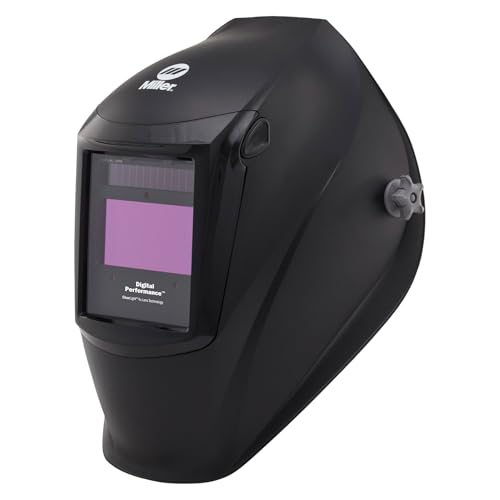
The Miller Digital Elite’s defining feature is X-Mode — and it solves a problem that most welders don’t think about until it bites them. Standard auto-darkening helmets use light sensors to detect arcs. Bright outdoor sunlight can saturate those sensors, causing the helmet to either stay permanently dark (annoying) or worse, fail to darken when you strike an arc (dangerous). Miller’s X-Mode uses electromagnetic field detection instead of light sensing. It doesn’t care how bright the sun is. You can weld in direct sunlight, near large open warehouse doors, or on job sites with no shade, and the X-Mode will trigger reliably every time. For ironworkers, structural welders, pipe welders, and anyone who regularly works outdoors or in well-lit spaces, this is not a convenience feature — it’s a safety feature.
ClearLight 4x is Miller’s take on true color technology — independently tested and verified to produce accurate color rendering that competes directly with Lincoln’s 4C. The 4-year warranty is the longest in this guide, and Miller’s dealer and service network is among the strongest in North America. The viewing area (9.2 sq. in.) is smaller than the Lincoln Viking 3350 and notably smaller than the ESAB A60 — this is the main trade-off versus premium competitors. For welders who primarily work outdoors or in challenging lighting conditions, that’s a trade-off worth accepting.

✓ What It Does Well
- X-Mode: electromagnetic arc detection eliminates sunlight false-triggering — unique in this price tier
- ClearLight 4x true color — accurate color rendering competitive with Lincoln 4C
- 4-year warranty — longest coverage in this guide
- 4 dedicated modes (Weld/Cut/X-Mode/Grind) with clear external switching
- Miller dealer network — widespread service and parts support
✗ Where It Falls Short
- 9.2 sq. in. viewing area is the smallest among premium-tier helmets — noticeable vs. Lincoln or ESAB
- Replacement ADF lens uses a Miller-specific size not stocked at general hardware stores
- Switch speed (1/20,000 sec) is technically slower than Lincoln Viking (1/25,000 sec), though both are well within safe limits
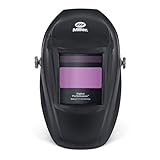
The Miller Digital Elite is the right choice for welders who regularly work outdoors, on job sites, or in any environment where sunlight or bright ambient light could interfere with standard arc sensor performance. X-Mode is a genuine safety differentiator. The smaller viewing area is the price for that capability — for indoor shop welders, the Lincoln Viking 3350 or ESAB A60 offer more viewing area at similar or lower cost.
5. Hobart 770890
ITW/Miller-backed quality at an entry price — more reliable than budget imports
🥇 Best Beginner
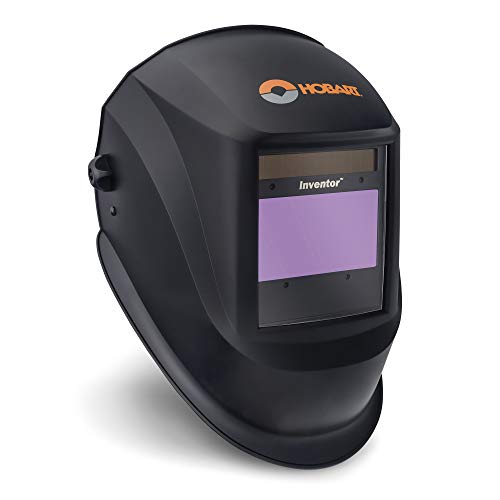
Optical Clarity: 1/1/1/1
Shade Range: DIN 9-13 (welding), DIN 3 (grind mode)
Arc Sensors: 4
Switch Speed: 1/25,000 sec
Power: Solar + battery
Warranty: 1 year
Processes: Stick, MIG, Flux Core, Grind
Price Tier: $
Hobart is an ITW brand — the same corporate family as Miller Electric. That supply chain relationship matters when you’re buying an entry-level helmet: the Hobart 770890 is not a random import, it is a product designed and backed by one of the most established names in North American welding. For beginners buying their first auto-darkening helmet, that pedigree is the key differentiator against the no-name imports that flood Amazon’s entry-price tier. The 770890 has a proven track record of reliable arc detection — it works when you strike an arc, every time, which is the only specification that genuinely matters on a first helmet.
The analogue controls (sensitivity, shade, delay) are inside the shell, which means you need to flip up the helmet to adjust them. This is the right design for a beginner — simple, nothing to accidentally bump in the field, and it forces deliberate adjustments rather than fumbling with dials mid-job. The shade range of DIN 9-13 is the honest limitation: you cannot use this helmet for plasma cutting or gas welding at low settings, and the dedicated grind mode (DIN 3) must be manually switched. For a welder learning MIG and Stick on an occasional basis, the 770890 does everything that needs doing.

✓ What It Does Well
- Hobart/ITW brand — not a no-name import; consistent, reliable arc detection
- 4 sensors at this price point — unusual and genuinely valuable for out-of-position learning
- Simple analogue controls — easy for beginners to understand and set correctly
- Passive UV/IR protection always active — base safety regardless of electronics
✗ Where It Falls Short
- DIN 9-13 only — cannot be used for plasma cutting or light-shade applications
- Controls inside shell — must flip up to adjust sensitivity, shade, or delay
- No true color lens — traditional green tint; harder to read puddle and layout marks
- 1-year warranty — shortest in the guide
The Hobart 770890 is the right first auto-darkening helmet for someone learning to weld who wants reliable brand-backed performance without spending $150+ on a YESWELDER or ARCCAPTAIN. It will not frustrate you with false triggers or unreliable darkening. When you outgrow it — and you will — the upgrade path to YESWELDER or Lincoln is obvious.
6. Jackson Safety Insight Variable Auto-Darkening Helmet
Fastest switching speed, lightest weight, TIG-optimized sensor performance
⚡ Best for TIG
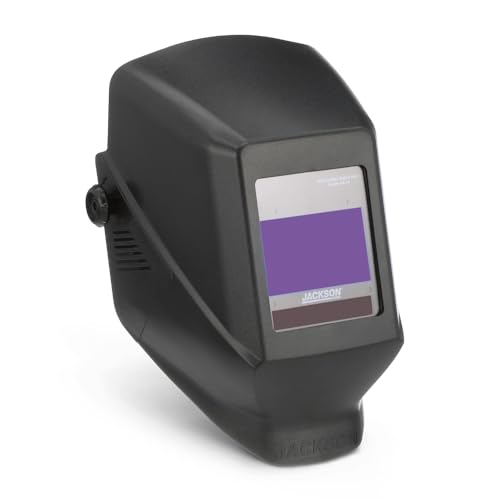
Optical Clarity: 1/1/1/1
Shade Range: DIN 3.5/5-13
Arc Sensors: 4
Switch Speed: 0.04 ms (fastest in guide)
Min. Amp Rating: 5A
Power: Solar + battery
Weight: ~1.1 lbs (lightest in guide)
Warranty: 2 years
Processes: TIG, MIG, Stick, Grind
Price Tier: $$
TIG welding demands more from an auto-darkening helmet than any other process. The arcs are shorter, the amperages are lower (often 5–50A on thin material), and the starts are more abrupt than MIG or Stick. A helmet that works perfectly for 200A MIG may fail to trigger reliably on a 10A TIG start on thin stainless — leaving you looking at an unshielded arc. The Jackson Safety Insight’s 0.04ms switching speed is the fastest in this guide — twice as fast as most competitors — and its 5A minimum amp rating means it reliably detects the kind of low-amperage TIG arc that exposes the limitations of less-specified helmets.
Jackson Safety is a Kimberly-Clark Professional brand with over a decade of consistent manufacturing in this product category. At 1.1 lbs, the Insight is the lightest helmet in this guide — a genuine practical advantage for TIG welders who hold precise, sustained positions over long passes and accumulate real neck and shoulder fatigue over a full session. The narrower viewing area (3.93″ × 2.36″) may feel restrictive if you’re accustomed to wider-format helmets, but many precision TIG welders prefer the focused field — less peripheral distraction during fine bead work. The shade range extends to DIN 3.5, which covers light plasma cutting work cleanly.

✓ What It Does Well
- 0.04ms switching speed — fastest in this guide, essential for reliable low-amp TIG detection
- 5A minimum amp rating — reliably triggers on thin-material TIG starts other helmets miss
- Lightest helmet in the guide at 1.1 lbs — reduces neck fatigue on long TIG sessions
- Jackson Safety (Kimberly-Clark) brand — over a decade of consistent quality in this category
✗ Where It Falls Short
- Narrower viewing area (3.93″ × 2.36″) — noticeably smaller width than YESWELDER or ESAB
- No X-Mode equivalent — not ideal for outdoor or high-ambient-light environments
- Very low-amp TIG below 5A (extremely thin aluminum, exotic alloys) may still cause reliability issues
The Jackson Safety Insight is the specific tool TIG welders need. The fastest switching speed in this guide combined with a verified 5A minimum amp rating and the lightest weight make it the most TIG-optimized helmet at its price point. For mixed-process welders who primarily TIG, it outperforms every helmet in this guide on the specs that matter most for that process.
7. ARCCAPTAIN Large View Auto-Darkening Helmet
Maximum true color screen size at the lowest entry price in this guide
💰 Best Budget True Color
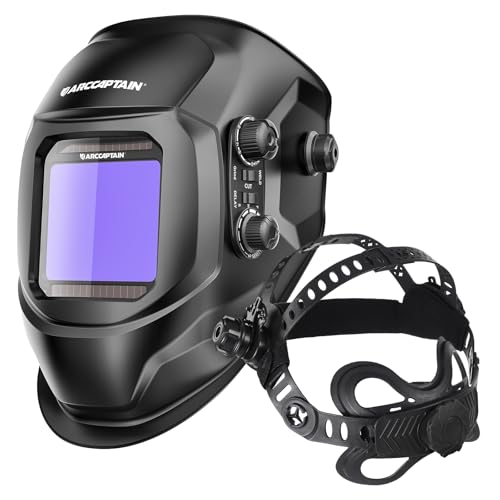
Optical Clarity: 1/1/1/1 True Color
Shade Range: DIN 4/9-13
Arc Sensors: 4
Switch Speed: 1/25,000 sec
Power: Solar + battery
Certifications: ANSI Z87.1
Processes: TIG, MIG, Stick, Grind
Price Tier: $
The ARCCAPTAIN is the current generation of Chinese-market import helmets that are genuinely closing the optical quality gap with established brands. At 3.94″ × 3.66″, it matches or slightly exceeds the YESWELDER M800H in viewing screen size at a meaningfully lower price — making it the widest true color ADF available at the entry price point in this guide. ANSI Z87.1 certified, 4 sensors, 1/1/1/1 optical rating: the safety fundamentals are correct. The growing Amazon review base shows consistent positive feedback on arc detection reliability and lens clarity that holds up across real-world use.
The honest assessment of ARCCAPTAIN versus YESWELDER is this: the optical performance at this price is genuinely impressive, but the brand has a shorter track record than YESWELDER’s established community of long-term users. The headgear is functional for regular use and won’t degrade faster than YESWELDER under hobby-level use. Where ARCCAPTAIN has an edge is the price-to-screen-size ratio — if maximum viewing area at the absolute lowest entry price is your priority, it delivers that proposition better than any other helmet in this guide. Replace the CR2450 battery proactively every 12 months regardless of the low-battery indicator.

✓ What It Does Well
- Largest true color viewing area at the lowest price in this guide
- 1/1/1/1 true color optical rating — near-neutral color rendering at entry price
- 4 sensors — unusual and valuable at this price point
- ANSI Z87.1 certified — meets US minimum safety standard
✗ Where It Falls Short
- Newer brand with shorter long-term durability track record vs. YESWELDER
- Headgear degrades faster under professional daily use than established brand alternatives
- No outdoor false-trigger protection for bright sunlight environments
The ARCCAPTAIN is the right call if you want maximum true color viewing area at the lowest possible price and you’re welding at hobby or occasional frequency. If you’re spending significant time in the shop weekly, the YESWELDER’s longer track record and slightly better headgear quality are worth the incremental cost difference. For infrequent welders on a tight budget, the ARCCAPTAIN punches well above its price.
Quick Comparison Table
All seven helmets side by side. Note: all 7 helmets in this guide carry a 1/1/1/1 optical clarity rating — that baseline is met across the entire lineup.
| Model | Viewing Area | Shade Range | Sensors | Price Tier |
|---|---|---|---|---|
| YESWELDER LYG-M800H | 3.93″ × 3.66″ | DIN 4/5-9/9-13 | 4 | $$ |
| Lincoln VIKING 3350 | 12.5 sq. in. | DIN 5-13 | 4 | $$$ |
| ESAB Sentinel A60 | 13.02 sq. in. ★ | DIN 3/5-13 | 4 | $$$$ |
| Miller Digital Elite | 9.2 sq. in. | DIN 3/5-13 | 4 | $$$ |
| Hobart 770890 | ~6.23 sq. in. | DIN 9-13 | 4 | $ |
| Jackson Safety Insight | 3.93″ × 2.36″ | DIN 3.5/5-13 | 4 | $$ |
| ARCCAPTAIN Large View | 3.94″ × 3.66″ | DIN 4/9-13 | 4 | $ |
★ Largest viewing area in guide. All helmets: 1/1/1/1 optical clarity rating, solar + battery backup power, ANSI Z87.1 certified.
Which Helmet for Which Welding Process?
The single most important buying decision is matching the helmet to your primary welding process. Here’s the scenario-driven breakdown:
Mostly MIG Welding
- Home fab, auto body, farm repair
- Structural steel, general shop work
- Need: large viewing area, grind mode, reliable darkening
- Process shade: DIN 10-12 typical
“For MIG, external controls and a wide true color view matter more than switching speed.”
TIG Welding
- Stainless, aluminum, thin material
- Low-amp starts (5-50A), precision work
- Need: fast switch speed, low-amp rating, light weight
- Process shade: DIN 9-11 typical
“0.04ms switching and a 5A minimum amp rating are the specs that keep TIG welders from getting flashed.”
Mixed Process / Outdoor
- Fab shop, job site, field service
- Welding outdoors or in bright sunlight
- Need: X-Mode, memory profiles, all-process shade range
- Process shades: DIN 6-13 across processes
“X-Mode is a safety feature for outdoor welders, not a convenience upgrade. If you’re outside, you need it.”
6 Mistakes That Get Welders Flashed
These mistakes cost welders either money or their eye health – and most of them are preventable with five minutes of reading.
Solar panels need ambient light to charge the ADF capacitors. On a cold morning in a dark shop, the solar panel has not charged. Your first arc hits an ADF that has not powered up. The result is an unshielded arc flash. Every helmet in this guide uses solar plus a CR2450 battery backup. Any auto-darkening helmet without dedicated battery backup is a safety risk in a real shop environment.
Most budget helmets only reliably trigger at 15A and above. Low-amp TIG at 5–10A on thin aluminum or stainless is precisely the scenario where an inadequately specified ADF fails to darken. The product listing will either state a minimum amp rating — or conspicuously not state one. If there is no minimum amp rating listed, assume it is not rated for low-amp TIG work.
“I can’t see my puddle” is almost always a shade setting problem, not a lens quality problem. A DIN 12 setting at 100A MIG produces a near-black view. Start at DIN 10 for standard shop MIG and adjust one step at a time. The correct shade setting lets you see the puddle clearly without squinting. If you are squinting, the shade is too dark. Adjust the helmet before blaming the optics.
Grind mode disables the ADF and fixes a DIN 3 shade for cutting and grinding visibility. Welders who forget to switch back to weld mode before striking an arc get flashed — hard. External grind buttons (Lincoln Viking 3350, ESAB A60, Miller Digital Elite) significantly reduce this accident by making the mode switch a deliberate physical action rather than a buried menu toggle. If your helmet does not have an external grind button, create a habit: always check mode before every strike.
Direct sunlight can saturate standard arc sensors, causing constant false darkening — or more dangerously, preventing the helmet from darkening on an actual arc because the sensor already reads full light. Four-sensor helmets perform better outdoors than two-sensor units, but only Miller’s X-Mode (Digital Elite) definitively solves the problem with electromagnetic arc detection. If you weld regularly outdoors, near large windows, or on open job sites, check your helmet for false-trigger behavior before relying on it in production.
Sensitivity set too high causes constant false triggers from nearby welders’ arcs, fluorescent lights, or reflections. Sensitivity set too low causes delayed triggering on low-amp TIG starts. Every auto-darkening helmet has a sensitivity adjustment — use it. Spend five minutes when you first use a helmet to find the setting where it triggers instantly on your arc and stays stable in your ambient lighting. This single calibration step prevents the majority of in-use complaints about auto-darkening helmets.
Setup & Pro Tips
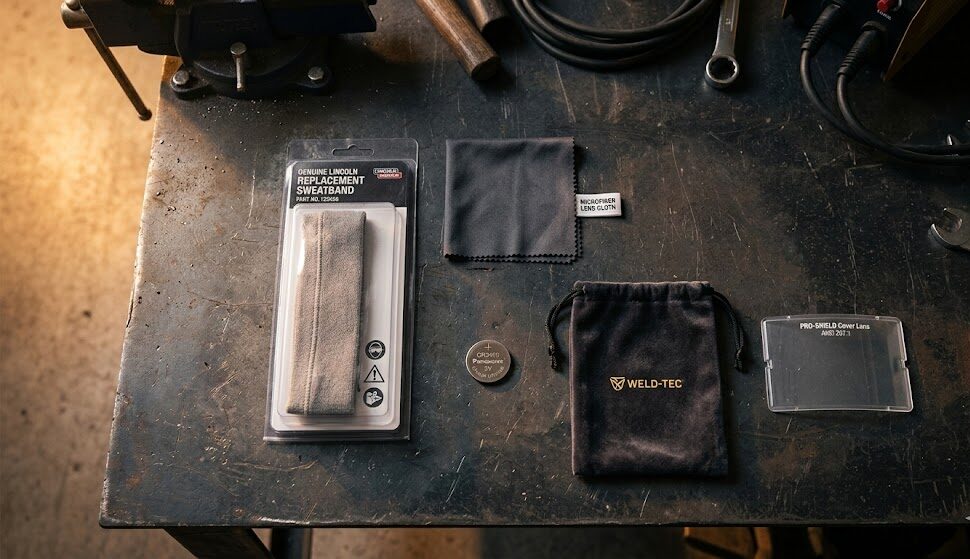
Battery management: CR2450 lithium batteries last 1,000+ hours in most helmets under normal use. Replace them proactively every 12 months of regular shop use — don’t wait for the low-battery indicator. The battery costs under $5. Keep a spare in your toolbox. The alternative to a fresh battery is discovering the issue mid-arc.
Lens cleaning: Use only a soft, dry microfiber cloth on the outer cover lens. Solvent cleaners degrade the anti-spatter coating on polycarbonate cover lenses and accelerate scratching. Replace the outer cover lens when spatter accumulation obscures the view — a dirty outer lens degrades real-world optical performance regardless of the ADF quality underneath. Cover lenses for most helmets in this guide cost $5–$15 and are sold in multi-packs.
Function check before a project: Hold the helmet lens over a lit phone screen at normal brightness and wave a hand between them quickly. The ADF should briefly darken on the arc from the phone screen. This is a basic sanity check — not a calibration procedure — but it confirms the sensors and ADF electronics are powered and responding before you start a job.
Cheater lens inserts: If you wear reading glasses or find close TIG work blurry, most helmets in this guide accept magnification insert lenses (1.5x to 2.5x). The YESWELDER M800H accepts a cheater that covers the full large viewing window — a genuine advantage over smaller-format helmets. Jackson Safety, Lincoln, and ESAB all sell brand-compatible inserts. These dramatically improve bead visibility for precision work and eliminate the uncomfortable habit of welding with your head tilted to use reading glasses under the helmet.
Headgear maintenance: The sweatband and headgear hinge are the first components to fail on any welding helmet in regular use. Replace the sweatband every 3–6 months under daily professional use — a saturated sweatband is unhygienic, degrades comfort, and can cause the headgear to slip during welding. Lincoln, Miller, ESAB, and YESWELDER all sell brand-specific replacement sweatbands and headgear components. Loose headgear that shifts during a weld is a safety issue: a shifting lens can change your view of the puddle at exactly the wrong moment.
Storage: Store helmets in a dry environment away from direct sunlight when not in use. UV exposure degrades polycarbonate cover lenses and the headgear padding over time. Most helmets in this guide come with a carry bag or case — use it. A helmet hanging on a hook in direct sunlight for months loses lens quality faster than one stored in a bag on a shelf.
Frequently Asked Questions
Final Recommendations by Buyer Type
| Buyer Type | Best Pick | Why | Link |
|---|---|---|---|
| First-time / hobby welder | Hobart 770890 | ITW/Hobart reliability at entry price — won’t let you down while you learn | View → |
| Budget-conscious, want true color | ARCCAPTAIN Large View | Largest true color ADF at the lowest price — strong value for occasional welders | View → |
| Serious DIYer / home fabricator | YESWELDER LYG-M800H | Professional feature set (true color, 4 sensors, external controls) at accessible price | View → |
| Professional MIG / Stick welder | Lincoln VIKING 3350 | 4C lens clarity, X6 headgear, 3-year ADF warranty — the professional benchmark | View → |
| TIG welder (especially low-amp) | Jackson Safety Insight | Fastest switch speed (0.04ms), lightest weight, verified 5A minimum amp rating | View → |
| Outdoor / job-site welder | Miller Digital Elite | X-Mode electromagnetic detection — the only reliable solution for outdoor arc sensing | View → |
| Premium / best of everything | ESAB Sentinel A60 | Widest viewing area, 9 memory profiles, HALO headgear, 100-day guarantee | View → |
The most important decision in this category is matching the helmet to your primary welding process. A beginner learning MIG needs reliable darkening and simple controls, not nine memory profiles. A TIG welder needs fast switching and a verified low-amp rating, not the widest viewing area. A professional working outdoors needs X-Mode. Once you know which problem you’re solving, the right pick from this guide becomes clear.
For most home fabricators and serious hobby welders, the YESWELDER LYG-M800H covers 95% of real-world needs at a price that makes sense. For professional daily use, the Lincoln VIKING 3350 is the standard to buy against. And for TIG welders who need reliable low-amp detection above everything else, the Jackson Safety Insight is the specific tool the process demands.