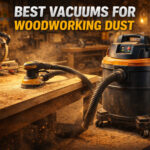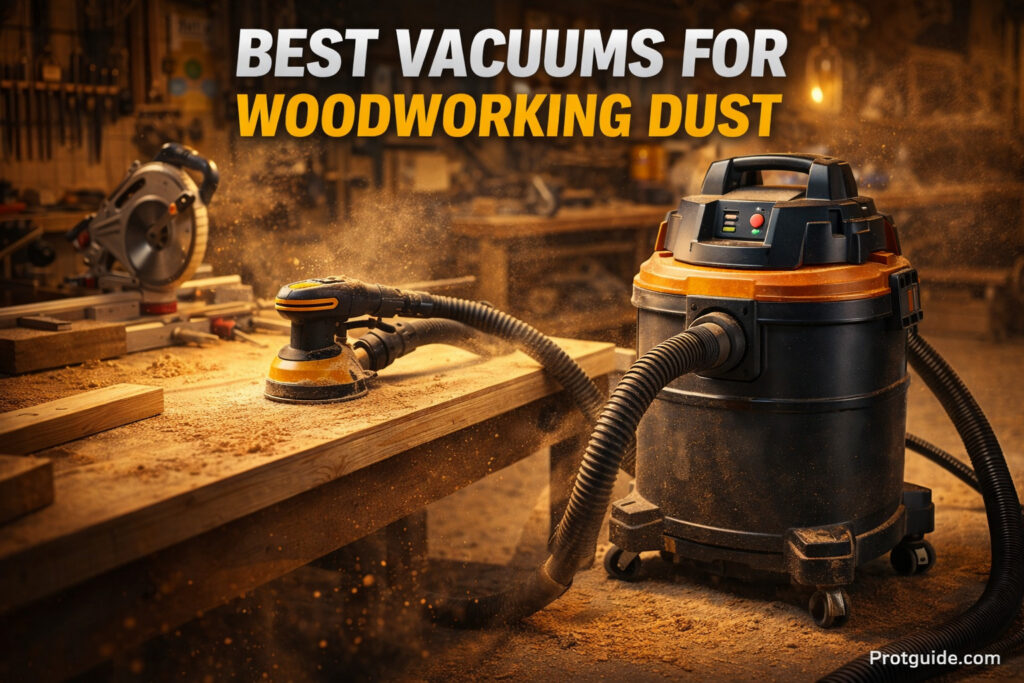
Fine wood dust (under 10 microns) is the biggest invisible hazard in any woodworking shop — it stays airborne for hours and can cause serious respiratory damage. A shop vacuum with the right filtration is your first line of defense.
Not all shop vacuums are built equal when it comes to woodworking dust. A standard shop vac without proper filtration can actually blow fine sawdust back into the air, making things worse. After testing and researching dozens of models, we’ve identified the best shop vacuums specifically for woodworking dust — whether you’re a weekend hobbyist or a serious craftsman with a full workshop.
Our Top Picks at a Glance
- Best Overall: RIDGID 62703 RT1200 NXT 12-Gallon
- Best Professional / HEPA: Bosch VAC090AH 9-Gallon Dust Extractor
- Best Heavy-Duty: DeWalt DXV09PA 9-Gallon
- Best for Fine Sawdust: Vacmaster VFB511B Professional
- Best Auto Tool-Start: Makita VC4210L 11-Gallon HEPA
- Best Mid-Range: Craftsman CMXEVBE17607
- Best Budget: Stanley SL18116P 6-Gallon
- Best DIY Setup: Harbor Freight Bauer + Oneida Dust Deputy Cyclone

Table of Contents
What to Look for in a Shop Vac for Woodworking Dust
Choosing the right shop vacuum for woodworking isn’t just about picking the most powerful model. Fine sawdust behaves very differently from workshop debris or water, and the wrong vacuum can clog quickly, lose suction, or worse — expel fine particles straight back into your breathing zone. Here’s what actually matters:
1. HEPA-Grade Filtration
This is the single most important feature for woodworking. A true HEPA filter captures 99.97% of particles down to 0.3 microns — including the ultra-fine dust from sanders, routers, and scroll saws that poses the greatest health risk. Look for models certified to HEPA standard, not just “HEPA-style” or “HEPA-type” filters, which are significantly less effective.
2. CFM (Airflow) vs. Water Lift (Suction)
Key insight: Most people focus on horsepower, but for fine sawdust, CFM (cubic feet per minute) matters more than water lift. CFM determines how much air — and dust — the vacuum can move, while water lift measures suction against restriction. For woodworking, aim for at least 100+ CFM.
3. Tank Capacity
For a typical woodworking session, a 6–12 gallon tank is the sweet spot. Smaller tanks mean more frequent emptying; larger tanks become unwieldy in tight shop spaces. If you do heavy production work, consider a 14–16 gallon model or pair any tank with a cyclone separator (see our section below).
4. Auto-Start (Tool-Triggered Power)
Many professional-grade shop vacs include a power outlet on the unit — plug your power tool in, and the vacuum automatically starts when the tool starts and shuts off a few seconds after you stop. This is an enormous convenience that also ensures you never forget to run dust collection.
5. Automatic Filter Cleaning
When collecting fine sawdust, filters clog fast. Models with a self-cleaning filter mechanism (like the Bosch Auto Filter Clean) pulse air to knock dust off the filter cartridge without you having to stop and clean it manually, maintaining consistent suction throughout your work session.
6. Noise Level
Shop vacuums are notoriously loud. If you work in a shared space or enclosed garage, look for models rated under 75 dB. Some models (especially the Festool and Bosch professional range) are significantly quieter, making them easier to use for extended periods.
7. Hose Compatibility
The standard shop vac hose is 2.5 inches. Many woodworking tools (routers, track saws, random orbit sanders) use a 1.25-inch dust port. Make sure your chosen vacuum includes adapters or is compatible with the Dust Right adapter system used by most power tools.
Quick Comparison Table — Best Shop Vacuums for Woodworking
| Model | Capacity | CFM | HEPA | Auto-Start | Filter Clean | Noise | Best For |
|---|---|---|---|---|---|---|---|
| RIDGID RT1200 NXT Top Pick | 12 gal | ~180 CFM | Compatible | No | Manual | ~85 dB | All-around workshop use |
| Bosch VAC090AH Pro Pick | 9 gal | 150 CFM | ✓ True HEPA | Yes | Auto | ~72 dB | Fine dust, pros, health-conscious |
| DeWalt DXV09PA | 9 gal | ~175 CFM | Compatible | Yes | Manual | ~83 dB | Heavy debris + dust |
| Vacmaster VFB511B | 5 gal | ~210 CFM | Compatible | No | Manual | ~84 dB | Sanders, routers, fine dust |
| Makita VC4210L AWS | 11 gal | ~145 CFM | ✓ True HEPA | Yes (AWS) | Auto | ~69 dB | Makita tool users |
| Craftsman CMXEVBE17607 | 14 gal | ~165 CFM | Compatible | No | Manual | ~84 dB | Mid-range hobbyist |
| Stanley SL18116P | 6 gal | ~130 CFM | No | No | Manual | ~86 dB | Beginners, occasional use |
The 7 Best Shop Vacuums for Woodworking Dust — Full Reviews
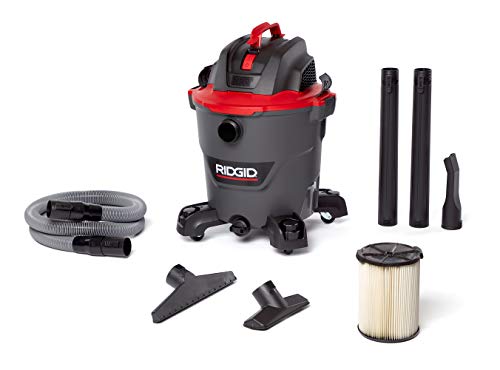

The RIDGID RT1200 NXT is the undisputed workhorse of woodworking shop vacuums. With a 12-gallon drum, 5.0 Peak HP motor, and the NXT locking hose system that prevents accidental disconnections mid-session, this vacuum handles everything from rough planer shavings to the finest belt-sander dust without skipping a beat. It’s built in the USA with a reinforced drum that survives being knocked around a busy workshop.

What makes it especially good for woodworking is its wide accessory ecosystem — RIDGID’s VF6000 HEPA filter and VF5000 cartridge filter are inexpensive upgrades that transform this into a fine-dust machine. The HEPA filter upgrade is a $20–$30 investment that takes the RT1200 from “good” to “excellent” for capturing fine sawdust and sanding dust. The casters are large enough to roll smoothly over workshop floors and wood chips.
Pros
- Massive 12-gal capacity for long sessions
- Locks hose prevents annoying disconnects
- Affordable HEPA filter upgrade available
- Extremely durable, USA-made drum
- Huge compatible accessory range
- Excellent value per dollar
Cons
- No built-in auto-start feature
- Bulky for small or cramped shops
- Loud (~85 dB) during operation
- HEPA filter sold separately
Bottom line: If you want one shop vac that does everything well in the woodworking shop, the RIDGID RT1200 NXT is the clear choice. Buy the VF6000 HEPA filter alongside it and you have a best-in-class setup for under $100.
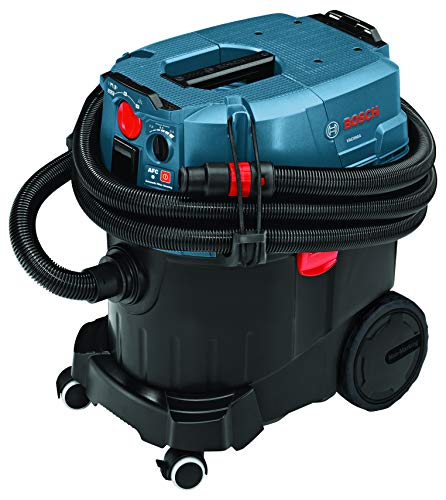
The Bosch VAC090AH is the gold standard for woodworkers who take dust safety seriously. It ships with a factory-certified true HEPA filter (not an add-on upgrade) and Bosch’s proprietary Auto Filter Clean system, which automatically pulses the filter to knock captured dust off every few seconds during operation. This means suction stays consistent throughout an entire sanding session without any manual intervention.

The built-in power outlet with auto-start is a game changer for power tool connection — plug in your router, track saw, or random orbital sander, and the VAC090AH automatically powers on the moment the tool starts. It’s also noticeably quieter than most shop vacs at around 72 dB, making it much more comfortable for extended work sessions. The trade-off is price: the Bosch costs significantly more than budget alternatives, but for health-conscious woodworkers, the certified HEPA filtration justifies every penny.
Pros
- Factory-certified true HEPA filtration
- Auto filter cleaning keeps suction consistent
- Built-in auto-start power outlet
- Quieter than most shop vacs (~72 dB)
- Excellent hose and tool compatibility
- Great for sanding and routing dust
Cons
- Premium price point
- 9-gal tank fills faster with heavy debris
- Replacement filters are expensive
Bottom line: If you have asthma, allergies, or simply work with your shop vac every day, the Bosch VAC090AH is the healthiest and most professional choice on this list. You get true certified HEPA, auto-filter cleaning, and auto-start all in one box.


The DeWalt DXV09PA is built for woodworkers who push their tools hard. Its 5.5 Peak HP motor delivers serious suction, and the included auto-start power outlet means it’s ready to trigger automatically alongside your table saw, jointer, or planer. The poly housing is extremely rugged, designed to survive the daily punishment of a professional cabinet shop or busy garage workshop.
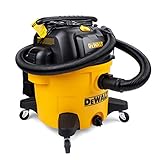
The DXV09PA handles a wider range of debris than most models — from wet sawdust and wood shavings to larger planer chips — without clogging. For dust collection specifically, pair it with DeWalt’s DWV9401 HEPA filter upgrade to lock down fine particle capture. Its large casters and ergonomic handle make moving it between tools easy even in a cluttered shop. The only significant downside compared to the Bosch is that automatic filter cleaning isn’t included.
Pros
- Extremely powerful 5.5 Peak HP motor
- Auto-start tool trigger outlet included
- Handles large debris + fine dust equally well
- Pro-grade rugged build quality
- Wide accessory compatibility
Cons
- No auto filter cleaning
- HEPA filter sold separately
- Louder than the Bosch (~83 dB)


The Vacmaster VFB511B stands out on this list for one specific reason: it has the highest airflow (CFM) of any model reviewed here. For woodworkers whose primary concern is fine dust from random orbital sanders, belt sanders, or router tables, high CFM is the number that matters most. The powerful airflow ensures it pulls fine particles directly at the source rather than letting them disperse into the air.

Its compact 5-gallon size makes it easy to store or hang on a wall when not in use, and it maneuvers easily around a bench-top setup. The trade-off is that the 5-gallon tank fills quickly during heavy cleanup sessions — this is a focused fine-dust machine rather than a general workshop cleanup vac. For dedicated sanding stations or router table setups, it’s the best choice on this list.
Pros
- Highest CFM airflow on this list (~210)
- Compact and easy to maneuver
- Ideal for sanders and router tables
- Good price-to-performance ratio
Cons
- Small 5-gallon tank fills quickly
- No auto-start feature
- No auto filter cleaning
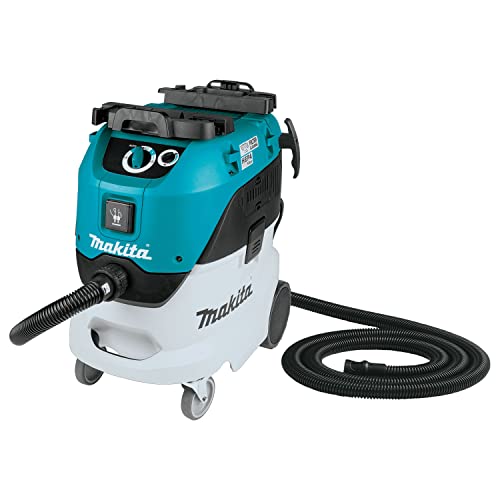
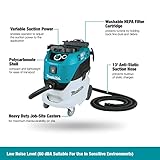
The Makita VC4210L is in a class of its own if you use Makita power tools in your workshop. Its AWS (Auto-start Wireless System) uses Bluetooth to wirelessly communicate with compatible Makita tools — the vacuum starts the instant your Makita track saw, sander, or router starts, and stops a few seconds after you release the trigger. No cords between the tool and the vacuum required. It also ships with a factory-certified true HEPA filter and auto filter cleaning, making it a complete dust-management solution.

The VC4210L is also one of the quietest shop vacs on this list at approximately 69 dB, making long shop sessions considerably more comfortable. Its 11-gallon capacity is generous enough for extended cleanup, and it works with Makita’s full range of dust collection accessories and hose adapters. The premium price reflects its professional-grade feature set — this is a dust extractor that rivals Festool at a more accessible cost.
Pros
- Wireless AWS Bluetooth auto-start
- Factory true HEPA filtration
- Auto filter cleaning system
- Very quiet (~69 dB)
- Large 11-gallon capacity
- Works with Makita tool ecosystem
Cons
- AWS only works with Makita tools
- High price point
- Heavy and less portable


The Craftsman CMXEVBE17607 is the right choice for hobbyist woodworkers who need a capable all-rounder without spending professional-tool money. Its 14-gallon tank means you’ll rarely need to stop and empty it during a typical garage shop session, and the 6.5 Peak HP motor provides plenty of suction for bench-top tools and general cleanup. The QIC Lock filter system makes filter changes quick and tool-free.

It includes a blower function, a 3-in-1 floor nozzle, car/upholstery nozzle, and crevice tool — a solid accessory kit for the price. For woodworking dust specifically, upgrade the included filter to Craftsman’s HEPA-compatible cartridge filter, which is an inexpensive addition that meaningfully improves fine dust capture. This is a solid everyday workhorse that punches above its price class.
Pros
- Large 14-gal tank for long sessions
- 6.5 Peak HP powerful motor
- 3-function: wet, dry, blower
- Affordable mid-range price
- QIC Lock easy filter changes
Cons
- No auto-start feature
- HEPA filter upgrade needed for fine dust
- Bulky to store in small shops


The Stanley SL18116P is the best option for beginners, occasional woodworkers, or anyone on a tight budget who needs basic dust control. It covers the essentials — wet/dry capability, 6-gallon tank, 16-foot reach, and a blower function — at a price point that won’t break the bank. For light workshop use (weekend hobbyist projects, occasional sanding), it gets the job done without fuss.

The honest limitation is filtration — the standard filter isn’t rated for ultra-fine sawdust, and without a HEPA-compatible upgrade (which may require third-party adapters on this model), some fine particles will escape. For light, occasional use it’s acceptable; for daily woodworking with sanders and routers, invest in a step up. That said, as a starter vac before upgrading later, it’s a practical choice that still outperforms having no dust collection at all.
Pros
- Very affordable price
- Compact and easy to store
- Wet, dry, and blower in one
- Good 16-ft reach with hose + cord
- Good starter vac for beginners
Cons
- No HEPA filtration
- 6-gal tank fills quickly
- Not ideal for daily/heavy woodworking
- No auto-start feature
Shop Vac vs. Dust Extractor for Woodworking — Which Do You Need?
This is one of the most common questions in woodworking forums, and most review sites gloss over it. Here’s the real breakdown:
| Feature | Shop Vacuum | Dust Extractor |
|---|---|---|
| Primary purpose | General cleanup, wet & dry debris | Continuous fine dust capture at source |
| Filtration | Standard or HEPA-compatible (add-on) | HEPA standard or certified (built-in) |
| Duty cycle | Intermittent use | Continuous (all-day use) |
| Noise level | 80–88 dB (louder) | 68–76 dB (quieter) |
| Auto tool-start | Some models (via outlet) | Standard (corded or wireless) |
| Auto filter clean | Rare | Common (standard feature) |
| Price range | $40–$250 | $200–$800+ |
| Best for | Small shops, general cleanup, budget users | Daily woodworking, sanders, CNC routers, health-critical users |
The Shop Vac + Cyclone Separator: The Ultimate Budget Setup
If you want professional-level dust collection on a budget, pairing any shop vac with a cyclone separator (also called a dust deputy or pre-separator) is the smartest upgrade you can make. Here’s how it works:
- Wood chips and shavings enter the cyclone first — the spinning airflow flings 99% of debris into a separate collection bucket before it ever reaches the vacuum.
- Only ultra-fine dust reaches the vacuum filter — your filter stays clean far longer, maintaining strong suction throughout the session.
- Empty the collection bucket instead of the vac — no more fighting with the main drum to dump wet sawdust.
The best cyclone separator for woodworking is the Oneida Dust Deputy 2.5, which fits any standard 5-gallon bucket and connects to any shop vac with a 2.5-inch hose. Search for it on Amazon using your affiliate tag: amazon.com/s?k=Oneida+Dust+Deputy+2.5&tag=protguide-20
Best Filters for Woodworking Dust — What You Need to Know
The filter is the most important component for woodworking dust capture, yet most buyers ignore it completely. Here’s what each filter type means in practice:
Standard Foam Sleeve Filter
Comes stock on most budget shop vacs. Good for large debris and wet pickup only. Not suitable for fine sawdust — fine particles pass straight through and can be blown back into the air. Always replace with a cartridge or HEPA filter before using with power tools.
Cartridge Filter (Pleated)
A significant step up from foam. Pleated cartridge filters dramatically increase surface area, capturing much finer particles while maintaining strong airflow. Most are rated for particles down to 1–5 microns. This is the minimum acceptable filter for woodworking dust. Look for models labeled “fine dust” cartridge.
HEPA Filter + Paper Bag Combo (Best Setup)
The gold standard for fine woodworking dust. A HEPA-rated filter captures 99.97% of particles to 0.3 microns — well below the size of fine sanding dust. Using a paper bag inside the drum in combination with the HEPA filter extends filter life significantly by trapping most debris in the bag before it reaches the filter media. This two-stage approach delivers the cleanest air output possible from a shop vac.
How to Set Up Your Shop Vac for Woodworking Dust Collection
- Install a HEPA or fine-dust cartridge filter — Remove the stock foam filter and replace it with a pleated cartridge or HEPA filter rated for fine dust. Add a paper bag inside the drum for two-stage filtration.
- Add a cyclone separator (optional but highly recommended) — Mount the Oneida Dust Deputy or similar cyclone between the hose and the vacuum to pre-separate debris and extend filter life.
- Connect the correct hose adapter — Most woodworking tools have a 1.25-inch or 27mm dust port. Use a step-down adapter to connect to the standard 2.5-inch shop vac hose. Dust Right (Rockler) adapters are widely compatible.
- Route the hose to your first tool — For router tables or table saws, position the hose inlet as close to the blade or cutter as possible for maximum capture.
- Set auto-start if your vac supports it — Plug your power tool into the vac’s outlet and set the delay (usually 1–3 seconds after tool stop).
- Use blast gates for multi-tool setups — If you’re running a single vac between multiple tools, install inexpensive plastic blast gates on each tool’s hose branch. Open only the gate on the tool you’re currently using to maximize suction.
Frequently Asked Questions
Is a shop vac good enough for woodworking dust collection?
Yes — with the right filter. A standard shop vac without a HEPA or fine-dust cartridge filter is actually harmful because it can blow fine particles back into the air. But a shop vac fitted with a quality HEPA filter (like the RIDGID VF6000 or Bosch HEPA upgrade) captures fine sawdust effectively and is perfectly adequate for most hobby and semi-professional woodworking shops.
What CFM do I need for woodworking dust collection?
For bench-top tools (sanders, routers, scroll saws), aim for a minimum of 100 CFM. For larger stationary tools like table saws and jointers, look for 150–200+ CFM. Remember: CFM (airflow volume) matters more than water lift (suction pressure) for fine dust applications.
Can I use a shop vac instead of a dust collector?
For most small shops and hobbyists, yes. A shop vac with a HEPA filter handles dust collection from most bench-top and handheld tools very well. Dedicated dust collectors have higher CFM and are better suited for large floor tools like wide drum sanders, large planers, or when running multiple machines simultaneously. If your shop runs one tool at a time, a good shop vac is entirely sufficient.
What size shop vac is best for a small wood shop?
For most garage and small woodworking shops, a 6–12 gallon tank is ideal. Smaller tanks (5–6 gal) are compact and great for bench-top use. Larger tanks (12–16 gal) work better if you do heavy cleanup or have multiple tools. Pair any size with a cyclone separator to effectively multiply your capacity without buying a bigger tank.
Do I need a HEPA filter for woodworking dust?
Strongly recommended, especially for sanding and routing. Fine wood dust particles under 10 microns are the most dangerous to inhale — they penetrate deep into lungs and stay airborne for hours. A HEPA filter (99.97% efficiency at 0.3 microns) captures these particles before they recirculate. If you have any respiratory sensitivity, a HEPA filter is essential, not optional.
How often should I clean my shop vac filter?
For woodworking use, check your filter after every 2–3 sessions of heavy sanding or after a full day of general woodworking. Gently tap the filter over a trash can to dislodge loose dust. Never wash a paper or cardboard HEPA filter — it destroys the filtration media. Some models (Bosch, Makita) have auto-clean systems that pulse the filter during operation, dramatically extending cleaning intervals.
What shop vac is quietest for woodworking?
The Makita VC4210L (~69 dB) and Bosch VAC090AH (~72 dB) are the quietest models on our list. For context, most standard shop vacs operate at 83–88 dB. The difference between 70 dB and 85 dB isn’t just noticeable — it’s the difference between comfortably working without hearing protection and needing ear defenders during vacuum use.
🏆 Our Top Recommendation
For most woodworkers, the RIDGID RT1200 NXT paired with a HEPA filter upgrade gives you the best performance-per-dollar. Serious pros or health-conscious woodworkers should step up to the Bosch VAC090AH.