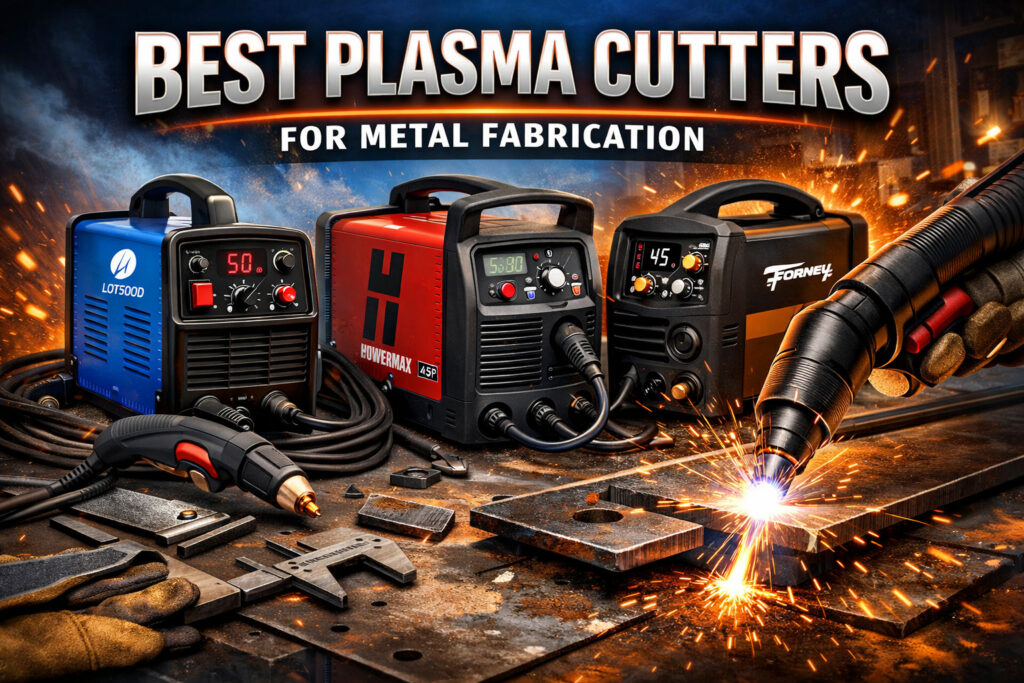
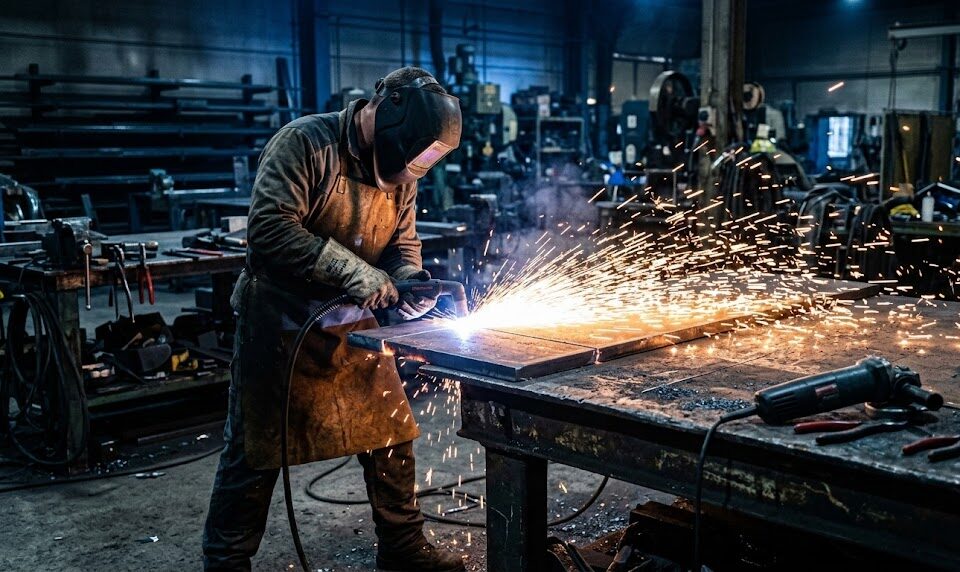
You’re mid-job — cutting brackets for a trailer frame, trimming angle iron for a roll cage, or slicing through worn-out farm equipment that needs a fix before the season starts. Your 30A hobby cutter is either bogging down or leaving dross you’ll spend an hour grinding. An 80A industrial machine is overkill, needs serious wiring, and costs more than your truck payment. What you actually need is a plasma cutter in the 40A–60A range — the real working sweet spot for serious metal fabrication.
This range handles 3/8″–5/8″ clean cuts in mild steel, runs on a single-phase 240V shop circuit, and stays portable enough to move around a garage or haul to a job site. It’s the right tool for automotive builders, small fab shops, farm mechanics, HVAC contractors, CNC table builders, and serious DIYers who’ve outgrown entry-level gear.
This guide covers the best plasma cutters for metal fabrication in the 40A–60A range with real-world specs, honest trade-offs, and clear recommendations by use case. No severance-cut marketing tricks. No inflated duty cycle numbers. Just the machines worth buying and why.
🏆 Quick Picks — Best Plasma Cutters (40A–60A)
| Best Overall | PrimeWeld CUT60 — Best value 60A with real shop duty cycle |
| Best for CNC | Everlast HATCHET 60 — Non-HF arc, divided voltage output, CNC-ready out of the box |
| Best Portability | Hobart Airforce 40i — American brand quality, dual voltage, built for mobile work |
| Best Budget | LOTOS LTP5000D — Lightest 50A unit, solid first upgrade from hobby gear |
| Best Light Fab | Forney Easy Weld 140 — Simplest interface, good for auto body and thin steel |
| Best Mid-Range | YESWELDER 55 — 55A non-HF with 60% duty cycle at a mid-range price |
Most readers in this category will end up choosing between the PrimeWeld CUT60 (best overall shop machine) or the Everlast HATCHET 60 (if CNC is your goal). The other four serve specific use cases — portability, tight budgets, or light fab work — covered in full in the reviews below.
What Actually Matters When Choosing a Shop Plasma Cutter
Plasma cutter spec sheets are full of numbers designed to sell machines, not to help you cut steel. Before you spend a dollar, understand what actually matters on the shop floor.
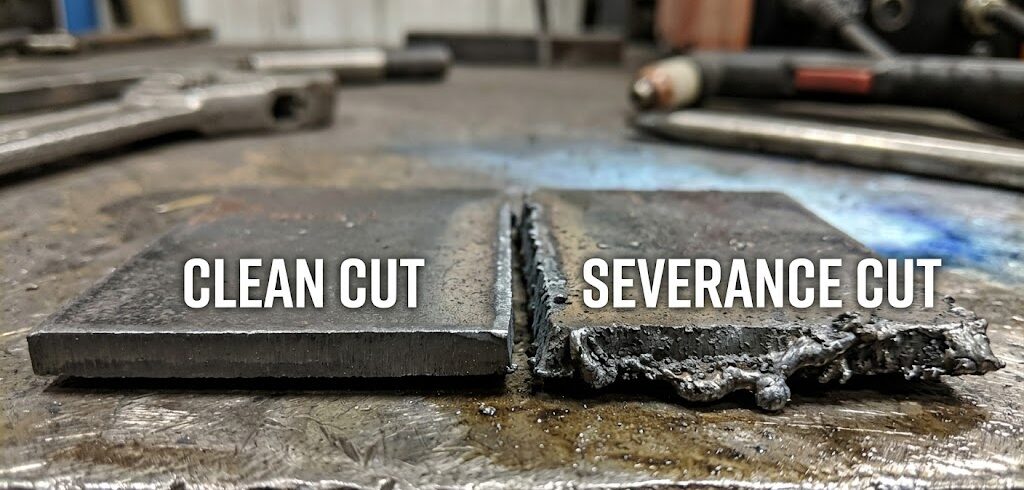
Clean Cut vs. Severance Cut — Don’t Get Tricked
This is the single most misread spec in the category. Most manufacturers lead with the severance cut rating — the maximum thickness the arc will punch through, slowly, with a rough, heavily drossed edge. That’s not a fabrication cut. That’s the machine working at its absolute limit, producing output you’ll need to grind before doing anything useful with it.
The number that actually matters is the clean cut — the thickness you can slice through at full travel speed with a square kerf, minimal dross, and an edge that’s ready for the next step. As a rule of thumb, the severance cut is roughly 1.5–2x the clean cut rating. If a product page only shows “cuts up to X inches” without specifying which rating, assume it’s the severance number.
| Amperage | Clean Cut | Severance Cut | Best For |
|---|---|---|---|
| 40A | 3/8″ | 5/8″ | Auto body, sheet metal, brackets |
| 50A | 1/2″ | 3/4″ | General fabrication, frames |
| 60A | 5/8″–3/4″ | 7/8″–1″ | Structural steel, farm equipment |
Duty Cycle — Production Work vs. Hobby Use
Duty cycle is expressed as a percentage over a 10-minute window. A 60% duty cycle at 60A means 6 minutes of cutting, 4 minutes of cooling, per 10-minute period. For occasional use in a home garage, 35–40% is workable. For a production shop cutting daily, anything below 60% at rated amperage is going to cost you time and frustration.
⚠ Watch out for spec inflationSome manufacturers list duty cycle at a much lower amperage than the machine’s rated output — for example, “60% @ 20A” on a 60A machine. That number is nearly meaningless. Always find the duty cycle rated at the machine’s maximum amperage before you buy.
Pilot Arc Type & CNC Compatibility
If CNC is anywhere in your plans — now or in the future — pilot arc type is non-negotiable.
High-Frequency (HF) start fires a high-voltage RF spark to initiate the arc. It works fine for hand cutting, but that RF interference can corrupt CNC motion controllers, damage stepper drivers, and cause unpredictable behavior in any nearby electronics. If you’re building or planning a CNC plasma table, HF-start machines are the wrong tool for the job — full stop.
Blowback (non-HF) start initiates the arc by briefly touching the electrode to the nozzle, then retracting — no radio frequency interference. It’s safe around CNC electronics, sensitive equipment, and painted or coated surfaces. For any machine going near a CNC table, this is the only acceptable option.
Beyond pilot arc type, true CNC-ready machines also need: a divided arc voltage output port (for THC — Torch Height Controller integration), and a machine torch option from the manufacturer.
Air Supply & Moisture Control
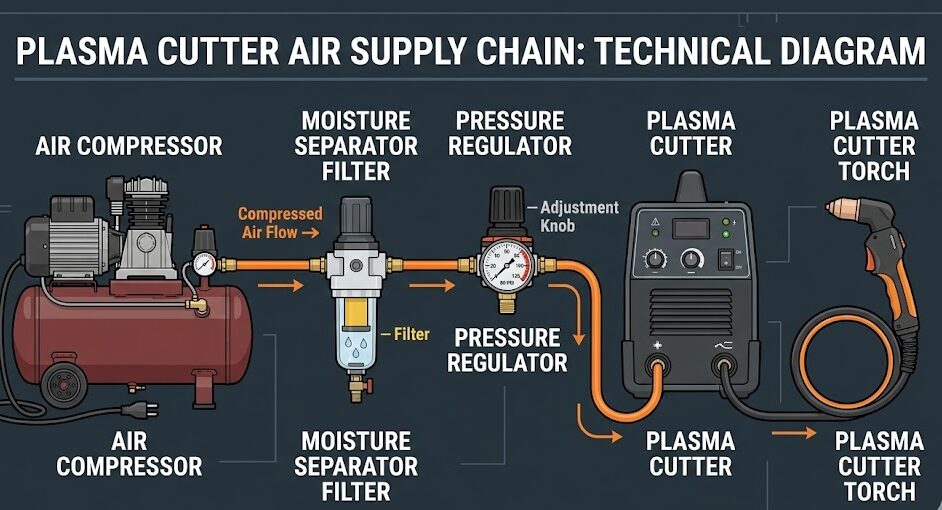
Most 50–60A plasma cutters require 4–6 CFM sustained at 70–90 PSI. The critical word is sustained — a large tank with a weak pump will hit the right PSI at rest but drop below 4 CFM during a 30-second continuous cut, causing arc dropout mid-job. Tank size is largely irrelevant. CFM output from the compressor pump is everything.
Moisture is the number one cause of premature consumable failure and arc instability. An inline coalescing moisture separator at the plasma cutter inlet is not optional — it’s as essential as the air compressor itself. A decent coalescing filter runs $30–$60 and will save you far more than that in consumables within the first month.
Consumables & True Cost of Ownership
The electrode and nozzle in your plasma torch are wear items. How long they last per set — and how easy they are to source — significantly affects the real-world economics of whichever machine you choose.
Mid-range brands like PrimeWeld and Everlast sit in a reasonable middle ground: better than no-name imports, with active aftermarket consumable ecosystems on Amazon. Budget brands like LOTOS wear faster and occasionally source non-standard consumables that become hard to find. Check consumable availability on Amazon before committing to any import brand.
Inverter Tech vs. Transformer
Every machine in this roundup uses modern IGBT inverter technology — lighter, more energy-efficient, faster arc response than older transformer-based units. The practical trade-off: inverter machines are more sensitive to dirty or wet air supply and input voltage fluctuations. This reinforces the moisture separator point. Keep your air dry and your power stable, and IGBT inverters perform excellently.
The Best 40A–60A Plasma Cutters — Detailed Reviews

⭐ Best Overall
Clean Cut: 1/2″–5/8″
Duty Cycle: 60% @ 60A
Pilot Arc: Non-HF (blowback)
CNC Ready: Yes
Weight: ~23 lbs
Price Tier: $$
The PrimeWeld CUT60 has built one of the strongest reputations in the import plasma cutter market — and it’s earned. A legitimate 60% duty cycle at full amperage is rare at this price point and genuinely changes what the machine is capable of in a production environment. While cheaper 60A units inflate their specs by rating duty cycle at 20–30A, the CUT60 delivers its number at maximum output.
The non-HF blowback pilot arc means it’s safe around CNC electronics and coated surfaces. The CNC port is included and works with most THC setups without modification. PrimeWeld’s customer support — email and community-based — is consistently responsive for an import brand. The user community is active and large, which means real-world answers to real-world problems are usually one forum search away.

✓ What It Does Well
- Legitimate 60% duty cycle at rated 60A — rare at this price
- Non-HF arc: CNC-friendly and safe near electronics
- CNC port works with most THC setups out of the box
- Strong support reputation and large user community
✗ Where It Falls Short
- More sensitive to air moisture than premium units — wet air shows up in arc quality faster
- At ~23 lbs, it’s heavier than 40A options; not ideal for frequent field work

The CUT60 earns its reputation. If you cut 1/2″ steel regularly and want reliable duty cycle without paying premium prices, this is your machine. For most readers in this guide, this is the right call.
2. Everlast HATCHET 60
The best-equipped machine for CNC table integration at a mid-range price
🔧 Best for CNC
Clean Cut: ~5/8″
Duty Cycle: 60% @ 60A
Pilot Arc: Non-HF
CNC Ready: Yes (divided arc voltage)
Weight: ~26 lbs
Price Tier: $$$
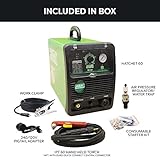
If you’re building or running a CNC plasma table, the Everlast HATCHET 60 is the most direct path to a working setup in this price range. The divided arc voltage output is standard — no modification, no workaround, no adapter required for THC integration. A machine torch is available directly from Everlast, and the non-HF pilot arc means no RF interference with your motion controller.
IGBT inverter technology delivers a stable, consistent arc through the 1/2″–5/8″ range where CNC cutting happens most. The 60% duty cycle at rated amperage holds up in production environments. This is a machine built with the CNC use case in mind, not one that happens to have a port added as an afterthought.
✓ What It Does Well
- Divided arc voltage output standard — direct THC compatibility, no modification needed
- Machine torch available from Everlast; simplifies CNC setup significantly
- Non-HF arc: zero RF interference risk for CNC electronics
- Stable IGBT arc; consistent in production cutting at 1/2″–5/8″
✗ Where It Falls Short
- Heavier than comparable units at ~26 lbs
- Customer service response times can be slower than PrimeWeld’s

The most friction-free CNC integration at this price point. If a plasma table is your goal — now or in the future — the HATCHET 60 removes the setup headaches that plague HF-start machines. For hand-cutting-only shops, the PrimeWeld CUT60 is the stronger value.
3. Hobart Airforce 40i
American brand build quality with dual voltage for mobile and garage work
🚗 Best Portability

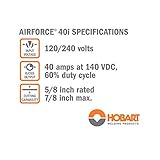
Clean Cut: 3/8″
Duty Cycle: 40% @ 40A
Pilot Arc: HF start
CNC Ready: No
Voltage: Dual 120V/240V
Weight: ~27 lbs
Price Tier: $$$
The Hobart/Miller build standard is noticeable the moment you pick this machine up. The construction feels substantially more solid than import alternatives at a similar price — that’s not marketing, it’s what you pay for with a North American brand. The dual voltage capability is genuine and useful: on 120V it handles thin material and light field repair without needing a dedicated 240V circuit.
The Airforce 40i is the right tool for automotive restorers cutting floor pans and patch panels, HVAC contractors doing field work, and mobile fabricators who move between job sites. The 40A output limits clean cuts to 3/8″ — that covers the vast majority of automotive sheet metal and light fab work cleanly.
✓ What It Does Well
- Hobart/Miller build quality — noticeably more durable than import alternatives
- Dual voltage works reliably; 120V is usable for thin material
- Strong North American dealer and service network
- Right-sized for automotive and mobile fab work
✗ Where It Falls Short
- 40A caps clean cuts at 3/8″ — wrong machine for regular 1/2″+ work
- HF start: not suitable for CNC use
- 40% duty cycle limits sustained cutting sessions
The right call for automotive restorers, mobile contractors, and fabricators who value brand reliability and dual-voltage flexibility over raw cutting power. Don’t buy it to cut structural steel daily — it’s not built for that.
4. LOTOS LTP5000D
The lightest 50A unit available — solid first upgrade from hobby-grade gear
💰 Best Budget

Clean Cut: ~1/2″
Duty Cycle: 60% @ 50A
Pilot Arc: Blowback
CNC Ready: No
Voltage: Dual 120V/240V
Weight: ~14 lbs
Price Tier: $
At 14 lbs, the LOTOS LTP5000D is the lightest machine in this roundup — by a significant margin. That matters if you’re moving between workstations, working out of the back of a truck, or just don’t want a heavy machine hanging on your shop wall. For genuine 50A output at the lowest price in this guide, it’s a capable first step up from 30A hobby gear.
The blowback start works fine for hand cutting. The dual voltage is genuinely functional. The 60% duty cycle at 50A is a real number. What you’re trading off is consistency — LOTOS units show more quality control variance than the mid-range brands, and consumables wear faster. Budget for a set of spares from the start.

✓ What It Does Well
- Lightest unit in this roundup at 14 lbs
- Lowest price entry point for real 50A output
- Blowback start; dual voltage works on both 120V and 240V
- Good first upgrade from 30A hobby machines
✗ Where It Falls Short
- Quality control inconsistency — check recent Amazon reviews before buying
- Consumables wear faster; budget for spares from day one
- Not CNC ready

A capable machine if budget is your primary constraint and you’re not doing high-volume production cutting. Buy knowing the trade-offs, keep consumables stocked, and you’ll get solid value for the price.
5. Forney Easy Weld 140
Simplest interface in this roundup — built for auto body and light repair work
🔩 Best Light Fab
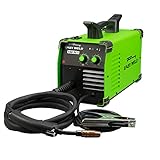
Clean Cut: ~3/8″
Duty Cycle: 35% @ 40A
Pilot Arc: HF start
CNC Ready: No
Voltage: 120V/240V
Weight: ~17 lbs
Price Tier: $
The Forney Easy Weld 140 is designed for people who cut steel occasionally and want the process to be straightforward. The interface is minimal — plug in, set your amperage, cut. No steep learning curve, no complicated setup. For a hobbyist working on classic car restoration, cutting patch panels, or making occasional repair cuts in thin plate, this machine does the job cleanly.
It’s light, accessible on both 120V and 240V, and backed by Forney’s solid North American distribution. The honest limitation is the 35% duty cycle — the lowest in this roundup. Sustained cutting sessions will hit that ceiling. If you’re cutting 1/4″+ steel more than a few times a week, step up to 50A minimum.

✓ What It Does Well
- Simplest interface in this roundup — minimal setup and learning curve
- Lightweight at 17 lbs; easy to store and move
- Functional on 120V for sheet metal and thin bracket work
- Forney brand: solid North American parts availability
✗ Where It Falls Short
- 35% duty cycle — lowest in this roundup; not suitable for sustained shop use
- HF start: no CNC compatibility
- 40A limits useful cutting to 3/8″ and under in practice
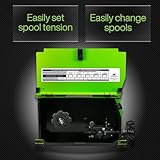
The right machine for light repair work, auto body patches, and occasional thin steel cutting. Not a fabrication shop machine. If you’re cutting more than occasionally or need to go beyond 3/8″, the LOTOS LTP5000D gives you more capability for a similar price.
6. YESWELDER 55
55A non-HF with 60% duty cycle — hits the gap between budget and premium
⚡ Best Mid-Range

Clean Cut: ~1/2″
Duty Cycle: 60% @ 55A
Pilot Arc: Non-HF
CNC Ready: Partial
Weight: ~22 lbs
Price Tier: $$
The YESWELDER 55 fills a real gap: 55A output with a non-HF arc and 60% duty cycle at a mid-range price. If the CUT60 is out of budget or out of stock and you need more than 50A, this is a legitimate alternative. The non-HF pilot arc means it’s safe around electronics — a step up from the HF units at this price tier.

YESWELDER has been building a solid reputation in the value welding and cutting segment. The 55 is a newer entry with less long-term user data than the PrimeWeld or Everlast units, but the specifications are credible and the brand track record is positive. Main caveat: verify consumable aftermarket availability before committing, as the ecosystem is smaller than the more established brands.
✓ What It Does Well
- 55A non-HF arc bridges the gap between 50A budget and 60A mid-range
- Legitimate 60% duty cycle at rated amperage
- Non-HF arc is safe around electronics and coated surfaces
- YESWELDER brand building a positive reputation in value segment
✗ Where It Falls Short
- Newer model with less long-term user data than PrimeWeld or Everlast
- Consumable ecosystem is smaller — verify aftermarket availability
- Not the first choice for full CNC integration; Everlast HATCHET 60 is better equipped for that

A strong mid-range option for the fabricator who needs genuine 55A performance and non-HF arc without stepping up to full 60A pricing. Worth considering if the CUT60 is unavailable or if 55A meets your cut capacity needs.
Quick Comparison Table
All six machines side by side. For duty cycle, weight, and CNC details, see the individual reviews above.
| Model | Amps | Clean Cut | Pilot Arc | Price Tier |
|---|---|---|---|---|
| PrimeWeld CUT60 | 60A | 1/2″–5/8″ | Non-HF | $$ |
| Everlast HATCHET 60 | 60A | 5/8″ | Non-HF | $$$ |
| Hobart Airforce 40i | 40A | 3/8″ | HF | $$$ |
| LOTOS LTP5000D | 50A | 1/2″ | Blowback | $ |
| Forney Easy Weld 140 | 40A | 3/8″ | HF | $ |
| YESWELDER 55 | 55A | 1/2″ | Non-HF | $$ |
40A vs. 50A vs. 60A — Which Should You Choose?
Match your amperage to your most common material thickness. Buying too little means constant limitation; buying too much means overspending on power and circuit capacity you’ll never use.
Choose 40A
- Auto body & sheet metal
- Cuts under 1/4″ mostly
- Occasional 3/8″ plate
- Portable or 120V access needed
“Restoring a classic truck? Cutting floor pans and patch panels? 40A is plenty — don’t overspend.”
Choose 50A–55A
- Regular 3/8″–1/2″ steel
- Frames, brackets, trailers
- General shop fabrication
- Budget is a real constraint
“Cutting utility trailer frames or 3/8″ plate a few times a week? 50A is your floor.”
Choose 60A
- Structural steel, farm repair
- Frequent 1/2″+ cuts
- CNC table use (now or later)
- Production environment
“Cutting 1/2″ AR400 for skid plates or building a CNC table? 60A is where you want to be.”
Head-to-Head: PrimeWeld CUT60 vs. Everlast HATCHET 60
These two machines occupy the same price tier and both deliver 60A with non-HF arcs. For most buyers deciding between them, the answer comes down to one question: is CNC in your plans?
Cut quality: Both produce clean 1/2″–5/8″ cuts on mild steel. Real-world performance is close. PrimeWeld has more community-documented use cases and a larger user base to draw comparisons from. Neither produces a dramatically different result on hand-cutting work.
CNC integration: The Everlast HATCHET 60 wins this cleanly. Divided arc voltage output is standard — direct THC compatibility without modification. Machine torch is available from Everlast. The CUT60 can work with CNC setups but requires more setup work and is not as cleanly configured for table use out of the box.
Community & support: PrimeWeld has a larger, more active user community and faster direct customer support. Everlast has been in the market longer but support response speed is inconsistent.
Building or running a CNC table: Everlast HATCHET 60. The CNC-specific features justify the choice without question.
Undecided: PrimeWeld CUT60. It’s the safer all-around bet for most buyers.
Common Mistakes When Buying a Plasma Cutter
These are the mistakes that cost people money — sometimes on the machine itself, often on consumables and air equipment they didn’t budget for.
The “cuts up to 1 inch” claim is the severance number. Your actual clean-cut capacity is roughly half that. Every spec sheet in this category needs to be read critically. Always find the rated clean cut before you buy.
A 35% duty cycle machine on a production cutting job means more downtime than cutting time. Match duty cycle to your actual workflow before you spend a dollar. And always verify it’s rated at the machine’s full amperage.
A 60-gallon tank with a weak pump will drop below 4 CFM sustained during a 30-second continuous cut. Tank size doesn’t matter — CFM output from the pump is everything. Verify your compressor’s sustained CFM at 90 PSI before buying any machine in this range.
Wet air destroys consumables and destabilizes the arc. A coalescing inline filter costs $30–$60. Skipping it will cost you far more in ruined electrodes and nozzles within the first month of use.
Some import brands use non-standard consumables that become nearly impossible to source within 18 months of the machine launching. Before you commit to any machine, search Amazon for its consumables and verify multiple sources exist.
This is not a minor inconvenience. High-frequency start creates RF interference that can corrupt stepper drivers and damage CNC motion controllers — sometimes irreversibly. Non-HF start is a hard requirement for CNC use, not a preference.
Setup & Safety Essentials
Air drying: Install an inline coalescing moisture separator at the plasma cutter inlet — not just a basic bowl separator. Coalescing filters capture fine moisture that bowl separators miss entirely. This single step extends consumable life more than any other maintenance practice.
Grounding: Clamp your work lead directly to the material being cut, not to the table. For CNC setups especially, grounding to the table rather than the workpiece causes arc wander and inconsistent cut quality.
Eye protection: Plasma cutting requires a shade 5–8 lens — significantly lighter than welding. Many auto-darkening welding helmets default to shade 10–13 and won’t auto-dim correctly for plasma work. Verify your helmet has a plasma-specific setting before you start cutting.
Fume hazards by material:
- Galvanized steel: Zinc oxide fumes are seriously hazardous. Grind the coating back from cut lines or use strong extraction ventilation.
- Stainless steel: Produces hexavalent chromium fumes — a known carcinogen. Always cut stainless with extraction ventilation.
- Mild steel: Standard shop ventilation is sufficient for most environments.
- Painted surfaces: Grind paint back from cut lines; burning paint produces toxic fumes regardless of the paint type.
Ear protection: Plasma cutting runs above 85dB sustained. Use hearing protection for any cutting session longer than a few minutes.
Frequently Asked Questions
Final Recommendations by Buyer Type
| Buyer Type | Best Pick | Why | Link |
|---|---|---|---|
| Small shop / serious DIY | PrimeWeld CUT60 | Best value for real shop duty cycle + support | View → |
| CNC table builder | Everlast HATCHET 60 | Divided arc voltage + machine torch + non-HF | View → |
| Mobile / field fabricator | Hobart Airforce 40i | Build quality + portability + dual voltage | View → |
| Budget first upgrade | LOTOS LTP5000D | Lowest price for genuine 50A output | View → |
| Light repair / auto body | Forney Easy Weld 140 | Simple, affordable, right-sized for the work | View → |
| Mid-range step-up | YESWELDER 55 | 55A non-HF with 60% duty cycle at mid price | View → |
The decision logic is straightforward: match your amperage to your most common material thickness, prioritize 60% duty cycle at rated amps for any production work, and choose a non-HF pilot arc if CNC is anywhere in your future plans. For most fabricators reading this, the PrimeWeld CUT60 is the right call — it has the duty cycle, the community support, and the track record to back it up. If CNC integration is your priority, step to the Everlast HATCHET 60 without hesitation.