A flooring installer pulls up 400 square feet of engineered hardwood three weeks after installation — cupped, buckled, and destroyed — because nobody tested the subfloor moisture content before laying it down. A restoration contractor finishes a drywall repair, the client moves back in, and six months later mold appears behind the wall because the framing was never fully dried out. A concrete coating delamination failure voids the warranty because no one documented slab relative humidity before the pour. An insurance adjuster rejects a water damage claim because the contractor can’t produce a single moisture reading from the job site.
These are not hypothetical situations. They happen constantly, and they share one common cause: moisture that wasn’t measured.
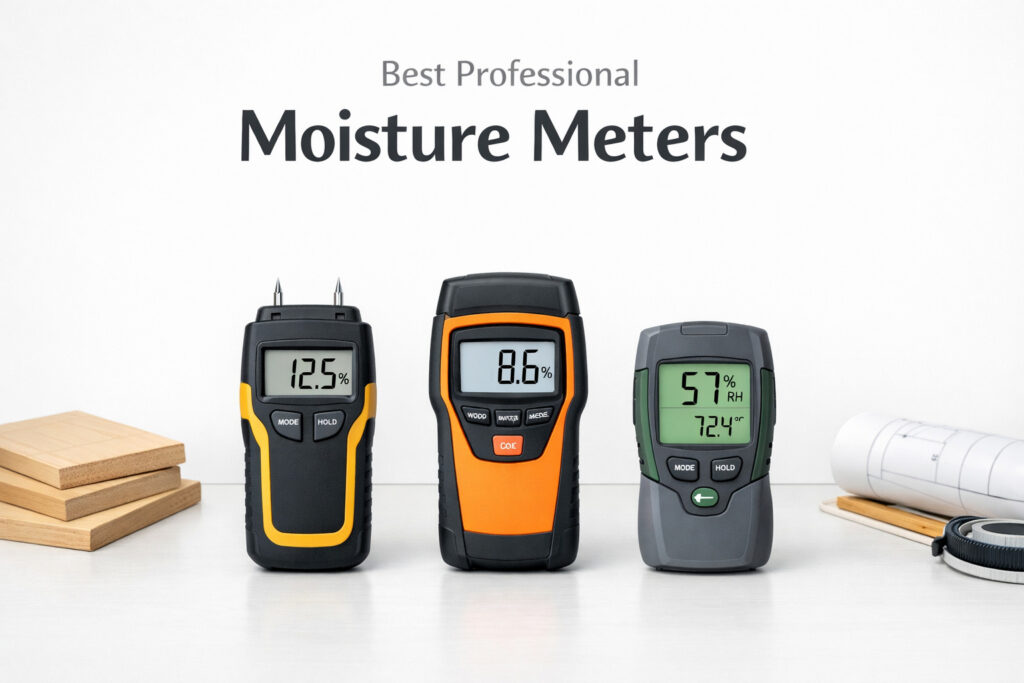
The best moisture meters for professionals are not diagnostic gadgets — they are profit protection tools and liability reduction tools. A meter in the $100–$400 range, used correctly, can save you from callbacks, disputes, and claims that dwarf its cost many times over. Anything under $50 lacks the accuracy and calibration reliability that professional work demands. Anything over $500 moves into specialty territory most contractors don’t need.
Below are the five professional moisture meters that hold up on real job sites — reviewed for flooring installers, home inspectors, restoration contractors, general contractors, and cabinet makers.
▶ Jump to Comparison Table |
▶ Jump to Product Reviews |
▶ Jump to Buying Guide
Best moisture meters for professionals
| Product | Type | Best For | Depth | Materials | Price |
|---|---|---|---|---|---|
| Protimeter SurveyMaster BLD5375 | Pin + Pinless | All-around pros, home inspectors | ¾” pinless / deep with probes | Wood, drywall, concrete, EIFS | ~$250–$320 |
| Wagner Orion 950 | Pinless | Flooring installers, woodworkers | ¼” shallow / ¾” deep | Wood, plywood, OSB, MDF, bamboo | ~$350–$400 |
| Wagner Orion 940 | Pinless | Restoration, data documentation | ¼” / ¾” | Wood, building materials | ~$220–$280 |
| Delmhorst BD-2100 | Pin | Restoration, drywall, EIFS | 5/16″ integral / deep with probes | Wood, drywall, gypsum, concrete, roofing | ~$180–$260 |
| AccuMASTER Duo Pro 7440 | Pin + Pinless | General contractors, value buyers | Standard pin / pinless scan | Wood, drywall, concrete, brick, plaster | ~$100–$130 |
Professional Moisture Meter Reviews
1. Protimeter SurveyMaster BLD5375 — Best Overall Professional Moisture Meter

Who It’s For
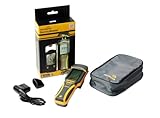
The SurveyMaster is the go-to choice for home inspectors and multi-trade contractors who move between wood framing, drywall, concrete, and EIFS in a single job. If you need one meter that handles every substrate without compromising on accuracy or calibration integrity, this is it. Property managers running moisture surveys across multiple units will also find the dual-mode scanning workflow genuinely useful.

Key Specs
- Type: Dual-mode — Pin (Measure) and Pinless (Search)
- Pin range: 7.9%–99% WME (Wood Moisture Equivalent)
- Pinless range: 70–999 relative scale (RF signal, up to ¾” / 19mm depth)
- Materials: Wood, drywall, concrete, EIFS, masonry
- Calibration: Auto calibration check every 50 power cycles; user field calibration for pinless mode
- Connectivity: Bluetooth to Protimeter Connect app
- Battery life: 3× longer than previous model
- Probe accessories: Accepts full Protimeter electrode range, including deep wall probes
- Warranty: 2 years
Why Professionals Choose It
- Switching between Search Mode and Measure Mode on a single unit eliminates the need to carry two meters on multi-material inspections
- The built-in calibration check system is auditable — critical when readings appear in insurance or litigation documentation
- Compatibility with Protimeter’s extended electrode range means you can probe deep into wall assemblies and EIFS systems without purchasing a separate instrument
- The Connect app logs readings with timestamps and location tags, which meets basic documentation requirements for restoration and inspection reports
Pros
- Genuine dual-mode capability — not a compromise on either function
- Calibration verification built into the workflow, not an afterthought
- Strong accessory ecosystem for deep probing applications
- Bluetooth data logging reduces transcription errors on multi-point surveys
Cons
- Pinless mode outputs a relative scale (70–999), not direct MC% — requires interpretation rather than a direct percentage reading
- The Connect app is functional but basic compared to Wagner’s ecosystem
- Price sits at the higher end of the mid-range — overkill for contractors who only need one material type
Real Job Scenario

You’re surveying a water-damaged rental property after a slow pipe leak — walls, subfloor, and ceiling all potentially affected. You sweep the walls in Search Mode to flag wet zones quickly without marking up finished drywall. Once you’ve identified the hot spots, you switch to Measure Mode with a deep wall probe to get precise WME readings through the assembly. Those logged readings go directly into the adjuster’s documentation report from the app. One tool, start to finish.
Bottom Line
The Protimeter SurveyMaster BLD5375 is the most versatile professional moisture meter in this price range — the right choice whenever your work spans multiple materials or requires defensible documentation.
2. Wagner Orion 950 — Best for Flooring & Wood Professionals

Who It’s For
The Orion 950 is built specifically for flooring installers, hardwood specialists, and cabinet makers who need the most accurate pinless wood moisture readings available under $400. If your work is wood-centric and precision matters more than material versatility, this is the most capable meter in its class. The built-in EMC calculator is a genuine job-site tool, not a marketing feature.
Key Specs
- Type: Pinless
- MC range: 4.0%–32.0% wood; 0–100 relative scale for building materials
- Depth: ¼” shallow scan and ¾” deep scan (selectable)
- Species: Supports virtually all wood species globally via app
- Calibration: Wagner On-Demand Calibrator — the only system of its kind
- Sensors: Built-in temperature and relative humidity sensor
- Connectivity: Bluetooth to Wagner DataMaster app
- Warranty: 7 years
- Battery: 9V
Why Professionals Choose It

- The On-Demand Calibrator is the only field calibration system in this market — you can verify accuracy on the job site, not just assume it
- Dual-depth scanning (¼” and ¾”) lets you distinguish between surface moisture and subfloor moisture without repositioning or guessing
- The EMC calculator accounts for current temperature and humidity conditions, telling you whether wood has genuinely acclimated to the space — not just what its MC is in isolation
- Seven-year warranty is a meaningful signal of build confidence from a brand that has been in this market for decades
Pros
- Most accurate pinless wood reading available in the professional price range
- On-Demand Calibration eliminates calibration drift uncertainty
- EMC calculator is directly actionable for installation decisions
- Longest warranty in this comparison
Cons
- Wood-optimized — not the right tool if you need precise drywall or concrete readings
- Top of the price range at $350–$400
- No pin mode — if you need confirmation readings through a finished surface into a substrate, you need a second tool
Real Job Scenario

You’re installing 800 square feet of site-finished white oak over a concrete subfloor with in-floor radiant heat. The material has been on-site for a week. Before you commit to the install, you use the ¾” deep scan to check the subfloor, then run the EMC calculator against the room’s current temperature and RH. The calculator confirms the wood hasn’t finished acclimating — you wait two more days. That decision, documented through the DataMaster app, is your liability protection if the client pushes back on the delay.
Bottom Line
For flooring installers and wood professionals who need the most accurate, calibration-verified pinless meter available, the Wagner Orion 950 justifies its price.
3. Wagner Orion 940 — Best for Restoration Documentation

Who It’s For
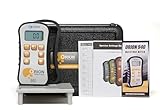
The Orion 940 is the documentation-focused version of Wagner’s professional pinless lineup. It’s best suited to restoration contractors, insurance remediation specialists, and flooring installers who need to log large numbers of readings efficiently across a job site. If you’re producing moisture maps for adjusters or project managers, the 940’s data collection modes are purpose-built for that workflow.
Key Specs
- Type: Pinless
- MC range: 5%–30% wood; relative scale for building materials
- Depth: ¼” and ¾” selectable
- Data logging: Manual and automatic collection modes
- Connectivity: Bluetooth to Wagner DataMaster app
- Calibration: Compatible with Wagner On-Demand Calibrator (sold separately)
- Warranty: 7 years
Why Professionals Choose It
- Automatic data collection mode logs readings continuously as you move across a floor or wall system — no button-press required per reading
- Generates timestamped data sets that can be exported directly for insurance or project documentation
- At $220–$280, it provides a meaningful step up from basic meters without reaching the 950’s price point
- The 7-year warranty applies here as well
Pros
- Automatic data collection is genuinely faster than manual logging on large jobs
- App-based documentation meets insurance adjuster requirements
- Good mid-tier price for a professional Wagner instrument
- Long warranty provides confidence in long-term accuracy
Cons
- No EMC calculator — that feature is exclusive to the 950
- No built-in calibrator — On-Demand Calibrator requires separate purchase
- Wood-focused like all Wagner pinless meters — limited on concrete and drywall
Real Job Scenario

A pipe burst in a multi-unit residential building has affected the subfloor across four units. You walk each unit in automatic collection mode, and the 940 logs a reading approximately every second without any manual input. By the end of the survey, you have 200+ timestamped readings organized by unit, which the app compiles into a moisture map. That documentation goes to the adjuster the same day, and the remediation scope is agreed on the next morning rather than after a two-day back-and-forth.
Bottom Line
If your work involves multi-point moisture surveys and documentation for third parties, the Wagner Orion 940 pays for itself in time saved on paperwork alone.
4. Delmhorst BD-2100 — Best Pin Meter for Drywall & Restoration

Who It’s For
The BD-2100 is the first choice for restoration contractors, building envelope specialists, and inspectors whose work is heavily focused on drywall, gypsum assemblies, and roofing materials. Its three-scale system — wood, gypsum, and reference — makes it one of the few meters in this price range with a properly calibrated drywall reading, rather than a generic approximation. EIFS inspectors will also value the deep probe compatibility.
Key Specs
- Type: Pin
- Scales: Wood (6%–40% MC), Gypsum (0.2%–50% MC), Reference (0–100)
- Calibration: Built-in calibration check
- Memory: Averages up to 100 accumulated readings
- Alarm: Adjustable moisture threshold alarm
- Probe compatibility: Accepts full Delmhorst electrode range for deep probing
- Warranty: 1 year
Why Professionals Choose It

- The calibrated gypsum scale is the standout feature — it gives you real MC% in drywall, not a reference number you have to interpret
- The adjustable alarm lets you set a moisture threshold and scan quickly without watching the display — the meter tells you when you’ve hit a problem area
- Delmhorst’s electrode accessory system is one of the most comprehensive available, including probes for wall cavities, roofing systems, and EIFS assemblies
- The 100-reading average is useful for establishing baseline moisture levels across a drying project
Pros
- Calibrated gypsum scale is rare and genuinely useful for drywall-heavy work
- Adjustable alarm speeds up large-area scanning
- Extensive probe accessory ecosystem
- Built-in calibration check supports documentation integrity
Cons
- Pin-only — no non-invasive scanning, which limits speed on finished surfaces
- Shorter warranty (1 year) compared to Wagner
- No Bluetooth or app integration — readings must be manually recorded
Real Job Scenario
You’re assessing drywall moisture after a roof leak in a commercial office. You switch the BD-2100 to the gypsum scale and set the alarm at 15% MC — the industry threshold above which mold risk becomes significant. Moving room to room, you only need to stop when the alarm sounds, which cuts your survey time in half. In three rooms, the alarm triggers. Those are your affected areas, documented with precise gypsum-scale readings, not generic reference numbers. That data supports a scoped remediation rather than a speculative tear-out.
Bottom Line
For any professional whose work involves drywall assessment, the Delmhorst BD-2100’s calibrated gypsum scale is the feature that separates it from every other meter in this price range.
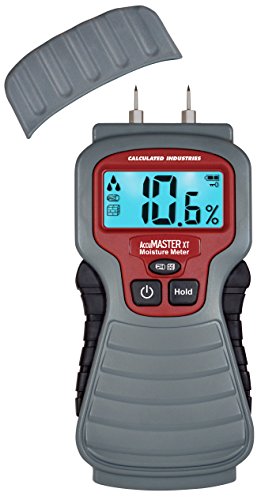
5. Calculated Industries AccuMASTER Duo Pro 7440 — Best Value Combination Meter
Who It’s For
The AccuMASTER Duo Pro is the right choice for general contractors who encounter moisture issues across multiple material types but don’t specialize in any single one. At $100–$130, it’s the entry point for genuine professional-grade dual-mode capability. It won’t replace a dedicated Wagner or Protimeter on specialized jobs, but it handles the range of situations a general contractor faces without requiring a multi-meter investment.
Key Specs
- Type: Pin + Pinless
- Wood range: 5%–50% MC
- Building materials range: 1.5%–33% relative
- Material modes: Wood, drywall, concrete, plaster, brick
- Calibration: Factory calibrated; no on-demand system
- Data logging: None
- Warranty: 1 year
Why Professionals Choose It
- Pin and pinless in a single unit at a price that doesn’t require budget justification
- Material modes cover the full range of substrates a general contractor encounters
- Straightforward operation — no app required, no setup complexity
- Lightweight and compact for everyday carry
Pros
- Best dual-mode value in the professional tier
- Multi-material coverage without switching instruments
- Simple to operate — minimal learning curve
- Low cost means it can live on a truck without being a loss concern
Cons
- No calibration verification system — you’re trusting factory calibration over time
- No data logging — unsuitable for jobs requiring documented readings
- Accuracy specifications are broader than premium alternatives
Real Job Scenario

You’re a general contractor roughing in a bathroom addition. Before the subcontractors arrive, you want to confirm the existing concrete slab is dry enough, check the framing lumber for moisture after a week of rain delays, and scan the adjacent drywall for any moisture intrusion. The AccuMASTER handles all three in one pass. You don’t need precision documentation — you need a fast go/no-go read on each substrate. At $100–$130, this is exactly what the Duo Pro is built for.
Bottom Line
The AccuMASTER Duo Pro 7440 is the most capable entry-level professional moisture meter available — the right choice for general contractors who need multi-material coverage without specialization-level investment.
Professional Moisture Meter Buying Guide
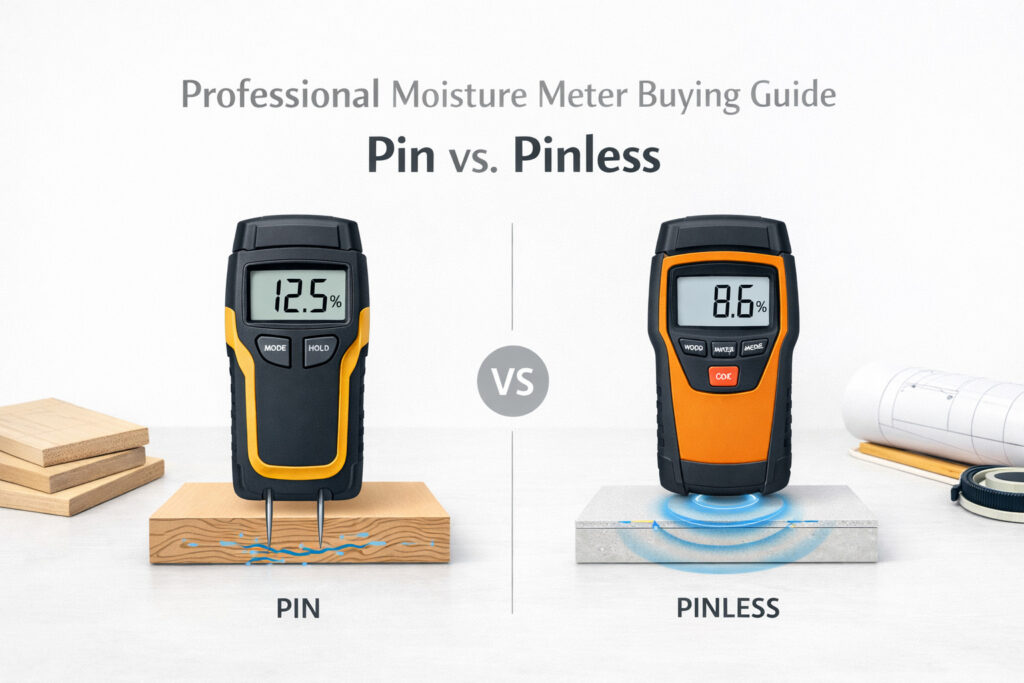
Pin vs. Pinless: What Professionals Actually Use
Pin meters measure electrical resistance between two probes driven into the material. The resistance correlates to moisture content — wet material conducts electricity better than dry material. They leave small pin holes, which matters on finished surfaces, but they allow deep readings with extended electrode accessories and give direct MC% values. Pin meters are the tool for confirmation readings.
Pinless meters use an electromagnetic signal that penetrates the material to a set depth without surface contact. They scan quickly, leave no marks, and are the right tool for surveying large areas efficiently. The limitation is that they read a zone of material, not a specific point — which makes them excellent for locating wet areas, but less precise for determining exact moisture content at a specific depth.
The standard professional workflow combines both: pinless to scan and locate, pin to confirm and document.
| Factor | Pin | Pinless |
|---|---|---|
| Speed | Slower — point by point | Fast — continuous scan |
| Surface damage | Small pin holes | None |
| Accuracy | Direct MC% at probe depth | Zone reading — precise locating, less precise MC |
| Depth | Adjustable with probe accessories | Fixed scan depth (¼” or ¾”) |
| Best use | Confirmation, documentation | Surveying, screening large areas |
Best Moisture Meter for Wood
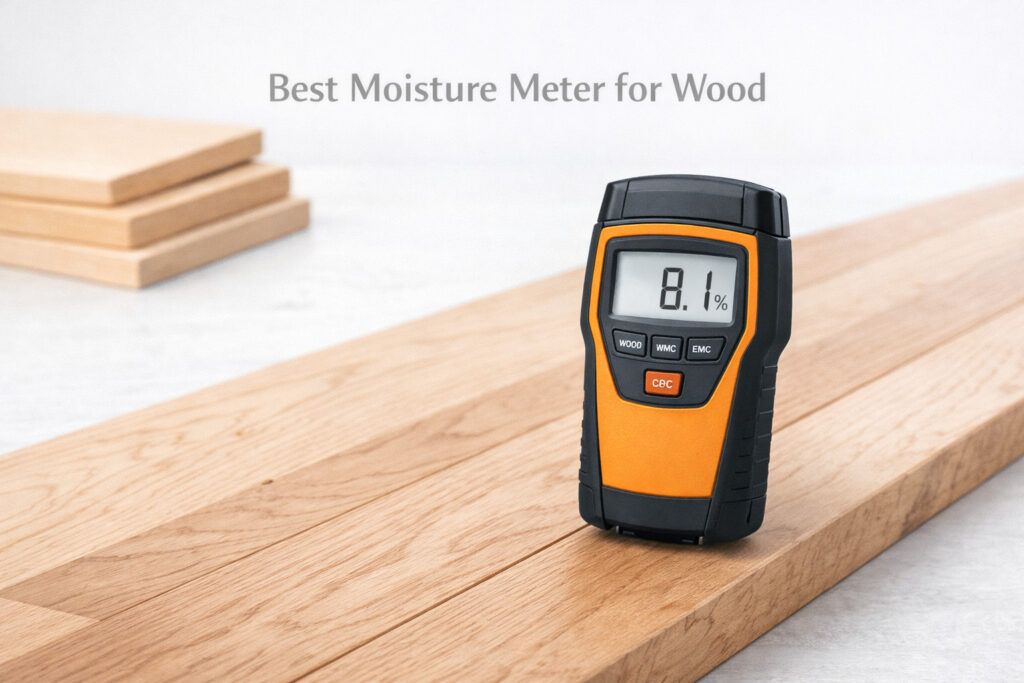
Wood moisture content is the central variable in hardwood flooring installation, cabinetry, and finish carpentry. The National Wood Flooring Association (NWFA) specifies that hardwood flooring should be installed at less than 12% MC, with subfloor moisture typically within 4% of the flooring material’s MC. Exceeding these thresholds is one of the most common causes of flooring callbacks.
Species calibration matters significantly here. Oak and pine have very different density profiles — using an uncalibrated reading across species can introduce errors of 3–5% MC, which is the difference between a safe installation and a problem. Meters that support species-specific settings, like the Wagner Orion 950, give you readings you can actually rely on. ASTM D4444 governs the standard test method for moisture content in wood products — a meter that complies with this standard is the baseline for professional work. For more on wood moisture standards, the ASTM International website provides the complete D4444 specification.
Best Moisture Meter for Concrete
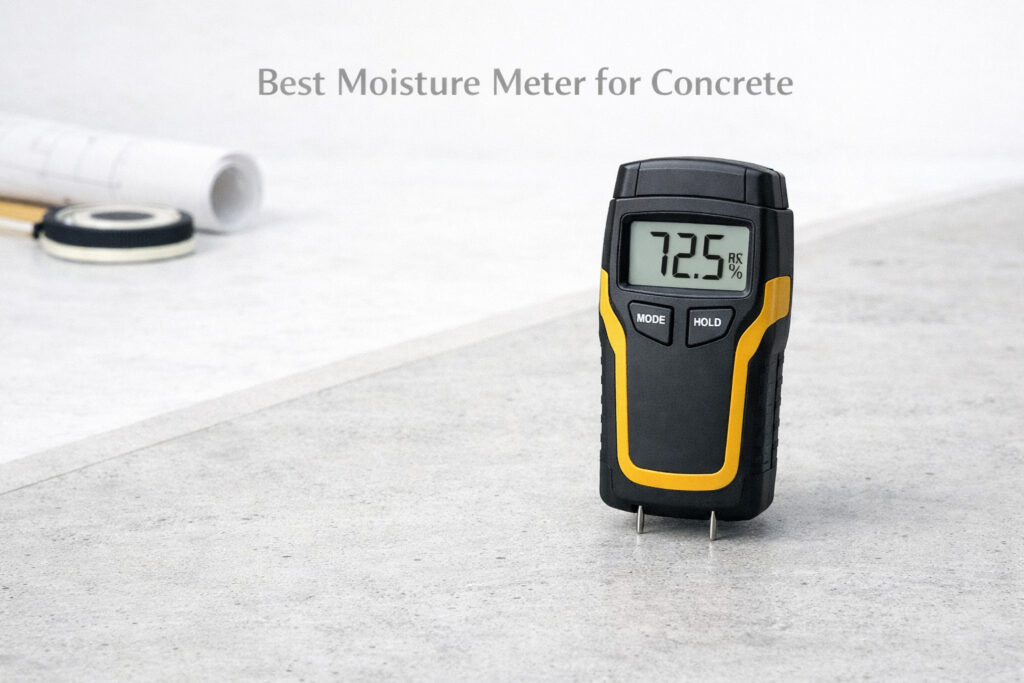
This is where cheap meters fail most visibly. A surface reading on concrete does not represent the moisture condition of the slab. Concrete is porous and stratified — surface readings can appear acceptable while the interior of the slab holds significant moisture vapor that will migrate upward and destroy flooring adhesives and coatings.
ASTM F2170 specifies the standard for measuring relative humidity in concrete slabs using in-slab RH probes. This is the test that flooring manufacturers require before their warranties apply. The threshold is typically 75% RH — above that, most adhesives and coatings are at risk of failure. No moisture meter in the $100–$400 range performs a full ASTM F2170 test on its own. What these meters can do is provide a preliminary surface scan to identify areas of concern, which then guides where you place RH probes for the full test. Be honest with clients about what a surface reading tells you — and what it doesn’t.
Best Moisture Meter for Drywall
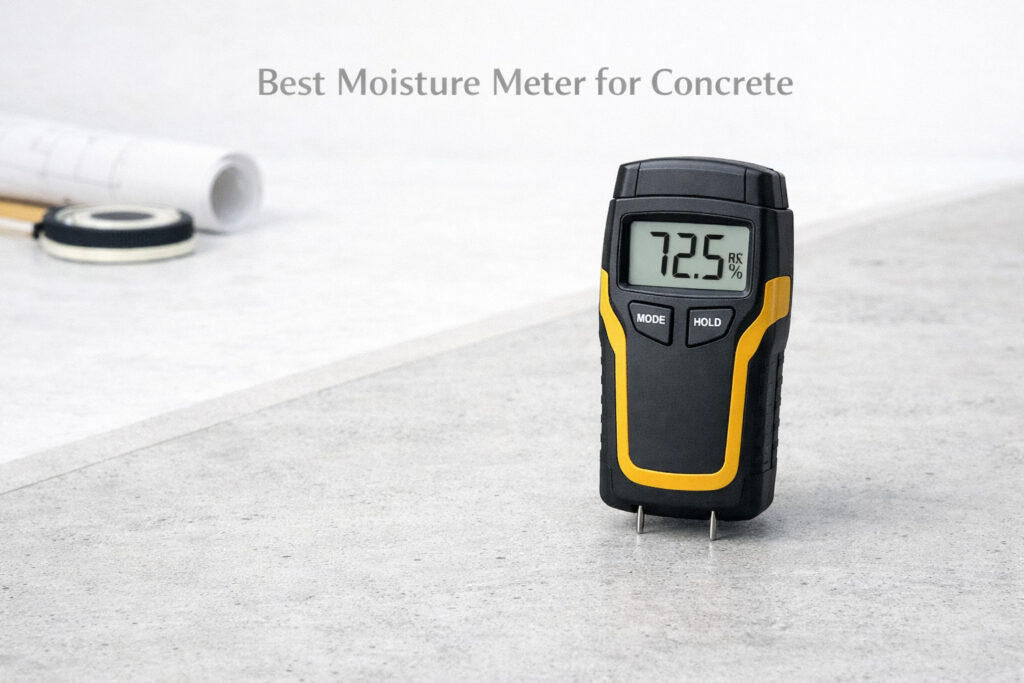
Gypsum board holds moisture differently than wood. The industry threshold for mold risk in drywall is 15% MC — above that, conditions are suitable for mold growth, and remediation is the responsible path. A meter without a calibrated gypsum scale is essentially guessing on drywall readings.
Non-invasive scanning is especially important for finished drywall — pin holes in a painted wall create additional repair work and client friction. For insurance documentation purposes, the meter and readings need to be defensible. A gypsum-specific calibration and a built-in calibration check are the two features that make a moisture meter useful in a professional drywall inspection context.
Calibration and Accuracy
Accuracy specifications in moisture meters are typically expressed as ±0.5% (laboratory-grade) or ±1.0% (professional-grade). For flooring installation, restoration, and inspection work, ±1.0% is generally acceptable — but only if the calibration is maintained. Moisture meters experience calibration drift over time, particularly when exposed to temperature extremes and physical wear. A meter that read accurately when new may not read accurately six months later.
Most manufacturers recommend checking calibration regularly, but checking calibration requires a calibration standard — which most contractors don’t carry. Wagner’s On-Demand Calibrator is the only system currently available that allows true field calibration verification at the point of use. For everyone else, periodic factory recalibration is the alternative. Documentation-heavy work — insurance claims, commercial inspections, installation certifications — requires a defensible calibration record. If your readings are going into a formal report, the calibration status of your meter needs to be part of that record.
Depth of Detection
Different jobs require different detection depths. A ¼” shallow scan reads surface layers and is appropriate for thin flooring products and painted drywall surfaces. A ¾” deep scan penetrates through finished flooring to detect subfloor moisture — the depth required before hardwood installation. Extended pin probes from Protimeter and Delmhorst can reach 5″–9″ into wall assemblies, which is necessary for EIFS inspections, wall cavity assessment, and post-remediation verification.
Before purchasing, map the depth requirements your work actually demands. A contractor doing only hardwood floor installations doesn’t need deep wall probe capability. An inspector assessing post-water-damage wall assemblies does.
Professional Moisture Thresholds Reference
Know your thresholds before you pick up a meter. These standards define what the numbers on your display actually mean for job-site decisions.
| Material | Safe Level | Risk Threshold | Governing Standard |
|---|---|---|---|
| Hardwood Flooring | <12% MC | Warping / gapping above threshold | NWFA / ASTM D4444 |
| Drywall / Gypsum | <15% MC | Mold growth risk above threshold | Industry standard |
| Concrete Slab | <75% RH | Adhesive / coating failure above threshold | ASTM F2170 |
| Softwood Lumber | <19% MC | Decay and structural risk above threshold | IRC Building Code |
The difference between these thresholds matters. A hardwood floor at 13% MC is a problem. The same lumber in a wall assembly at 13% MC is fine. Know which standard applies to the material and application before interpreting your readings.
Which Moisture Meter Should You Buy?
| Professional | Recommended Pick | Reason |
|---|---|---|
| Home Inspector | Protimeter SurveyMaster | Multi-material capability, calibration verification, Bluetooth logging — handles any substrate in a single inspection |
| Flooring Installer | Wagner Orion 950 | Most accurate pinless wood reading, EMC calculator for acclimation verification, On-Demand Calibration |
| Restoration Contractor | Delmhorst BD-2100 + Wagner Orion 940 | Pin depth with gypsum scale for drywall assessment; auto data logging for large-area documentation |
| Woodworker / Cabinet Maker | Wagner Orion 940 | Accurate wood readings without the 950’s premium price; data logging for shop records |
| General Contractor | AccuMASTER Duo Pro 7440 | Multi-material, dual-mode, compact, under $130 — the right tool for non-specialist moisture checks |
| Property Manager | Protimeter SurveyMaster | Fast non-invasive scanning across wall, floor, and ceiling materials; Bluetooth logging for unit-by-unit records |
Not sure which fits your work? Review the full comparison table ↑
Common Mistakes When Buying a Professional Moisture Meter
Buying a drywall-specific meter for slab work. A meter calibrated for gypsum is not reading your concrete slab accurately. Each material type requires appropriate calibration settings or dedicated scales. Multi-material meters have modes for a reason — use them.
Ignoring species calibration for wood work. The density difference between white oak and Douglas fir can produce a 3–5% MC reading error if your meter isn’t calibrated to the correct species. That error margin can mean the difference between a safe installation and a callback.
Overpaying for Bluetooth and data logging on jobs that don’t require documentation. If your work doesn’t involve insurance claims, commercial certifications, or multi-point surveys, the extra cost for connected features doesn’t return value. The AccuMASTER Duo Pro does the job for half the price of a Protimeter in those circumstances.
Assuming pinless is always more accurate than pin. Pinless meters are faster and non-invasive, but they read a zone, not a precise point. For confirmation readings, warranty-required documentation, or precise MC% at a specific depth, pin meters give you the more defensible number.
Not checking replacement pin and probe availability before purchasing. A meter is only as useful as its accessories. Before committing to any brand, confirm that replacement pins, electrodes, and extended probes are available and reasonably priced. Delmhorst and Protimeter both have strong accessory ecosystems. Some lesser-known brands do not.
Skipping calibration verification as part of job setup. Calibration drift is real. A meter that was accurate at purchase may not be accurate after a season in a tool bag. If your readings go into formal reports, build calibration verification into your pre-job routine — or choose a meter with an on-demand calibration system.
Frequently Asked Questions
What moisture level is safe for hardwood flooring?
The National Wood Flooring Association specifies that hardwood flooring should be installed at less than 12% MC, with the subfloor moisture content within 4% of the flooring material’s MC. In practice, most flooring installers target 6%–9% MC for the flooring itself, depending on species, region, and the equilibrium moisture content of the installation environment. A floor installed above the 12% threshold — or with an excessive differential between the flooring and subfloor — is at high risk of cupping, crowning, or gapping as the wood adjusts after installation. Measure both the flooring material and the subfloor before committing to any installation.
Can moisture meters detect mold?
No — moisture meters detect moisture content, not mold. They cannot identify whether mold is present, what species it is, or whether spore counts are elevated. What they can do is identify moisture conditions that are conducive to mold growth. Above 15% MC in drywall, conditions are generally considered favorable for mold development. A positive moisture reading in a wall assembly should trigger further investigation — visual inspection, air quality testing, or thermal imaging — rather than being treated as a mold confirmation on its own. Moisture meters support the assessment process; they don’t replace it.
Are pinless moisture meters accurate for professional use?
Yes — with an understanding of their limitations. Pinless meters are highly accurate for locating wet zones and screening large areas quickly. They output either a direct MC% (like the Wagner Orion series) or a relative scale that indicates moisture presence and severity. Where they are less precise than pin meters is in reading moisture at a specific depth or producing a single-point value for documentation purposes. The professional practice of using pinless to scan and pin to confirm captures the best of both systems. Wagner’s On-Demand Calibration system also allows pinless accuracy to be verified in the field — a feature that meaningfully changes the documentation value of pinless readings.
How deep do professional moisture meters read?
Depth varies by meter type and configuration. Standard pinless meters offer ¼” shallow scan (for surface layers and thin flooring) and ¾” deep scan (for subfloor detection through finished floors). These are the most commonly used depth settings for flooring and restoration work. Extended pin probes for Protimeter and Delmhorst meters reach 5″–9″ into wall assemblies, making them appropriate for EIFS inspections, deep wall cavity assessment, and roofing systems. Before purchasing, determine what depths your most common job scenarios require — and verify that the meter you’re considering either has that depth capability built in or can be equipped with appropriate accessories.
Do I need a separate meter for concrete slabs?
It depends on what your work requires. For a preliminary surface scan to identify potential moisture concern areas, most professional meters with a concrete mode will give you useful directional information. However, if your work involves flooring installations or coatings where manufacturer warranties and ASTM F2170 compliance apply, a surface meter reading is not a substitute for in-slab RH probe testing. The 75% RH threshold that governs adhesive and coating suitability requires an in-slab measurement — a test that no general-purpose moisture meter in the $100–$400 range performs on its own. Surface readings are a preliminary screening tool; in-slab RH probes are the compliance test.
Is $100 enough for a professional moisture meter?
At $100, you’re at the very bottom of the professional tier — and the Calculated Industries AccuMASTER Duo Pro 7445 is what that budget gets you. It provides genuine dual-mode capability, multi-material modes, and acceptable accuracy for general contracting applications. What it doesn’t provide is calibration verification, data logging, or the accuracy specification of premium instruments. For a general contractor doing occasional moisture checks across different materials, it’s a defensible professional tool. For flooring specialists, restoration professionals, or inspectors who produce documentation for third parties, the investment in a $200–$350 instrument pays for itself quickly in the accuracy, calibration integrity, and logging capability that professional work actually requires.
How do I know if my moisture meter is calibrated correctly?
Most meters include a calibration check function that verifies the meter is reading within its specified range at a known standard. This is a go/no-go check, not a precision calibration. Wagner’s On-Demand Calibrator, available for the Orion series, is the only system currently available that allows genuine field calibration verification against a traceable standard at the point of use. For other meters, periodic factory recalibration — typically annually for instruments used in professional applications — is the responsible practice. If your readings support insurance claims, installation warranties, or formal inspection reports, your calibration record needs to be as defensible as the readings themselves.
What is WME (Wood Moisture Equivalent)?
WME stands for Wood Moisture Equivalent and is used primarily by Protimeter meters when measuring non-wood materials. Because pin meters work on electrical resistance — a property that varies by material — reading a material like concrete or drywall on a wood scale produces a WME value rather than a true MC% for that material. WME allows the meter to express a comparative moisture level in terms that a wood-calibrated instrument can output, which is useful for identifying wet vs. dry relative conditions in non-wood materials. For precise readings in specific materials, a meter with dedicated calibration scales for those materials — like the Delmhorst BD-2100’s gypsum scale — gives more actionable numbers than a WME reading.
Final Verdict: Best Moisture Meters for Professionals
For most professionals, the Protimeter SurveyMaster BLD5375 is the best overall choice in this comparison. It handles wood, drywall, concrete, and EIFS in a single instrument, its calibration verification is built into the workflow rather than an afterthought, and the Bluetooth documentation capability meets the requirements of insurance and inspection reporting. If you work across multiple material types and your readings need to be defensible, the SurveyMaster earns its price.
For flooring installers and wood specialists who work primarily with hardwood and engineered flooring products, the Wagner Orion 950 is the premium specialist choice. The EMC calculator, On-Demand Calibration, and 7-year warranty are practical differentiators — not marketing features. At $350–$400, it’s at the top of the professional sweet spot, and it justifies that position.
The $100–$400 range covers every legitimate professional moisture meter need. Below $100, you’re buying uncertainty. Above $400, you’re entering specialized territory that most field contractors never need to reach.