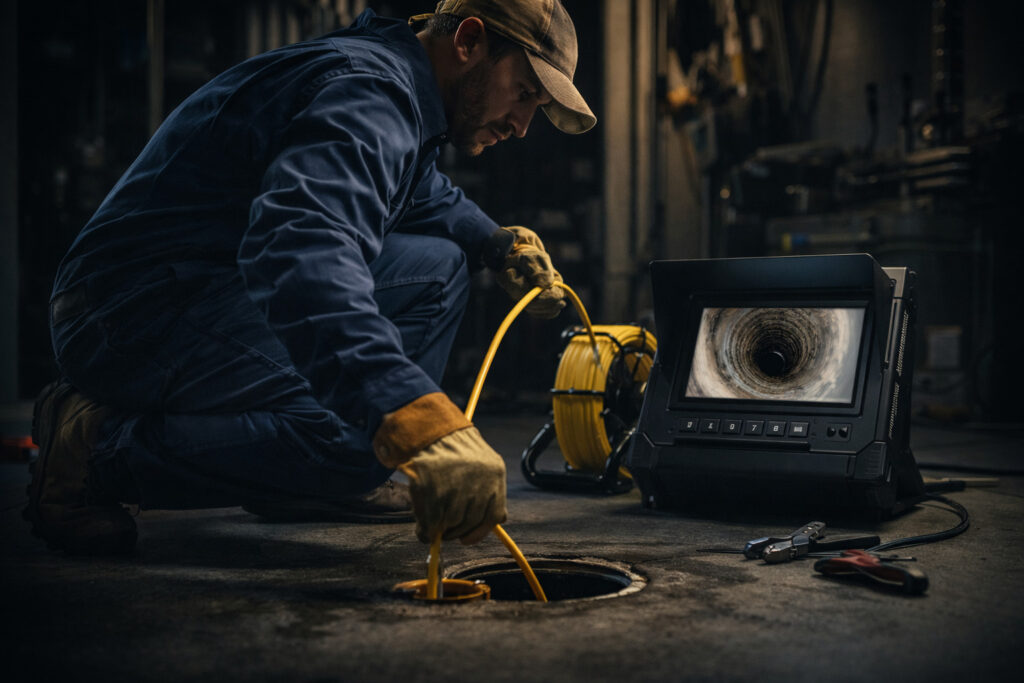
Whether you’re a professional plumber chasing a blockage in a 100-year-old sewer lateral, a home inspector flagging pipe corrosion before a sale closes, or a homeowner trying to figure out why the kitchen sink keeps backing up without paying a $300 service call — you have the same problem. You need to see what’s happening inside a pipe or wall before you start cutting, digging, or guessing.
Operating blind isn’t just frustrating. It’s expensive. A wrong diagnosis means wasted labor, ruined materials, and jobs that have to be redone. The right pipe and wall inspection camera gives you complete control over the diagnostic process before a single tile gets pulled or a trench gets dug.
This guide covers both tool types — short-cable borescopes for walls, engines, and household drains, and long-cable sewer push cameras for main laterals — across three user groups:
- Homeowners & DIYers: Occasional use, drain clogs, pre-purchase inspections, finding lost items
- Plumbers & Contractors: Daily professional use, documentation, blockage location, 512Hz sonde for underground pinpointing
- Home Inspectors & Property Managers: HVAC ducts, wall cavities, multi-unit building maintenance
Real-world specs, honest trade-offs, clear picks for every use case. No marketing fluff.
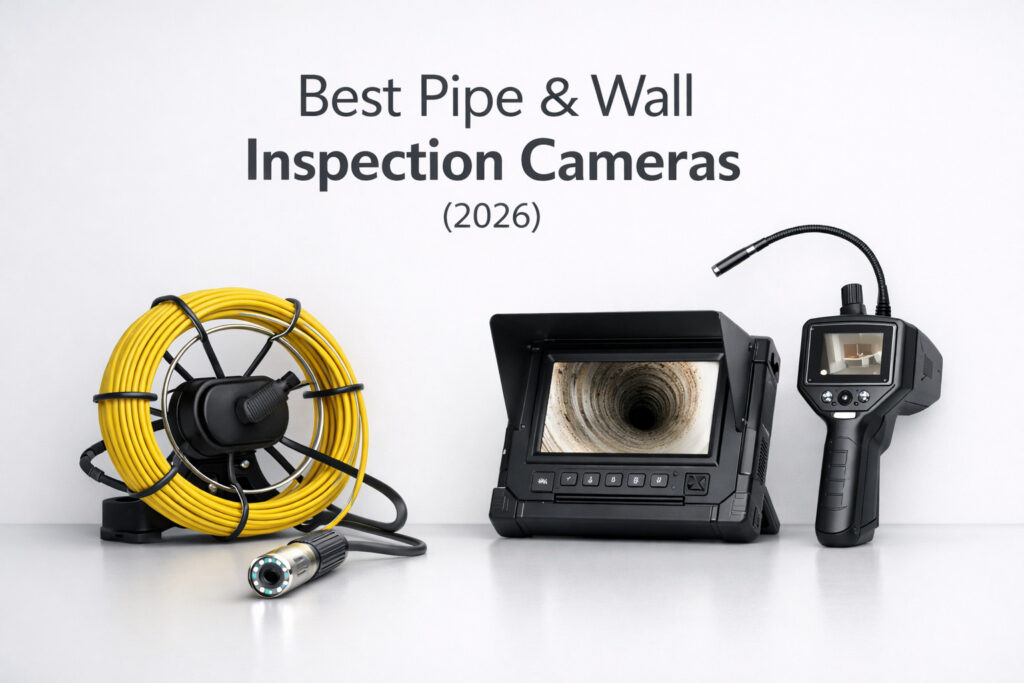
🏆 Quick Picks — Best Pipe & Wall Inspection Cameras (2026)
| Best Overall | Teslong NTS300 Pro — Best all-round borescope: 5″ IPS, dual lens, modular system |
| Best Value | DEPSTECH DS300 — Dual lens + 32GB card included at a lower price than Teslong |
| Best for Plumbers | VEVOR 165ft Sewer Camera — 165ft cable, 512Hz sonde, 9″ IPS monitor, DVR |
| Best Articulating | Anykit Articulating Borescope 210° — 210° articulating tip, 4-way steering for complex inspections |
| Best Brand Backing | RIDGID micro CA-25 — RIDGID reliability, standalone display, no phone dependency |
| Best Wireless | Klein Tools ET17 — Wi-Fi to phone, instant client-shareable documentation |
| Best Budget | DEPSTECH WF060 — 1080P wireless at the lowest entry price in this guide |
Most homeowners and DIYers will land on the Teslong NTS300 or DEPSTECH DS300 — they offer the best balance of reach, dual-lens capability, and price. Plumbers running full sewer laterals need the VEVOR 165ft. And if you just want to try an inspection camera without a major spend, the DEPSTECH WF060 is the lowest-risk starting point.
Two Types of Inspection Camera — Which Do You Need?
The single most expensive mistake buyers make in this category is buying the wrong type of camera for the job. Inspection cameras divide into two completely different tool categories. Getting this wrong means the cable is either too short to reach the problem, or the head is too large to fit in the pipe.
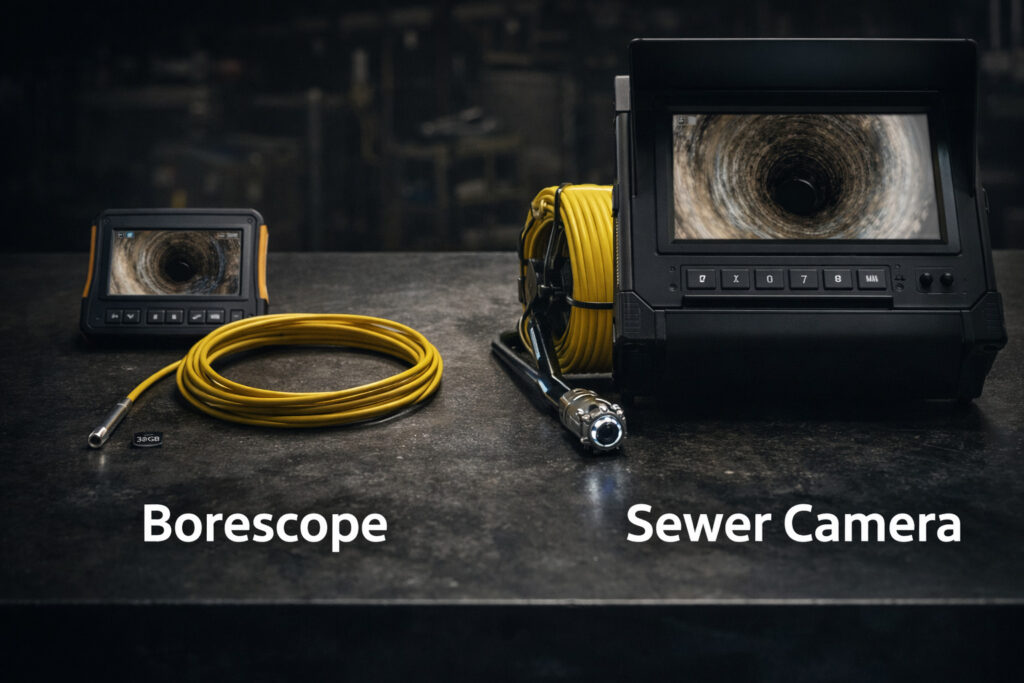
🔦 Borescope / Endoscope
- Cable: 3–50ft flexible gooseneck or semi-rigid
- Head diameter: 5.5mm–17mm
- Best for: Wall cavities, engine bays, HVAC ducts, under-sink P-traps, tight spaces
- Display: Built-in handheld screen or Wi-Fi to phone
- Users: Homeowners, inspectors, mechanics, HVAC techs, light plumbing
✗ NOT suitable for running 100ft down a main sewer lateral — cable will buckle and fold
🚿 Sewer / Drain Push Camera
- Cable: 50–200ft+ rigid fiberglass push rod on a reel
- Head diameter: 23mm–32mm
- Best for: Sewer laterals, main drain lines, 2″–8″ pipes
- Display: Large monitor unit with DVR and SD card recording
- Users: Plumbers, drain cleaners, property managers
✗ NOT suitable for tight bends, narrow sink pipes, or wall cavities
⚠ Head diameter vs. pipe size — check this before buyingA standard P-trap under a kitchen sink has a 1.5″ (38mm) opening. A sewer camera with a 23mm head might physically fit the opening but the rigid push cable will never navigate the tight U-bend. For household drains, always choose a flexible borescope under 8mm.
Still not sure? Use this decision table:
| Your Job | Right Tool Type | Starting Pick |
|---|---|---|
| Check a blocked kitchen drain | Borescope (short) | DEPSTECH DS300 |
| Inspect wall cavity / wiring | Borescope (short) | Teslong NTS300 |
| Navigate complex bends / tight angles | Articulating borescope | Anykit 210° |
| Run a main sewer lateral | Push camera (long) | VEVOR 165ft |
| Pre-purchase home inspection | Borescope (short) | Teslong NTS300 |
| Instant client documentation | Wireless borescope | Klein Tools ET17 |
What Actually Matters When Choosing an Inspection Camera
Spec sheets in this category are full of inflated numbers and vague marketing terms. Here’s what actually determines how well a camera performs on a dark, wet job site.
Camera Resolution & Image Quality
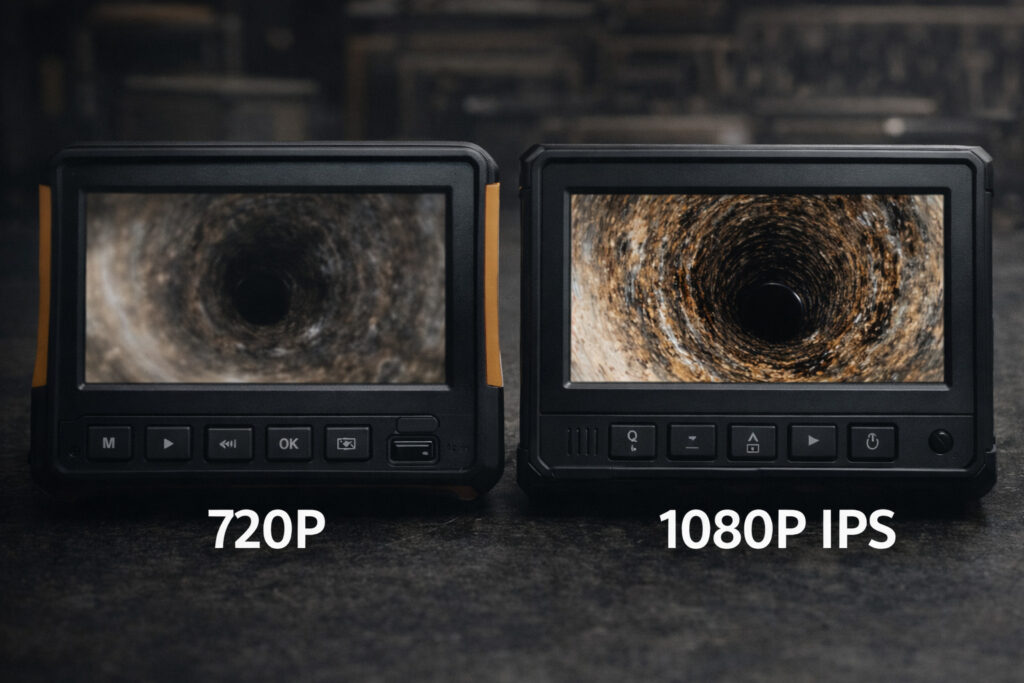
The baseline has shifted. While 720P was the standard a few years ago, 1080P (1920×1080 digital resolution) is what you should be paying for today. Be skeptical of terms like “1200TVL” or “1920P” without a stated pixel count — TVL is an analog TV line spec, not a digital resolution, and a 1200TVL analog camera can produce worse images than a true 1080P sensor.
Screen technology matters as much as resolution. An IPS display provides significantly better color accuracy and viewing angles than older TN panels — critical for identifying subtle pipe corrosion, hairline cracks, or mineral buildup. And dual-lens systems (forward-facing + 90° side-view) are dramatically more useful than single-lens units for inspecting pipe walls without repositioning the cable.
Cable Length & Type
For borescopes, 16.5ft (5m) is the practical minimum for most household tasks. Semi-rigid gooseneck cables navigate bends better than stiff rod cables. For sewer cameras, 100ft handles most residential laterals; 165ft covers longer commercial runs. Cable diameter is critical — a 5.5mm head fits standard household drain lines; a 22–23mm head is for main sewer laterals only. Fiberglass push rod resists kinking over long distances; spring steel handles daily professional abuse better.
IP Rating (Waterproofing)
Pipes are wet. IP67 means submersible to 1 meter for 30 minutes — fine for drain and household pipe inspection. IP68 is rated for deeper, longer submersion and is the standard for serious sewer work. Always verify whether the IP rating covers just the camera probe head or the full monitor housing — they’re often rated differently.
Display & Recording
Built-in screen versus Wi-Fi to phone is the central trade-off. A built-in screen is more reliable in the field — no phone dependency, no app crashes, no Wi-Fi drops in a metal pipe. Phone-connected units are more convenient for instant documentation and client sharing. For professionals, DVR function with SD card recording (32GB preferred) is essential for handing over inspection reports. Screen size: 4.3″ is workable, 5″ is noticeably better, 7–9″ monitors are best for sewer camera use.
Locator / Sonde — Sewer Cameras Only
A 512Hz sonde is a radio transmitter built into the camera head. A compatible locator receiver above ground pinpoints the camera’s exact position and depth underground. This is the feature that separates a professional plumbing tool from an import camera. Without it, you can see the blockage but you can’t tell the customer exactly where to dig. Don’t buy a mainline sewer camera without a sonde. For homeowners, it’s unnecessary — most won’t own the $1,000+ surface receiver required to use it anyway.
Articulating vs. Fixed Camera Head
Standard borescopes have a fixed camera head — you steer by bending the cable. Articulating borescopes have a motorized tip that steers in 2 or 4 directions via a joystick, giving you precise control around tight corners, inside engine cylinders, and in complex duct bends. The Anykit 210° in this guide offers 4-way steering up to 210° — a genuine advantage when a fixed camera leaves you guessing at the angle. The trade-off: articulating units cost more and the articulating mechanism adds a potential failure point.
Battery Life
Running out of power mid-inspection is a serious problem. Minimum 4,000mAh for field work — units with 5,000–8,500mAh deliver 6–14 hours depending on LED usage. Check whether the unit charges via standard USB-C or requires a proprietary cable or battery pack.
Build Quality & Durability
The camera head should have a stainless steel housing — plastic heads crack on contact with cast iron blockages. The cable spring protection at the junction with the camera head is the highest-wear point on every inspection camera — cheap units fail here first. Rubber-overmolded or reinforced monitor bodies handle trade-use drops. RIDGID and Milwaukee lead on build quality; Teslong, DEPSTECH, and Anykit are competitive in the mid-range for non-daily-abuse use.
The Best Pipe & Wall Inspection Cameras — Detailed Reviews
1. Teslong NTS300 Pro
The most capable all-around inspection camera for non-plumber professionals
⭐ Best Overall
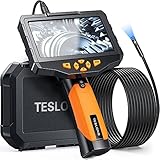
Head: 5.5–8mm
Resolution: 1080P
Screen: 5″ IPS
IP Rating: IP67
Recording: TF card
Sonde: No
Price Tier: $$
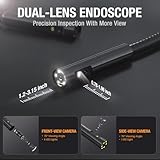
The Teslong NTS300 Pro earns its top position through one feature that changes how inspection work actually gets done: the dual-lens system. A forward-facing lens and a 90° side-view lens let you inspect along pipe walls and around corners without pulling the cable back out and repositioning it. That saves time on every single inspection job, and over a day of work it compounds significantly.
The 5″ IPS screen produces noticeably better color accuracy and contrast than the TN panels used by cheaper alternatives — you can identify the difference between mineral buildup, active corrosion, and a hairline crack with confidence. The modular probe system is a real long-term value: camera probes are interchangeable, so you can upgrade to a triple-lens or different diameter probe without replacing the entire monitor unit. At 5,000mAh the battery covers a full day of inspections comfortably.
✓ What It Does Well
- Dual-lens (front + 90° side view) saves significant repositioning time on every job
- 5″ IPS screen — best color accuracy and contrast in this price tier
- Modular probe system: upgrade probes without replacing the monitor
- 5,000mAh battery — full day of inspections without recharging
✗ Where It Falls Short
- 16.5ft cable limits it strictly to household plumbing, walls, and ducts — not a sewer lateral camera
- No Wi-Fi streaming; documentation requires physically removing the TF card

The Teslong NTS300 Pro is the right machine for homeowners, home inspectors, HVAC techs, and contractors who need a versatile short-range camera for drains, walls, and ducts. The modular system means your monitor investment pays off across multiple probe upgrades over time.
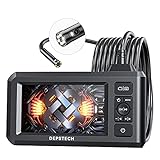
2. DEPSTECH DS300 Dual Lens Endoscope
Dual lens and built-in storage at a step below the Teslong price
💰 Best Value
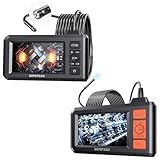
Head: 7.9mm
Resolution: 1080P
Screen: 4.3″ LCD
IP Rating: IP67
Recording: 32GB card included
Sonde: No
Price Tier: $$
The DS300 delivers the dual-lens feature that matters most — front and side-view capability — at a price that meaningfully undercuts the Teslong. For homeowners and DIYers who don’t need the modular system or the larger IPS screen, this is where the value sits. DEPSTECH includes a 32GB TF card in the box, which few competitors in this price range bother to do.
The Bluart 2.0 LED lighting system provides even, consistent illumination without the harsh hotspots that plague budget inspection cameras — a genuine engineering improvement over earlier DEPSTECH models. DEPSTECH has built solid North American support and a large, active user community that makes troubleshooting and real-world usage questions easy to answer.
✓ What It Does Well
- Dual-lens 1080P at a price below the Teslong — strong value for the feature set
- Bluart 2.0 LEDs: even illumination with no harsh hotspots
- 32GB TF card included — ready to record out of the box
- Proven DEPSTECH brand with strong community support
✗ Where It Falls Short
- 4.3″ screen is noticeably smaller than the Teslong’s 5″ IPS — visible difference side by side
- Semi-rigid cable is slightly less flexible in very tight P-trap bends than gooseneck alternatives

The DS300 is a genuine workhorse for the price. It won’t outperform the Teslong on screen quality or cable flexibility, but it keeps the crucial dual-lens feature while undercutting on price. For budget-conscious homeowners and DIYers, this is the smart buy.
3. VEVOR 165ft Sewer Camera with 512Hz Locator
Professional sewer inspection at a fraction of RIDGID SeeSnake pricing
🚿 Best for Plumbers

Head: 23mm
Resolution: 720P
Screen: 9″ IPS
IP Rating: IP68
Recording: 16GB DVR
Sonde: Yes — 512Hz
Price Tier: $$$
The VEVOR 165ft is the accessible entry point into professional sewer inspection. The 165ft fiberglass push cable reaches the full length of most residential sewer laterals and many commercial runs. The built-in 512Hz sonde transmitter is the feature that separates a real plumbing tool from an import camera — a compatible locator receiver above ground pinpoints the camera’s exact position underground, letting you tell the customer precisely where to dig.
The 9″ IPS monitor gives you a genuinely large, clear display for a tool you’re using in poor lighting conditions under pressure. Twelve adjustable LEDs illuminate dark sewer environments cleanly. The IP68-rated stainless steel camera head handles corrosive environments, and the distance counter tracks cable depth for client documentation. The DVR with 16GB SD card captures the complete inspection for reports and insurance documentation.

✓ What It Does Well
- 165ft reach covers full residential laterals and commercial runs
- 512Hz sonde enables underground locating with a compatible receiver
- 9″ IPS monitor — largest, clearest display in this guide
- IP68 stainless steel head + DVR recording for professional documentation
✗ Where It Falls Short
- 23mm head is too large for household P-traps — mainline sewer use only
- Integrated sonde has depth limitations beyond 3–4ft underground vs. separate transmitters
- Heavy at 30+ lbs with reel — not a portable carry tool

The VEVOR gives professional plumbers roughly 80% of a $6,000–$9,000 RIDGID SeeSnake’s functionality at a fraction of the price. The sonde has depth limitations at the integrated price point — factor that in for precision underground locating — but for inspection, documentation, and client reporting work, it delivers serious ROI.
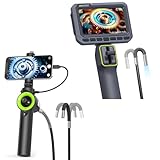
4. Anykit Articulating Borescope 210°
4-way joystick steering for inspections where a fixed camera leaves you guessing
🎮 Best Articulating
Resolution: 1080P
Screen: 4.3″ IPS
IP Rating: IP67
Recording: SD card
Sonde: No
Price Tier: $$$
Standard borescopes steer by bending the cable — you’re working with whatever angle the pipe geometry gives you. The Anykit 210° changes that entirely. The motorized articulating tip moves 210° in four directions via a joystick control, letting you steer precisely around tight corners, look back along a pipe wall, inspect inside engine cylinders, or navigate complex HVAC duct bends with deliberate, controlled camera placement.
This capability matters most in scenarios where a fixed lens physically cannot get a useful view — inspection of turbine blades, engine valve seats, bend junctions in pipe systems, or anywhere the geometry demands a camera angle the cable routing can’t provide. The 1080P resolution and 4.3″ IPS screen deliver clean, accurate imagery once you’ve steered the camera into position. For multi-trade professionals who regularly hit complex inspection angles, this is the tool that eliminates the guesswork.

✓ What It Does Well
- 210° 4-way articulating tip: steer precisely where a fixed camera can’t reach
- 1080P on a 4.3″ IPS screen — accurate color and resolution when you need detail
- IP67 camera head handles wet environments and drain work
- Expands capability significantly for mechanics, HVAC techs, and complex pipe inspections
✗ Where It Falls Short
- Articulating mechanism adds cost over fixed-tip borescopes at the same resolution
- The steering mechanism is an additional potential failure point with heavy daily use
- Overkill for simple straight-run household drain inspections

The Anykit 210° is the right tool when fixed-tip borescopes consistently fail to get the camera angle you need. For mechanics inspecting engine internals, HVAC techs navigating duct bends, and contractors dealing with complex pipe junctions, the joystick articulation is a genuine capability upgrade — not a gimmick.
5. RIDGID micro CA-25
RIDGID brand reliability with a standalone display and no phone dependency
🏗 Best Brand Backing

Head: 17mm
Resolution: 640×480
Screen: 3.5″ color LCD
IP Rating: IP67
Recording: Photo capture
Sonde: No
Price Tier: $$$
RIDGID’s brand backing is what you’re paying for here — and for many professional contractors, that’s worth real money. A strong dealer support network, long-term parts availability, and a warranty you can actually enforce make the CA-25 a dependable choice for contractors who need the tool to work when the job starts. Turn it on, inspect, done — no app, no phone, no connection required.
The bright ring LED array around the 17mm head produces well-lit, clear images that compensate meaningfully for the lower resolution sensor. The housing is built for daily trade abuse — drop-resistant, rubber-overmolded, designed to survive what a job site actually looks like. For occasional-use inspection in larger pipes and wall cavities, it consistently delivers.

✓ What It Does Well
- RIDGID brand: dealer network, warranty support, long-term parts availability
- Bright LED ring produces clear, well-lit images despite lower resolution
- Rugged drop-resistant housing built for daily trade environments
- Fully standalone — turn on and inspect, zero phone or app dependency
✗ Where It Falls Short
- 17mm head won’t fit narrow household P-traps or smaller drain lines
- 3.5″ screen is the smallest in this guide — harder to read fine detail
- 640×480 resolution is a generation behind modern 1080P competitors

The CA-25 has been superseded on resolution and screen size by newer competition, but if RIDGID brand support and rugged standalone reliability matter more to you than cutting-edge specs, it remains a legitimate professional choice. Best for contractors who already run RIDGID equipment and want consistent brand integration.
6. Klein Tools ET17 Wi-Fi Borescope
Instant Wi-Fi to phone — best for documentation-first workflows
📱 Best Wireless

Head: 9mm
Resolution: 1080P
Display: Wi-Fi to iOS/Android
IP Rating: IP67
Recording: App to camera roll
Sonde: No
Price Tier: $$
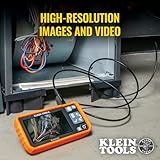
The ET17’s value is in its documentation workflow, not its raw inspection depth. Wi-Fi streaming to iOS and Android means your phone becomes the monitor — full-resolution video and photos capture directly to your camera roll, ready to email to clients, attach to insurance claims, or drop into real estate inspection reports without any extra steps. For home inspectors and real estate professionals who photograph findings on every job, this removes a friction step that adds up across dozens of inspections.
Klein Tools is a respected North American trade brand with genuine reliability credentials — the ET17 is not a budget import dressed up with a well-known name. The 10ft cable provides solid reach for household inspection work, and at 1080P the image quality is a step up from older 720P wireless units.

✓ What It Does Well
- Wi-Fi to iOS & Android: photos and video go straight to your camera roll for instant sharing
- 1080P — sharper than older 720P wireless competitors
- Klein Tools brand: genuine trade reliability, not a rebadged import
- Lightweight and compact — no bulky monitor to carry alongside other tools
✗ Where It Falls Short
- Phone dependency: battery drain, app crashes, and Wi-Fi drops in metal pipes can interrupt inspections
- 10ft cable limits depth — not suitable for deeper drain runs beyond household P-traps
If every inspection ends with photos emailed to a client, the ET17’s Wi-Fi workflow is genuinely useful and saves real time. If you’re doing serious diagnostic work in crawl spaces or deep drains, a wired unit with a dedicated screen is more reliable. Buy this for documentation-first use cases; buy the Teslong for diagnostic-first.
7. DEPSTECH WF060 Wireless Endoscope
The lowest-risk first inspection camera — 1080P wireless at entry price
🛒 Best Budget

Head: 5.5mm
Resolution: 1080P
Display: Wi-Fi to iOS/Android
IP Rating: IP67
Recording: App recording
Sonde: No
Price Tier: $
The WF060 is the right starting point for anyone who wants to try drain and wall inspection without committing to a full-priced unit. The 5.5mm head fits standard household drain lines including narrow under-sink P-traps — the most versatile size for homeowner use. At 1080P, the image quality significantly exceeds what you’d expect at this price point. The 16.5ft semi-rigid cable handles the majority of household inspection scenarios from dryer vents to bathroom drain checks.
It’s a single-lens unit with Wi-Fi-only output, so you’re dependent on your phone and accepting a simpler feature set than the DS300 or Teslong. For a homeowner who checks a slow drain twice a year, that trade-off is perfectly reasonable. If you find yourself reaching for it regularly, upgrade to the DEPSTECH DS300 — the path is obvious and the investment is justified.

✓ What It Does Well
- Lowest price 1080P entry in this guide — image quality exceeds the price
- 5.5mm head fits household P-traps and standard drain lines
- 16.5ft cable handles most household inspection scenarios
- Wi-Fi to iOS and Android — no separate monitor needed
✗ Where It Falls Short
- Single lens only — no side-view capability for detailed pipe wall inspection
- Wi-Fi only — fully dependent on phone staying connected and charged
- Occasional-use homeowner tool; not built for professional daily abuse

The WF060 is a sensible entry point — low enough in price that there’s minimal risk in trying it, capable enough to handle real household inspection tasks. If you use it regularly, you’ll know within a month whether the upgrade to DS300 or Teslong is worth it. Most homeowners will find it does the job.
Quick Comparison Table
All seven cameras side by side. For battery life, articulation details, and full CNC/sonde specs see the individual reviews above.
| Model | Cable | Head Dia. | Screen | Price Tier |
|---|---|---|---|---|
| Teslong NTS300 Pro | 16.5ft | 5.5–8mm | 5″ IPS | $$ |
| DEPSTECH DS300 | 16.5ft | 7.9mm | 4.3″ LCD | $$ |
| VEVOR 165ft Sewer | 165ft | 23mm | 9″ IPS | $$$ |
| Anykit Articulating 210° | Varies | Varies | 4.3″ IPS | $$$ |
| RIDGID micro CA-25 | 3ft | 17mm | 3.5″ LCD | $$$ |
| Klein Tools ET17 | 10ft | 9mm | Phone app | $$ |
| DEPSTECH WF060 | 16.5ft | 5.5mm | Phone app | $ |
Note: The VEVOR sewer camera requires a separate locator receiver wand to use the 512Hz sonde feature — the receiver is sold separately.
Borescope vs. Sewer Camera: Full Breakdown
If you’re still deciding between the two tool types, here’s the scenario-driven breakdown.
Choose a Borescope
- Checking a clogged sink or tub drain
- Wall cavities, HVAC ducts, crawl spaces
- Engine inspection, automotive work
- Under 33ft covers 95% of jobs
“A 16.5ft flexible borescope gets under your bathroom vanity easily. A 165ft rigid sewer camera won’t fit the P-trap.”
Choose a Sewer Camera
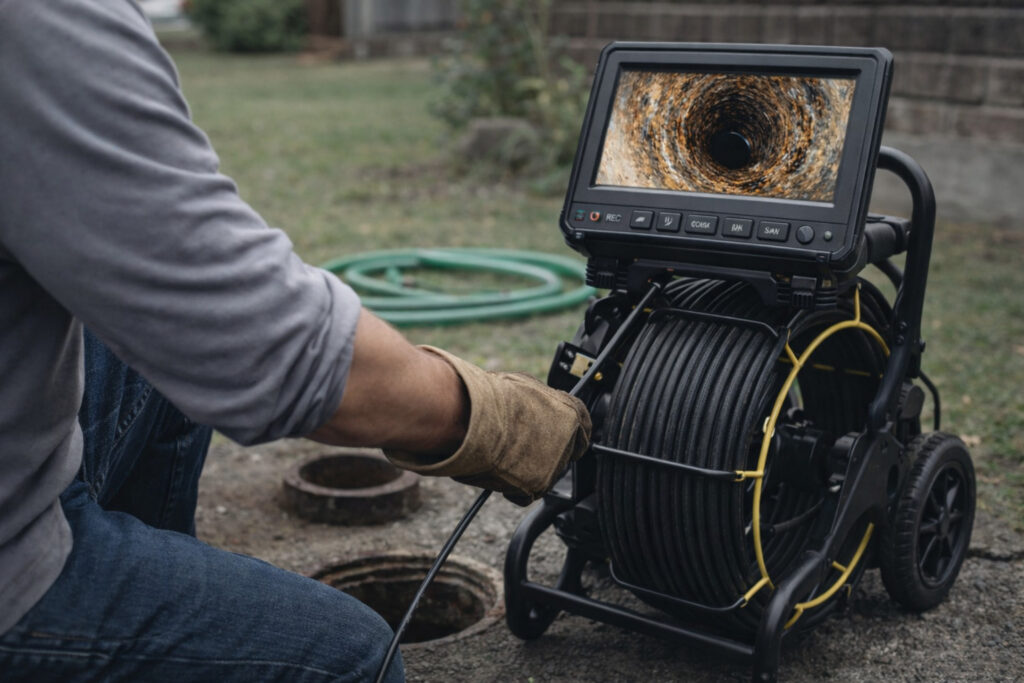
- Running main sewer laterals
- 100ft+ reach for commercial lines
- Underground locating with sonde
- DVR documentation for client reports
“To show a homeowner where the tree root intrusion is and how deep, you need a 9″ monitor and a 512Hz sonde.”
Choose Wireless
- Documentation is the primary output
- Photos go straight to client emails
- Real estate / home inspector workflow
- Minimal carry weight needed
“If every inspection output goes into a client email, Wi-Fi to phone saves a step every single time.”
Common Mistakes When Buying an Inspection Camera
These mistakes cost people money — either on the wrong tool purchase or on consumables and equipment they didn’t budget for.
Most sewer cameras have 22–23mm heads. A standard P-trap has a 1.5″ (38mm) opening — the head might fit, but the rigid fiberglass push cable absolutely will not navigate the U-bend. For household drains, you need a flexible borescope under 8mm. This is the most common and most expensive type mismatch in the category.
“1200TVL” is an analog TV line spec — not a digital pixel count. A 1200TVL camera can produce worse images than a true 1080P digital sensor. Always verify the stated pixel resolution (1920×1080 for 1080P) before buying. If a product listing only shows TVL, that’s a red flag.
A Wi-Fi borescope sounds convenient until your phone dies mid-inspection, the app crashes, or the Wi-Fi drops inside a metal pipe. For serious diagnostic work, a unit with a built-in dedicated screen is substantially more reliable.
A 5.5mm probe fits standard 1.5″ drain lines. A 23mm sewer camera head needs a minimum 2″ pipe to move freely — it will not navigate a P-trap at all. Check your pipe size before buying.
Without a 512Hz sonde, you can see the blockage on screen but you can’t tell the customer exactly where to dig. For professional sewer work, a camera without a locator is a severely limited tool. Don’t buy a mainline sewer camera without it.
When a camera hits a tough obstruction, the temptation is to force it through. This destroys the lens housing and internal sensors — camera head replacements can run close to the cost of the original unit. Guide the camera slowly. It’s an inspection tool, not a drain snake.
Setup & Pro Tips
Cable care: The junction between the camera head and the cable is the highest-wear point on every inspection camera. Never force the cable around sharp bends — guide it slowly with gentle rotation. After each use, wipe the cable clean before coiling to prevent grit and debris from damaging the outer jacket over time.
LED brightness: Start at 50% LED brightness and adjust from there. Full brightness in a tight, reflective pipe creates blowout that washes out exactly the detail you’re trying to see — the same way a headlight blinds you at close range. Dial back brightness as you approach the inspection target.
Record before you push: For any professional or documentation-purpose inspection, hit record before you push the camera in — not after you find the issue. The full approach on tape provides context and complete transparency for client reports.
P-trap navigation: For short borescopes navigating under-sink P-traps, use a semi-rigid gooseneck cable and pre-bend it slightly at the anticipated turn angle before inserting. Gentle twisting while advancing navigates the bend far better than forward pressure alone.
Phone-app units: Put your phone in airplane mode with Wi-Fi turned back on before starting. This prevents call interruptions mid-inspection. Keep the phone charged above 50% — LED-intensive inspection apps drain batteries faster than most users expect.
Storage: Store cables loosely coiled in a carry case, never tightly wound on a small-diameter spool. Tight wrapping creates cable memory that makes the cable fight you on every future inspection.
Frequently Asked Questions
Final Recommendations by Buyer Type
| Buyer Type | Best Pick | Why | Link |
|---|---|---|---|
| Homeowner / DIYer | DEPSTECH DS300 | Dual lens, 32GB card included, proven brand, right price | View → |
| Home Inspector | Teslong NTS300 Pro | 5″ IPS screen, dual lens, modular probes, documentation-ready | View → |
| Plumber (residential) | VEVOR 165ft Sewer Camera | 165ft push cable + 512Hz sonde + 9″ monitor + DVR recording | View → |
| Mechanic / HVAC Tech | Anykit Articulating 210° | 4-way joystick steering for complex angles fixed cameras can’t reach | View → |
| Brand-loyal contractor | RIDGID micro CA-25 | RIDGID dealer network, standalone reliability, no app dependency | View → |
| Real estate / documentation | Klein Tools ET17 | Wi-Fi to phone — instant shareable photos for client reports | View → |
| Budget / first camera | DEPSTECH WF060 | Lowest price 1080P entry with 16.5ft cable and 5.5mm head | View → |
The right inspection camera comes down to one decision above all others: pipe diameter and cable length needed. A 5.5mm flexible borescope for household drains and walls; a 23mm rigid push camera for sewer laterals — never swap them. For most homeowners and non-plumber professionals, the Teslong NTS300 Pro or DEPSTECH DS300 cover 95% of real-world needs at a sensible price. For working plumbers, the VEVOR 165ft is the accessible professional starting point. And for contractors who need to steer precisely around bends that would defeat a standard borescope, the Anykit 210° is the tool that changes what’s possible.