Dead batteries and winter go together like ice and snow—unfortunately for anyone who’s been stranded in sub-zero temperatures waiting for help. When you’re miles from the nearest town and your engine won’t turn over, a reliable jump starter isn’t just convenient; it’s a lifeline.
We’ve tested and researched dozens of portable jump starters to find the models that actually perform when temperatures plummet. Here’s what separates the best from the rest, plus our top 6 picks for 2026.
What Makes Cold Weather So Hard on Car Batteries?
Your car battery doesn’t just feel sluggish in winter—it’s fighting basic chemistry. Below freezing, chemical reactions inside the battery slow dramatically, reducing available power by 30-60%. Meanwhile, your engine oil thickens, requiring more power to crank the starter.
It’s a brutal combination. A battery that works fine in summer can fail completely at -20°C.
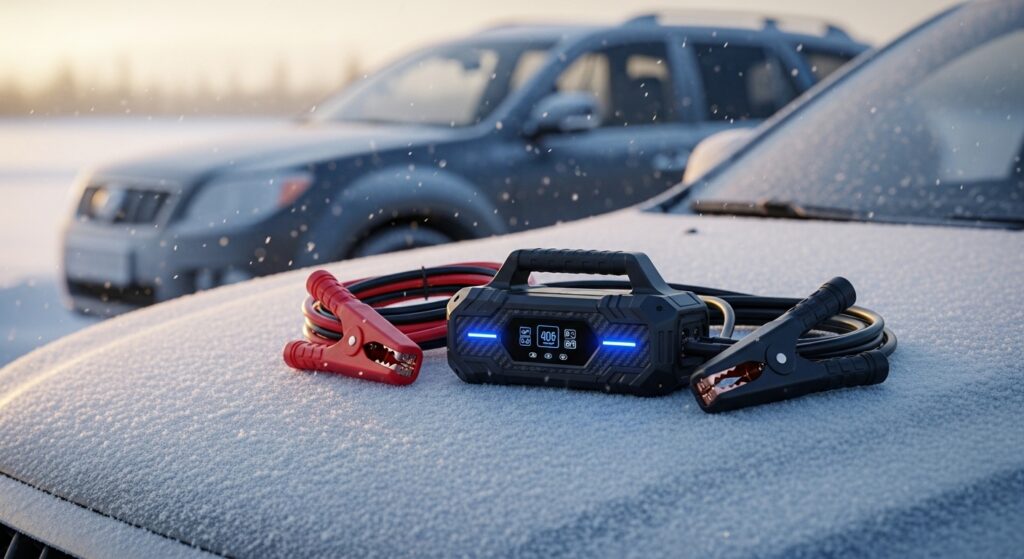
Traditional jumper cables solve one problem but create another: you need a second vehicle. In remote areas, during blizzards, or when you’re the only one on a back road, cables are useless. That’s where portable jump starters prove their worth—they’re self-contained power sources that work solo.
Buying Guide: What Actually Matters in a Winter Jump Starter
Power Output: Match It to Your Engine
Peak amperage tells you the maximum jolt a jump starter can deliver. Here’s what you need:
Cars and small SUVs: 1,000-1,500A handles most 4-cylinder and V6 engines
Large SUVs and light trucks: 2,000-3,000A for V8s and smaller diesels
Heavy-duty trucks and RVs: 4,000-6,000A for large diesels and commercial engines
Don’t confuse peak amps with cranking amps. Peak amps measure that critical first burst—exactly what you need for a cold start. Cranking amps measure sustained output, which matters less for jump-starting.
Battery Chemistry for Extreme Temperatures
Standard lithium-ion batteries lose capacity fast below 0°C. Look for:
LiFePO₄ (Lithium Iron Phosphate): More stable in extreme cold, longer lifespan
Advanced lithium polymer: Better cold-weather performance than basic li-ion
Operating range: Check the spec sheet—good models work down to -20°C or lower
Just as important: standby time. A jump starter that loses its charge after 3 months is worthless if your vehicle sits unused all winter. The best models hold 80%+ charge for 12-24 months.
Safety Systems That Actually Work
Connecting cables to a battery in -15°C darkness is when mistakes happen. Essential protections include:
Reverse polarity protection: Prevents damage if you swap positive/negative
Spark-proof clamps: No sparks until proper connection is verified
Over-current shutoff: Protects both the jump starter and your vehicle
Temperature monitoring: Prevents operation when too cold for safe use
Premium models add a boost mode—extra voltage for completely dead batteries that won’t respond to normal jumps.
Practical Features for Winter Emergencies
When you’re stranded, secondary features become primary:
Built-in LED work light: Essential for nighttime roadside repairs
USB charging ports: Keep your phone alive to call for backup help
Compact, insulated case: Easier to handle with gloves, stores in tight spaces
IP65+ weather rating: Protection from snow, sleet, and road spray
The 6 Best Jump Starters for Winter 2026
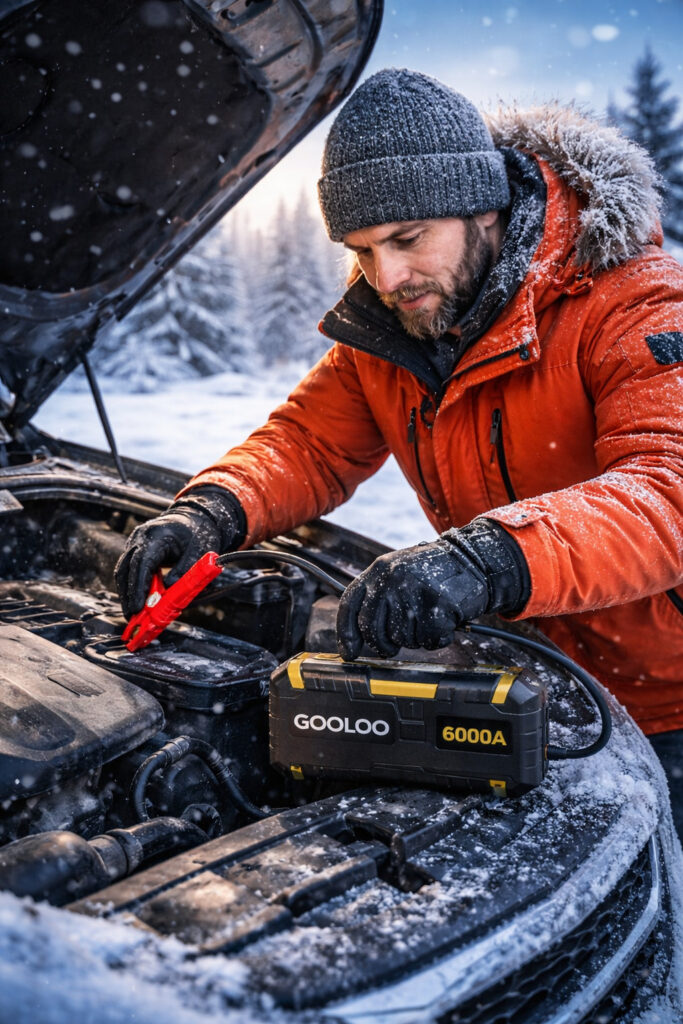
1. GOOLOO GT6000 – Maximum Power for Serious Winter Conditions

When “good enough” isn’t an option, the GOOLOO GT6000 delivers industrial-grade performance in a portable package.
Specifications:
- 27,000 mAh capacity
- 6,000A peak output—handles up to 12L diesel engines
- 24-month standby retention
- 100W USB-C fast charging (full recharge in 1.4 hours)
- IP65 dust/water resistance
- Multiple ports: 100W USB-C, dual USB-A (18W + 12W), 15V/10A DC
- LED array: work light, flashlight, strobe, SOS signal
Real-world performance: This unit starts full-size pickups at -25°C without hesitation. The 27,000 mAh capacity provides multiple jump starts on a single charge—critical if you’re managing a fleet or have several vehicles in storage.
Best for: Large trucks, RVs, commercial vehicles, remote work sites, anyone who needs absolute reliability in Arctic conditions.
Check current price on Amazon →
2. NOCO Boost Plus GB40 – The Glovebox Champion
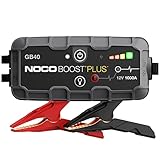
NOCO built their reputation on safety and reliability, and the GB40 delivers both in a package small enough to forget about until you need it.
Specifications:
- 1,000A peak current
- 2,150 mAh capacity (smaller but sufficient for most cars)
- Handles 6L gas or 3L diesel engines
- Patented safety: spark-proof technology, reverse polarity protection
- 7-mode LED (including emergency strobe and SOS)
- USB and 12V outputs
Real-world performance: We’ve used this on everything from motorcycles to mid-size SUVs. It won’t start a diesel truck, but for daily drivers and weekend vehicles, it’s nearly perfect. The safety features inspire confidence—even first-timers can use it correctly.
Best for: Commuter cars, compact SUVs, motorcycles, anyone who values portability and foolproof operation.
Check current price on Amazon →
3. AstroAI S8/S8 Ultra – Budget Pick with Surprising Power
Budget doesn’t mean compromise with the AstroAI S8 series. You get legitimate power at a price that makes sense for occasional users.
Specifications:
- 1,500-4,000A peak (model-dependent)
- 10,000-27,000 mAh capacity range
- Supports up to 8L gas engines
- LED work light, multiple USB ports
- Compact protective case included
Real-world performance: The S8 Ultra (higher-capacity model) punches well above its price point. Cold-weather performance is solid, though you’ll want to recharge every 2-3 months during winter storage—it doesn’t retain charge quite as long as premium models.
Best for: Budget-conscious buyers, secondary vehicles, keeping one in each car without breaking the bank.
Check current price on Amazon →
4. Battery Tender 2000 AMP – Dual-Purpose Winter Solution

Battery Tender took a different approach: combine jump-starting with intelligent battery maintenance. For vehicles in long-term storage, it’s brilliant.
Specifications:
- 800-1,200A peak jump-start capability
- 4A smart charging mode
- Automatic spark-proof and polarity protection
- Compact enough for trunk storage
Real-world performance: The smart charging function maintains batteries during winter storage, preventing sulfation and extending battery life. It’s particularly valuable for classic cars, boats, RVs, and seasonal equipment. Jump-start power is adequate for most passenger vehicles.
Best for: Vehicles in seasonal storage, classic car owners, RV winterization, anyone who needs both emergency starting and long-term battery maintenance.
Check current price on Amazon →
5. Etenwolf Helios J1 – Best Value in the Mid-Range

The Helios J1 occupies the sweet spot: enough power for most situations, features that matter, and a price that doesn’t sting.
Specifications:
- 2,000A peak output
- 16,000 mAh capacity
- Handles 8L gas or 6.5L diesel engines
- 18-month standby time
- IP65 weather protection
- 30W USB-C and 18W USB-A ports
- 4-mode LED flashlight
Real-world performance: This unit consistently surprises testers. The 2,000A output handles everything from sedans to full-size SUVs reliably. The 18-month standby is a genuine advantage—you can leave it in your vehicle all season without constant recharging.
Best for: Mid-size vehicles, light trucks, anyone who wants premium features without premium pricing, backup for larger vehicles.
Check current price on Amazon →
6. Clore Jump-N-Carry – Professional Workshop Standard
The Jump-N-Carry series isn’t trying to fit in a glovebox—it’s built for professionals who need reliable power for multiple vehicles daily.
Specifications:
- 1,700-2,000A peak (model-dependent)
- Lead-acid/AGM battery (18-22 Ah)—different chemistry from lithium models
- Extra-long industrial cables
- Digital voltage display
- Integrated LED work light
- Rolling base on larger models
Real-world performance: This is a different category—a shop tool, not a portable emergency device. The lead-acid battery performs consistently in heated garages, and the long cables reach batteries in large trucks and equipment easily. Not ideal for mobile use, but unbeatable for fixed locations.
Best for: Workshops, fleet garages, farms with multiple vehicles, anywhere you need professional-grade power in a stationary location.
Check current price on Amazon →
Side-by-Side Comparison
| Model | Peak Power | Ideal Use Case | Standout Feature |
|---|---|---|---|
| GOOLOO GT6000 | 6,000A | Heavy-duty trucks, diesel engines, remote locations | 24-month standby, IP65 rated, massive capacity |
| NOCO Boost Plus GB40 | 1,000A | Daily drivers, motorcycles, urban use | Ultra-compact, foolproof safety systems |
| AstroAI S8/S8 Ultra | 1,500-4,000A | Budget buyers, secondary vehicles | Best power-to-price ratio |
| Battery Tender 2000 / 4120 | 800-1,200A | Seasonal storage, classic cars, RVs | Dual jump-start and smart charging |
| Etenwolf Helios J1 | 2,000A | Mid-size vehicles, SUVs, value seekers | 18-month standby, excellent build quality |
| Clore Jump-N-Carry | 1,700-2,000A | Workshops, fleet maintenance, fixed locations | Professional-grade, extra-long cables |
How to Use a Jump Starter in Winter: Field-Tested Tips
Pre-Start Preparation
Warm the unit: If your jump starter has been in a cold vehicle, bring it inside for 10-15 minutes before use. Lithium batteries perform better at room temperature.
Check the charge: Most units have LED indicators. If you’re below 50%, you might get one jump—maybe. Always keep winter jump starters fully charged.
Clear the terminals: Brush off snow, ice, and corrosion from battery posts. Poor contact means poor results.
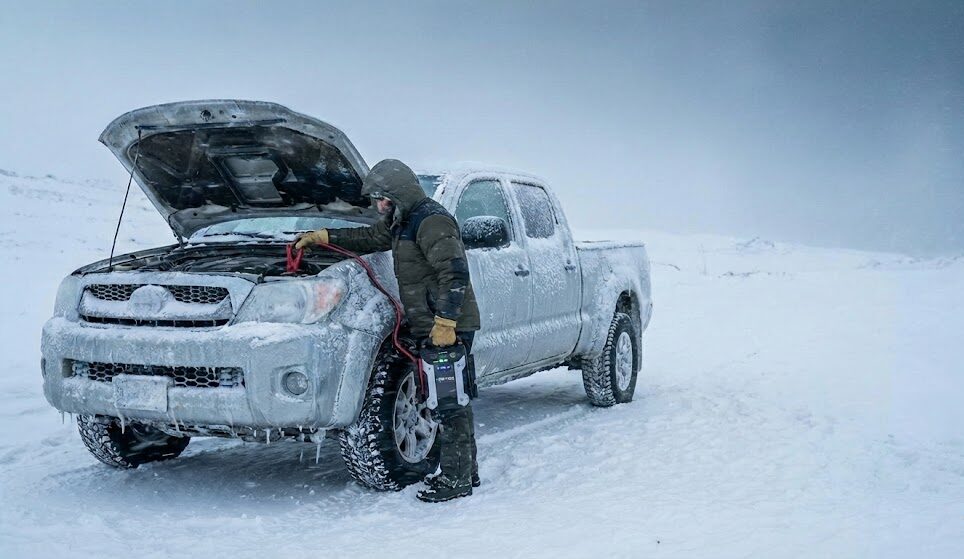
Connection Sequence (Critical in Cold Weather)
- Connect RED clamp to positive (+) terminal on dead battery
- Connect BLACK clamp to negative (-) terminal, or better: an unpainted metal ground point away from the battery
- Turn on the jump starter
- Use boost mode if available and the battery is completely dead
- Wait 30-60 seconds, then attempt to start the engine
- Once running, disconnect in reverse order: black first, then red
Common mistake: Trying to start immediately after connecting. Give the dead battery a minute to accept some charge—it makes starting easier and reduces strain on the jump starter.
After-Jump Protocol
Let the engine run 15-20 minutes minimum. The alternator needs time to recharge the battery, especially in cold weather when charging efficiency drops.
If the engine dies again within an hour, you have a bigger problem than a dead battery—likely a failing alternator or a battery that needs replacement.
Storage Strategy for Maximum Lifespan
Where to keep it: Inside the vehicle cabin if temperatures stay above -10°C. Below that, store indoors and grab it when needed.
Recharge schedule: Every 3 months minimum, monthly if you’re in severe cold. Set a phone reminder—it’s easy to forget.
Don’t let it fully discharge: Lithium batteries hate deep discharge. If you accidentally drain it completely, recharge immediately to prevent permanent damage.
Jump Starter vs. Traditional Cables: When Each Makes Sense
Jump starter wins when:
- You’re alone or in a remote area
- No other vehicles are available
- You need USB power for phones/GPS
- You want foolproof safety features
- You’re working with expensive vehicles (less risk of electrical damage)
Traditional cables win when:
- Help is readily available
- Your jump starter is dead (always carry cables as backup)
- You’re dealing with extremely large engines beyond jump starter capacity
- Budget is severely limited
Reality check: Carry both. Quality jumper cables cost $30-50 and take up minimal space. Use the jump starter as your primary solution, cables as backup.
Common Questions About Winter Jump Starters
How many jump starts can I get from a full charge?
Depends on the unit and your engine. Small cars might get 15-20 starts from a high-capacity model like the GOOLOO GT6000. Large diesel trucks might get 3-5. Cold weather reduces these numbers by roughly 30%.
Can these handle diesel engines?
Yes, but check the specs. Diesels need more current to overcome high compression. The GOOLOO GT6000, Etenwolf Helios J1, and higher-end AstroAI models handle most diesel engines. The NOCO GB40 is marginal for diesels—it might work on smaller diesels, but don’t count on it.
What about snowmobiles, ATVs, and small equipment?
Perfect application. These smaller engines are easy for any jump starter to handle. The NOCO GB40 or Etenwolf Helios J1 are ideal—enough power, compact enough to carry in a backpack or sled storage.
Do I need a special jump starter for lithium car batteries?
No. Modern jump starters work fine with traditional lead-acid, AGM, and lithium automotive batteries. The chemistry in the jump starter is independent from your vehicle’s battery type.
How cold is too cold for these to work?
Most quality units function down to -20°C to -30°C. Below that, lithium batteries struggle. In extreme Arctic conditions (-40°C and lower), you need specialized equipment or engine block heaters to avoid starting issues entirely.
Final Verdict: Which Jump Starter Should You Buy?
For most people: The Etenwolf Helios J1 hits the best balance of power, features, and price. It handles standard vehicles easily, lasts 18 months between charges, and costs significantly less than premium models.
For maximum reliability: The GOOLOO GT6000 is worth the investment if you drive large vehicles, work in remote areas, or simply want the absolute best. The 24-month standby and 6,000A output mean you’ll never question whether it will work.
For urban commuters: The NOCO GB40 excels at its intended purpose—compact, safe, reliable for standard passenger vehicles. It’s small enough that you’ll actually keep it in your car instead of leaving it in the garage.
For winter storage: The Battery Tender 2000/4120 series earns its place by preventing dead batteries in the first place. If you store vehicles seasonally, the dual functionality saves you time and extends battery life.
Whatever you choose, buy it before you need it. Dead batteries don’t wait for convenient moments, and ordering one from a freezing roadside is a miserable experience. Add one to your winter emergency kit now—alongside blankets, a flashlight, and those jumper cables we mentioned earlier.
Stay warm, stay safe, and keep that engine running.